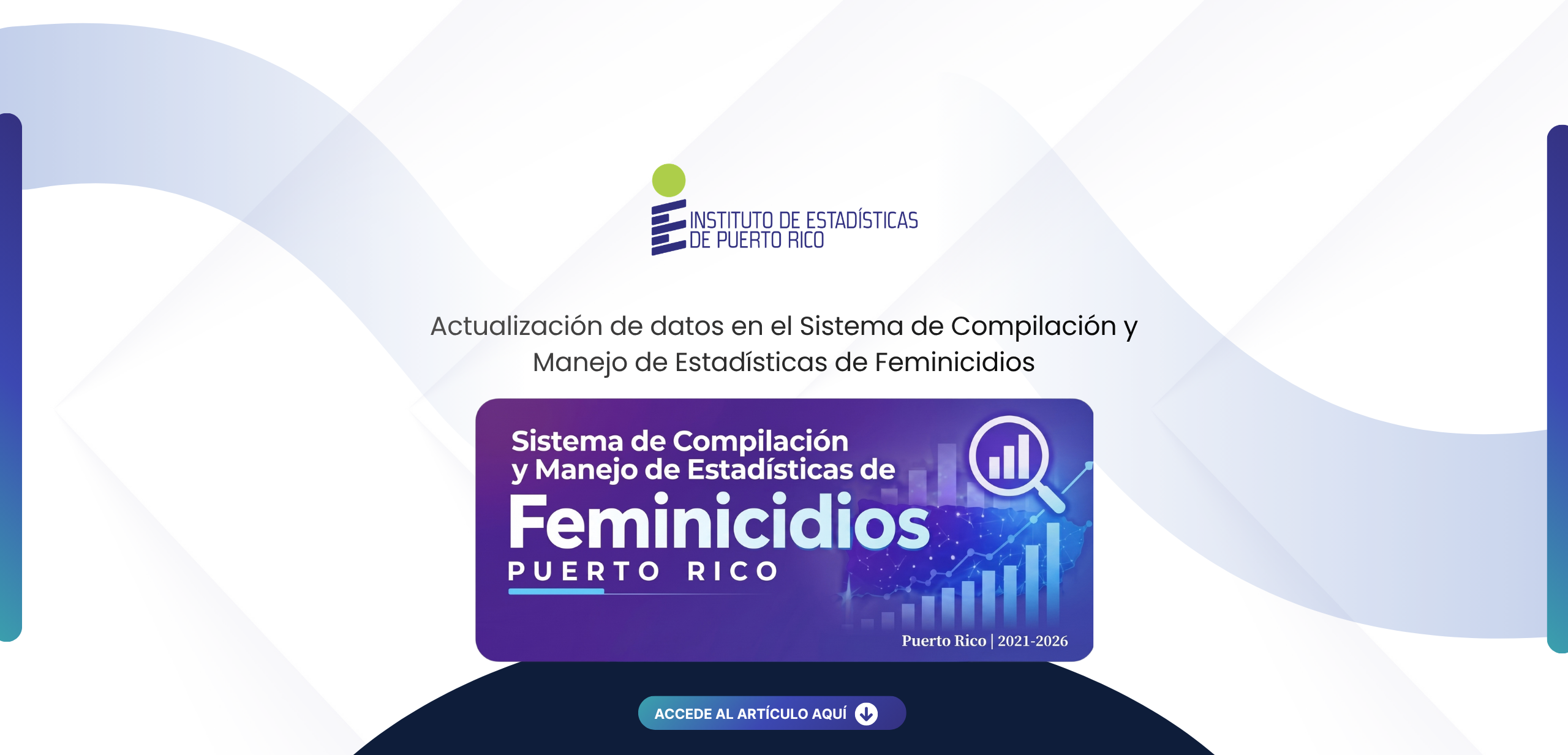
Actualización de datos en el Sistema de Compilación y Manejo de Estadísticas de Feminicidios
El Instituto de Estadísticas de Puerto Rico actualizó el portal del Sistema de Compilación y Manejo de Estadísticas de Feminicidios. Esta actualización incorpora los datos correspondientes al año 2026 y nuevos indicadores que permiten consultar estadísticas importantes como el total de feminicidios registrados por año y los casos de feminicidio seguidos por el suicidio del agresor. Además, se realizaron cambios en el diseño y la presentación del portal para facilitar la navegación y la comprensión de la información.
Entre los hallazgos se destacan los siguientes:
• En Puerto Rico, durante el período comprendido entre 2021 y agosto de 2026, cerca de la mitad de los homicidios de mujeres registrados fueron identificados como casos relacionados con razones de género. Se registraron 263 homicidios de mujeres, y de estos, 128 casos (48.7 %) fueron clasificados como feminicidios.
• De los 128 feminicidios registrados, 119 casos (93.0 %) fueron clasificados como feminicidios íntimos o familiares. La mayoría de estos casos ocurrieron en el contexto de relaciones cercanas entre las víctimas y los agresores.
• De las 128 víctimas de feminicidios, 46 (36%) fueron en incidentes de feminicidios seguido de el suicidio del agresor.
Como parte de esta actualización, el Instituto de Estadísticas incorporó una nueva infografía al dashboard de feminicidios con información correspondiente al período 2021–2025.
Esta presenta información adicional sobre el contexto de los feminicidios ocurridos durante el período de 2021–2025, incluyendo el perfil de las víctimas, el mecanismo de muerte, entre otras variables. También incluye secciones específicas sobre los feminicidios íntimos y los feminicidios seguidos por el suicidio del agresor, con información que permite examinar con mayor detalle las características de estos eventos. Estos datos permiten observar la importancia de analizar la violencia de género dentro de las relaciones de pareja y del entorno familiar.
La información actualizada y los recursos para facilitar la comprensión de las estadísticas de feminicidios están disponibles en el Sistema de Compilación y Manejo de Estadísticas de Feminicidios del Instituto de Estadísticas de Puerto Rico.
Acceda al sistema: Sistemade Compilación y Manejo de Estadísticas de Feminicidios


-p-130x130q80.png)
.png)
.png)
.png)
.png)
.png)
.png)
.png)
.png)
.png)
.png)
.png)

.png)
.png)
.png)
.png)