

Key Homicide Data in Puerto Rico: An Analysis in the International Context
The Puerto Rico Violent Death Reporting System (PRVDRS), attached to the Puerto Rico Institute of Statistics, has published a new information capsule with 2024 data analyzing the archipelago's situation compared to the rest of the world.
Below, we highlight the most relevant findings regarding the incidence of homicides in Puerto Rico and worldwide:
Puerto Rico's Position in the Region
- Homicide Rate: Puerto Rico recorded a crude rate of 15.2 homicides per 100,000 inhabitants.
- Caribbean Ranking: Among the 11 countries and jurisdictions analyzed in the Caribbean region, Puerto Rico ranks 10th, placing below jurisdictions such as the Turks and Caicos Islands (103.2), Haiti (64.3), Trinidad and Tobago (41.5), and Jamaica (40.4).
- Compared to the Regional Average: Although Puerto Rico's figure (15.2) sits below the Latin America and Caribbean average (19.3), it remains nearly three times higher than the global homicide average (5.1 per 100,000 inhabitants).
Firearm Prevalence: Puerto Rico – The Second Highest Figure in the Region
- 89.2% of Homicides Involve Firearms: Nearly 9 out of 10 homicides in the archipelago are committed using a firearm.
- Regional Leader: Alongside Saint Kitts and Nevis (89.3%), Puerto Rico presented the highest proportion of firearm homicides in all of Latin America and the Caribbean.
- International Contrast: This figure far exceeds the global average for firearm homicides (67.2%). The document emphasizes that a large portion of these incidents in Puerto Rico is related to organized crime.
Comparison by Gender and Racial Groups (Puerto Rico vs. United States)
When adjusting rates by age and comparing Puerto Rico's population with various groups in the U.S., significant disparities by sex are observed:
- Men: Men in Puerto Rico present the second-highest homicide risk rate (32.5 per 100,000 inhabitants), surpassed only by Black men in the U.S. (41.5). This figure is considerably higher than that of Hispanic men (8.6) and White men (3.6) in the U.S.
- Women: The adjusted rate for women in Puerto Rico is 3.9 per 100,000 inhabitants, placing below the risk level observed in Black women (6.9) and Native American women (5.9) in the U.S.
For more information, download the information capsule in the Access the Document section.
About the Data Source
The PRVDRS was established in 2016 with support from the Centers for Disease Control and Prevention (CDC). The system consolidates and validates information from the Bureau of Forensic Sciences, the Puerto Rico Police, and the Demographic Registry of the Department of Health to generate rigorous and internationally comparable statistics.
Links of interest: Puerto Rico Violent Death Reporting System
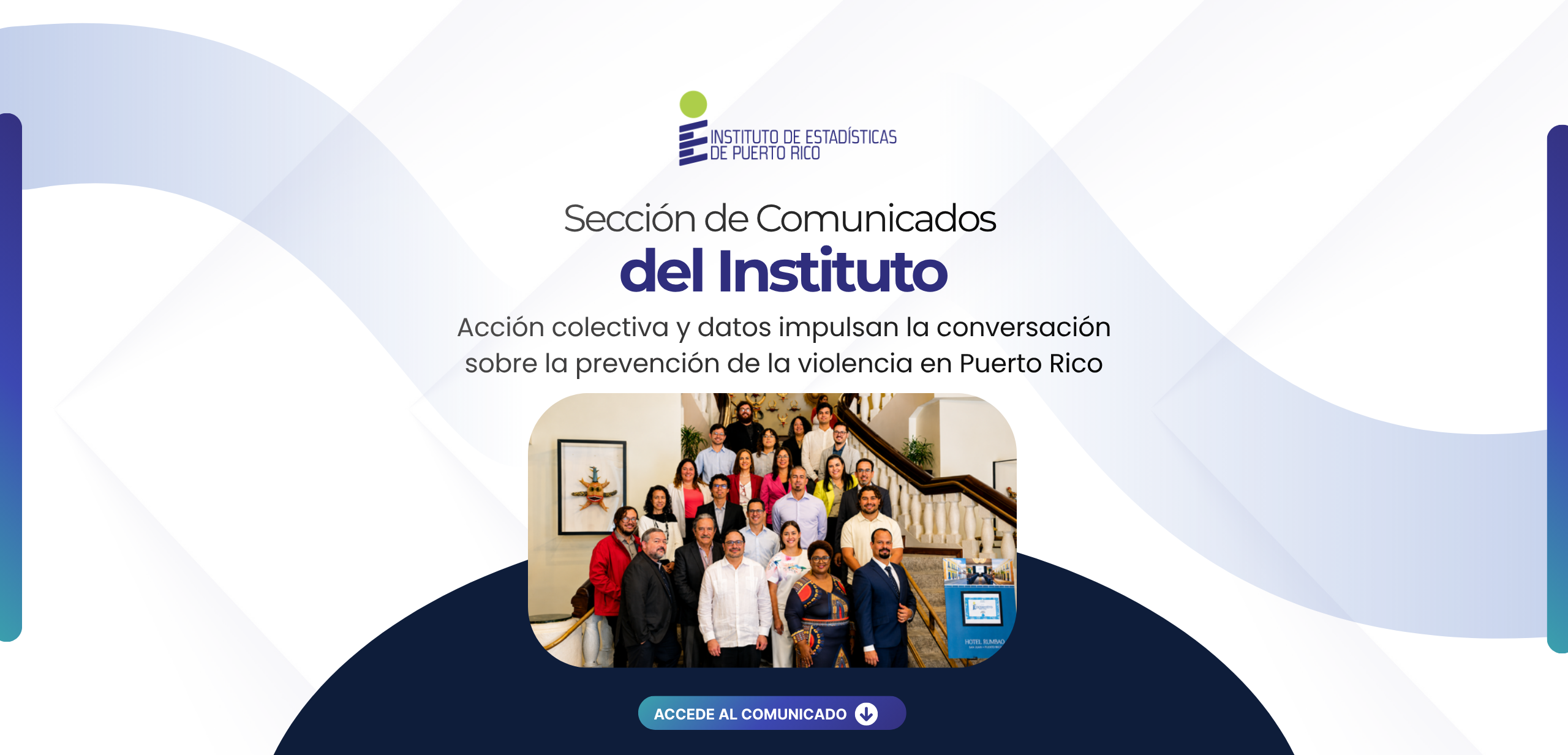
Experts analyzed statistics showing over 30 million controlled substance dispensations to nearly 2 million unique patients in Puerto Rico since 2019
The Puerto Rico Institute of Statistics hosted the symposium "Collective Action for Violence Prevention: Transforming Realities Through Prevention and Collective Action," a gathering that brought together researchers, public health professionals, justice system representatives, community organizations, and government officials to analyze trends, risk factors, and strategies aimed at preventing violence in Puerto Rico.
During the event, presentations and panels were held, including "Current Landscape of Violence Among Infants and Youth: Data and Trends," "Public Policy and Substance Use Prevention: Where Are We and Where Are We Going?," and "Multi-sectoral Action for the Protection of Women and the Eradication of Sexual Violence," all of which addressed various factors contributing to violence and opportunities for its prevention through multi-sector collaboration.
Among the data presented during the symposium, it was highlighted that since 2019, over 30 million controlled substance dispensations have been recorded for nearly 2 million unique patients in Puerto Rico. Participants also discussed statistics related to homicides, gun violence, domestic violence, sexual assault, and substance use prevention, as well as early intervention strategies and community action.
In the panel on substance use prevention, it was highlighted that benzodiazepines currently account for 66.2% of controlled substance dispensations in Puerto Rico, while opioids make up 15.9%. Furthermore, the recorded growth in prescribed fentanyl dispensations was discussed, as well as the role of the Controlled Substance Monitoring Program (PDMP) as a tool to promote responsible prescribing, strengthen prevention, and support informed decision-making in the healthcare system.
Presentations on violence among infants and youth revealed that between 2017 and 2024, 4,813 homicides were reported in Puerto Rico, and 92.3% of the victims were men. Experts also highlighted that firearm homicides are the leading cause of death among youth aged 1 to 19 in Puerto Rico. It was also reported that 54% of homicides among men aged 15 to 44 are related to manifestations of collective violence, including organized crime and drug trafficking.
Meanwhile, the panel on the protection of women and the eradication of sexual violence presented statistics showing that during 2024 and 2025, the Puerto Rico Police investigated 17,695 incidents of domestic violence. Furthermore, it was highlighted that, according to the Risk Assessment Form, one in four female complainants evaluated during the second half of 2024 faced an imminent risk of death, and nearly one in five had survived a non-fatal strangulation episode, one of the main indicators associated with the risk of femicide.
Participating experts agreed that many manifestations of violence are rooted in adverse childhood experiences, including abuse, emotional neglect, and early exposure to trauma. They also emphasized the importance of strengthening early interventions, mentorship, community programs, and coordination among health, education, security, and justice systems to address the causes of violence before it occurs.
"This symposium reaffirms the importance of using data to better understand the challenges we face as a society and to guide concrete prevention actions. Violence cannot be addressed by a single sector. It requires collaboration, evidence, and the commitment of multiple stakeholders to identify its causes, intervene promptly, and protect our communities," said Dr. Orville M. Disdier, Executive Director of the Puerto Rico Institute of Statistics.

The current situation presents an opportunity to strengthen production in Puerto Rico and increase its presence in the U.S. market through reshoring strategies.
The Puerto Rico Institute of Statistics presented estimates related to the scope of the tariff burden in Puerto Rico. The data shows that the amount of tariffs on imports increased by 288.66% between 2024 and 2025. In 2024, the total amount of tariffs was $236,641,688, while in 2025 it increased to $919,734,046.
Between 2010 and 2025, the year 2025 showed the highest amount in tariffs. These amounted to $919,734,046, representing an increase of $683,092,358 compared to 2024, equivalent to a year-over-year increase of 288.66%.
On the other hand, an analysis of the effective tariff rate provided a clearer view of the impact of tariffs by directly relating the amount of tariffs in U.S. dollars (USD) to the total value of imports in USD. In 2025, the effective tariff rate was 4.81%, representing an increase of 3.64 percentage points compared to 2024.
The impact of tariff regulations in 2025 can be observed in the monthly behavior of tariffs collected that year. These show a marked increase starting in April, reaching levels above $100 million in several months, while imports remained relatively stable. This imbalance between both variables directly translates into the observed increase in the effective tariff rate throughout 2025.
Effective from April 2025, increases in tariff rates were observed, which aligns with the tariff policies applied in the same month. During the second half of the year, significant increases were recorded, with November being the month with the highest effective tariff rate (7.61%) during 2025.
The full study can be accessed at: Tariffs in Puerto Rico 2025.

Parenting Experiences Survey Reveals Generational Shifts in Discipline, Communication, and Family Priorities
The Survey of Child Rearing Experiences in Puerto Rico revealed, among other data, that 48.6% of surveyed caregivers use disciplinary styles different from those they experienced with their own parents, reflecting a possible generational shift in parenting practices and in how Puerto Rican families approach the upbringing, communication, and well-being of children.
The study, developed through an alliance between ESCAPE, the Family Strengthening Center, and the Puerto Rico Institute of Statistics, collected the experiences, challenges, and needs of 1,143 voluntary participants via a self-administered online questionnaire conducted between February and June 2025. The survey was descriptive in nature and explored topics related to parenting experiences, discipline and communication, technology and quality time, as well as support needs and expectations for children's futures.
Among the most relevant findings of the survey are:
• More than two-thirds of respondents stated that parenting is more difficult or much more difficult than they expected.
• The main challenge identified was achieving a work-life balance (62.3%).
• 44.3% cited lack of personal time and rest as one of their biggest challenges.
• 41.6% expressed a need for tools to manage stress and their own mental health.
• 57.2% reported arguments related to the use of technological devices at home.
• 4% identified the use of physical aggression as a disciplinary strategy.
• 94% of participants indicated that they praise their children's achievements "almost always" or "always."
• Most participants defined discipline as a formative tool for teaching values and setting clear boundaries.
The survey also reflected that caregivers prioritize the development of self-esteem and self-confidence, responsible decision-making, and healthy emotional management for children's futures.
"The information collected allows us to better understand how family dynamics are changing and what real challenges are faced by those responsible for raising children in Puerto Rico. This data is fundamental for developing more effective public policies, programs, and interventions tailored to the current needs of Puerto Rican families," stated Dr. Orville M. Disdier Flores, Executive Director of the Puerto Rico Institute of Statistics.
Meanwhile, Yadira Pizarro Quiles, Executive Director of ESCAPE, highlighted that the results provide an important X-ray of families' emotional and structural needs. "This survey confirms the importance of continuing to strengthen families through prevention. Understanding how mothers, fathers, and caregivers are experiencing parenting allows us to better direct our efforts, develop support tools, and promote strategies that strengthen children's well-being and help prevent child abuse in Puerto Rico."
As part of the strategic recommendations derived from the study, it is proposed to strengthen emotional support initiatives for caregivers, promote flexible work policies, drive digital literacy campaigns at home, and expand preventive education efforts on parenting and those related to child well-being and protection.
The Survey of Child Rearing Experiences in Puerto Rico is available at the following link: www.estadisticas.pr.gov/productos/encuesta-de-experiencias-de-crianza-de-menores-en-puerto-rico-2025.
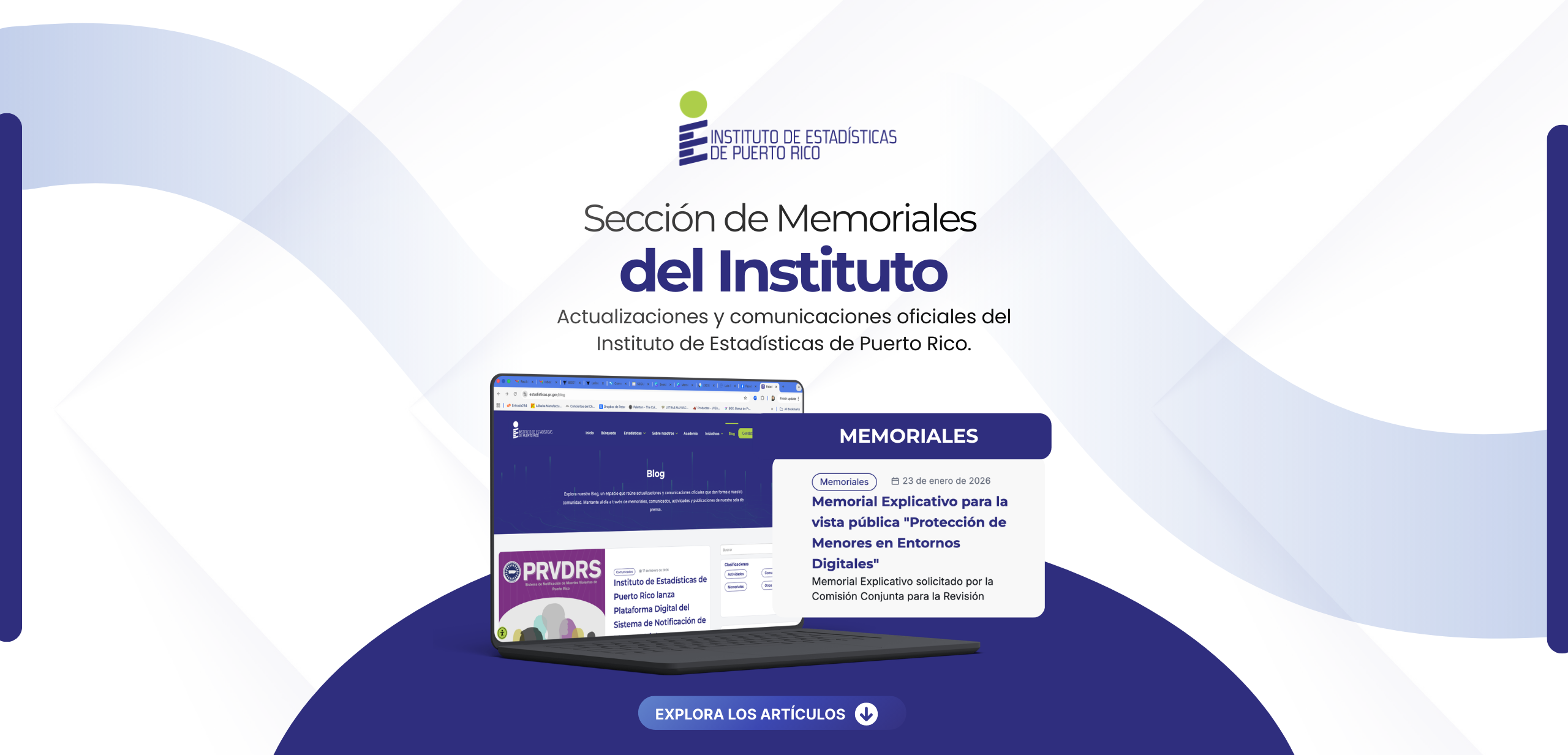
To amend Articles 3 and 4 of Act No. 3 of March 13, 1942, as amended, known as the "Working Mothers Protection Act," for the purpose of extending the maternity leave period for private sector employees from eight (8) to twelve (12) weeks, generally distributed as six (6) weeks of prenatal leave and six (6) weeks of postnatal leave, with the possibility of prenatal/postnatal redistribution subject to medical certification; to reaffirm the full payment of the employee's salary during said period; to extend these benefits, equally, to adoptive mothers; and for other related purposes.
To direct the Department of Health to conduct, in collaboration with the Puerto Rico Institute of Statistics and the Graduate School of Public Health of the Medical Sciences Campus of the University of Puerto Rico, a prevalence study to determine the statistical incidence of autism spectrum disorders in Puerto Rico.
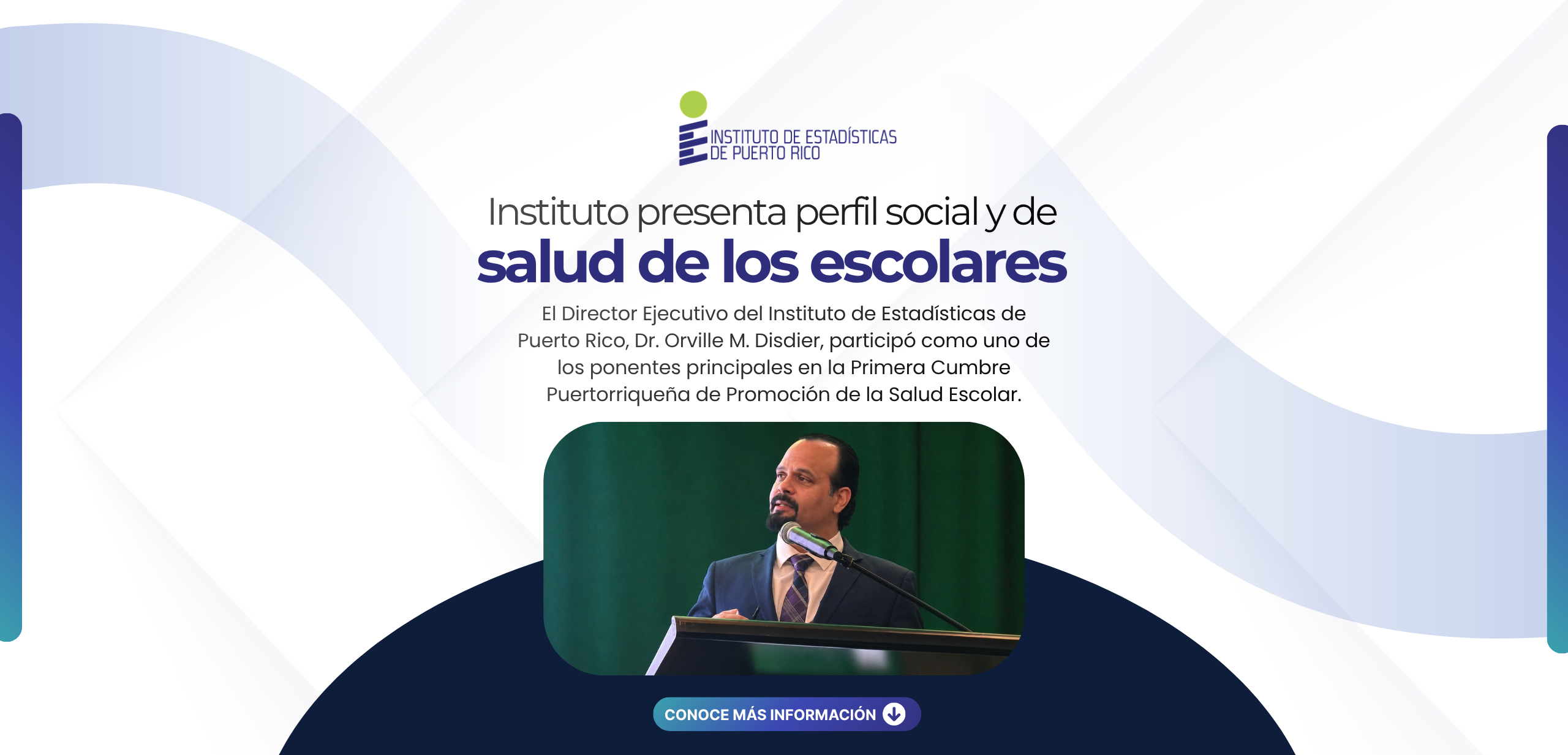
Dr. Orville M. Disdier, Executive Director of the Puerto Rico Institute of Statistics, was a keynote speaker at the First Puerto Rican Summit on School Health Promotion. During his presentation, he provided an update on the social and health profile of schoolchildren in Puerto Rico, highlighting the impact of social determinants on inequalities.
Dr. Disdier explained that Puerto Rico is facing a school enrollment crisis linked to demographic changes, as well as significant socioeconomic vulnerability, evidenced by more than 50% of minors living below the poverty level. However, he emphasized that despite high income inequality and various health challenges, education remains the primary driver of social mobility and an essential path to economic advancement.
Access a copy of the presentation at: The Social and Health Profile of Schoolchildren in Puerto Rico.
Please let us know your satisfaction level with our services.
Visit our Official Activities, and participate with us
Visit our Calls for applications and be part of the new opportunities we have for you.
If you have any questions or just want to contact us, visit the Contact Us section.
We are at your disposal. If you need custom statistics, do not hesitate to contact us.
Sign up for our online workshops. Connect with the experts and discover the power of data!
Visit our Blog and keep up to date with the latest news and topics of interest.
Visit our Press Releases and stay connected to the Institute.
Explore the Publication Calendar and keep up to date with Puerto Rico's statistics.
Complete the form for the selection of our Statistics Coordination Committee
Suscribe to receive news directly to your email.
Listen to the Official PRIS podcast and stay informed with the experts

.png)
.png)
.png)
.png)

-p-130x130q80.png)
.png)
.png)
.png)
.png)
.png)
.png)
.png)
.png)
.png)
.png)
.png)