
Webinar: Intimate Femicide Risk Map

Announcements
IEPR
14 April 2026

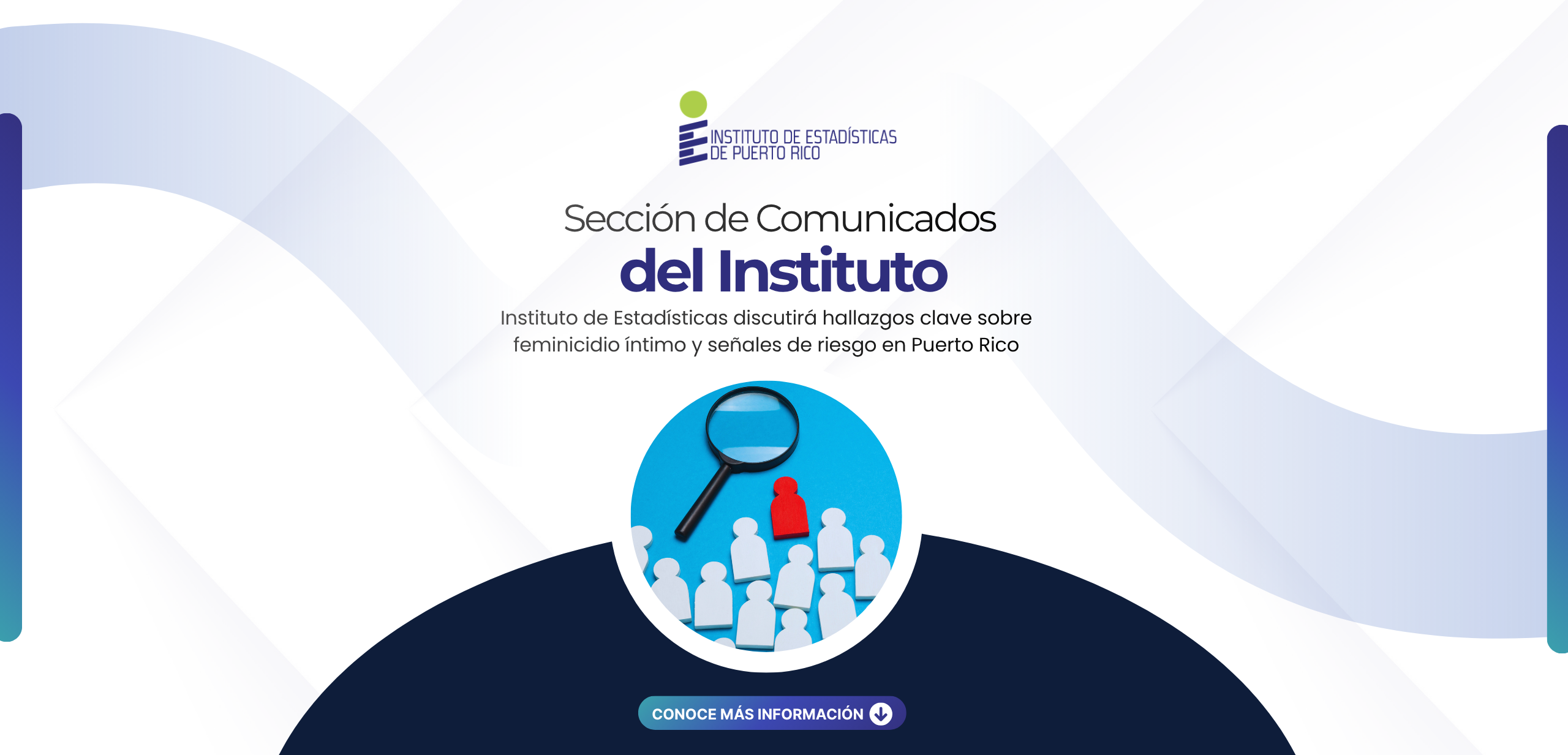
Puerto Rico Institute of Statistics to discuss key findings on intimate femicide and signs of risk in Puerto Rico

In a Webinar that will address risk assessment, non-fatal strangulation as a critical alert and the scope of Law 71-2024 on suffocation and its serious effects.

San Juan, Puerto Rico — April 13, 2026. The Puerto Rico Institute of Statistics will hold the webinar: “Intimate Femicide Risk Map: Sociodemographic Patterns and Prevention Measures in Puerto Rico”. This with the objective of strengthening tools for the protection and prevention against violence. The activity is free of charge, but requires registration at the following link: https://register.gotowebinar.com/register/4963876538944780637.

The virtual event will take place this Thursday, April 16, 2026 at 10:00 a.m. as part of the Institute's Academy Program. The seminar will have a panel of experts composed of:

- Mariluz Bezares Salinas, Manager of Statistical Projects at the Institute of Statistics.

- Dr. Idania R. Rodríguez Ayuso, Deputy Executive Director of the Institute of Statistics.

- Lcda. Laura Hernández Gutiérrez, Assistant Prosecutor IV, assigned to the Office of the Women's Attorney.

During the webinar, critical findings on intimate partner violence will be discussed, including the implementation of the Department of Justice's Danger Assessment and analyzed by the Institute. This tool examines lethality factors such as threats with weapons, daily control, and a history of strangulation.

One of the central themes will be non-fatal strangulation, identified as a high warning sign. In addition, the new Law 71-2024, a pioneer in Puerto Rico in recognizing strangulation and suffocation as crimes with serious psychological and physiological consequences, will be addressed.

The Puerto Rico Institute of Statistics is an autonomous governmental entity responsible for coordinating the Government's statistical production service to ensure that the data collection and statistics systems, on which public policies are based, are complete, reliable, and have quick and universal access.

To learn more about the Puerto Rico Institute of Statistics, you can access www.estadisticas.pr.gov or follow their social networks: Facebook (@estadisticas .pr), X (@EstadisticasPR), Instagram (@institutodeestadisticas) and LinkedIn (Puerto Rico Institute of Statistics).

Share this article:

Visit our Official Activities, and participate with us

Visit our Calls for applications and be part of the new opportunities we have for you.

If you have any questions or just want to contact us, visit the Contact Us section.

We are at your disposal. If you need custom statistics, do not hesitate to contact us.

Sign up for our online workshops. Connect with the experts and discover the power of data!

Visit our Blog and keep up to date with the latest news and topics of interest.

Visit our Press Releases and stay connected to the Institute.

Explore the Publication Calendar and keep up to date with Puerto Rico's statistics.

Complete the form for the selection of our Statistics Coordination Committee

Suscribe to receive news directly to your email.

Listen to the Official PRIS podcast and stay informed with the experts

Institute of Statistics publishes Creative Industries of Puerto Rico 2016

INSTITUTE OF STATISTICS PUBLISHES CREATIVE INDUSTRIES OF PUERTO RICO 2016

This is the second statistical report made on the subject and it shows that the largest number of related establishments (59%) has between 1 and 4 employees

San Juan, PR, May 17, 2018 — The Puerto Rico Statistics Institute (Institute) released today Creative Industries in Puerto Rico 2016, which is the second publication that presents statistics on creative industries, with the purpose of supporting their development, in accordance with Law No. 173 of October 13, 2014, also known as the Law to Promote Creative Industries.

The purpose of this second report is to capture some indicators that in the long term serve as metrics of the execution of Creative Industries in the production of goods and services for the local market and their export. There is currently no consensus on the type of industries that should be classified as “creative”. However, Article 3 of Law 173-2014 defines creative industries based on the following list of industries:

  • Design (graphic, industrial, fashion and interiors)
  • Arts (music, visual and performing arts and publications)
  • Media (application development, video games, online media, digital content and multimedia)
  • Creative Services (architecture and creative education)

The published compendium presents all the statistics already available on these industries. But, in addition, statistics are presented on several additional industries that have been classified as “creative” in previous UNESCO studies, among others, and these, together with those defined by Law 173-2014, are referred to in the report as “Law 173+”:

  • other Arts (cinematography, jewelry, sewing)
  • other media (radio, television, cable, books)
  • other Creative Services (advertising, drawing)
  • Heritage (libraries, museums and historic sites)

Below are some of the publication's key findings:

1) The largest concentration of Creative Industries in the Ley 173+ group took place in establishments with 1 to 4 employees, who brought together 58.5% of them. An experience that was most strongly repeated in the sectors of Law 173, which comprised 71.7% of the establishments (County Business Patterns, CBP). In the case of 173+ sectors, those dedicated to Jewelry, followed by Computer system design and Advertising agencies (in that order) were the ones with the highest number of establishments in the sources consulted. In the specific case of Law 173, it was the establishments dedicated to System design Computer scientists and Computer Programming Services (CBP and Quarterly Census of Employment and Wages, QCEW).

2) The line of number of employees by industry, for the sectors of Law 173+, followed the same pattern as the previous line, with establishments dedicated to Jewelry, Computer system design and Agencies of publicity (in that order) those who employed the largest number of employees. The second of these, Computer system design, was the one who occupied the first position under Law 173, followed by Computer Programming Services (QCEW).

3) In the analysis of number of employees by occupation The first position in the entirety of Law 173+ corresponds to Wired telecommunications service operators with 3,148 employees, followed by those dedicated to Computer system design, with 2,030 employees. For Law 173, specifically, people employed in Computer system design (2,030) and Services of computer programming (1,842) ranked first and second (QCEW).

4) In the distribution of employees by sex, the industry of the Ley 173+ group with the highest percentage of employed women was Libraries and archives (87%) and in the lower position was the Sound industry with 12%. The most even distribution by sex occurred in Advertising Industries with 50%. In the case of jobs grouped under Law 173, the jobs of Editing and dissemination of content over the internet and search services was the one with the highest percentage of female participation (62%). The jobs of Software publishing was the one with the most even distribution (42%), being those of the Sound industry, mentioned above, those with the lowest female participation (Public Use Microdata Sample of the Puerto Rico Community Survey, PRCS-PUMS).

5) For both Law 173+ and Law 173 sectors, the Average revenue by industry The highest was $118,665 for the line of Software publishing (QCEW).

6) For both Law 173+ and Law 173 sectors, the Average annual wage by occupation The highest corresponded to System software developers with $67,530 (Occupational Employment Statistics, OES).

7) In the presentation of creative establishments per inhabitant for the Ley 173+ group The median number of establishments grouped under the creative industries by municipalities It was 2 establishments per 10,000 inhabitants. San Juan had approximately 25 establishments per 10,000 inhabitants (QCEW).

8) As for the value of imports and exports of assets of the Creative Industries in the Law 173+ sectors, in 2016 there was a trade balance of -$200 million (Institute).

To view the full report you can visit: Creative-Industries-of-Puerto Rico-2016.

In this second edition of the Creative Industries in Puerto Rico report, the secondary data sources and methodologies developed in the first report continued to be used. Industrias_Creativas_en_Puerto_Rico_2014.pdf. Since most of the available sources provide data up to 2016, it was decided to title this report with that reference date.

The Puerto Rico Statistics Institute is an autonomous governmental entity responsible for coordinating the Government's statistical production service to ensure that the data collection and statistics systems, on which public policies are based, are complete, reliable, and have quick and universal access. The IEPR has in its inventory, accessible through https://estadisticas.pr.gov, about 300 statistical products. In addition, it is a custodian and provides access to over 100 data sets or “data sets” through https://data.pr.gov and to over 40 tables and more than 6 thousand indicators through: https://www.indicadores.pr.

In addition, as the leading entity of the Puerto Rico SDC, the IEPR manages the SDC portal, where you can find the main statistical reports and publications of the U.S. Census Bureau on Puerto Rico, specifically those that are most in demand, such as annual population estimates; the Puerto Rico Community Survey (Puerto Rico Community Survey) and official statistics on Puerto Rico's 10-year population and housing censuses, among others. The Puerto Rico SDC portal can be accessed through: https://censo.estadisticas.pr.

For more information you can visit our website: https://estadisticas.pr.gov. In addition, you can follow us on social networks through Facebook accounts (https://www.facebook.com/estadisticas.pr), Twitter (https://twitter.com/estadisticaspr) and LinkedIn (https://www.linkedin.com/company/instituto-de-estadisticas-de-puerto-rico).

##

Press Contact: Sandra Morales Blanes/(787) 688-0401

More than half of Puerto Rico's households have internet access

More than half of Puerto Rico's households have internet access

American Statistical Association asks Ricardo Rosselló not to dismantle the Puerto Rico Statistics Institute

AMERICAN STATISTICAL ASSOCIATION REQUIRES ROSSELLÓ NOT TO DISMANTLE PUERTO RICO'S STATISTICS INSTITUTE

The executive director attacked the measure and invited the Government to take statistics seriously at this time of fiscal crisis

San Juan, PR, January 25, 2018 — The American Statistical Association, known as the American Statistical Association (ASA) today released a cyber petition entitled Clear Accounts: Let's Preserve the Autonomy and Impartiality of the Puerto Rico Statistics Institute in which he calls on both Governor Ricardo Rosselló and members of the Legislature to desist from transferring the functions of the Puerto Rico Statistics Institute (IEPR) to the Puerto Rico Department of Economic Development and Trade in order to eventually outsource all the statistical functions of the Government of Puerto Rico.

The ASA request makes specific reference to Reorganization Plan No. 1 And to Senate Bill 809, which was published yesterday and signed by five scientists from prestigious entities such as Harvard T.H. Chan School of Public Health and Yale University.

In addition, he emphasizes that this measure “would dismantle the IEPR and its autonomy, and would jeopardize the transparent and impartial statistical analyses that are critical to the functioning of Puerto Rico and to decision-making in all sectors of society, public and private.”

To this end, the executive director of the Puerto Rico Institute of Statistics, Dr. Mario Marazzi-Santiago, insisted that everywhere in the world there is a recognition of the need for official statistics to be prepared by independent governmental entities so that they can carry out their functions in a manner totally disconnected from political influences.

The Government of Puerto Rico has a long history of producing, disseminating and presenting rigged, outdated, misinterpreted, and incomplete statistics, and then access to sources of information is not provided so that the information can be verified, either by the citizen or by a congressman. The reality is that statistics are a serious issue and it is time for our Government to take them seriously, particularly if it wants to address its own fiscal problem.

Marazzi Santiago assured that there is no way that the proposed reorganization of the Institute of Statistics, as a program within the Department of Economic Development and Trade or outsourced by it, will solve the serious problem of reliability and credibility that the Government of Puerto Rico has with its statistics.

“We appreciate the efforts of the American Statistical Association (ASA) to create a vehicle that allows data users to express themselves publicly about the proposed reorganization,” said Dr. Marazzi-Santiago.

-

The Puerto Rico Statistics Institute is an autonomous governmental entity responsible for coordinating the Government's statistical production service to ensure that the data collection and statistics systems, on which public policies are based, are complete, reliable, and have quick and universal access. The Institute has in its inventory, accessible through www.estadisticas.pr, more than 300 statistical products. In addition, it is a guardian and provides access to over 100 data sets or “data sets” through www.data.pr.gov and to over 40 tables and more than 6 thousand indicators through: www.indicadores.pr.

For more information you can visit our website: www.estadisticas.pr. In addition, you can follow us on social networks through Facebook (estadisticas.pr), Twitter (@EstadisticasPR) and LinkedIn (Institute of Statistics of Puerto Rico) accounts.