

Some variables are easier to measure than others, but certain questions require special care, both in how they are formulated and in the instruments are used to collect them. One of the most complex is without a doubt, that related to people's ethnic and cultural origin, and also the skin color. In the most recent newsletter of the Puerto Rico State Data Center (SDC-PR) network brief notes are shared about the research on ethnic-racial identification and colorism that has been carried out from the Institute's. Access the current newsletter here, or explore previous newsletters and press releases from the SDC-PR network.

To amend Articles 2, 3, 9, 10 and 36 of Act No. 24 of April 1931, as amended, known as the “Puerto Rico Demographic Registration Act”, in order to include in the Death Certificate the identification of natural disasters as a contributing factor to death; and to order the Demographic Registration and Vital Statistics Division of the Department of Health to send the report every six months with vital statistics to the Puerto Rico Statistics Institute and for other related purposes.
To establish the new “Puerto Rico Minimum Wage, Vacation and Sick Leave Act”, in order to allow the state minimum wage in Puerto Rico to prevail over the federal minimum wage the higher it is; create the Minimum Wage Evaluation Board attached to the Department of Labor and Human Resources, to establish its powers and composition; to provide protection for workers in local companies not covered by the Federal Fair Labor Standards Act of 1938; to establish everything related to vacation and sick leave ; empower the Secretary of Labor and Human Resources to implement this Act; repeal Act 180-1998, as amended; and for other related purposes.
RED STATE DATA CENTER OF PUERTO RICO
97,000 PEOPLE IMMIGRATED TO THE UNITED STATES IN 2017
The figure includes only a few of the people who migrated after Hurricane Maria.
San Juan, PR — El U.S. Census Bureau published today the most recent estimates of the Puerto Rico Community Survey known as Puerto Rico Community Survey (PRCS). These statistics refer to information collected during the 2017 calendar year and include social, economic and housing characteristics for Puerto Rico and municipalities with a population of 65,000 people or more. As the leading entity of the Network State Data Center Of U.S. Census Bureau in Puerto Rico, the Puerto Rico Statistics Institute (Institute) presents this brief summary of several findings from this disclosure:
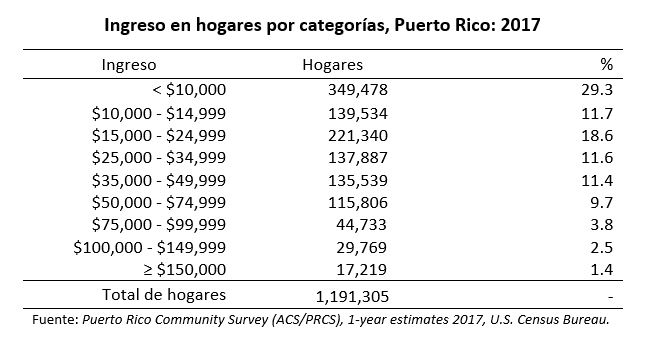
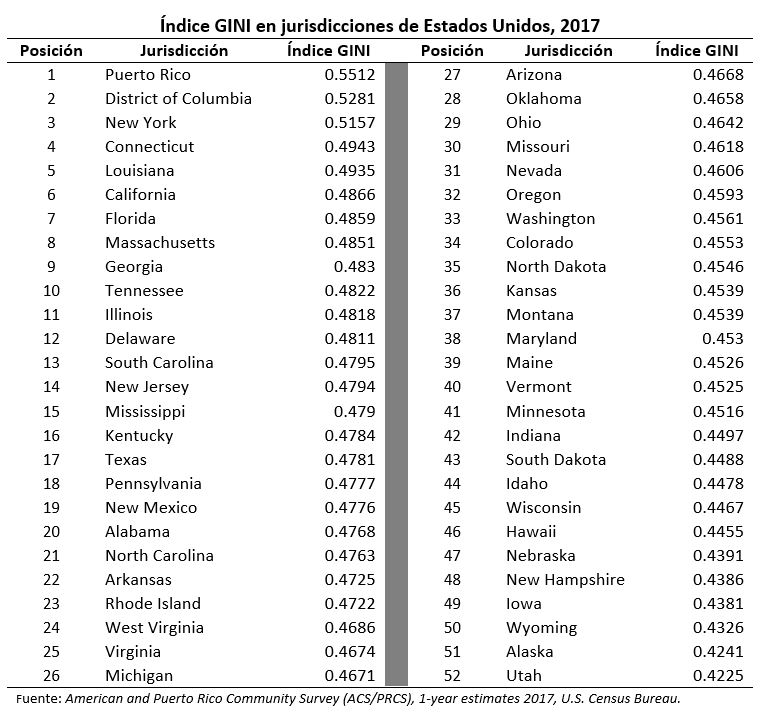
“Although again in 2017 emigration broke records in the Community Survey, this was to be expected after the passage of Hurricane Maria. On the other hand, when analyzing these figures, it is important to recognize that the Community Survey is not designed to adequately capture the population displacement that can occur rapidly and volcanically following a natural disaster. As a result, we warned that these numbers only include some of the people who moved in the wake of Hurricane Maria. Many other people who may have moved temporarily or permanently are not captured in this Survey, either because they moved to other foreign countries, relocated to temporary housing where the Survey questionnaire does not arrive, or are even staying in the homes of family members who were living in the United States before 2017, among other possible reasons. In that sense, it will be necessary to wait to see the results of the Survey for 2018 to have a more complete picture of post-Maria migration,” explained Dr. Mario Marazzi-Santiago, executive director of the Institute.
More statistics on the Community Survey estimates can be obtained at: http://factfinder2.census.gov/. If you need assistance using this tool to obtain data, you may find the self-study guide for using this available tool useful: https://censo.estadisticas.pr/fact-finder. Information on the methodology used to produce the estimates can be accessed hither. More details on the characteristics of migrants between Puerto Rico and the United States 2017 will be available at the end of 2018 in the publication of the 2017 Migrant Profile. The Migrant Profile is an annual publication published by the Institute. To view the published Profiles press hither.
In addition, as the leading entity of the Puerto Rico SDC, the IEPR manages the SDC portal, where you can find the main statistical reports and publications of the U.S. Census Bureau on Puerto Rico, specifically those that are most in demand, such as annual population estimates; the Puerto Rico Community Survey (Puerto Rico Community Survey) and official statistics on Puerto Rico's 10-year population and housing censuses, among others. The Puerto Rico SDC portal can be accessed through: https://censo.estadisticas.pr/.
The Puerto Rico Statistics Institute is an autonomous governmental entity responsible for coordinating the Government's statistical production service to ensure that the data collection and statistics systems, on which public policies are based, are complete, reliable, and have quick and universal access. The Institute has in its inventory, accessible through www.estadisticas.pr.gov, over 300 statistical products. In addition, it is a custodian and provides access to over 100 data sets or “data sets” through www.data.pr.gov and to over 40 tables and more than 6 thousand indicators through: www.indicadores.pr.
For more information you can visit our website: www.estadisticas.pr.gov. In addition, you can follow us on social networks through Facebook (estadisticas.pr), Twitter (@EstadisticasPR) and LinkedIn (Institute of Statistics of Puerto Rico) accounts.
##
Press Contact: Sandra Morales Blanes (787) 688-0401
To create the “Puerto Rico Financial Transparency Act” for the purpose of government agencies, public corporations and municipalities establishing a collaborative agreement with the Puerto Rico Institute of Statistics to join its financial transparency platform.
To create the “Puerto Rico Financial Transparency Act” for the purpose of government agencies, public corporations and municipalities establishing a collaborative agreement with the Puerto Rico Institute of Statistics to join its financial transparency platform.
To amend Art. 143 of the Civil Code of Puerto Rico to insert in its paragraph (2) a limitation on the establishment of the obligation to provide food for ascendants.
Please let us know your satisfaction level with our services.
Visit our Official Activities, and participate with us
Visit our Calls for applications and be part of the new opportunities we have for you.
If you have any questions or just want to contact us, visit the Contact Us section.
We are at your disposal. If you need custom statistics, do not hesitate to contact us.
Sign up for our online workshops. Connect with the experts and discover the power of data!
Visit our Blog and keep up to date with the latest news and topics of interest.
Visit our Press Releases and stay connected to the Institute.
Explore the Publication Calendar and keep up to date with Puerto Rico's statistics.
Complete the form for the selection of our Statistics Coordination Committee
Suscribe to receive news directly to your email.
Listen to the Official PRIS podcast and stay informed with the experts

.png)
.png)
.png)
.png)

-p-130x130q80.png)
.png)
.png)
.png)
.png)
.png)
.png)
.png)
.png)
.png)
.png)
.png)