
97,000 people immigrated to the United States in 2017

Announcements
IEPR
26 December 2025

PRESS RELEASE September 13, 2018

RED STATE DATA CENTER OF PUERTO RICO

97,000 PEOPLE IMMIGRATED TO THE UNITED STATES IN 2017

The figure includes only a few of the people who migrated after Hurricane Maria.

San Juan, PR — El U.S. Census Bureau published today the most recent estimates of the Puerto Rico Community Survey known as Puerto Rico Community Survey (PRCS). These statistics refer to information collected during the 2017 calendar year and include social, economic and housing characteristics for Puerto Rico and municipalities with a population of 65,000 people or more. As the leading entity of the Network State Data Center Of U.S. Census Bureau in Puerto Rico, the Puerto Rico Statistics Institute (Institute) presents this brief summary of several findings from this disclosure:

  1. During 2017, 97,000 people moved from Puerto Rico to the United States, while 20,000 people moved in the opposite direction, resulting in a net migratory movement of -77,000 people. Since the PRCS began to be carried out in 2005, this migratory movement, both in absolute and in net terms, represents the highest. These data will be described in greater depth in the Institute's 2017 Migrant Profile, which will be published in the coming months.
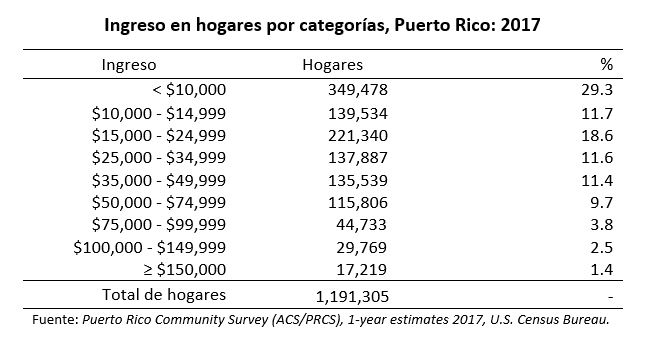
  2. The median household income in Puerto Rico decreased by 3.7% between 2016 ($20,078) and 2017 ($19,343). Household income categories showed that 60% of households had incomes under $25,000. Of these, nearly half (29%) had incomes of less than $10,000.
  3. In 2017, 44% of people and 41% of families were below the poverty level. In families where women are heads of household without a husband present, the percentage was 59%.
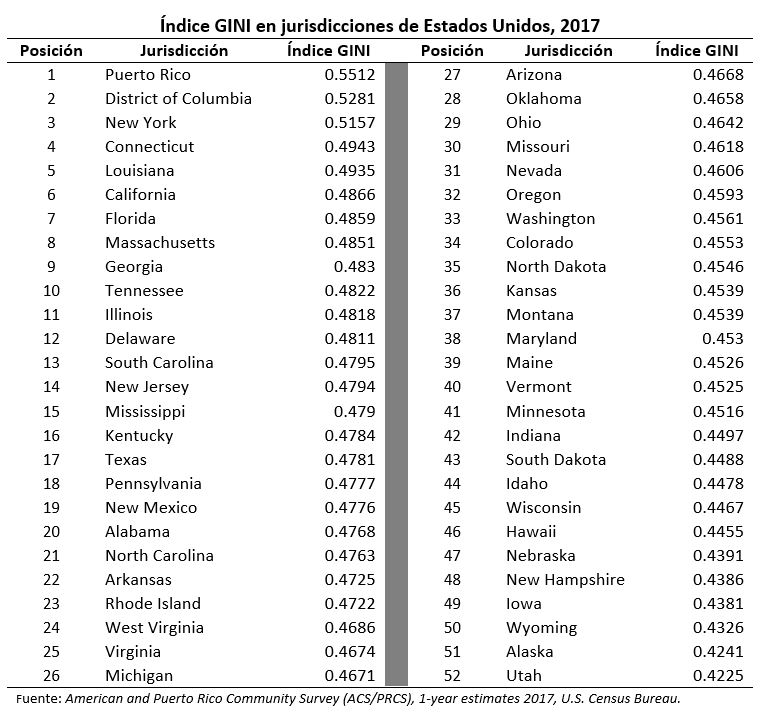
  4. Puerto Rico had a GINI index of 0.55, ranking as the jurisdiction with the highest inequality in income distribution compared to other jurisdictions in the United States. The GINI index measures inequality, where a value of 0 is a perfect distribution of income and a value of 1 is a completely unequal distribution.
“Although again in 2017 emigration broke records in the Community Survey, this was to be expected after the passage of Hurricane Maria. On the other hand, when analyzing these figures, it is important to recognize that the Community Survey is not designed to adequately capture the population displacement that can occur rapidly and volcanically following a natural disaster. As a result, we warned that these numbers only include some of the people who moved in the wake of Hurricane Maria. Many other people who may have moved temporarily or permanently are not captured in this Survey, either because they moved to other foreign countries, relocated to temporary housing where the Survey questionnaire does not arrive, or are even staying in the homes of family members who were living in the United States before 2017, among other possible reasons. In that sense, it will be necessary to wait to see the results of the Survey for 2018 to have a more complete picture of post-Maria migration,” explained Dr. Mario Marazzi-Santiago, executive director of the Institute.

More statistics on the Community Survey estimates can be obtained at: http://factfinder2.census.gov/. If you need assistance using this tool to obtain data, you may find the self-study guide for using this available tool useful: https://censo.estadisticas.pr/fact-finder. Information on the methodology used to produce the estimates can be accessed hither. More details on the characteristics of migrants between Puerto Rico and the United States 2017 will be available at the end of 2018 in the publication of the 2017 Migrant Profile. The Migrant Profile is an annual publication published by the Institute. To view the published Profiles press hither.

In addition, as the leading entity of the Puerto Rico SDC, the IEPR manages the SDC portal, where you can find the main statistical reports and publications of the U.S. Census Bureau on Puerto Rico, specifically those that are most in demand, such as annual population estimates; the Puerto Rico Community Survey (Puerto Rico Community Survey) and official statistics on Puerto Rico's 10-year population and housing censuses, among others. The Puerto Rico SDC portal can be accessed through: https://censo.estadisticas.pr/.

The Puerto Rico Statistics Institute is an autonomous governmental entity responsible for coordinating the Government's statistical production service to ensure that the data collection and statistics systems, on which public policies are based, are complete, reliable, and have quick and universal access. The Institute has in its inventory, accessible through www.estadisticas.pr.gov, over 300 statistical products. In addition, it is a custodian and provides access to over 100 data sets or “data sets” through www.data.pr.gov and to over 40 tables and more than 6 thousand indicators through: www.indicadores.pr.

For more information you can visit our website: www.estadisticas.pr.gov. In addition, you can follow us on social networks through Facebook (estadisticas.pr), Twitter (@EstadisticasPR) and LinkedIn (Institute of Statistics of Puerto Rico) accounts.

##

Press Contact: Sandra Morales Blanes (787) 688-0401

Share this article:

Visit our Official Activities, and participate with us

Visit our Calls for applications and be part of the new opportunities we have for you.

If you have any questions or just want to contact us, visit the Contact Us section.

We are at your disposal. If you need custom statistics, do not hesitate to contact us.

Sign up for our online workshops. Connect with the experts and discover the power of data!

Visit our Blog and keep up to date with the latest news and topics of interest.

Visit our Press Releases and stay connected to the Institute.

Explore the Publication Calendar and keep up to date with Puerto Rico's statistics.

Complete the form for the selection of our Statistics Coordination Committee

Suscribe to receive news directly to your email.

Listen to the Official PRIS podcast and stay informed with the experts

Statistics Institute calls for the opening of information on the economic incentives that the Government negotiates with private companies on Civic Hacker Day

Statistics Institute calls for the opening of information on the economic incentives that the Government negotiates with private companies on Civic Hacker Day

Statistics Institute releases new version of the Occupied Positions Report

PRESS RELEASE

Statistics Institute releases new version of the Occupied Positions Report

A new programming improves the visualization of the statistics of positions held in the government

A new programming carried out by the Puerto Rico Institute of Statistics will allow a better visualization of the Occupied Positions (PO) Report in the Government and the ability to compare current information with previous months, among other advantages. For the redesign of this report, free of charge and open source software was used R, so now it is done completely through this program, eliminating manual processes that were previously carried out.

“This new program is an advanced one because it optimizes the efficiency and effectiveness of statistical processes on this topic, improves our ability to monitor government positions with updated information, and allows comparisons to be made with previous years.”, said Dr. Orville M. Disdier, executive director of the Puerto Rico Institute of Statistics.

The new design, as indicated by Ana Gabriela Jara Castro, manager of statistical projects at the Puerto Rico Institute of Statistics, includes a monthly report tabulated by agency and type of position, in addition to the time series, with the following information:

  1. Number of POs at the end of the reference month, broken down by type of position (career, trust, temporary, irregular, among others) and by type of agency.
  2. Monthly change in the number of POs by type of position and by type of entity.
  3. Total PO for each government entity.

Jara Castro explained that, within this new format, a table (Table 4) was included that represents entities that have not reported their positions to the Office of the Comptroller for more than six months.

“The inclusion of this new table will allow the accountability process, for positions in government entities, to be a more transparent one, and more accessible to the population. The main objective of this report is to summarize the information of all the agencies represented in the Office of the Comptroller on its website,” said Ana G. Jara Castro, who was primarily responsible for the redesign of the report.

According to the website of the Puerto Rico Institute of Statistics, the statistics presented in the Report on Statistics of Occupied Government Positions, come from the Register of Occupied Positions and Related Information, created under Act No. 103-2006, known as the Puerto Rico Government Tax Reform Act of 2006. This law states that every governmental entity has a duty to certify this information to the Comptroller's Office on a monthly basis. In those cases where the entity has not fulfilled its duty to certify its figures in a timely manner, the Statistics Institute performs a simple statistical attribution of the missing data to complete the statistics. All figures are under constant review and may change in future reports. The January 2021 edition is the most recent edition of this report and reflects that the number of total POs in government has fallen from 275,448 in January 2008 to 150,502 in January 2021. In the same way, “De Carrera” POs have fallen from 218,540 in January 2008 to 109,975 in January 2021. The report can be accessed through the following link: Statistics of Occupied Positions in the Government.

The Puerto Rico Statistics Institute is an autonomous governmental entity tasked with coordinating the government's statistical production service to ensure that the data collection and statistics systems, on which public policies are based, are complete, reliable, and accessible quickly and universally.

For more information you can visit the website: https://estadisticas.pr.gov/. In addition, you can follow the Institute on social networks, through Facebook (@estadisticas .pr), Twitter (@EstadisticasPR) and LinkedIn (Institute of Statistics of Puerto Rico) accounts.

###

Contact:

Idia M. Martinez, R-28

787-603-3200

An index to measure Puerto Rico's knowledge economy is presented

An index to measure Puerto Rico's knowledge economy is presented