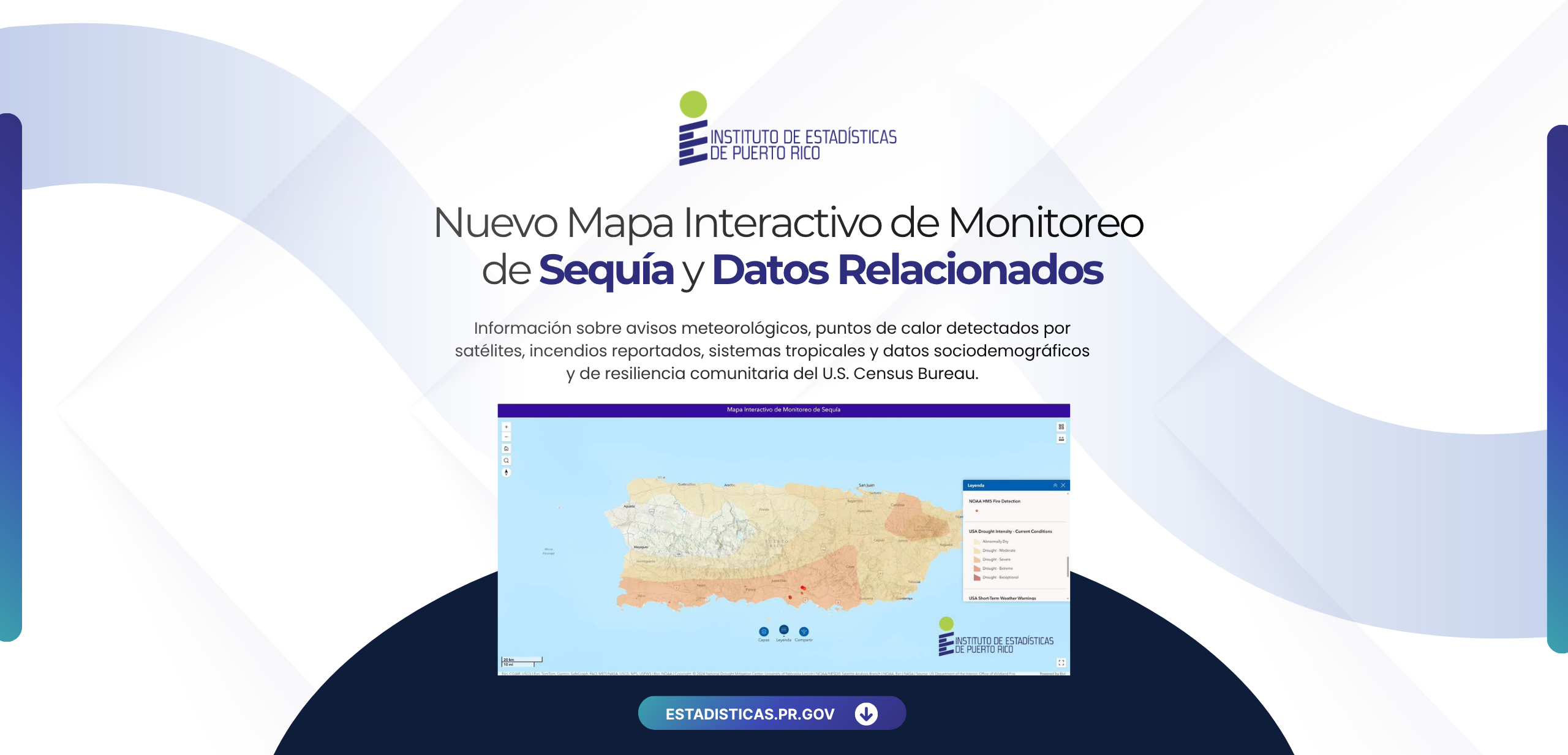

New Interactive Drought Monitoring and Related Data Map
This new tool from the Puerto Rico Institute of Statistics integrates information on weather alerts, satellite-detected hotspots, reported fires, tropical systems, and sociodemographic and community resilience data from the U.S. Census Bureau into a single location.
The primary purpose of this tool is to facilitate the monitoring of drought conditions and support planning, preparedness, and decision-making through updated geospatial information.
Explore the map at: www.estadisticas.pr.gov/productos/mapasequia

The most recent annual resident population estimates for U.S. jurisdictions were released on Tuesday, January 27, 2026. These include a review of the previuos years of the current decade, as well as an estimate of the population aged 18 years and over.
In summary, the total population of Puerto Rico was estimated at 3,184,835 as of July 1, 2025. This represented a reduction of around 18,000 people compared to the previous year 2024 and of about 97,000 fewer people than in 2020. On the other hand, the components of population change considered indicate that from 2024 to 2025 there were about 17,950 births, about 32,857 deaths and a net migration of -2,779 people. You can access the most recent population estimates for Puerto Rico and its municipios in the following section: https://censo.estadisticas.pr/EstimadosPoblacionales.
The following infographic summarizes the published results for Puerto Rico:
Francisco J. Pesante González
Statistical Project Manager
(created with https://gemini.google.com)
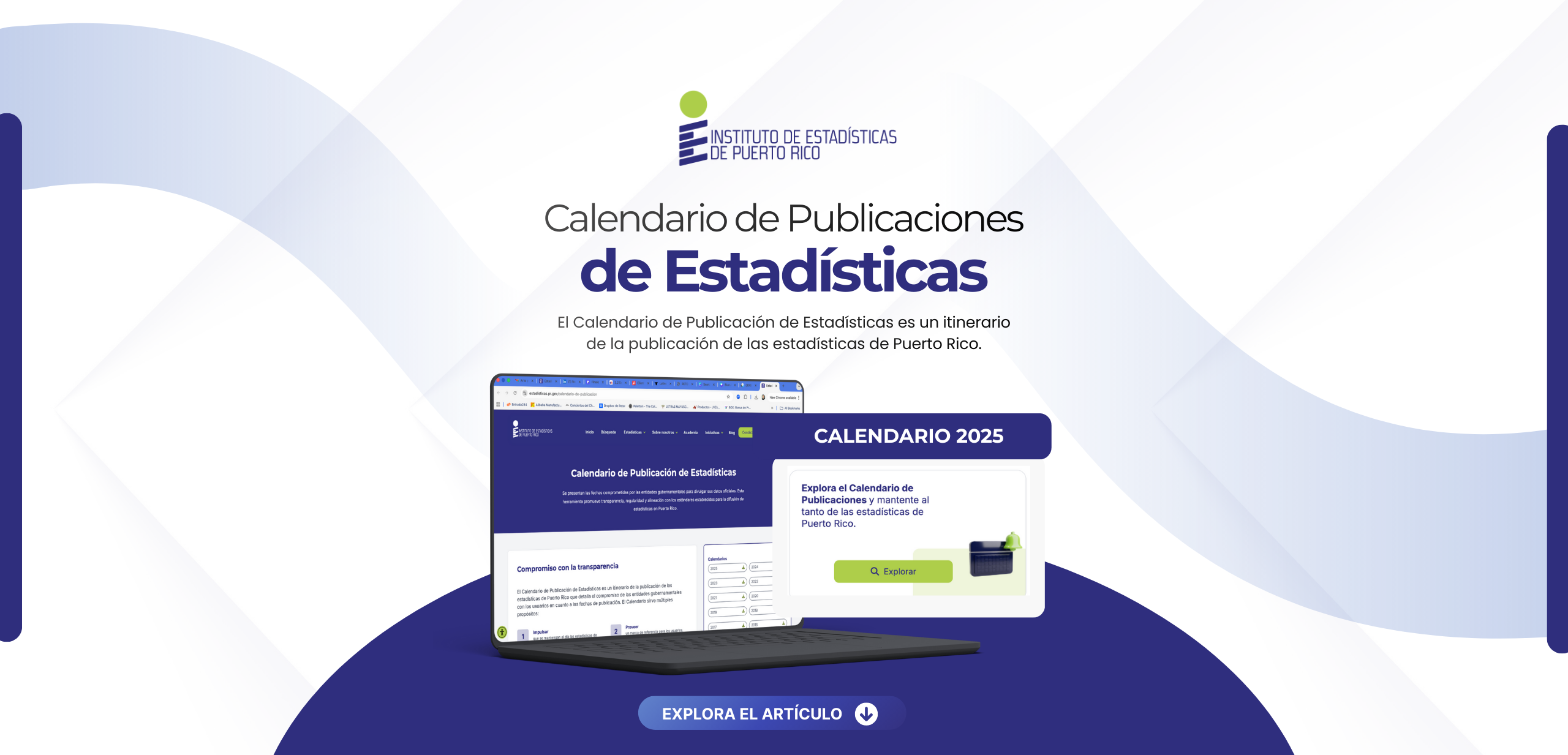
In the world of data analysis and decision-making, uncertainty is our greatest enemy. Knowing what the data says is vital, but knowing when it will be available is what allows us to plan with certainty. This is where a fundamental tool for transparency in Puerto Rico comes into play: the Calendar for the publication of statistics.
What exactly is this Calendar?
In simple terms, the Statistics Release Schedule is the official itinerary that governs the publication of statistics for Puerto Rico. It's not just a list of dates; it's a document that details the formal commitment that government entities have to us, the users, about when their statistics will be made public.
This instrument is not optional. It is the duty of the Statistics Institute, enshrined in its enabling law (Act No. 209 of 2003, as amended), to establish strict schedules and ensure that government agencies comply with them.
Beyond Dates: Measuring Efficiency
The interesting thing about this Calendar is that it works as an accountability tool using specific metrics. The Institute records three key moments for evaluating performance:
From these dates, something critical called the Opportunity Interval (IO) is calculated. The IO measures the number of days that pass from when the statistic occurs until it is finally published.
Why does IoT matter? Because it serves as the basic measure of data “opportunity”. Also known as data lag, this interval directly affects how investors and economists can take advantage of information to make decisions. If we see IoT on the rise, it's a clear sign that the work processes in that unit of government need improvement.
The relevance: why do we need this Calendar?
The existence and compliance of this Calendar are vital for five main reasons:
Conclusion
The Statistical Publication Schedule is more than an administrative agenda; it is the guarantee that Puerto Rico is governed by the same data dissemination standards used by jurisdictions such as Germany, Mexico or the U.S. Census Bureau. At the end of the day, greater regularity and frequency in publication allows us to make better use of statistical information to build a better future. Access this product at: https://www.estadisticas.pr.gov/calendario-de-publicacion
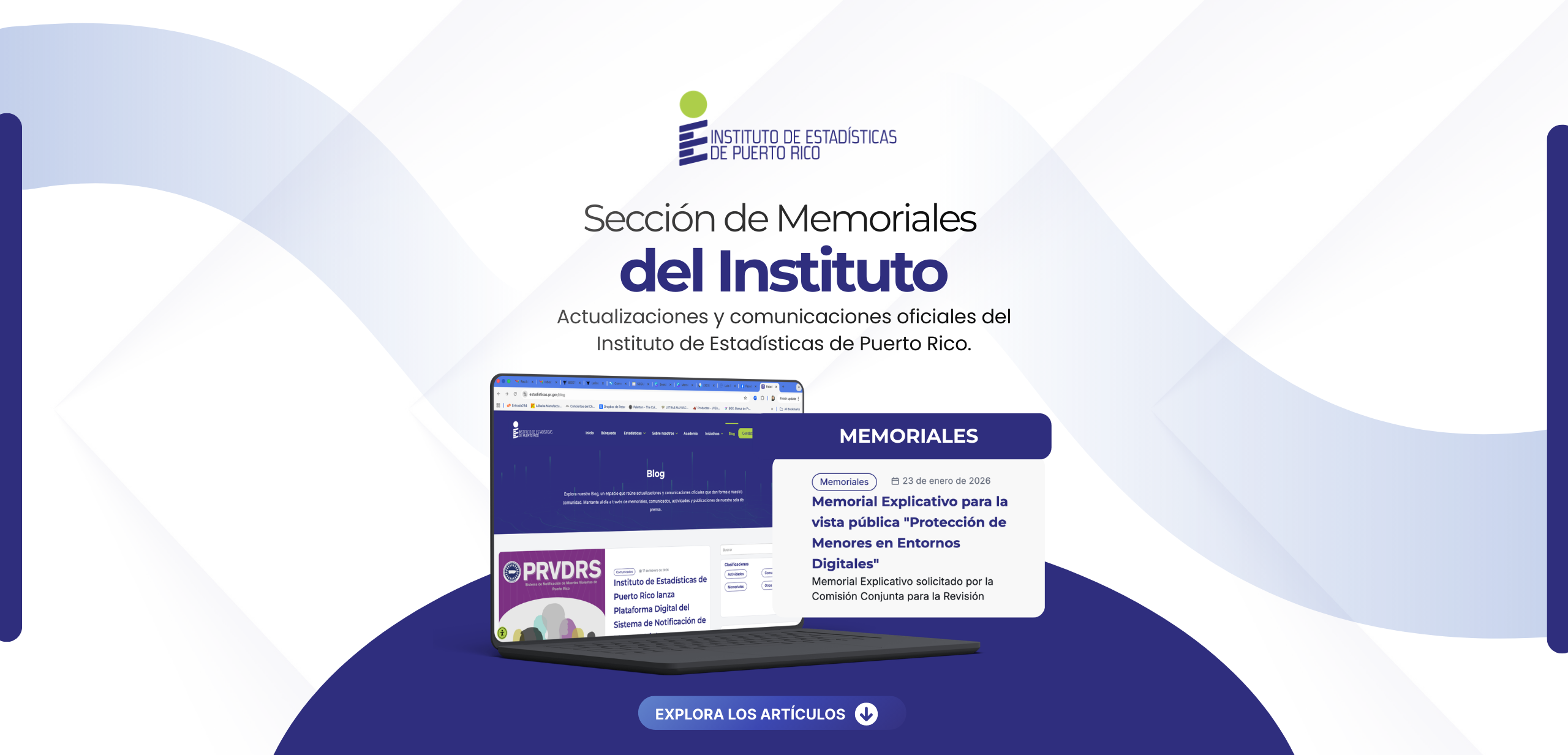
Explanatory Memorial requested by the Joint Commission for the Continuous Review of the Puerto Rico Criminal Code for the public hearing entitled “Protecting Minors in Digital Environments: Identifying Legal Gaps in the Puerto Rico Criminal Code Regarding Grooming in Preparatory Stages, Cyberbullying as an Autonomous Crime and Sextortion of Minors
To amend Articles 3, 4, 6 and 8 of Law 209-2003, as amended, known as the “Puerto Rico Statistics Institute Act”, for the purpose of updating references to laws that have been repealed and replaced by existing legislation; increasing the threshold for approval of contracts by the Board of Directors; and for other related purposes.

Be part of our
Team
job posting for:
Administrative Assistant
Join and be a fundamental part of the team that promotes the
statistics in Puerto Rico.
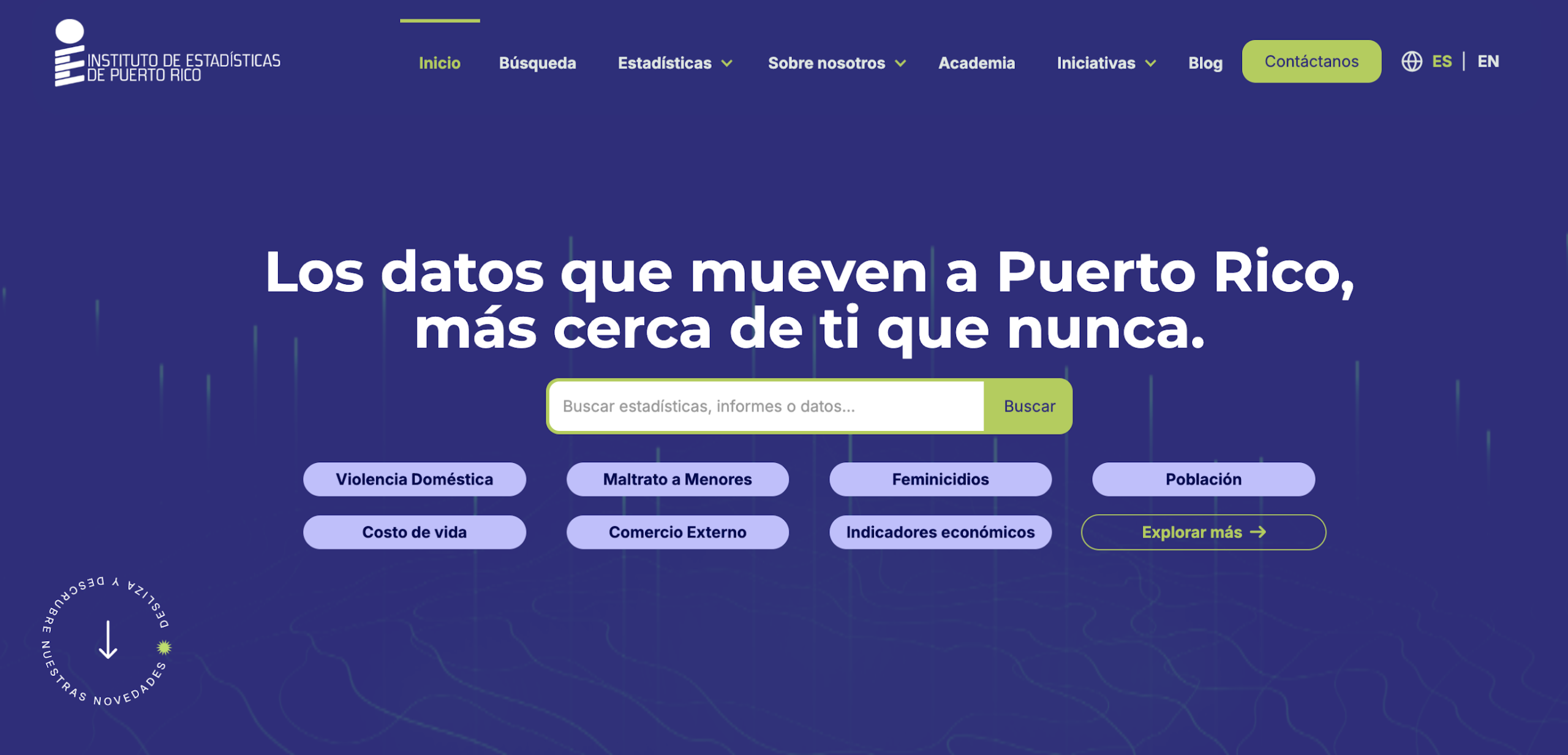
San Juan, Puerto Rico. January 2, 2026. The Puerto Rico Statistics Institute announced the launch of its new website, a digital platform framed by the transparency and accessibility of critical statistics for Puerto Rico. The new website, available through: https://www.estadisticas.pr.gov, focuses on a better user experience with a better search engine, allowing for more intuitive navigation. The more than 300 statistical products contained in the new platform are rigorously organized by categories that make it easier to find information. This logical architecture makes it easier for students, researchers and citizens to locate specific indicators on economy, health, education or demography, among other topics, consolidating in a single access point the vast production of data and interactive dashboards that were previously more dispersed.
On the other hand, the new portal launches a dynamic blog section designed as an institutional chronicle center that includes, among others: press releases, recent activities, explanatory memorials, and notifications of importance to Puerto Rico. Another important aspect of the new website is that it has been designed to the highest standards to guarantee access for people with disabilities or with diverse access needs. In the same way, the cybersecurity of the portal was substantially improved. “With the creation of this new website, the Institute consolidates its leadership in providing Puerto Rico with quick and universal access to statistics, eliminating barriers and reaffirming that statistical knowledge is a right for the entire population,” said Dr. Orville M. Disdier, executive director of the Institute.
Anyone who has questions about the functionality of the new page or has difficulty finding any data or information on the page, can write to preguntas@estadisticas.pr. They can also follow social networks through Facebook (@estadisticas .pr), X (@EstadisticasPR), LinkedIn (Institute of Statistics of Puerto Rico) and Instagram (@institutodeestadisticas) accounts.
The Puerto Rico Statistics Institute is an autonomous governmental entity responsible for coordinating the Government's statistical production service to ensure that the data collection and statistics systems, on which public policies are based, are complete, reliable, and have quick and universal access.
Please let us know your satisfaction level with our services.
Visit our Official Activities, and participate with us
Visit our Calls for applications and be part of the new opportunities we have for you.
If you have any questions or just want to contact us, visit the Contact Us section.
We are at your disposal. If you need custom statistics, do not hesitate to contact us.
Sign up for our online workshops. Connect with the experts and discover the power of data!
Visit our Blog and keep up to date with the latest news and topics of interest.
Visit our Press Releases and stay connected to the Institute.
Explore the Publication Calendar and keep up to date with Puerto Rico's statistics.
Complete the form for the selection of our Statistics Coordination Committee
Suscribe to receive news directly to your email.
Listen to the Official PRIS podcast and stay informed with the experts

.png)
.png)
.png)
.png)

-p-130x130q80.png)
.png)
.png)
.png)
.png)
.png)
.png)
.png)
.png)
.png)
.png)
.png)