
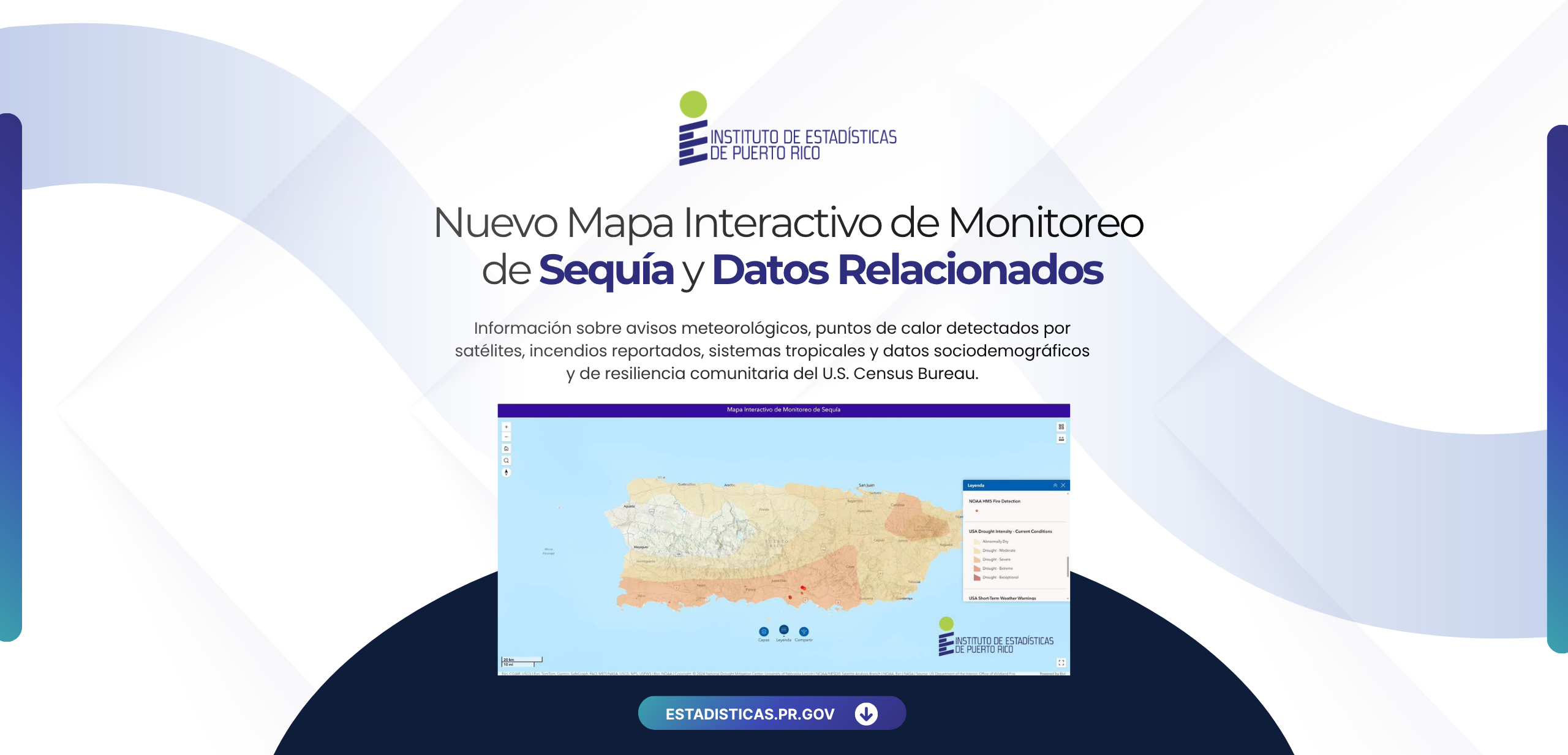

New Interactive Drought Monitoring and Related Data Map
This new tool from the Puerto Rico Institute of Statistics integrates information on weather alerts, satellite-detected hotspots, reported fires, tropical systems, and sociodemographic and community resilience data from the U.S. Census Bureau into a single location.
The primary purpose of this tool is to facilitate the monitoring of drought conditions and support planning, preparedness, and decision-making through updated geospatial information.
Explore the map at: www.estadisticas.pr.gov/productos/mapasequia
More than 4,300 Homicides and 1,600 Suicides Since 2017: Digital Platform Allows Exploration of Violent Deaths in Puerto Rico
From 2017 to 2023, Puerto Rico has recorded 4,304 homicides and 1,685 suicides.These figures reflect a complex phenomenon that impacts families, communities, and public safety and health throughout the archipelago.
With the goal of promoting a deeper and more accessible understanding of this reality, the Puerto Rico Violent Death Reporting System (PRVDRS) developed a digital platform that allows for a detailed and contextualized examination of the data.
“The public policy formulation process requires reliable data and rigorous analysis. This tool allows us to measure the magnitude of violent deaths in Puerto Rico and better understand the circumstances surrounding these incidents. Evidence-based decision-making is fundamental to effectively addressing this public health and safety issue,” expressed Planner Mario O. Font Martin, Statistical Projects Manager and Coordinator of the PRVDRS.
Data to Help Understand the Phenomenon
The PRVDRS integrates information from multiple official sources, including the Puerto Rico Police, the Institute of Forensic Sciences, and the Demographic Registry of the Department of Health. By combining these sources into an anonymized database, the system allows for the analysis of not only how many deaths occur but also the circumstances surrounding them.
From the start of data collection in 2017 through 2023, the system has documented:
This integration allows for the identification of patterns and trends that are not always visible in individual reports.
What Does the Digital Platform Offer?
The tool allows citizens to:
Currently, the platform presents official consolidated data through 2023, along with preliminary data from 2024 to 2026, which will be updated monthly.
A Nationally Integrated Effort
The PRVDRsis part of the National Violent Death Reporting System (NVDRS), coordinated by the Centers for Disease Control and Prevention (CDC). The PRVDRS collects information documented by the Puerto Rico Police, the Institute of Forensic Sciences, and death certificates from the Department of Health's Demographic Registry into an anonymous database with over 600 variables. For more information on the NVDRS, you can access the following link: National Violent Death Reporting System.
This methodology allows for an understanding of not only the cause of death but also the circumstances and factors related to each case, facilitating comparisons with other U.S. jurisdictions.
Public Access
The platform is available through the official portal of the Puerto Rico Institute of Statistics: Puerto Rico Violent Death Notification System (PRVDRS) interactive tool
Open access to this data strengthens transparency and fosters informed conversations regarding violence prevention and public policy. Understanding the data is an essential step toward addressing one of the most complex challenges facing Puerto Rico in an informed manner.
About the Puerto Rico Institute of Statistics
The Institute is an autonomous government entity responsible for coordinating the production of government statistics to ensure that the data collection systems upon which public policies are based are complete, reliable, and provide rapid and universal access.

During 2025, imports of flowers and buds classified under HTS code 0603 showed monthly variations throughout the year. The highest value was recorded in February, when imports reached $1,243,389.
This pattern reflects seasonality, meaning variations that occur at specific times of the year due to recurring factors that influence commercial activity.
The disaggregation by country of origin allows us to examine the origin of the imports and their monthly distribution.

.jpg)
The monthly analysis makes it possible to identify temporary variations in foreign trade and better understand its behavior throughout the year.
To access more foreign trade statistics, visit the Applications section of our official portal (the use of Mozilla Firefox is recommended):
https://apps.estadisticas.pr/iepr/Publicaciones/Proyectosespeciales/ComercioExterno.aspx
Source: Puerto Rico Statistics Institute and U.S. Census Bureau.

To order the Health Commission and the Labor Affairs Committee to investigate and evaluate compliance with Act No. 82 of May 31, 1972, as amended, known as the Puerto Rico Examination Board and Association of Nutritionists and Dieticians Act; the need to review and update the salary scales and remuneration of nutritionists-dieticians who work in the government; to investigate other issues relevant to this group of professionals; and for other related purposes.
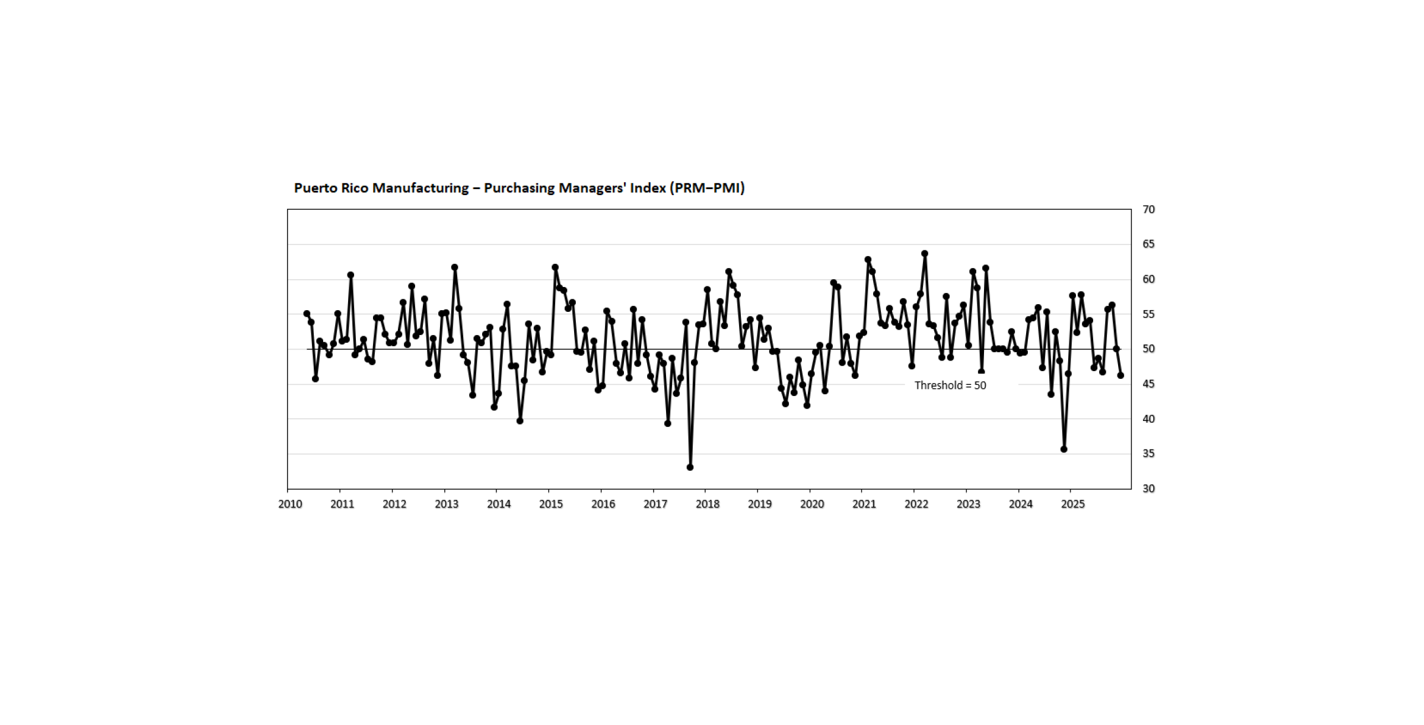
The Purchasing Managers Index (PMI) for manufacturing in Puerto Rico, the main leading indicator of the performance of the manufacturing sector, registered a value of 46.2 in December 2025, indicating a contraction in the sector compared to the previous month. A value lower than 50 indicates a decrease in manufacturing activity compared to the previous period.
The PMI is the main indicator of manufacturing performance in Puerto Rico and is published on a monthly basis. The Puerto Rico Institute of Statistics produces and disseminates this indicator as part of its institutional commitment to provide objective, reliable and independent statistical information, in support of economic analysis and informed decision-making.
During December, although the general index remained below the 50 threshold, some of its components recorded different results. In particular, the employment and supply delivery components were located at or above that level, reflecting a different evolution of these components compared to the general index. In addition, own inventories increased compared to the previous month.
As part of a supplementary survey of manufacturing establishments, the main challenges identified during the month were concentrated in three areas. In the operational area, costs, limitations in the availability of raw materials, supplier deliveries, supply chain logistics and sales were highlighted. In the area of human resources, the main challenge reported was absenteeism from work. In addition, problems related to the reliability of the electrical power supply were noted.
Since the beginning of the survey, the manufacturing PMI in Puerto Rico has been at or above the expansion threshold in 116 of the 187 months observed, allowing us to contextualize the December result within its historical trajectory.
Access the full PMI report and data set here:
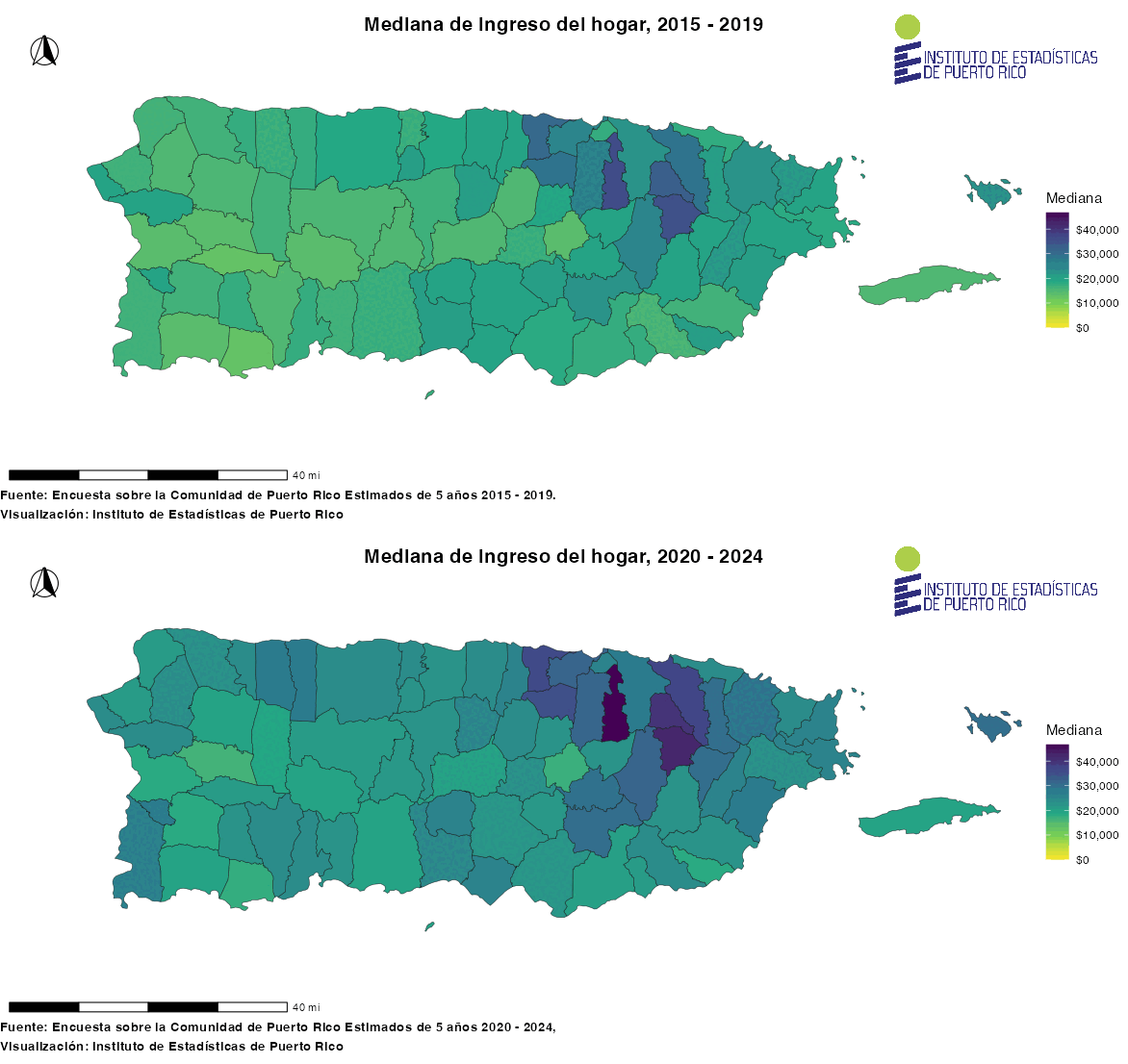
On January29, 2026, the United States Census Bureau published the Puerto Rico CommunitySurvey (PRCS) new estimates, the data refer to the five-year period 2020-2024. Unlike the estimates of one year of information by the Survey, an important aspect of publishing the five-year periods of the survey is that estimates canbe produced for all municipalities in Puerto Rico, or areas with populations below 60,000 people.
Among the variety of topics collected in the PRCS, we address the median household incomeas ad the first (1/4) of four socioeconomic aspects. A comparison was made with theprevious period 2015-2019, which allows us to examine the variations by municipios and their distribution within the jurisdiction of Puerto Rico according to the socioeconomic characteristic.
Median Household Income by Municipalities
The measure shows the amount of income that came into the household, thus householdersand all other individuals aged 15 years or older in the household.
In the period 2015-2019, the level of income between municipalities ranged from $12 thousand to $36 thousand dollars per year, with Maricao and Guaynabo being the extreme points of the distribution, respectively. During the period 2020-2024, revenues ranged from $16,000 to $47,000 annually, with Las Marías being the onewith the lowest income and Guaynabo the one with the highest income. Regarding the change within the periods considered, it should be noted that only the municipio of Maunabo did not increase its median household income.
Among the 77 municipalities that showed an increase in household income, they can besummarized as:
Explore more details in the table with the comparison of household income between themost recent year periods, as well as the maps with the geographicaldistribution on the Institute Census Data andInformation (SDC-PR) page.
To establish the Public Policy for Science, Technology and Innovation of the Government of Puerto Rico, define the mechanisms for implementing, measuring and evaluating public policy; ensure its effective execution and continuous review; establish clear metrics and promote multisectoral collaboration to strengthen the innovation ecosystem, strengthening the role of the Puerto Rico Trust for Science, Technology and Research, the Department of Economic Development and Commerce, universities and the private sector; and for other purposes related.
Please let us know your satisfaction level with our services.
Visit our Official Activities, and participate with us
Visit our Calls for applications and be part of the new opportunities we have for you.
If you have any questions or just want to contact us, visit the Contact Us section.
We are at your disposal. If you need custom statistics, do not hesitate to contact us.
Sign up for our online workshops. Connect with the experts and discover the power of data!
Visit our Blog and keep up to date with the latest news and topics of interest.
Visit our Press Releases and stay connected to the Institute.
Explore the Publication Calendar and keep up to date with Puerto Rico's statistics.
Complete the form for the selection of our Statistics Coordination Committee
Suscribe to receive news directly to your email.
Listen to the Official PRIS podcast and stay informed with the experts

.png)
.png)
.png)
.png)

-p-130x130q80.png)
.png)
.png)
.png)
.png)
.png)
.png)
.png)
.png)
.png)
.png)
.png)