
Blog

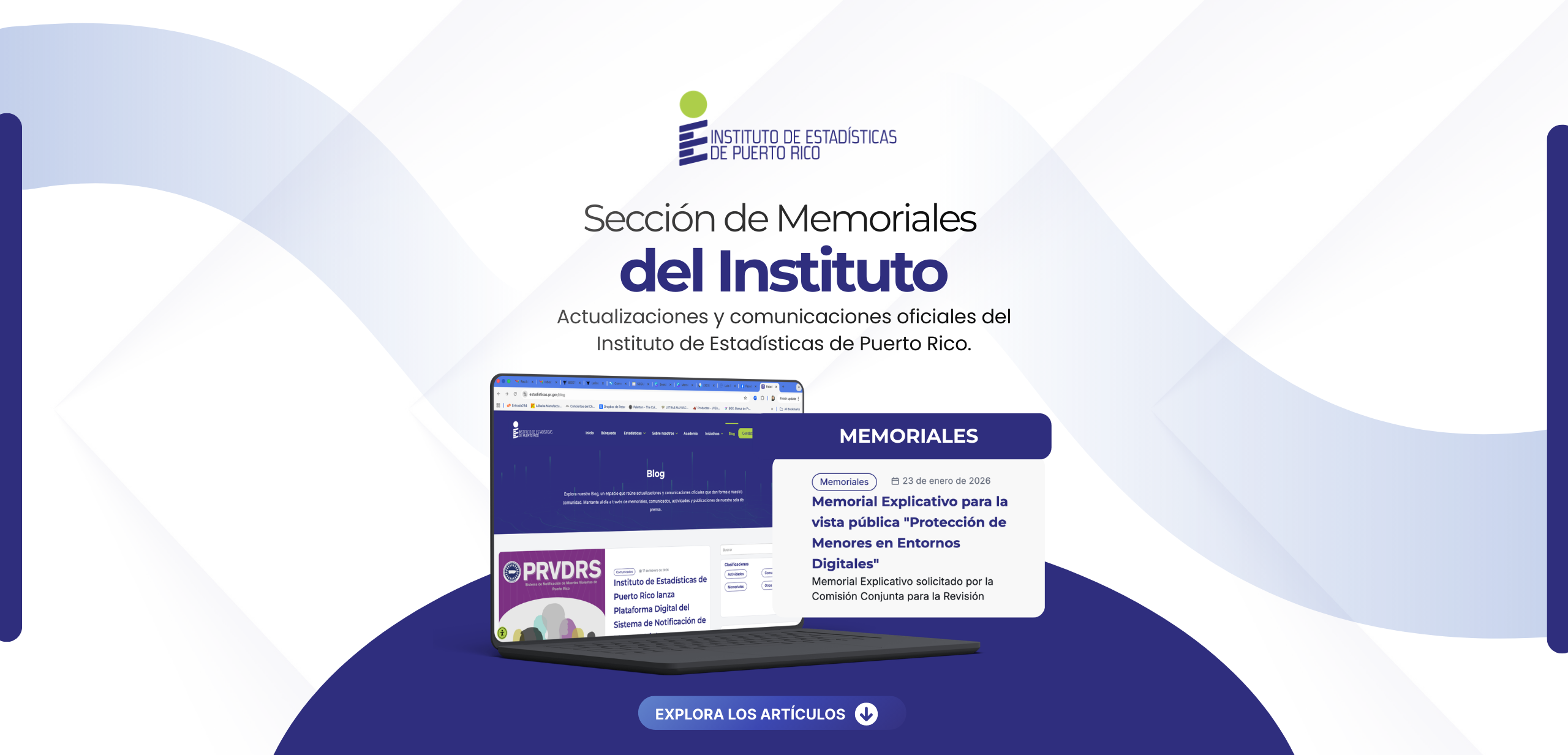
Explore our Blog, a space that brings together updates and official communications that shape our community. Stay up to date through memorials, announcements, activities and publications in our newsroom.
Representative Blog ImageImagen Representativa de Blog
Memorials
February 27, 2026
P. de la C. 1108

To establish the “Act to Declare a State of Emergency for Child Violence in Puerto Rico”, for the purpose of declaring a state of emergency for child violence, in accordance with the provisions and terms established by this Act; and for other related purposes.

Representative Blog ImageImagen Representativa de Blog
Announcements
January 22, 2025
Data presented from the Report on Violent Deaths in Puerto Rico

Data presented from the Report on Violent Deaths in Puerto Rico

598 homicides and 190 suicides were reported in Puerto Rico in 2022

The Puerto Rico Violent Death Notification System (PRVDRS, in English) established at the Puerto Rico Institute of Statistics, presented data from the Puerto Rico Violent Deaths Report for the year 2022. The report reports that in 2022, there were 727 incidents of violent deaths, with a total of 809 fatalities. Of the total number of violent deaths, 598 were homicides and 190 were suicides, representing 97.4% of violent deaths.

In 2022, 73.9% of victims of violent deaths were reported in single or multiple homicide incidents and 23.5% were suicide incidents. Seven homicide-suicide incidents were reported, resulting in 14 fatalities. In addition, 6 violent deaths attributed to legal intervention (0.7%), four violent deaths from unintentional self-inflicted firearms (0.5%) and 11 violent deaths with undetermined intent (1.4%) were documented during this period. In 2022, approximately 9 out of 10 victims of violent deaths (89.6%) were men. The crude rate of violent deaths for Puerto Rico in 2022 was 25.1 per 100,000 inhabitants, 47.6 in men and 4.9 in women.

Of the 809 violent deaths recorded in 2022, 598 were homicides (73.9%). The majority of homicides occurred between the ages of 15 and 39. In these age groups, 73.2% of all homicides occurred among men and 66.0% among women. The primary mechanism of the homicides was firearms. In Puerto Rico, 93.6% of homicides were committed with firearms. Globally, firearm homicides account for 69.5%.

In 2022, nearly half of the homicides occurred in an environment of collective violence. 255 of the 598 homicides (42.6%) registered in 2022 occurred in a context related to criminal groups involved in the trafficking of illegal drugs.

In 2022, 28 fatal victims of family violence were reported. Family violence (violence between family members) includes child or adult abuse and violence against an intimate partner. Most of these cases were related to violence in an intimate or former partner environment (13 cases, 67.9%). There were 9 fatal incidents among family members (32.1%). The vast majority of victims of intimate partner violence were women (n= 13, 68.4%). More than half of these women were victims of their former spouse or former male partner (61.5%), while 30.8% were victims of their current spouse or partner. In addition, a firearm was used in 10 of the 13 femicides/femicides (76.9%).

As for suicides in Puerto Rico, the report highlights that the frequency is lower than that of homicides. However, as in homicides, suicides are more frequent in men (85.5%). In 2022, the crude suicide rate was 5.9 per 100,000 inhabitants, 10.6 in men (1 of 145 men) and 1.6 in women (1 of 788 women). The main mechanism was asphyxiation (62.3% in men and 53.6% in women).

The collection of this type of data involves fieldwork that usually takes more than two years, from the time the incident occurs until the collection, review and publication of the data is completed. Mariluz Bezares Salinas, Manager of Statistical Projects at the Institute of Statistics and co-principal investigator of the Report on Violent Deaths in Puerto Rico, said: “This report not only reflects the magnitude of violent deaths in Puerto Rico, but it also provides a detailed overview of the circumstances and factors associated with the occurrence of violent deaths. This information is crucial for guiding public policy decisions and designing interventions that save lives and promote safer communities.”

“This violent death reporting system is a reliable, complete and unique reference source that helps describe vital information about the circumstances surrounding violent deaths in Puerto Rico. This data is essential for government agencies and community organizations to implement evidence-based prevention programs,” said Dr. Diego Zavala, epidemiologist and co-principal investigator of the PRVDRS.

For the Executive Director of the Puerto Rico Institute of Statistics, Dr. Orville M. Disdier, the Puerto Rico Violent Death Notification System has been and is fundamental to understanding the magnitude and characteristics of this public health problem. “Data from 2022 allow us to identify crucial patterns and trends to develop more effective and efficient prevention strategies. Our commitment at the Institute of Statistics is to continue strengthening this statistical and epidemiological system to continue to have statistics, complete, reliable and quickly and universally accessible, on this topic,” argued Dr. Disdier.

The PRVDRS is an epidemiological surveillance system affiliated with the Institute of Statistics and designed to obtain a complete and standardized census of violent deaths in Puerto Rico. The PRVDRS began its participation in the National Violent Death Notification System (National Violent Death Reporting System, NVDRS) in September 2016 through a collaborative agreement granted by the Centers for Disease Control and Prevention (CDC) of the United States Department of Health and Human Services.

The Puerto Rico Statistics Institute is an autonomous governmental entity tasked with coordinating the government's statistical production service to ensure that the data collection and statistics systems, on which public policies are based, are complete, reliable, and accessible quickly and universally.

The 2022 Report on Violent Deaths in Puerto Rico is available at: Puerto Rico Violent Death Notification System. To learn about the Institute of Statistics, you can access it on social networks through Facebook (@estadisticas .pr), X (formerly Twitter) (@EstadisticasPR) and LinkedIn (Institute of Statistics of Puerto Rico) accounts.

Representative Blog ImageImagen Representativa de Blog
Announcements
December 11, 2024
Justice and Statistics Institute study reveals: One in four domestic violence plaintiffs faces risk of death

JUSTICE STUDY AND THE INSTITUTE OF STATISTICS REVEALS:

ONE OF FOUR DOMESTIC VIOLENCE PLAINTIFFS FACES A RISK OF DEATH

Based on the findings of the pilot study of the Risk Assessment used by Department of Justice prosecutors analyzed by the Institute for Statistics

San Juan, Puerto Rico. Wednesday, December 11, 2024 -- The Puerto Rico Statistics Institute and the Puerto Rico Department of Justice presented the preliminary findings of the analysis of the Risk Assessment, a tool recently implemented by prosecutors in the criminal investigation process, to identify the levels of dangerousness of femicide faced by victims of domestic violence in Puerto Rico. The pilot study, which covered 2,021 cases during the first half of 2024, revealed worrying data that highlight the urgency of continuing to strengthen prevention and protection strategies against domestic violence in Puerto Rico.

Among the data, the following stand out:

  • The injured parties have an average age of 36.3 years, with the group from 20 to 39 years old being the most represented (62.1% of cases).
  • One in four victims faced a level of danger from severe to extreme.
    • Women with severe or extreme danger are almost 13 times more likely to have been attacked or threatened with a weapon, compared to those who are of varying or increasing danger.
    • When evaluating the group of women with severe or extreme dangerousness, it was due to the fact that the partner or former partner was jealous of them and shows it violently and constantly (82.6%). 79.1% fear that their partner or ex-partner is capable of killing them.
    • The municipalities with the highest adjusted rates of victims, aged 15 and over with severe or extreme danger, were Barranquitas, Salinas and Patillas.

The Puerto Rico Statistics Institute and the Puerto Rico Department of Justice reaffirmed their commitment to continue working together so that the Government of Puerto Rico uses these findings as a basis for the design and implementation of effective public policies that prioritize the safety of victims of domestic violence.

“These data not only represent a picture of reality, but they are the result of a rigorous statistical analysis process led by the Institute of Statistics, in which the risk assessment sheets were validated, integrated into a centralized database and the necessary analyses were carried out to identify the most critical risk factors. This work is a key tool to guide government agencies' efforts toward more effective and targeted interventions,” said Dr. Orville M. Disdier Flores, executive director of the Puerto Rico Institute of Statistics. For his part, the Secretary of Justice, Domingo Emanuelli Hernández, pointed out that “these data are not just numbers, they are an urgent call for joint action to reinforce prevention, protection and justice strategies for victims of domestic violence. This preliminary report provides us with a path of action to identify areas that need to be reinforced in the fight to eradicate domestic violence. The analysis of data from the Department of Justice's Risk Assessment will allow the development of public policies and measures in addition to those that have already been implemented to meet the needs of the complainants and prevent femicide. My commitment, as part of the justice system, is to work tirelessly to turn these statistics into tangible solutions that prioritize the safety, dignity and rights of victims. It is extremely important that it be continued, as it is an effective initiative to continue building a future where no woman fears for her life in her own home.”

On the other hand, Dr. Idania R. Rodríguez Ayuso, Deputy Executive Director of the Institute of Statistics, noted that “The analysis of these data allowed us to identify patterns and critical risk factors that highlight the seriousness of domestic violence in Puerto Rico. This process, which included the validation and detailed analysis of risk assessment sheets, is essential for generating reliable information that serves as a basis for designing more effective prevention and protection strategies. These findings call on us to act urgently to prioritize high-risk cases and ensure the safety of victims.”

“The Risk Assessment analysis allows prosecutors to make determinations with greater certainty and can be inserted into prevention efforts. In turn, it helps them to guide victims and channel the aid and services they require, including security measures,” said the chief prosecutor, Jessika Correa González.

“The results of the Department of Justice's pilot Risk Assessment study confirm an alarming reality that we cannot ignore: one in four female complainants faces a level of danger that puts their lives at risk. As a society, we cannot allow fear and violence to continue to mark the lives of so many women. However, this effort cannot fall solely on government institutions. The active collaboration of communities is essential to identify risks, provide support to victims and promote a culture of respect,” said prosecutor Laura Hernández Gutiérrez, director of the Coordination Division of the Specialized Units for Domestic Violence, Sexual Offences and Child Abuse of the Department of Justice.

The Puerto Rico Statistics Institute and the Puerto Rico Department of Justice reiterated their call to continue government and community collaboration, as well as to continue strengthening the collection and analysis of regional data to eventually eradicate domestic violence in Puerto Rico. For his part, the Secretary of the Department of Justice reported that the results obtained will allow law and order agencies to strengthen the response in municipalities with high rates of danger, thus allowing for more focused and effective interventions. In addition, he explained that it will be essential to continue the specialized training that the Department of Justice implemented to train professionals who work directly with victims of domestic violence, ensuring that they have the necessary tools to identify and manage risky situations appropriately. Finally, the leaders of both agencies said that these findings will make it possible to design better prevention and education campaigns aimed at raising awareness of the risk factors associated with the risk of intimate femicide.

For more information you can visit the website www.estadisticas.pr.gov or the social media accounts of Facebook (@estadisticas .pr), Twitter (@EstadisticasPR) and LinkedIn (Institute of Statistics of Puerto Rico).

To access the study: Risk Assessment Sheet Findings Report.

About the Puerto Rico Institute of Statistics

The Puerto Rico Statistics Institute is an autonomous governmental entity responsible for coordinating the Government's statistical production service to ensure that the data collection and statistics systems, on which public policies are based, are complete, reliable, and have quick and universal access.

About the Puerto Rico Department of Justice

The Department of Justice has the mission of ensuring faithful compliance with the Constitution and laws of the Commonwealth of Puerto Rico and aspiring to the highest principles of equality and human dignity. It also represents the people of Puerto Rico in civil and criminal cases, and provides certainty to the legal trafficking of real estate on the island. It performs these functions with effectiveness, integrity, a sense of justice and the strongest commitment to public service.

Representative Blog ImageImagen Representativa de Blog
Announcements
December 9, 2024
59% of visitors to Puerto Rico were women and 63% are Puerto Ricans residing in other jurisdictions

59% of visitors to Puerto Rico were women and 63% are Puerto Ricans residing in other jurisdictions

This is according to the Visitor Profile for Fiscal Year 2023-2024 published by the Puerto Rico Institute of Statistics in collaboration with the Tourism Company

San Juan, Puerto Rico. December 9, 2024. The Puerto Rico Statistics Institute (Institute) in collaboration with the Puerto Rico Tourism Company (CTPR) published the Visitor Profile Fiscal Year 2023-2024. This Profile includes the findings of the Traveler Survey conducted from July 2023 to June 2024. This survey was conducted at Luis Muñoz Marín airports in Carolina, Mercedita in Ponce and Rafael Hernández airports in Aguadilla, as well as at the tourist docks of Old San Juan. The term “visitor” includes all non-resident travelers staying in hotels, hostels, rented apartments, homes of family and/or friends, own home, guesthouse, and others.

“The main statistical product of traveler surveys are estimates of visitor expenses, which are included in Puerto Rico's Balance of Payments as income for our economy. In addition, these surveys contribute to the determination of Gross Product and generate statistics on the characteristics of travelers, characteristics that are necessary for decision-making both at the governmental level and by the private sector,” explained Dr. Orville M. Disdier Flores, Executive Director of the Institute.

For his part, the executive director of the CTPR, Carlos Mercado Santiago, highlighted that “the new Traveler Survey questionnaires were specifically designed to respond to the data needs identified by the CTPR, Discover Puerto Rico, the Department of Economic Development and Commerce, the Puerto Rico Planning Board and Aerostar Airport Holdings, LLC. This strategic adaptation allowed us to collect key information for the planning, execution and evaluation of short and long-term promotion strategies, in addition to meeting the main objectives of economic statistics.”

The Visitor Profile provides information about visitors regarding their place of origin, gender, age, education, occupation, income level, the purpose of their trip, type of accommodation, places visited, average number of days spent, activities carried out, the quality of the services offered at airports, their satisfaction with their visit and their expenses in various categories. It should be noted that several reported analyses were broken down between Puerto Rican visitors and other types of visitors, allowing for certain contrasts. Among the most significant findings from this study are the following:

  • 93% of visitors come from other jurisdictions in the United States.
  • 63% of the people who visit us are Puerto Ricans who reside in other jurisdictions.
  • 59% of the visitors were women.
  • Puerto Rican women between 40 and 59 years of age represent Puerto Rico's most frequent visitor profile.
  • The majority of visitors are highly educated, with 53% having a baccalaureate or higher degree.
  • More than 50% of Puerto Rican visitors reported annual family incomes greater than $60,000 while most other visitors reported annual family incomes of $80,000 or more.
  • The majority of Puerto Rican visitors visit us for vacations or to visit family and friends (36% and 32%, respectively).
  • 47% of visitors stayed in the private residences of friends or family, followed by hotels (22%) and short-term rentals (20%).
  • The main municipalities where non-Puerto Rican visitors stayed were San Juan, Carolina and Rio Grande. Puerto Rican visitors tended to disperse more across other regions outside the metropolitan area.
  • The Metro region was the most visited in general, by 66% of visitors. This region is particularly popular with non-Puerto Rican visitors (76%).
  • The regions of Porta del Sol, known for its beach tourism, and Porta Cordillera, famous for its mountainous landscapes, showed relatively low visitor values at 28% and 15%, respectively. 20% of the total number of visitors reported visiting Porta Caribe, famous for its culture and history.
  • A low percentage of visitors (17%) participate in ecotourism activities.
  • 95% of visitors were “very satisfied” or “satisfied” with their visit and 96% of visitors stated that they are “very likely” or “likely” to return to Puerto Rico.
  • The total expenditure of air visitors reached $2,546 million, of which 52% were Puerto Rican visitors. Including cruise ship hikers in transit, total spending is close to $2.6 billion, representing approximately 3% of Puerto Rico's Gross Product.

To access the Visitor Profile Fiscal Year 2023-2024, you can visit Visitor profile.

The Puerto Rico Statistics Institute is an autonomous governmental entity responsible for coordinating the Government's statistical production service to ensure that the data collection and statistics systems, on which public policies are based, are complete, reliable, and have quick and universal access.

For more information you can visit the website: www.estadisticas.pr or write to preguntas@estadisticas.pr. They can also follow social networks through Facebook (@estadisticas .pr), X (@EstadisticasPR), LinkedIn (Institute of Statistics of Puerto Rico) and Instagram (@institutodeestadisticas) accounts.

Authorized by the Office of the Electoral Comptroller OCE-SA-2024- 13775

Representative Blog ImageImagen Representativa de Blog
Announcements
November 22, 2024
The price of eggs in the urban area of San Juan-Bayamón-Caguas is 40% higher than the average in urban areas of the United States

40% higher the price of eggs in the urban area of San Juan-Bayamón-Caguas

Similarly, grocery items are 11.4% more expensive in this area than the average among 295 participating urban areas in the United States

San Juan, Puerto Rico — November 22, 2024. The Puerto Rico Statistics Institute released the results of the Cost of Living Index (COLI) for the third quarter of 2024, corresponding to the months of July, August and September. The data reveals that the urban area of the Metropolitan Statistical Area (MSA) of San Juan-Bayamón-Caguas is ranked number 18 in the supermarket category. In percentage terms, the supermarket items in the San Juan-Bayamón-Caguas MSA are 11.4% more expensive than the average among 295 participating urban areas in the United States.

Within the category of supermarket items, the San Juan-Bayamón-Caguas MSA is positioned as the most expensive urban area in the United States for the cost of eggs, ranking first in the ranking. This means that this product is 40% higher than the average in urban areas of the United States. On the other hand, in the health care category, the visit to the general practitioner is in position number 295, while dental cleaning is in position 293, positioning the urban area as one of the most affordable among the participants in the country for these services.

In terms of the overall Cost of Living, the urban area of Metropolitan Statistical Area San Juan-Bayamón-Caguas is ranked 80th out of 295 in the United States, with a composite index of 102.3. This indicates that the cost of living in this area is 2.3% higher than the average of participating urban areas in the United States.

Below are the indexes and rankings by category for the urban area of the San Juan-Bayamón-Caguas MSA:


Category

Index

Ranking

Utilities

155.3

5/295

Grocery items

111.4

18/295

Housing

102.1

83/295

Transportation

91.1

238/295

Miscellaneous goods and services

92.4

246/295

Health care

70.5

295/295

COLI Index

102.3

80/295

The composite index is derived from six main categories of consumer spending, with high costs in public services and supermarket items highlighted. These are partially offset by relatively low costs in health care and miscellaneous goods and services.

The 15 municipalities that make up the San Juan-Bayamón-Caguas MSA and that meet the characteristics for price collection according to the established methodology are: Bayamón, Caguas, Canóvanas, Carolina, Cataño, Cidra, Dorado, Gurabo, Guaynabo, Rio Grande, San Juan, Toa Alta, Toa Baja, Trujillo Alto and Vega Alta.

“The COLI results for the third quarter of 2024 show that in the San Juan-Bayamón-Caguas MSA, public services, grocery items and housing are, on average, much more expensive than in most participating MSAs in the rest of the United States. The COLI, carried out by the Puerto Rico Statistics Institute, is an essential tool for evidence-based decision-making related to the development and economic growth of Puerto Rico,” explained Dr. Orville M. Disdier, Executive Director of the Institute.

COLI is a crucial tool for understanding regional differences in the costs of consumer goods and services. The indices are calculated based on data collected quarterly in each participating urban area. Since 1968, the Council for Community and Economic Research (C2ER) has developed this widely recognized methodology.

The Puerto Rico Statistics Institute also offers a comparative cost-of-living calculator between the urban area of the San Juan-Bayamón-Caguas MSA and the rest of the participating cities in the United States. This tool is available at: https://apps.estadisticas.pr/coli/.

The Puerto Rico Statistics Institute is an autonomous governmental entity responsible for coordinating the Government's statistical production service to ensure that the data collection and statistics systems, on which public policies are based, are complete, reliable, and have quick and universal access.

For more information you can visit the website: www.estadisticas.pr or write to preguntas@estadisticas.pr. They can also follow social networks through Facebook (@estadisticas .pr), X (@EstadisticasPR), LinkedIn (Institute of Statistics of Puerto Rico) and Instagram (@institutodeestadisticas) accounts.

Representative Blog ImageImagen Representativa de Blog
Announcements
October 24, 2024
They present economic and social indicators for Puerto Rico

They present economic and social indicators for Puerto Rico

In activity between the Puerto Rico Institute of Statistics and the United States Census Bureau

San Juan, Puerto Rico. October 24, 2024. The Puerto Rico Statistics Institute, in collaboration with the United States Census Bureau, presented the conference “Economic and Social Indicators on Puerto Rico: Exploring the Economic and Social Reality of Puerto Rico”, in which they examined the main economic and social indicators that impact Puerto Rico. Experts from the United States Census Bureau and the Puerto Rico Institute of Statistics presented key issues, such as the cost of living, labor force, community resilience and migratory flow, among others. The activity took place on October 4. “Knowing some of the indicators that reflect the economic and social reality of Puerto Rico is essential for the development of effective public policies. This collaboration with the Census Bureau helps us to have more accurate and reliable data that will help us better understand the challenges and opportunities facing Puerto Rico,” said the executive director of the Puerto Rico Institute of Statistics, Dr. Orville M. Disdier.

For his part, Michael López-Pelliccia, (Chief of Staff, Economic Department) of the United States Census Bureau in Puerto Rico, said that, “The opening of the first Federal Center for Statistical Data Research in Puerto Rico (FSRDC) and events such as this conference are part of an ongoing effort to strengthen technical capacity in Puerto Rico. Through seminars, workshops, and webinars, we seek to provide local people with a more practical and accessible approach to using Census data. This type of technical assistance is key to ensuring that Puerto Rico can make the most of the wealth of information we offer.”

The conference included presentations by experts such as Ana G. Jara Castro, Clara E. Santiago Bello, Javier Gómez and Marijulie Martínez from the United States Census Bureau, who addressed issues such as building permit indicators and the “Census Business Builder” tool, among others. On behalf of the Puerto Rico Institute of Statistics, Dr. Ronald G. Hernández Maldonado presented the Cost of Living Index, while Alberto L. Velázquez Estrada spoke about the migratory flow and the structure of the labor group in Puerto Rico.

Among the various indicators presented at the conference, the following stood out:

  • El Quarterly Workforce Indicators which includes 32 labor force indicators that cover employment, job changes and income. This is a single work-level data source that provides demographic information on the labor market.
  • The Community Resilience Estimates (CRE), which are modeled estimates of vulnerability factors in the population such as functional diversity, poverty level, access to vehicles and internet, employment, education, and others, combining data from the Community Survey.
  • The tool Census Business Builder, which is a customer-focused application. It provides access to data to develop business plans, request financial assistance, study economic development, plan strategies and create emergency plans.
  • The Internet page Puerto Rico Profile which links between its tools automated profiles for municipalities with data on employment, poverty, income, education and health, among others.
  • The Cost of Living Index (COLI). This reflected in the most recent results for Puerto Rico, that the cost of grocery items in San Juan, Bayamón and Caguas is 12.2% more expensive than the average of the participating urban areas in the United States.
  • Regarding the Migratory Flow and Structure of the Working Age Group in Puerto Rico, it was highlighted that emigration has been a constant in the history of Puerto Rico, but this has taken a deep toll on the working population in recent years. About 70% of working-age emigration occurred at ages 16 to 44.

The presentations and materials used during the conference are available through the following link: https://estadisticas.pr/en/Conferencia-Indicadores-Económicos-y-Sociales.

The Puerto Rico Statistics Institute is an autonomous governmental entity responsible for coordinating the Government's statistical production service to ensure that the data collection and statistics systems, on which public policies are based, are complete, reliable, and have quick and universal access.

For more information you can visit the website: www.estadisticas.pr or write to preguntas@estadisticas.pr. They can also follow social networks through Facebook (@estadisticas .pr), X (@EstadisticasPR), LinkedIn (Institute of Statistics of Puerto Rico) and Instagram (@institutodeestadisticas) accounts.

Authorized by the Office of the Electoral Comptroller OCE-SA-2024-12788

Representative Blog ImageImagen Representativa de Blog
Activities
October 4, 2024
Conference: Economic and Social Indicators on Puerto Rico

Exploring Economic and Social Reality: Statistics and Their Impact

The collaborative activity, between the Puerto Rico Institute of Statistics and the United States Census Bureau, took place on Friday, October 4, 2024, at the Criollo Center for Caribbean Science and Technology (C3Tec). The purpose of the conference was to clarify various sources and statistics available to the public. As part of the mission of both entities, to provide statistical information on the jurisdiction of Puerto Rico, two sections were organized aimed at the audience of the government, private sector, academia and researchers, as well as the general public.

The Initiative:

The conference focused on economic and social indicators for the jurisdiction of Puerto Rico, covering multiple specific indicators and showing participants the tools or sources to access them. Among the topics presented were the following: Building Permit Survey, Quarterly Workforce Indicators, Community Resilience Estimates, Census Business Builder, Puerto Rico Profile webpage, Migration and Workforce Structure and the Cost of Living Index (COLI). At the end of the conference, the diverse information shared was reviewed and related questions and doubts were addressed, in order to guide participants to explore economic and social aspects of Puerto Rico using the available statistics.

Presentations:

U.S. Census Bureau

Puerto Rico Institute of Statistics

Materials:

Agenda

Pics

Video Summary

Press Release

Classifications
Thank you! Your submission has been received!
Oops! Something went wrong while submitting the form.

Visit our Official Activities, and participate with us

Visit our Calls for applications and be part of the new opportunities we have for you.

If you have any questions or just want to contact us, visit the Contact Us section.

We are at your disposal. If you need custom statistics, do not hesitate to contact us.

Sign up for our online workshops. Connect with the experts and discover the power of data!

Visit our Blog and keep up to date with the latest news and topics of interest.

Visit our Press Releases and stay connected to the Institute.

Explore the Publication Calendar and keep up to date with Puerto Rico's statistics.

Complete the form for the selection of our Statistics Coordination Committee

Suscribe to receive news directly to your email.

Listen to the Official PRIS podcast and stay informed with the experts