
Blog

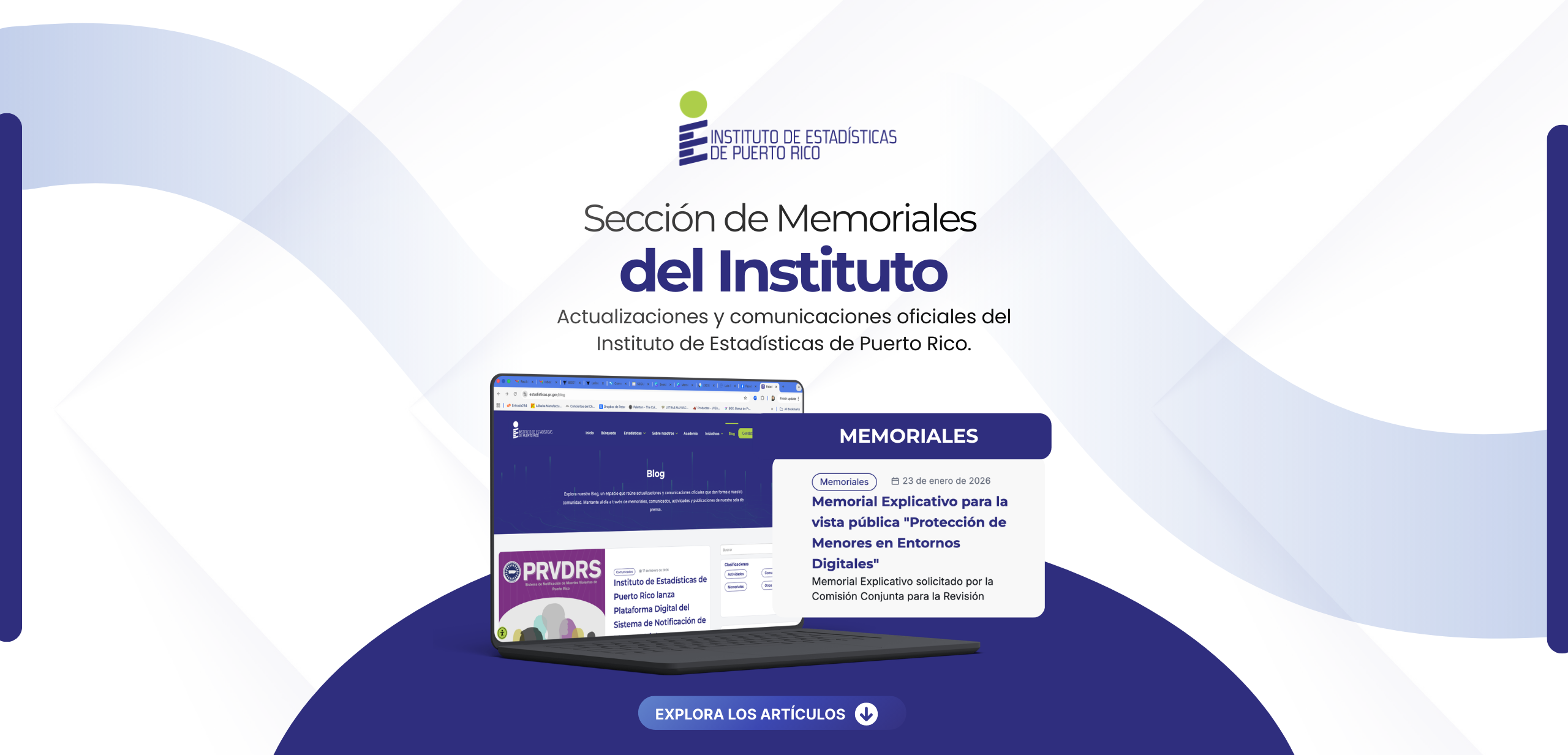
Explore our Blog, a space that brings together updates and official communications that shape our community. Stay up to date through memorials, announcements, activities and publications in our newsroom.
Representative Blog ImageImagen Representativa de Blog
Other
January 30, 2026
New annual estimate of the resident population in Puerto Rico as of 2025

The most recent annual resident population estimates for U.S. jurisdictions were released on Tuesday, January 27, 2026. These include a review of the previuos years of the current decade, as well as an estimate of the population aged 18 years and over.

In summary, the total population of Puerto Rico was estimated at 3,184,835 as of July 1, 2025. This represented a reduction of around 18,000 people compared to the previous year 2024 and of about 97,000 fewer people than in 2020. On the other hand, the components of population change considered indicate that from 2024 to 2025 there were about 17,950 births, about 32,857 deaths and a net migration of -2,779 people. You can access the most recent population estimates for Puerto Rico and its municipios in the following section: https://censo.estadisticas.pr/EstimadosPoblacionales.

The following infographic summarizes the published results for Puerto Rico:

Representative Blog ImageImagen Representativa de Blog
Announcements
November 22, 2024
The price of eggs in the urban area of San Juan-Bayamón-Caguas is 40% higher than the average in urban areas of the United States

40% higher the price of eggs in the urban area of San Juan-Bayamón-Caguas

Similarly, grocery items are 11.4% more expensive in this area than the average among 295 participating urban areas in the United States

San Juan, Puerto Rico — November 22, 2024. The Puerto Rico Statistics Institute released the results of the Cost of Living Index (COLI) for the third quarter of 2024, corresponding to the months of July, August and September. The data reveals that the urban area of the Metropolitan Statistical Area (MSA) of San Juan-Bayamón-Caguas is ranked number 18 in the supermarket category. In percentage terms, the supermarket items in the San Juan-Bayamón-Caguas MSA are 11.4% more expensive than the average among 295 participating urban areas in the United States.

Within the category of supermarket items, the San Juan-Bayamón-Caguas MSA is positioned as the most expensive urban area in the United States for the cost of eggs, ranking first in the ranking. This means that this product is 40% higher than the average in urban areas of the United States. On the other hand, in the health care category, the visit to the general practitioner is in position number 295, while dental cleaning is in position 293, positioning the urban area as one of the most affordable among the participants in the country for these services.

In terms of the overall Cost of Living, the urban area of Metropolitan Statistical Area San Juan-Bayamón-Caguas is ranked 80th out of 295 in the United States, with a composite index of 102.3. This indicates that the cost of living in this area is 2.3% higher than the average of participating urban areas in the United States.

Below are the indexes and rankings by category for the urban area of the San Juan-Bayamón-Caguas MSA:


Category

Index

Ranking

Utilities

155.3

5/295

Grocery items

111.4

18/295

Housing

102.1

83/295

Transportation

91.1

238/295

Miscellaneous goods and services

92.4

246/295

Health care

70.5

295/295

COLI Index

102.3

80/295

The composite index is derived from six main categories of consumer spending, with high costs in public services and supermarket items highlighted. These are partially offset by relatively low costs in health care and miscellaneous goods and services.

The 15 municipalities that make up the San Juan-Bayamón-Caguas MSA and that meet the characteristics for price collection according to the established methodology are: Bayamón, Caguas, Canóvanas, Carolina, Cataño, Cidra, Dorado, Gurabo, Guaynabo, Rio Grande, San Juan, Toa Alta, Toa Baja, Trujillo Alto and Vega Alta.

“The COLI results for the third quarter of 2024 show that in the San Juan-Bayamón-Caguas MSA, public services, grocery items and housing are, on average, much more expensive than in most participating MSAs in the rest of the United States. The COLI, carried out by the Puerto Rico Statistics Institute, is an essential tool for evidence-based decision-making related to the development and economic growth of Puerto Rico,” explained Dr. Orville M. Disdier, Executive Director of the Institute.

COLI is a crucial tool for understanding regional differences in the costs of consumer goods and services. The indices are calculated based on data collected quarterly in each participating urban area. Since 1968, the Council for Community and Economic Research (C2ER) has developed this widely recognized methodology.

The Puerto Rico Statistics Institute also offers a comparative cost-of-living calculator between the urban area of the San Juan-Bayamón-Caguas MSA and the rest of the participating cities in the United States. This tool is available at: https://apps.estadisticas.pr/coli/.

The Puerto Rico Statistics Institute is an autonomous governmental entity responsible for coordinating the Government's statistical production service to ensure that the data collection and statistics systems, on which public policies are based, are complete, reliable, and have quick and universal access.

For more information you can visit the website: www.estadisticas.pr or write to preguntas@estadisticas.pr. They can also follow social networks through Facebook (@estadisticas .pr), X (@EstadisticasPR), LinkedIn (Institute of Statistics of Puerto Rico) and Instagram (@institutodeestadisticas) accounts.

Representative Blog ImageImagen Representativa de Blog
Announcements
October 24, 2024
They present economic and social indicators for Puerto Rico

They present economic and social indicators for Puerto Rico

In activity between the Puerto Rico Institute of Statistics and the United States Census Bureau

San Juan, Puerto Rico. October 24, 2024. The Puerto Rico Statistics Institute, in collaboration with the United States Census Bureau, presented the conference “Economic and Social Indicators on Puerto Rico: Exploring the Economic and Social Reality of Puerto Rico”, in which they examined the main economic and social indicators that impact Puerto Rico. Experts from the United States Census Bureau and the Puerto Rico Institute of Statistics presented key issues, such as the cost of living, labor force, community resilience and migratory flow, among others. The activity took place on October 4. “Knowing some of the indicators that reflect the economic and social reality of Puerto Rico is essential for the development of effective public policies. This collaboration with the Census Bureau helps us to have more accurate and reliable data that will help us better understand the challenges and opportunities facing Puerto Rico,” said the executive director of the Puerto Rico Institute of Statistics, Dr. Orville M. Disdier.

For his part, Michael López-Pelliccia, (Chief of Staff, Economic Department) of the United States Census Bureau in Puerto Rico, said that, “The opening of the first Federal Center for Statistical Data Research in Puerto Rico (FSRDC) and events such as this conference are part of an ongoing effort to strengthen technical capacity in Puerto Rico. Through seminars, workshops, and webinars, we seek to provide local people with a more practical and accessible approach to using Census data. This type of technical assistance is key to ensuring that Puerto Rico can make the most of the wealth of information we offer.”

The conference included presentations by experts such as Ana G. Jara Castro, Clara E. Santiago Bello, Javier Gómez and Marijulie Martínez from the United States Census Bureau, who addressed issues such as building permit indicators and the “Census Business Builder” tool, among others. On behalf of the Puerto Rico Institute of Statistics, Dr. Ronald G. Hernández Maldonado presented the Cost of Living Index, while Alberto L. Velázquez Estrada spoke about the migratory flow and the structure of the labor group in Puerto Rico.

Among the various indicators presented at the conference, the following stood out:

  • El Quarterly Workforce Indicators which includes 32 labor force indicators that cover employment, job changes and income. This is a single work-level data source that provides demographic information on the labor market.
  • The Community Resilience Estimates (CRE), which are modeled estimates of vulnerability factors in the population such as functional diversity, poverty level, access to vehicles and internet, employment, education, and others, combining data from the Community Survey.
  • The tool Census Business Builder, which is a customer-focused application. It provides access to data to develop business plans, request financial assistance, study economic development, plan strategies and create emergency plans.
  • The Internet page Puerto Rico Profile which links between its tools automated profiles for municipalities with data on employment, poverty, income, education and health, among others.
  • The Cost of Living Index (COLI). This reflected in the most recent results for Puerto Rico, that the cost of grocery items in San Juan, Bayamón and Caguas is 12.2% more expensive than the average of the participating urban areas in the United States.
  • Regarding the Migratory Flow and Structure of the Working Age Group in Puerto Rico, it was highlighted that emigration has been a constant in the history of Puerto Rico, but this has taken a deep toll on the working population in recent years. About 70% of working-age emigration occurred at ages 16 to 44.

The presentations and materials used during the conference are available through the following link: https://estadisticas.pr/en/Conferencia-Indicadores-Económicos-y-Sociales.

The Puerto Rico Statistics Institute is an autonomous governmental entity responsible for coordinating the Government's statistical production service to ensure that the data collection and statistics systems, on which public policies are based, are complete, reliable, and have quick and universal access.

For more information you can visit the website: www.estadisticas.pr or write to preguntas@estadisticas.pr. They can also follow social networks through Facebook (@estadisticas .pr), X (@EstadisticasPR), LinkedIn (Institute of Statistics of Puerto Rico) and Instagram (@institutodeestadisticas) accounts.

Authorized by the Office of the Electoral Comptroller OCE-SA-2024-12788

Representative Blog ImageImagen Representativa de Blog
Activities
October 4, 2024
Conference: Economic and Social Indicators on Puerto Rico

Exploring Economic and Social Reality: Statistics and Their Impact

The collaborative activity, between the Puerto Rico Institute of Statistics and the United States Census Bureau, took place on Friday, October 4, 2024, at the Criollo Center for Caribbean Science and Technology (C3Tec). The purpose of the conference was to clarify various sources and statistics available to the public. As part of the mission of both entities, to provide statistical information on the jurisdiction of Puerto Rico, two sections were organized aimed at the audience of the government, private sector, academia and researchers, as well as the general public.

The Initiative:

The conference focused on economic and social indicators for the jurisdiction of Puerto Rico, covering multiple specific indicators and showing participants the tools or sources to access them. Among the topics presented were the following: Building Permit Survey, Quarterly Workforce Indicators, Community Resilience Estimates, Census Business Builder, Puerto Rico Profile webpage, Migration and Workforce Structure and the Cost of Living Index (COLI). At the end of the conference, the diverse information shared was reviewed and related questions and doubts were addressed, in order to guide participants to explore economic and social aspects of Puerto Rico using the available statistics.

Presentations:

U.S. Census Bureau

Puerto Rico Institute of Statistics

Materials:

Agenda

Pics

Video Summary

Press Release

Representative Blog ImageImagen Representativa de Blog
Activities
October 4, 2024
Exploring Economic and Social Reality: Statistics and Their Impact

Exploring Economic and Social Reality: Statistics and Their Impact

The collaborative activity, between the Puerto Rico Institute of Statistics and the United States Census Bureau, took place on Friday, October 4, 2024, at the Criollo Center for Caribbean Science and Technology (C3Tec). The purpose of the conference was to clarify various sources and statistics available to the public. As part of the mission of both entities, to provide statistical information on the jurisdiction of Puerto Rico, two sections were organized aimed at the audience of the government, private sector, academia and researchers, as well as the general public.

The Initiative:

The conference focused on economic and social indicators for the jurisdiction of Puerto Rico, covering multiple specific indicators and showing participants the tools or sources to access them. Among the topics presented were the following: Building Permit Survey, Quarterly Workforce Indicators, Community Resilience Estimates, Census Business Builder, Puerto Rico Profile webpage, Migration and Workforce Structure and the Cost of Living Index (COLI). At the end of the conference, the diverse information shared was reviewed and related questions and doubts were addressed, in order to guide participants to explore economic and social aspects of Puerto Rico using the available statistics.

Presentations:

U.S. Census Bureau

  • Ana G. Jara Castro, Economic Indicators Building Permit Survey, Quarterly Workforce Indicators; Links to QwiExplorer, Census Visualizations Statemap, Census Visualizations Datatool
  • Javier Gómez, Community Resilience Estimates (CRE); Links Community Resilience Estimates for Puerto Rico Viewer
  • Clara E. Santiago Bello, Census Business Builder; Links to Census Business Builder (CBB), CBB MAP & Industries
  • Marijulie Martínez Lozano, Puerto Rico Census Profile Webpage Link

Puerto Rico Institute of Statistics

  • Dr. Ronald G. Hernandez Maldonado, Cost of Living Index (COLI)
  • Alberto L. Velazquez Estrada, Migratory Flow and Structure of the Puerto Rico Labor Group

Materials:

Agenda

Pics

Video Summary

Representative Blog ImageImagen Representativa de Blog
Announcements
July 12, 2024
2.3% more expensive to live in the urban area of San Juan, Bayamón and Caguas

San Juan, Puerto Rico — July 10, 2024. The Puerto Rico Institute of Statistics released the results of the Cost of Living Index (COLI) for the first quarter of 2024, whose data show that the urban area of Metropolitan Statistical Area (MSA) of San Juan-Bayamón-Caguas, is ranked 82nd out of 301 urban areas in terms of overall cost of living in the United States, with a composite index of 102.3. The 15 municipalities that make up the San Juan-Bayamón-Caguas MSA are: Bayamón, Caguas, Canovanas, Carolina, Cataño, Cidra, Dorado, Gurabo, Guaynabo, Rio Grande, San Juan, Toa Alta, Toa Baja, Trujillo Alto and Vega Alta.

At the national level, the average cost of living is set at an index of 100. The composite index of 102.3 for the urban area of the San Juan-Bayamón-Caguas MSA indicates that living in this region is 2.3% more expensive than the average of the 301 participating urban areas nationwide.

The composite index is derived from six main categories of consumer spending, of which the following table presents the Rankings for the urban area of the San Juan-Bayamón-Caguas MSA. The combination of higher costs in supermarkets and utilities is partially offset by relatively low costs in health care and miscellaneous goods.

Categoría

Índice

Ranking

Artículos de supermercado

112.8

14/301

Bienes y servicios misceláneos

92.1

251/301

Cuidado de salud

69.5

301/301

Servicios públicos

153.1

4/301

Transportación

89.4

261/301

Vivienda

103.4

80/301

Índice COLI

102.3

82/301

About the Cost of Living Index (COLI):

COLI is a crucial tool for understanding regional differences in the costs of consumer goods and services. The indices are calculated based on data collected quarterly by different entities in each participating urban area. The COLI has been calculated in urban areas of the United States since 1968, using the methodology developed by the Council for Community and Economic Research (C2ER), a non-profit organization dedicated to research on community and economic development. The Puerto Rico Statistics Institute, together with the network of members affiliated with C2ER, is responsible for collecting prices for goods and services established by C2ER.

The Puerto Rico Statistics Institute has designed a comparative calculator for the cost of living between the urban area of the San Juan-Bayamón-Caguas MSA and the rest of the participating cities in the United States. This tool is available at: https://apps.estadisticas.pr/coli/.

The Puerto Rico Statistics Institute is an autonomous governmental entity responsible for coordinating the Government's statistical production service to ensure that the data collection and statistics systems, on which public policies are based, are complete, reliable, and have quick and universal access.

For more information you can visit the website: www.estadisticas.pr or write to preguntas@estadisticas.pr. They can also follow social networks through Facebook (@estadisticas .pr), X (@EstadisticasPR), LinkedIn (Institute of Statistics of Puerto Rico) and Instagram (@institutodeestadisticas) accounts.

Representative Blog ImageImagen Representativa de Blog
Announcements
July 3, 2024
Dr. Orville M. Disdier, Executive Director of PRIS, offered a presentation at ECLAC

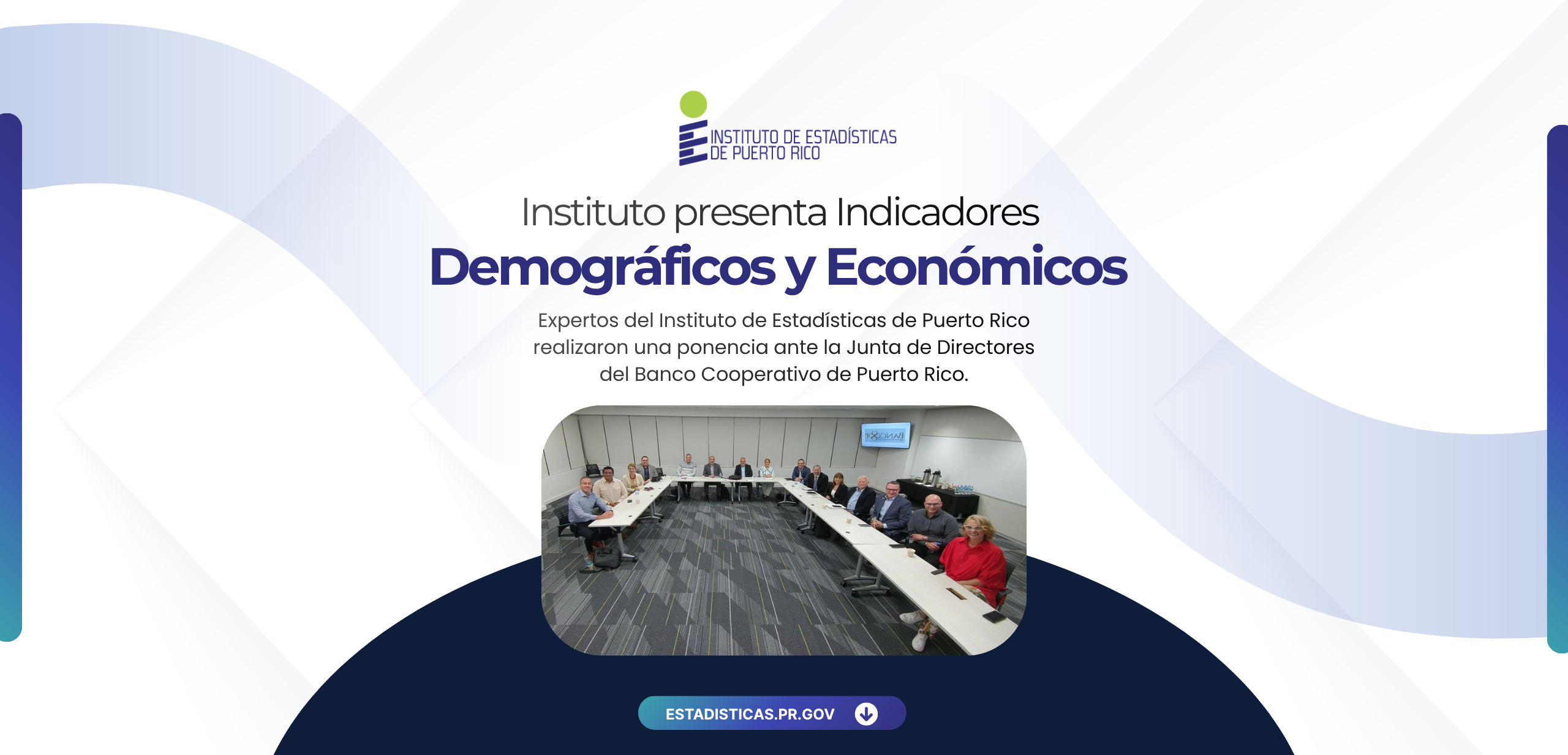
Dr. Orville M. Disdier, Executive Director of the Puerto Rico Institute of Statistics (PRIS), offered a presentation at a recent meeting of the Economic Commission for Latin America and the Caribbean (ECLAC).

The Executive Director offered a presentation as part of a virtual expert group meeting on statistics for sustainable development ECLAC associate member countries. Dr. Disdier highlighted Puerto Rico's significant economic challenges, such as outmigration and high energy costs. He emphasized the importance of including Puerto Rico in a wide range of statistical products to effectively address these challenges and formulate informed public policies. PRIS, as an independent public agency, plays a critical role in ensuring access to comprehensive and reliable statistics.

Dr. Disdier underscored the gaps in federal statistical products, noting that Puerto Rico is included in only 81 of 449 federal statistical products.

PRIS has been instrumental in addressing various statistical issues, such as correcting mortality statistics and eliminating biases in economic indicators. The presentation highlighted the crucial role of international statistical reports in promoting informed decision-making and public accountability, and gaining economic insights.

Dr. Disdier proposed steps to enhance Puerto Rico's inclusion in international reports, emphasizing the need for a detailed list of existing reports, prioritizing reports by importance, and establishing contact with experts to ensure technical assistance.

#statisticsPR

#estadísticasPR

Classifications
Thank you! Your submission has been received!
Oops! Something went wrong while submitting the form.

Visit our Official Activities, and participate with us

Visit our Calls for applications and be part of the new opportunities we have for you.

If you have any questions or just want to contact us, visit the Contact Us section.

We are at your disposal. If you need custom statistics, do not hesitate to contact us.

Sign up for our online workshops. Connect with the experts and discover the power of data!

Visit our Blog and keep up to date with the latest news and topics of interest.

Visit our Press Releases and stay connected to the Institute.

Explore the Publication Calendar and keep up to date with Puerto Rico's statistics.

Complete the form for the selection of our Statistics Coordination Committee

Suscribe to receive news directly to your email.

Listen to the Official PRIS podcast and stay informed with the experts