
Statistics Institute publishes new section on economic indicators

Announcements
IEPR
24 December 2025

PRESS RELEASE

Statistics Institute publishes new section on economic indicators

The executive director of the Puerto Rico Statistics Institute (Institute), Dr. Orville M. Disdier, announced the availability of a new section of some economic indicators on its website, presented through interactive graphics.

“Fulfilling our mission of providing citizens with universal and rapid access to statistics, we created this section that will serve as a reference for government and private enterprise, in economic terms. In the same way, as the section is nourished with new data, it could eventually help outline plans for economic recovery due to COVID-19,” said Disdier.

The section currently has interactive graphics covering the period from March 2017 to May 2020, which will be updated as the Institute receives information from the agencies or entities concerned. The first of them, Puerto Rico Manufacturing Purchasing Managers Index (PRM-PMI), is an indicator that measures the short-term productive side of Puerto Rico's economy, specifically manufacturing, and includes employment indicators, supplier deliveries, inventories, new orders and production.

In the graph, Production and Consumption of Electric Energy in Puerto Rico, information can be obtained from indicators, such as active customers, net generation in millions of kilowatt-hours (mKWh), total consumption (mKWh), cost per kWh purchased, and total income, among others.

Users of the page will also be able to access the graph, Total Non-Agricultural Wage Employment, adjusted and without seasonal adjustment.

In the fourth graph that the section currently has, you can obtain data on the number of initial Unemployment Insurance claims, which they receive at the Department of Labor and Human Resources in Puerto Rico.

The new economic indicators section can be found at www.estadisticas.pr.gov and can be accessed directly at the following Internet address: https://cutt.ly/2uv06YI.

“We call on agencies and the private sector that work with updated data or statistics that impact the Puerto Rico economy, both agriculture, international trade, and goods and services industries (manufacturing, tourism, construction, finance, consumption, among others), to contact us so that we can continue to add economy-related indicators that serve as a reference for decision-making for the well-being of Puerto Rico,” said Ana Gabriela Jara Castro, Manager of Statistical Projects.

About the Institute of Statistics

The Puerto Rico Statistics Institute is an autonomous governmental entity responsible for coordinating the Government's statistical production service to ensure that the data collection and statistics systems, on which public policies are based, are complete, reliable, and have quick and universal access.

For more information you can visit the website www.estadisticas.pr.gov or surveys on the social networks of Facebook (@estadisticas .pr), Twitter (@EstadisticasPR) and LinkedIn (Institute of Statistics of Puerto Rico).

##

Press Contacts:

Idia Martinez/787-603-3200/ imartinez@upfrontpr.net

Lourdes Burgos/787-562-2932/ lourdesburgos09@gmail.com

‍

Share this article:

Please let us know your satisfaction level with our services.

‍

Visit our Official Activities, and participate with us

Visit our Calls for applications and be part of the new opportunities we have for you.

If you have any questions or just want to contact us, visit the Contact Us section.

We are at your disposal. If you need custom statistics, do not hesitate to contact us.

Sign up for our online workshops. Connect with the experts and discover the power of data!

Visit our Blog and keep up to date with the latest news and topics of interest.

Visit our Press Releases and stay connected to the Institute.

Explore the Publication Calendar and keep up to date with Puerto Rico's statistics.

Complete the form for the selection of our Statistics Coordination Committee

Suscribe to receive news directly to your email.

Listen to the Official PRIS podcast and stay informed with the experts

The Institute of Statistics publishes the Puerto Rico Lag Index

San Juan, Puerto Rico — November 6, 2025 — The Institute of Statistics released the results of the Backwater Index for Puerto Rico, a study that offers a comprehensive look at the social and economic situation of Puerto Rico's municipalities. This index constitutes an analysis and planning tool that seeks to promote dialogue, reflection and informed action for the benefit of Puerto Rico's socioeconomic development.

El Lagging Index measures a multidimensional phenomenon using a summary data that allows us to compare the relative performance of municipalities in two dimensions: Economic Mobility and Demography. Five main variables were considered in its design: the percentage of people below the poverty level, the unemployment rate, the percentage of high school graduates (in a population aged 18 and over), the dependency rate by age and the median age.

The index was calculated for two comparative periods: 2014-2018 and 2019-2023, allowing us to observe changes in scores and relative positions of municipalities over time. Index values fluctuate between 0 and 1, with a higher score representing a higher relative level of lagging.

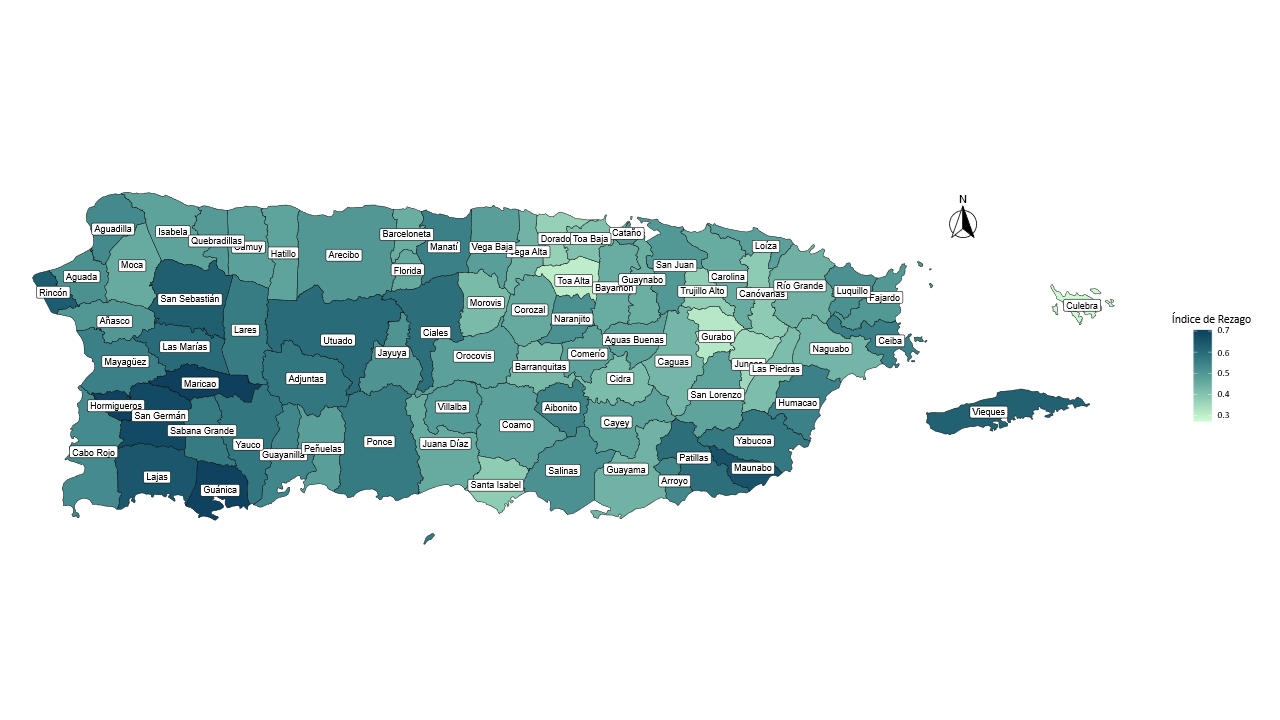
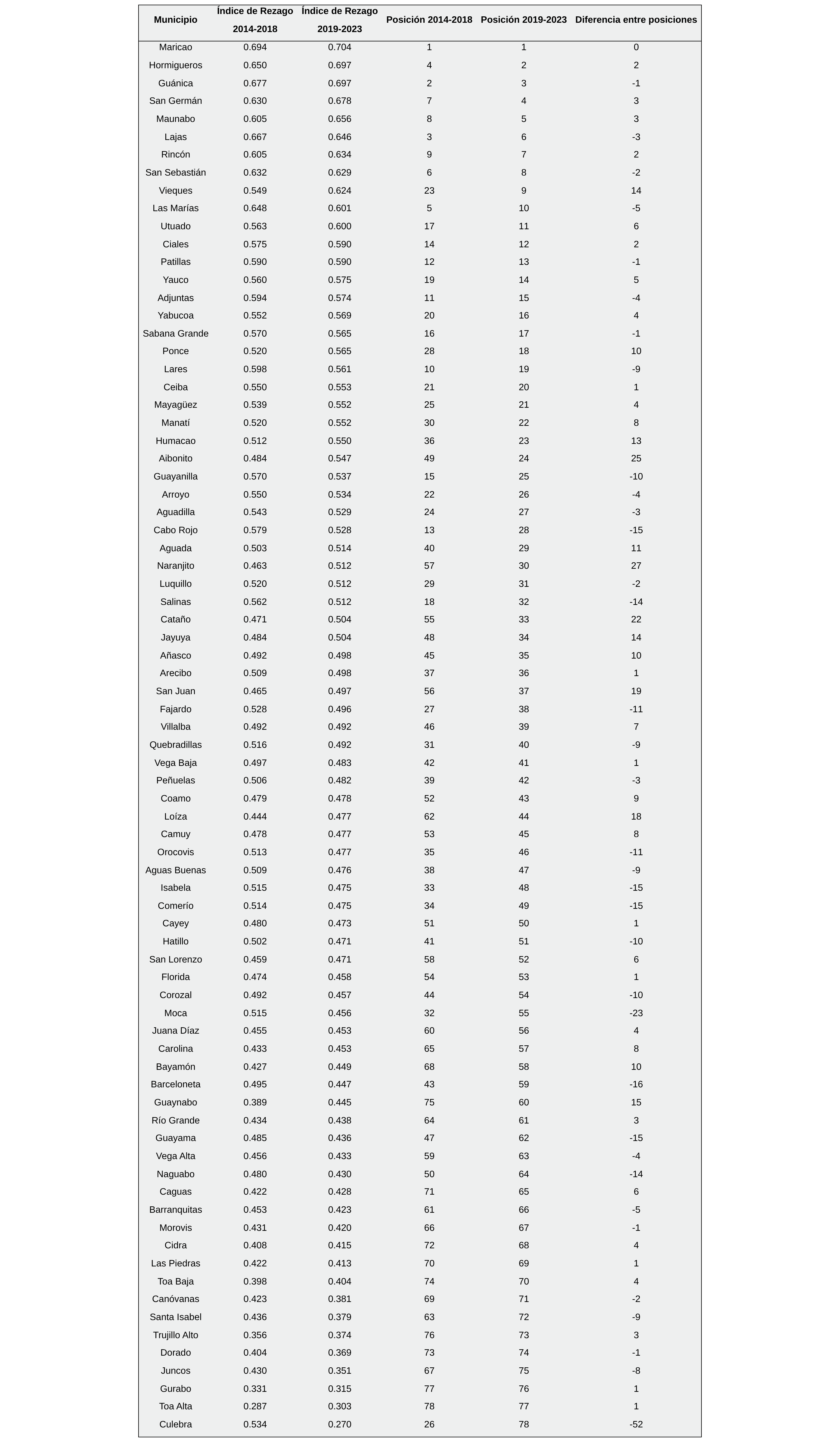
The analysis reveals that 42 municipalities showed a decrease in their score of the Lagging Index, which suggests a relative improvement in the conditions measured by the indicator. Of these, 22 municipalities registered a reduction of more than 5%. In the same way, there are concentrations of municipalities with higher scores —indicating greater relative lagging— in the center, south, southwest and southeast regions of Puerto Rico, while several municipalities in the metropolitan area and adjacent to it showed progress compared to the rest of the archipelago.

The municipalities of Culebra, Toa Alta, Gurabo, Juncos, Dorado, Trujillo Alto, Santa Isabel, Canóvanas, Toa Baja and Las Piedras performed better in their relative index in the last period analyzed (2019-2023). However, the Institute stresses that the index is a relative measure and not an absolute measure, so the results must be analyzed within the context and used as a basis for the development of more specific analyses.

“The value of the index is not in pointing out which municipality is better or worse, but in providing an objective basis for analysis, planning and decision-making. It is an opportunity for mayors and officials who participate in decision-making to know their social and economic reality and to develop strategies that respond to the specific needs of their municipalities,” said Dr. Ronald Hernández, Manager of Statistical Projects at the Institute of Statistics of Puerto Rico.

For the elaboration of the Lagging Index, the Institute applied rigorous statistical methods —including exploratory factor analysis, normalization and aggregation of variables—using data from the five-year estimates of the Community Survey of the U.S. Census Bureau And the Bureau of Labor Statistics.

Data

Table 1 shows the results of the Lagging Index at the municipal level for the periods 2014 - 2018 and 2019 - 2023. The table is ordered according to the position of the municipalities based on their index value for the period 2019 — 2023. The higher the index score, the worse or less favorable the outcome of the phenomenon.

‍

Table 1: Lagging Index Results

‍

According to Dr. Hernández, the results of the study highlight the need to design comprehensive public policies that address both the economic aspects and the demographic transformations of Puerto Rico. “The improvements seen in several municipalities are encouraging, but it is essential that socio-economic development efforts are integrated with strategies to respond to the ongoing demographic transition. This includes strengthening geriatric health services, care policies, retention of young people and urban planning adapted to long-lived communities,” said the Institute.”

Hernández indicated that, the Municipal Backwater Index seeks to promote an evidence-based dialogue between the different sectors of Puerto Rico. Its purpose is to serve as a planning and evaluation instrument, which facilitates the identification of areas of opportunity and guides investment decisions, municipal planning and public policy at the central and local levels.”

The full report of the Municipal Backwater Index is available in: Backwater Index for Puerto Rico

The Puerto Rico Statistics Institute is an autonomous governmental entity responsible for coordinating the Government's statistical production service to ensure that the data collection and statistics systems, on which public policies are based, are complete, reliable, and have quick and universal access.

For more information you can write to preguntas@estadisticas.pr. They can also follow social networks through Facebook (@estadisticas .pr), X (@EstadisticasPR), LinkedIn (Institute of Statistics of Puerto Rico) and Instagram (@institutodeestadisticas) accounts.

‍

Data presented from the Report on Violent Deaths in Puerto Rico

Data presented from the Report on Violent Deaths in Puerto Rico

639 homicides and 215 suicides were reported in Puerto Rico in 2021

The Puerto Rico Violent Death Notification System (PRVDRS) of the Puerto Rico Statistics Institute (Institute), presented data from the Puerto Rico Violent Deaths Report for 2021. The report reports that in 2021, 816 incidents of violent deaths occurred, with a total of 880 fatalities. Of the total number of violent deaths, 97% were distributed as 639 by homicides and 215 by suicides, with the remaining 26 violent deaths (3%) due to other causes.

In 2021, 72.6% of victims of violent deaths were incidents of single or multiple homicides and 24.4% were incidents of suicide. Two homicide-suicide incidents were reported, resulting in 4 fatalities. In addition, during this period, 2 violent deaths attributed to legal intervention (0.2%), three violent deaths from unintentional self-inflicted firearms (0.3%) and 21 violent deaths with undetermined intent (2.4%) were documented. In 2021, approximately 9 out of 10 victims of violent deaths (92.0%) were men. The crude rate of violent deaths for Puerto Rico in 2021 was 27.0 per 100,000 inhabitants, 52.5 in men and 4.0 in women.

Of the 880 violent deaths recorded in 2021, 639 were homicides (72.6%). The majority of homicides occurred between the ages of 15 and 39. In these age groups, 73.1% of all homicides occur among men and 59.5% among women. The primary mechanism of the homicides was firearms. In Puerto Rico, according to the report, 91.5% of homicides were committed with firearms, more than double the global average of 47.0%.

In 2021, the majority of homicides occurred in an environment of collective violence. In 358 of the 639 homicides (56.0%) recorded in 2021, they occurred in a context related to criminal groups, involved in the trafficking of illegal drugs.

In 2021, 31 fatal victims of family violence were reported. Family violence (violence between family members) includes child or adult abuse and violence against an intimate partner. The majority of these cases were related to violence in an intimate or former partner environment (20 cases, 64.5%). There were 11 fatal incidents among family members (35.5%). The majority of victims of intimate partner violence were women (18 cases, 90.0%). More than half of these women were victims of their current spouse or partner (61.1%), while 38.9% were victims of their ex-spouse or ex-partner. In addition, a firearm was used in 11 of the 18 femicides/femicides (61.1%).

As for suicides in Puerto Rico, the report highlights that the frequency is lower than that of homicides. However, as in homicides, suicides are more frequent in men (86.5%). In 2021, the crude suicide rate was 6.6 per 100,000 inhabitants, 12.0 in men (1 of 124 men) and 1.7 in women (1 of 774 women). The main mechanism was asphyxiation (64.5% in men and 55.2% in women).

Mariluz Bezares Salinas, Manager of Statistical Projects at the Institute and co-principal investigator of the Report on Violent Deaths in Puerto Rico, explained that the collection of this type of data could involve fieldwork that takes more than two years, from the moment the incident occurs until the collection and review of the data is completed.

“This system for reporting violent deaths is a reliable, complete and unique reference source that helps describe the context of violent deaths in the victim-aggressor relationship and the magnitude, trend and characteristics of violent deaths in Puerto Rico,” said Dr. Diego Zavala, epidemiologist and co-principal investigator of the PRVDRS.

For the Executive Director of the Institute, Dr. Orville M. Disdier, these statistics are one of the main tools to combat the phenomenon of violence in Puerto Rico. “These data, among others, serve as the basis for establishing effective measures for the prevention of violence in Puerto Rico, from multiple social, health and economic approaches. Our commitment at the Institute is to continue strengthening this statistical and epidemiological system, to continue improving the quality of this type of data,” argued Dr. Disdier.

The PRVDRS is an epidemiological surveillance system affiliated with the Institute of Statistics and designed to obtain a complete and standardized census of violent deaths in Puerto Rico. The PRVDRS began its participation in the National Violent Death Notification System (National Violent Death Reporting System, NVDRS) in September 2016, through a collaborative agreement granted by the Centers for Disease Control and Prevention (CDC) of the United States Department of Health and Human Services.

The Puerto Rico Statistics Institute is an autonomous governmental entity responsible for coordinating the Government's statistical production service to ensure that the data collection and statistics systems, on which public policies are based, are complete, reliable, and have quick and universal access.

For more information you can visit the website: https://estadisticas.pr/en/prvdrs or write to preguntas@estadisticas.pr. They can also follow social networks through Facebook (@estadisticas .pr), X (@EstadisticasPR), LinkedIn (Institute of Statistics of Puerto Rico) and Instagram (@institutodeestadisticas) accounts.

‍

Institute of Puerto Rican Culture joins Puerto Rico's Financial Transparency System to hold citizens accountable for their income and expenses

Institute of Puerto Rican Culture joins Puerto Rico's Financial Transparency System to hold citizens accountable for their income and expenses

‍