The purpose of this survey is to collect data on aspects related to COVID-19 in businesses in Puerto Rico. Having frequent and updated data will allow businesses to take all necessary steps to maintain services securely, effectively and efficiently.
This survey is encouraged to be completed twice a week, preferably on Mondays and Fridays before 3:00 p.m. The survey consists of a total of 20 questions and takes approximately 15 to 20 minutes to complete. It is recommended that this survey be completed by administrative or management staff.
EXECUTIVE DIRECTOR OF THE PUERTO RICO INSTITUTE OF STATISTICS QUESTIONS PURPOSE OF CONSOLIDATING TO “OUTSOURCE”
The executive director of the Puerto Rico Institute of Statistics, Dr. Mario Marazzi-Santiago, today questioned the purpose of consolidating this public entity, with the sole purpose of outsourcing it later, as proposed in Reorganization Plan No. 1 referring to the Department of Economic Development and Commerce (DDEC) for the Puerto Rico Statistics Institute.
To expedite the proposal to “outsource” the Institute's functions, the Government could simply propose a bill to amend the Institute's Organic Law. Another alternative could be to consider including your outsourcing proposal in an existing legislative vehicle, such as Senate Bill 236 (Open Data Act). But, in this case, it was proposed to merge for the sole purpose of 'externalizing' its functions. It is a proposal that seems strange to us. I don't want to think of it as a mechanism designed to prevent the Legislative Assembly from discharging its function of analyzing and finally approving the reorganizations of entities created by law, such as the Institute.
On January 8, 2018, at a press conference from La Fortaleza, the Secretary of Public Affairs and Public Policy, Lcdo. Ramón Rosario Cortés, presented a proposal to reorganize the DDEC and consolidate several public entities, including the Institute. In the case of the Institute, it is proposed to consolidate it with the DDEC, with the sole purpose of outsourcing its functions, in order to guarantee its “real independence” since, as recognized by Rosario Cortés himself that day, the Institute since its creation, “although it has had independence, it depends on appointments from the Governor, including Executive officials who are part of that Board”.
For his part, Dr. Marazzi-Santiago thanked the recognition that statistical functions must be performed without political interference. “We are ready to study alternative mechanisms that allow the selection of members of the Institute's Board of Directors without the need for the incumbent Government to interfere. Recent experiences with this issue provide compelling evidence to support the desirability of this change in public policy,” said the Executive Director of the Institute.
The Institute was created as a public instrument with so much administrative and fiscal autonomy that it already allows it to operate outside the Government, almost like a private company. As La Fortaleza is already aware, the Institute does not consult its contracts or appointments with La Fortaleza or with the Office of Management and Budget, but rather makes these decisions as in private companies, based on professional and technical criteria that ensure adequate governance of our institution.
Marazzi assured that this governance model has not only proven to be successful, but that the Institute's objectivity and professionalism have been recognized by numerous users of its services and interested individuals, most recently by the Congressional Task Force created under the Puerto Rico Oversight, Management, and Economic Stabilization Act (PROMESA) of 2016, which specifically recommended that the Institute continue to protect its independence.
-
The Puerto Rico Statistics Institute is an autonomous governmental entity responsible for coordinating the Government's statistical production service to ensure that the data collection and statistics systems, on which public policies are based, are complete, reliable, and have quick and universal access. The Institute has in its inventory, accessible through www.estadisticas.pr.gov, more than 300 statistical products. In addition, it is a guardian and provides access to over 100 data sets or “data sets” through www.data.pr.gov and to over 40 tables and more than 6 thousand indicators through: www.indicadores.pr.
For more information you can visit our website: www.estadisticas.pr.gov. In addition, you can follow us on social networks through Facebook (estadisticas.pr), Twitter (@EstadisticasPR) and LinkedIn (Institute of Statistics of Puerto Rico) accounts.
97,000 PEOPLE IMMIGRATED TO THE UNITED STATES IN 2017
The figure includes only a few of the people who migrated after Hurricane Maria.
San Juan, PR — El U.S. Census Bureau published today the most recent estimates of the Puerto Rico Community Survey known as Puerto Rico Community Survey (PRCS). These statistics refer to information collected during the 2017 calendar year and include social, economic and housing characteristics for Puerto Rico and municipalities with a population of 65,000 people or more. As the leading entity of the Network State Data Center Of U.S. Census Bureau in Puerto Rico, the Puerto Rico Statistics Institute (Institute) presents this brief summary of several findings from this disclosure:
During 2017, 97,000 people moved from Puerto Rico to the United States, while 20,000 people moved in the opposite direction, resulting in a net migratory movement of -77,000 people. Since the PRCS began to be carried out in 2005, this migratory movement, both in absolute and in net terms, represents the highest. These data will be described in greater depth in the Institute's 2017 Migrant Profile, which will be published in the coming months.
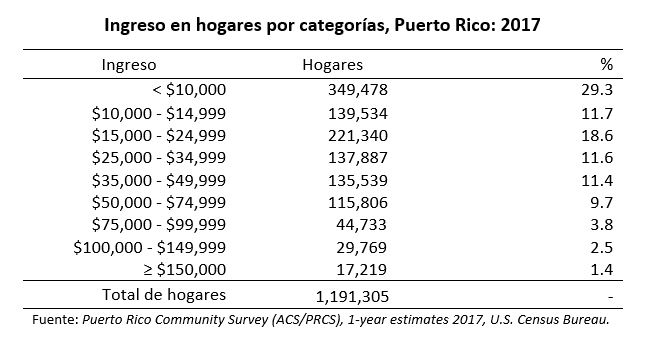
The median household income in Puerto Rico decreased by 3.7% between 2016 ($20,078) and 2017 ($19,343). Household income categories showed that 60% of households had incomes under $25,000. Of these, nearly half (29%) had incomes of less than $10,000.
In 2017, 44% of people and 41% of families were below the poverty level. In families where women are heads of household without a husband present, the percentage was 59%.
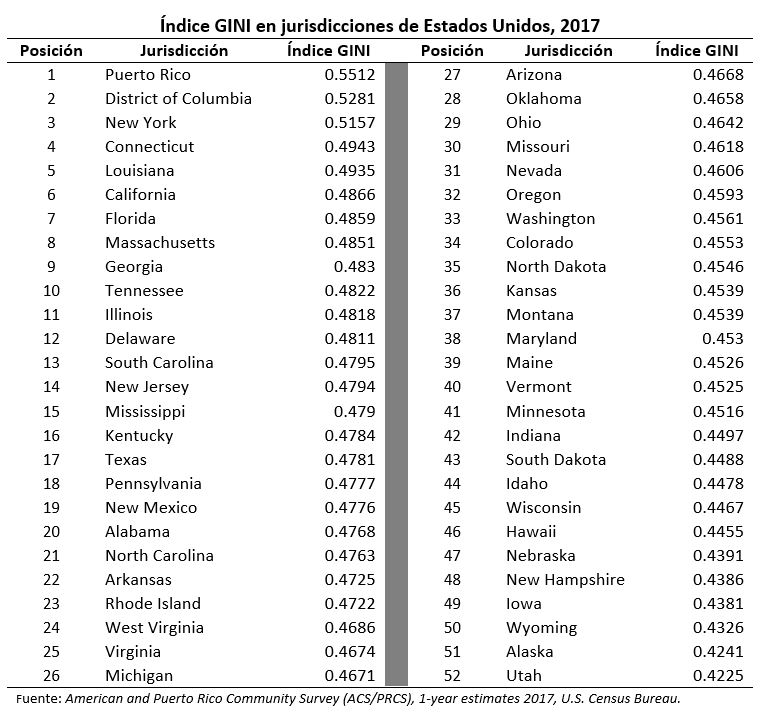
Puerto Rico had a GINI index of 0.55, ranking as the jurisdiction with the highest inequality in income distribution compared to other jurisdictions in the United States. The GINI index measures inequality, where a value of 0 is a perfect distribution of income and a value of 1 is a completely unequal distribution.
“Although again in 2017 emigration broke records in the Community Survey, this was to be expected after the passage of Hurricane Maria. On the other hand, when analyzing these figures, it is important to recognize that the Community Survey is not designed to adequately capture the population displacement that can occur rapidly and volcanically following a natural disaster. As a result, we warned that these numbers only include some of the people who moved in the wake of Hurricane Maria. Many other people who may have moved temporarily or permanently are not captured in this Survey, either because they moved to other foreign countries, relocated to temporary housing where the Survey questionnaire does not arrive, or are even staying in the homes of family members who were living in the United States before 2017, among other possible reasons. In that sense, it will be necessary to wait to see the results of the Survey for 2018 to have a more complete picture of post-Maria migration,” explained Dr. Mario Marazzi-Santiago, executive director of the Institute.
More statistics on the Community Survey estimates can be obtained at: http://factfinder2.census.gov/. If you need assistance using this tool to obtain data, you may find the self-study guide for using this available tool useful: https://censo.estadisticas.pr/fact-finder. Information on the methodology used to produce the estimates can be accessed hither. More details on the characteristics of migrants between Puerto Rico and the United States 2017 will be available at the end of 2018 in the publication of the 2017 Migrant Profile. The Migrant Profile is an annual publication published by the Institute. To view the published Profiles press hither.
In addition, as the leading entity of the Puerto Rico SDC, the IEPR manages the SDC portal, where you can find the main statistical reports and publications of the U.S. Census Bureau on Puerto Rico, specifically those that are most in demand, such as annual population estimates; the Puerto Rico Community Survey (Puerto Rico Community Survey) and official statistics on Puerto Rico's 10-year population and housing censuses, among others. The Puerto Rico SDC portal can be accessed through: https://censo.estadisticas.pr/.
The Puerto Rico Statistics Institute is an autonomous governmental entity responsible for coordinating the Government's statistical production service to ensure that the data collection and statistics systems, on which public policies are based, are complete, reliable, and have quick and universal access. The Institute has in its inventory, accessible through www.estadisticas.pr.gov, over 300 statistical products. In addition, it is a custodian and provides access to over 100 data sets or “data sets” through www.data.pr.gov and to over 40 tables and more than 6 thousand indicators through: www.indicadores.pr.
For more information you can visit our website: www.estadisticas.pr.gov. In addition, you can follow us on social networks through Facebook (estadisticas.pr), Twitter (@EstadisticasPR) and LinkedIn (Institute of Statistics of Puerto Rico) accounts.


-p-130x130q80.png)
.png)
.png)
.png)
.png)
.png)
.png)
.png)
.png)
.png)
.png)
.png)


.png)
.png)
.png)
.png)