
Parenting Experiences Survey

Announcements
IEPR
03 June 2026

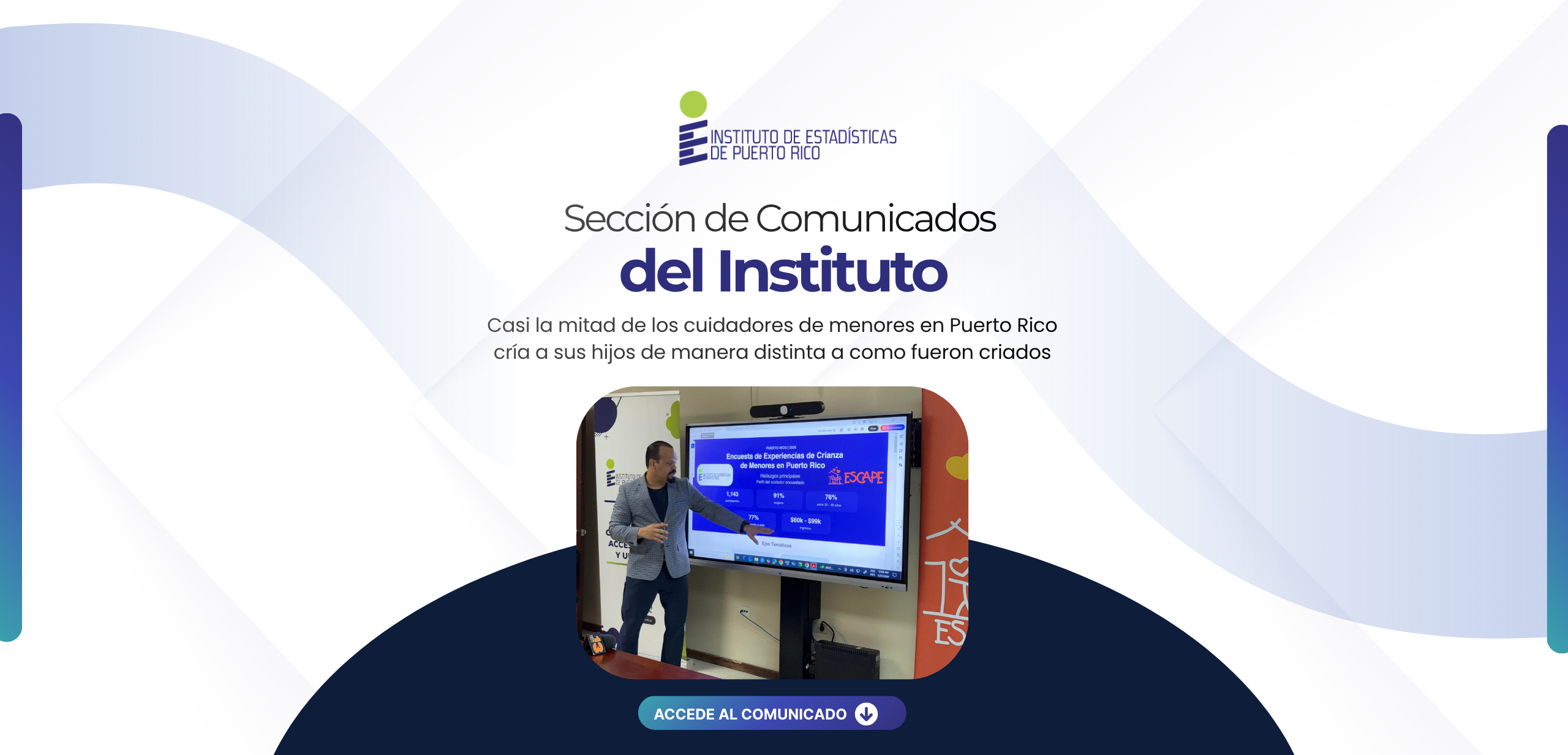
Almost half of child caregivers in Puerto Rico raise their children differently than they were raised.

Parenting Experiences Survey Reveals Generational Shifts in Discipline, Communication, and Family Priorities

The Survey of Child Rearing Experiences in Puerto Rico revealed, among other data, that 48.6% of surveyed caregivers use disciplinary styles different from those they experienced with their own parents, reflecting a possible generational shift in parenting practices and in how Puerto Rican families approach the upbringing, communication, and well-being of children.

The study, developed through an alliance between ESCAPE, the Family Strengthening Center, and the Puerto Rico Institute of Statistics, collected the experiences, challenges, and needs of 1,143 voluntary participants via a self-administered online questionnaire conducted between February and June 2025. The survey was descriptive in nature and explored topics related to parenting experiences, discipline and communication, technology and quality time, as well as support needs and expectations for children's futures.

Among the most relevant findings of the survey are:

• More than two-thirds of respondents stated that parenting is more difficult or much more difficult than they expected.

• The main challenge identified was achieving a work-life balance (62.3%).

• 44.3% cited lack of personal time and rest as one of their biggest challenges.

• 41.6% expressed a need for tools to manage stress and their own mental health.

• 57.2% reported arguments related to the use of technological devices at home.

• 4% identified the use of physical aggression as a disciplinary strategy.

• 94% of participants indicated that they praise their children's achievements "almost always" or "always."

• Most participants defined discipline as a formative tool for teaching values and setting clear boundaries.

The survey also reflected that caregivers prioritize the development of self-esteem and self-confidence, responsible decision-making, and healthy emotional management for children's futures.

"The information collected allows us to better understand how family dynamics are changing and what real challenges are faced by those responsible for raising children in Puerto Rico. This data is fundamental for developing more effective public policies, programs, and interventions tailored to the current needs of Puerto Rican families," stated Dr. Orville M. Disdier Flores, Executive Director of the Puerto Rico Institute of Statistics.

Meanwhile, Yadira Pizarro Quiles, Executive Director of ESCAPE, highlighted that the results provide an important X-ray of families' emotional and structural needs. "This survey confirms the importance of continuing to strengthen families through prevention. Understanding how mothers, fathers, and caregivers are experiencing parenting allows us to better direct our efforts, develop support tools, and promote strategies that strengthen children's well-being and help prevent child abuse in Puerto Rico."

As part of the strategic recommendations derived from the study, it is proposed to strengthen emotional support initiatives for caregivers, promote flexible work policies, drive digital literacy campaigns at home, and expand preventive education efforts on parenting and those related to child well-being and protection.

The Survey of Child Rearing Experiences in Puerto Rico is available at the following link: www.estadisticas.pr.gov/productos/encuesta-de-experiencias-de-crianza-de-menores-en-puerto-rico-2025.

Share this article:
Download the Document
Parenting Experiences Survey

Please let us know your satisfaction level with our services.

Visit our Official Activities, and participate with us

Visit our Calls for applications and be part of the new opportunities we have for you.

If you have any questions or just want to contact us, visit the Contact Us section.

We are at your disposal. If you need custom statistics, do not hesitate to contact us.

Sign up for our online workshops. Connect with the experts and discover the power of data!

Visit our Blog and keep up to date with the latest news and topics of interest.

Visit our Press Releases and stay connected to the Institute.

Explore the Publication Calendar and keep up to date with Puerto Rico's statistics.

Complete the form for the selection of our Statistics Coordination Committee

Suscribe to receive news directly to your email.

Listen to the Official PRIS podcast and stay informed with the experts

Statistics Institute announces opening of registration period for on-line workshops and webinars

Statistics Institute announces opening of registration period for on-line workshops and Webinars

Free of charge starting September 6, 2022 and includes five different workshops and two Webinars for the development of skills

August 23, 2022 - The Puerto Rico Statistics Institute (Institute) began the enrollment period, for the first semester, of the workshops on-line and Webinars for the new fiscal year 2023, whose purpose is to promote and provide theoretical and practical bases on issues related to statistics.

The offer, which starts on September 6, 2022, is free of cost and consists of five different workshops and two Webinars for the development of skills in managing different interfaces and programs for understanding, extracting, organizing, analyzing and presenting data. Some of these workshops are related to the management of the Census interface for accessing data and microdata (PUMS) of the Community Survey, the use of the QGIS program for spatial analysis and presentation of census data, the use of the RStudio tool for statistical analysis and Tableau Public as a tool for presenting data. The offer of workshops is mainly aimed at the development of government officials.

As for the offer of Webinars, these are open to the general public and are aimed at publicizing some of the Institute's programs and projects, such as the Cost of Living Index and the Puerto Rico Violent Death Surveillance System.

Dr. Francisco Pesante, coordinator of the Institute's academies and workshops program, said that “the Institute of Statistics has integrated the use of educational technologies on-line since 2015. In view of all the challenges presented to us by the coronavirus health emergency, we must recognize the advances in the adoption by the general population and public servants of electronic communication, meeting and education platforms on-line as part of the new normal. This allows us to overcome the barrier of time and geographical distance to offer a series of workshops and Webinars of benefit to promote the development of skills in the management of statistical resources”.

Those interested in the workshops and Webinars available can access the Academies and Sizes Program through https://bit.ly/iepr-talleres-webinar-2022-2 or write to the coordinator of the academies and workshops, Dr. Francisco Pesante, at francisco.pesante@estadisticas.pr.

Pre-enrollment must be carried out using the online enrollment system available at Academy. After the applicant completes the pre-enrollment form, the Institute will notify them by email if they were officially accepted and enrolled.

About the Puerto Rico Institute of Statistics

To learn more about the Institute of Statistics, you can access the website: https://estadisticas.pr.gov/. On social media through Facebook accounts (@statistics.pr), Twitter (@EstadisticasPR), Instagram (@institutodeestadisticas) and LinkedIn (Puerto Rico Institute of Statistics).

###

Contacts:

Idia M. Martinez, R-28, 787-603-3200

Lourdes Burgos, R-27, 787-562-2932

Urge to strengthen communication on AH1N1 influenza statistics

Urge to strengthen communication on AH1N1 influenza statistics

The Puerto Rico Statistics Institute collaborates in the development of a data collection tool for COVID-19 from hospitals

PRESS RELEASE

The Puerto Rico Statistics Institute collaborates in the development of a data collection tool for COVID-19 from hospitals

The system collects and consolidates daily data on suspected and confirmed cases

Dr. Orville M. Disdier, executive director of the Puerto Rico Institute of Statistics (Institute), reported that the Institute, in collaboration with the Department of Health and the Task Force Physician, the design, development and implementation of a system for the daily collection and consolidation of data on COVID-19 in hospitals was completed. Through this system, epidemiologists at each hospital can easily and quickly enter basic data on suspected and confirmed cases of COVID-19.

As explained by Disdier, the data required by the system are those necessary for the so-called rapid surveillance system. The content and logistics of this rapid surveillance system were designed and approved by doctors Cynthia Pérez and Enid García, in collaboration with other members of the Task Force and the Department of Health. The variables collected by the system are the following: Gender, age, municipality of residence, date of onset of symptoms, type of exposure, if the person was admitted to the hospital, if the person is on mechanical ventilation, if the person is in intensive care, date of taking the sample, type of test, result of the test, if the person died, and date of death, if that were the case.

“Faced with the urgent need for the Department of Health to have a rapid epidemiological surveillance system in hospitals, the Institute offered full assistance to the Department of Health and the Task Force Doctor. We are very grateful that they have accepted our collaboration. In just one week, we were able to implement the system and at this time hospitals send information in a fast, complete and standardized way about COVID-19 to the Department of Health. Rapid surveillance systems are essential to combat any epidemic or pandemic,” he argued.

The data that hospitals enter into the system is consolidated every day, at approximately 12:00 noon. After consolidation, epidemiologists from the Department of Health verify the quality of the data and make any necessary edits in consultation with hospital epidemiologists. Finally, the consolidated and verified data will be used by the Department of Health to generate daily statistical reports and for other epidemiological surveillance activities. It is also expected that this will help the Department of Health to comply with Act No. 209 of August 28, 2003, which requires them to share the official data generated with the Institute, an aspect with which the Department of Health has not fully complied with until now. In fact, this law establishes that the Institute is a co-owner of all the information and statistical product that government agencies develop, and that it can add and disseminate such information as it deems appropriate. “We urge the Department of Health to comply with the law and to send these and any other data related to COVID-19 to the Institute on a daily basis and promptly so that we can provide citizens with complete, reliable statistics with quick and universal access,” emphasized Dr. Disdier.

Disdier explained that this system of data collection and consolidation did not involve the use of additional funds, since it based its structure on other tools already existing at the Institute and on free-to-use programming languages, such as Python. The Institute's work team dedicated many hours of work to this project, despite all the challenges that COVID-19 represents for everyone in Puerto Rico and the fact that they are currently working remotely from home. The quality, efficiency and effectiveness of this new system is being verified daily by Institute personnel in collaboration with doctors Pérez and García, who have demonstrated a genuine commitment to overcoming COVID-19.

To learn more about the Institute of Statistics, you can access the website: www.estadisticas.pr.gov. On social media through Facebook (@estadisticas .pr), Twitter (@EstadisticasPR) and LinkedIn (Institute of Statistics of Puerto Rico) accounts.