Officials gather to form Statistics Coordination Committee


Download the Document
Officials gather to form Statistics Coordination Committee
Please let us know your satisfaction level with our services.
-p-130x130q80.png)
Visit our Official Activities, and participate with us
.png)
Visit our Calls for applications and be part of the new opportunities we have for you.
.png)
If you have any questions or just want to contact us, visit the Contact Us section.
.png)
We are at your disposal. If you need custom statistics, do not hesitate to contact us.
.png)
Sign up for our online workshops. Connect with the experts and discover the power of data!
.png)
Visit our Blog and keep up to date with the latest news and topics of interest.
.png)
Visit our Press Releases and stay connected to the Institute.
.png)
Explore the Publication Calendar and keep up to date with Puerto Rico's statistics.
.png)
Complete the form for the selection of our Statistics Coordination Committee
.png)
Suscribe to receive news directly to your email.
.png)
Listen to the Official PRIS podcast and stay informed with the experts
.png)
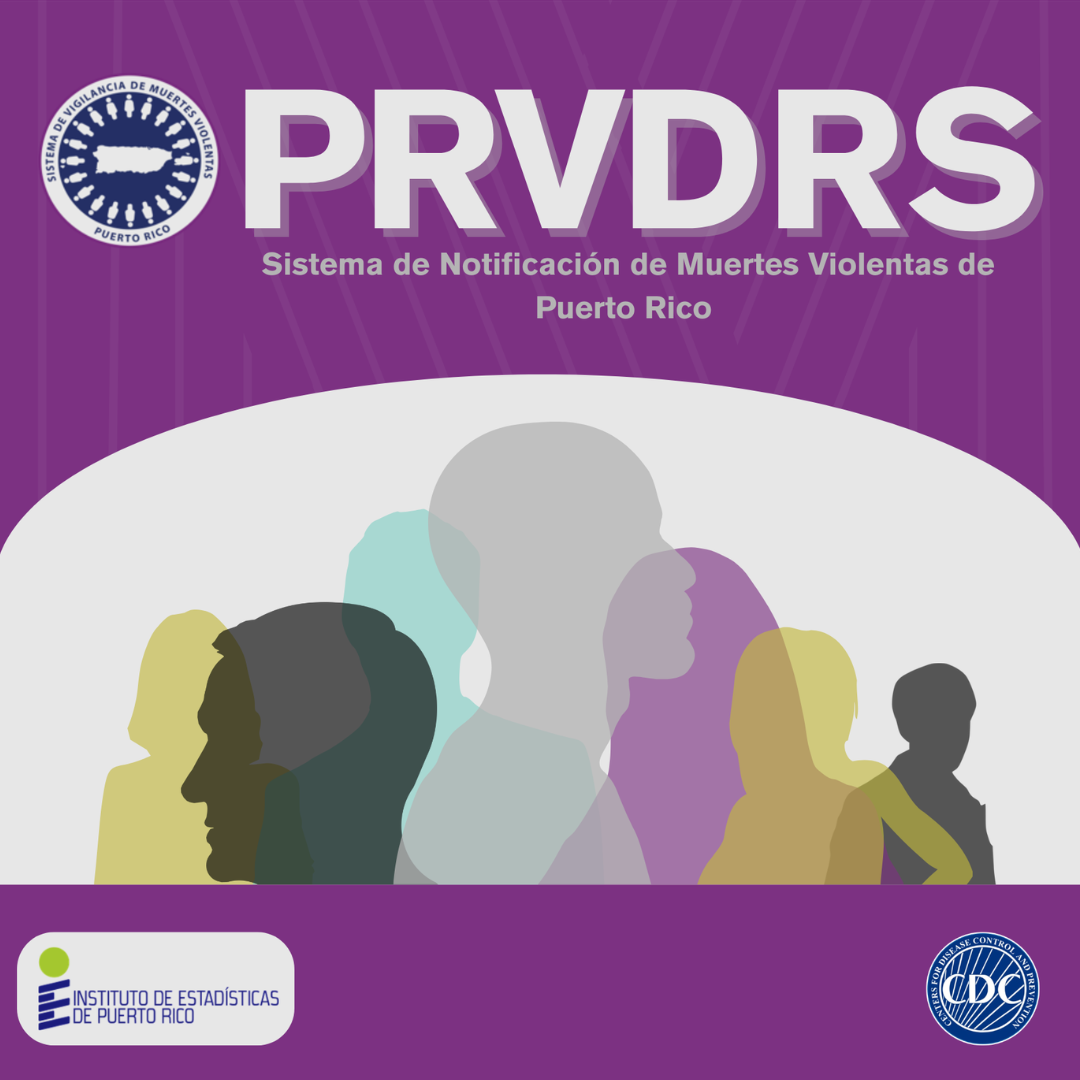
Puerto Rico Institute Statistics launches Digital Platform for the Violent Death Notification System
More than 4,300 Homicides and 1,600 Suicides Since 2017: Digital Platform Allows Exploration of Violent Deaths in Puerto Rico
From 2017 to 2023, Puerto Rico has recorded 4,304 homicides and 1,685 suicides.These figures reflect a complex phenomenon that impacts families, communities, and public safety and health throughout the archipelago.
With the goal of promoting a deeper and more accessible understanding of this reality, the Puerto Rico Violent Death Reporting System (PRVDRS) developed a digital platform that allows for a detailed and contextualized examination of the data.
“The public policy formulation process requires reliable data and rigorous analysis. This tool allows us to measure the magnitude of violent deaths in Puerto Rico and better understand the circumstances surrounding these incidents. Evidence-based decision-making is fundamental to effectively addressing this public health and safety issue,” expressed Planner Mario O. Font Martin, Statistical Projects Manager and Coordinator of the PRVDRS.
Data to Help Understand the Phenomenon
The PRVDRS integrates information from multiple official sources, including the Puerto Rico Police, the Institute of Forensic Sciences, and the Demographic Registry of the Department of Health. By combining these sources into an anonymized database, the system allows for the analysis of not only how many deaths occur but also the circumstances surrounding them.
From the start of data collection in 2017 through 2023, the system has documented:
- 4,304 homicides
- 1,685 suicides
This integration allows for the identification of patterns and trends that are not always visible in individual reports.
What Does the Digital Platform Offer?
The tool allows citizens to:
- Explore historical trends since 2017.
- Analyze data through interactive visualizations and maps.
- Examine the classification of violence (e.g., community or collective).
- Identify the type of weapon involved.
- Review circumstances associated with the incidents.
Currently, the platform presents official consolidated data through 2023, along with preliminary data from 2024 to 2026, which will be updated monthly.
A Nationally Integrated Effort
The PRVDRsis part of the National Violent Death Reporting System (NVDRS), coordinated by the Centers for Disease Control and Prevention (CDC). The PRVDRS collects information documented by the Puerto Rico Police, the Institute of Forensic Sciences, and death certificates from the Department of Health's Demographic Registry into an anonymous database with over 600 variables. For more information on the NVDRS, you can access the following link: National Violent Death Reporting System.
This methodology allows for an understanding of not only the cause of death but also the circumstances and factors related to each case, facilitating comparisons with other U.S. jurisdictions.
Public Access
The platform is available through the official portal of the Puerto Rico Institute of Statistics: Puerto Rico Violent Death Notification System (PRVDRS) interactive tool
Open access to this data strengthens transparency and fosters informed conversations regarding violence prevention and public policy. Understanding the data is an essential step toward addressing one of the most complex challenges facing Puerto Rico in an informed manner.
About the Puerto Rico Institute of Statistics
The Institute is an autonomous government entity responsible for coordinating the production of government statistics to ensure that the data collection systems upon which public policies are based are complete, reliable, and provide rapid and universal access.
The value of investment in Research and Development in Puerto Rico increases
The value of investment in Research and Development in Puerto Rico increases
Ten municipalities lose more than 10% of their population in the first half of this decade
Ten municipalities lose more than 10% of their population in the first half of this decade

.png)
.png)
.png)
.png)