Ten municipalities lose more than 10% of their population in the first half of this decade


Download the Document
Ten municipalities lose more than 10% of their population in the first half of this decade
Please let us know your satisfaction level with our services.
-p-130x130q80.png)
Visit our Official Activities, and participate with us
.png)
Visit our Calls for applications and be part of the new opportunities we have for you.
.png)
If you have any questions or just want to contact us, visit the Contact Us section.
.png)
We are at your disposal. If you need custom statistics, do not hesitate to contact us.
.png)
Sign up for our online workshops. Connect with the experts and discover the power of data!
.png)
Visit our Blog and keep up to date with the latest news and topics of interest.
.png)
Visit our Press Releases and stay connected to the Institute.
.png)
Explore the Publication Calendar and keep up to date with Puerto Rico's statistics.
.png)
Complete the form for the selection of our Statistics Coordination Committee
.png)
Suscribe to receive news directly to your email.
.png)
Listen to the Official PRIS podcast and stay informed with the experts
.png)
Lack of certified people in libraries to provide technological assistance to people with disabilities
Press Release
Lack of people certified in libraries to provide technological assistance to people with disabilities
The data comes from a study carried out by the Puerto Rico Institute of Statistics.
According to the report of the study on inclusive services and technological assistance in libraries in Puerto Rico by the Institute of Statistics of Puerto Rico, 83% of the participating libraries do not have people certified in technological assistance to people with disabilities. Similarly, almost 40% of libraries indicated that they do not have computers or electronic equipment required to comply with a technological assistance program for people with disabilities.
The main objective of Law No. 63 of 2011 is to establish the Inclusive Library Services System for Technological Assistance in all libraries in Puerto Rico. In the same way, this law orders the government to “collect annual statistical data on Inclusive Library Services for Technological Assistance”. Since its approval, the government has not been able to fully comply with this mandate. It is for this reason that the Institute of Statistics of Puerto Rico, in collaboration with the Technological Assistance Program of the University of Puerto Rico (PRATP), designed a collection system and a set of data so that the Government of Puerto Rico has the capacity to collect, analyze and disseminate data on the implementation of this law.
The data presented correspond to the calendar year 2019 and includes a sample of the libraries of the University of Puerto Rico system, private universities, higher education institutions and municipalities. This is the first report that Puerto Rico has made on statistics related to the implementation of Law No. 63 of 2011
“As a society we must and must guarantee all people access to education and information, and people with disabilities cannot be discriminated against. This study allows us, in addition to complying with the law, to determine where we should make the necessary adjustments to meet the access to information needs of people with disabilities,” said Dr. Orville M. Disdier, lead author of the study and acting executive director of the Puerto Rico Institute of Statistics.
Here are some of the study's most salient findings:
- A total of 36 libraries completed the questionnaire, the largest of them from private universities (39%).
- 36% of participating libraries do not have a plan to implement Act No. 63.
- Most (83%) of participating libraries reported that they do not have people certified in technological assistance.
- Only 8% of participating libraries indicated that the administration has plans to provide training on the use of technological assistance programs and equipment.
- Nearly 40% of participating libraries indicated that they do not have computers or electronic equipment required to comply with a technological assistance program for people with disabilities.
- Although 67% of participating libraries claimed that their library meets the requirements established by the Americans with Disabilities Act (ADA) regarding the accessibility of physical spaces for people with disabilities, all indicated that they do not have official certification for these purposes.
- Among the reasons that participating libraries established for not complying with Act No. 63 of 2011 are: Lack of financial resources, lack of guidance, lack of support from the administration and lack of human resources.
The Puerto Rico Statistics Institute is an autonomous governmental entity tasked with coordinating the government's statistical production service to ensure that the data collection and statistics systems, on which public policies are based, are complete, reliable, and accessible quickly and universally. To access this report or to learn more about the Institute of Statistics, you can access the website: www.estadisticas.pr.gov. On social media through Facebook (@estadisticas .pr), Twitter (@EstadisticasPR) and LinkedIn (Institute of Statistics of Puerto Rico) accounts.
###
Contacts:
Idia M. Martinez, R-28
787-603-3200
Lourdes Burgos, R-27
787-562-2932
With a new website, the Institute of Statistics of Puerto Rico
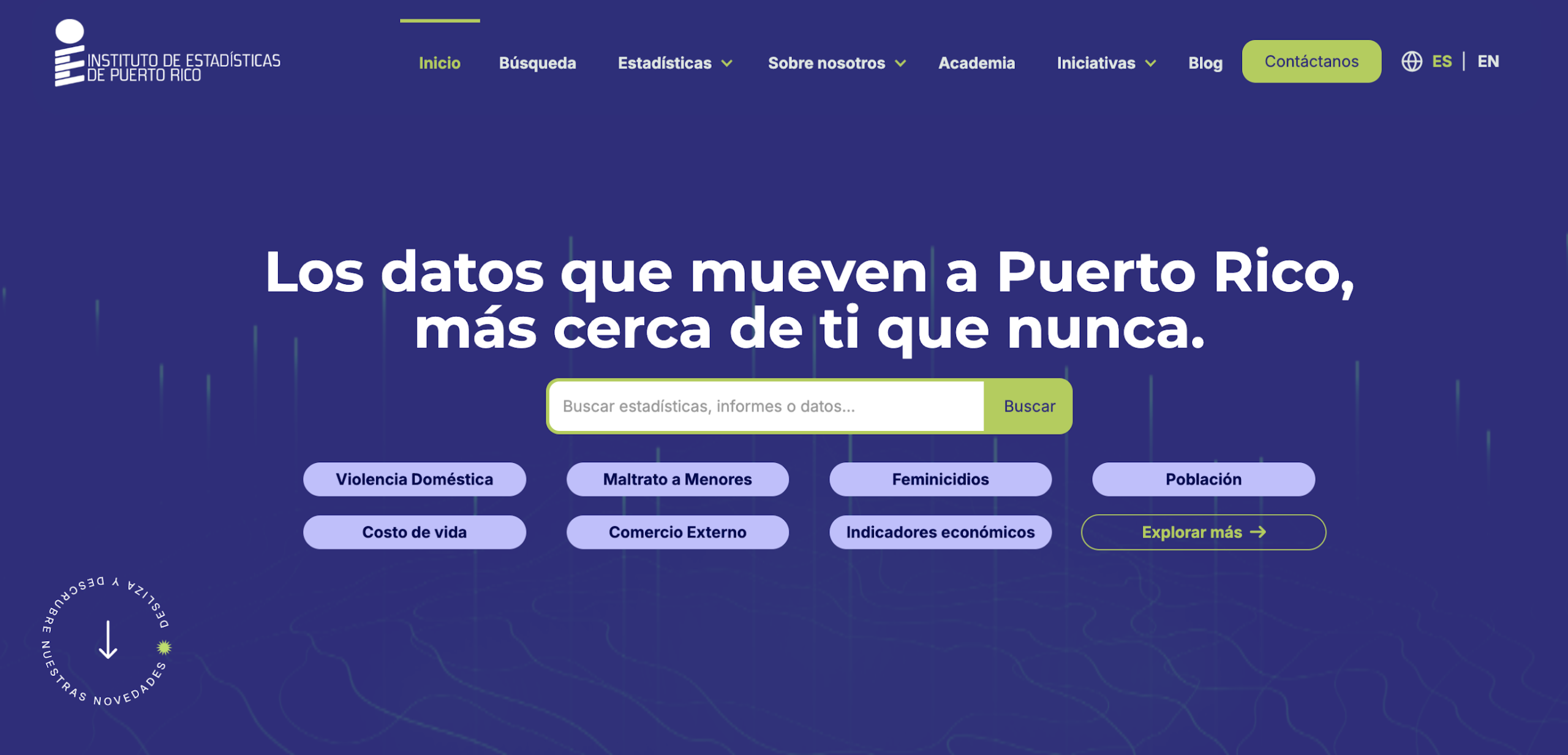
San Juan, Puerto Rico. January 2, 2026. The Puerto Rico Statistics Institute announced the launch of its new website, a digital platform framed by the transparency and accessibility of critical statistics for Puerto Rico. The new website, available through: https://www.estadisticas.pr.gov, focuses on a better user experience with a better search engine, allowing for more intuitive navigation. The more than 300 statistical products contained in the new platform are rigorously organized by categories that make it easier to find information. This logical architecture makes it easier for students, researchers and citizens to locate specific indicators on economy, health, education or demography, among other topics, consolidating in a single access point the vast production of data and interactive dashboards that were previously more dispersed.
On the other hand, the new portal launches a dynamic blog section designed as an institutional chronicle center that includes, among others: press releases, recent activities, explanatory memorials, and notifications of importance to Puerto Rico. Another important aspect of the new website is that it has been designed to the highest standards to guarantee access for people with disabilities or with diverse access needs. In the same way, the cybersecurity of the portal was substantially improved. “With the creation of this new website, the Institute consolidates its leadership in providing Puerto Rico with quick and universal access to statistics, eliminating barriers and reaffirming that statistical knowledge is a right for the entire population,” said Dr. Orville M. Disdier, executive director of the Institute.
Anyone who has questions about the functionality of the new page or has difficulty finding any data or information on the page, can write to preguntas@estadisticas.pr. They can also follow social networks through Facebook (@estadisticas .pr), X (@EstadisticasPR), LinkedIn (Institute of Statistics of Puerto Rico) and Instagram (@institutodeestadisticas) accounts.
The Puerto Rico Statistics Institute is an autonomous governmental entity responsible for coordinating the Government's statistical production service to ensure that the data collection and statistics systems, on which public policies are based, are complete, reliable, and have quick and universal access.
Database collected from the 2010-11 and 2011-12 Traveler Survey for sale
Database collected from the 2010-11 and 2011-12 Traveler Survey for sale

.png)
.png)
.png)
.png)