Statistics Institute publishes the Creative Industries report 2017
It reveals that the total number of establishments dedicated to Creative Industries was 2,054, the majority (41.7%) belonging to the Arts sector.
San Juan, PR, December 17, 2018 — The Puerto Rico Statistics Institute (Institute) today released its report of Creative Industries in Puerto Rico 2017, as part of public policy aimed at supporting the development of this sector, in accordance with Law No. 173 of October 13, 2014, also known as the Act to Promote Creative Industries. This law summarizes creative industries into the following groups:
Design (graphic, industrial, fashion and interiors)
Arts (music, visual and performing arts and publications)
Media (application development, video games, online media, digital content and multimedia)
Creative Services (architecture and creative education)
Here are some of the publication's key findings:
The total number of establishments dedicated to Creative Industries totaled 2,054. With 41.7% of the establishments, the Arts sector had the largest number of Creative Industries. Within this sector, the specific industries of Computer Systems Design were the one with the highest number with 195 establishments (10.2%).
The largest number of establishments (59.3%) was characterized by being in the category of 1 to 4 employees.
In terms of the number of employees per Creative Industry, the Media sector accounted for 46% (8,454) of the people employed in Creative Industries.
The largest number of employees is in the Computer Systems Design industry with 2,154 employees.
The Creative Industries were numerically dominated by the male population. The number of male population totaled 34,542 (63%) people, while the employed female population was estimated at 20,323 (37%) people.
The average annual wage for all industries was $28,680, the median was $23,650 and the minimum was $6,492.
The highest average annual wage was for the Software Publishing-related industry at $118,200.
The highest average annual salary, by occupation, was System Software Developers with $62.120.
Francisco Pesante González, author of the report, stated that “despite the fact that Puerto Rico has been in recession for more than 10 years, and has had to face the effects of hurricanes Irma and María, the 2017 indicators reveal consistent growth in exports from creative industries.”
For his part, Dr. Orville M. Disdier, Acting Executive Director, said: “With this third report prepared and published by the Institute of Statistics, we reiterate our commitment to join forces with the Institute of Culture and the Trade and Export Company, aimed at continuing the promotion and support of Creative Industries in Puerto Rico.”
The Puerto Rico Statistics Institute is an autonomous governmental entity responsible for coordinating the Government's statistical production service to ensure that the data collection and statistics systems, on which public policies are based, are complete, reliable, and have quick and universal access. The Institute has in its inventory, accessible through www.estadisticas.pr.gov, over 300 statistical products. In addition, it is a custodian and provides access to over 100 data sets or “data sets” through www.data.pr.gov and to over 40 tables and more than 6 thousand indicators through: www.indicadores.pr.
This is detailed in the most recent Migrant Profile 2021-2022
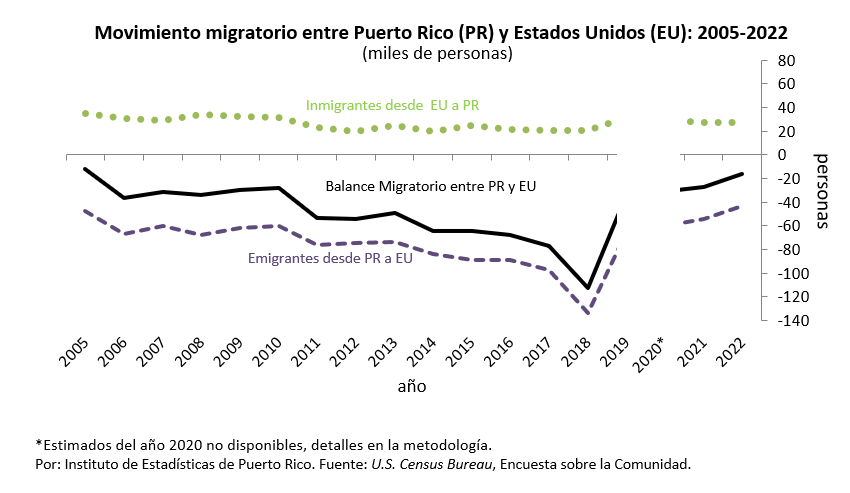
San Juan, PR, December 11, 2023 — During the calendar years 2021 and 2022, data from the Community Survey indicate that the net migration balance between Puerto Rico and the United States decreased from -27 to -16 thousand people emigrating or by -41%. This was revealed by the 2021-2022 Migrant Profile, which was published today by the Puerto Rico Institute of Statistics, and which presents an overview of the migratory movement in Puerto Rico in the calendar year 2021 and 2022. On the other hand, the values continue to reflect more people leaving than entering the jurisdiction in both years. Here are several key findings:
Between 2021 and 2022, Puerto Rico's migration indicators according to the Community Survey showed that:
the number of emigrants to the United States was estimated at about 55 thousand and 43 thousand people respectively, resulting in a decrease of -21%. Since 2010, the figure had not been lower than 60,000 emigrants
about 27,000 people immigrated to Puerto Rico each year
in net terms, the migratory balance between Puerto Rico and the United States decreased from -27 to -16 thousand people emigrating or by -41%.
The median age of the emigrant population decreased from 31.9 to 30.3 years, and immigrants were younger than emigrants, showing a reduction in the median age from 39 to 33.8 years.
The net migratory balance of the population with some post-secondary education or more decreased from about ten thousand (2021) to four thousand (2022) people emigrating.
DDuring the last twelve years of available information (2010-2019 and 2021-2022), it was estimated, according to the Community Survey, that some 649,000 more people have moved from residence to the United States from Puerto Rico than from the United States to Puerto Rico.
In 2022, passenger flow indicated that:
The net movement by plane from Puerto Rico to all destinations (not just the United States) had between seven (-7) thousand and one thousand (-1) passengers according to the U.S. Bureau of Transportation Statistics (BTS) and the Port Authority (AP), respectively.
the net movement of passengers by sea (ferry) between Puerto Rico and the Dominican Republic was less than one thousand (724) passengers, according to Caribbean Ferries.
The geographical distribution of emigrants to the United States was:
In 2022, as a destination for emigrants, 47% to the Southern region, 25% to the Northeast region and 16% to the Midwest region.
the Northeastern region reflected a gradual decrease in emigrants from 47% in 2005 to 25% in 2022.
The five states with the highest emigration from Puerto Rico were:
in 2021 Florida, Pennsylvania, Texas, Virginia and New Jersey.
in 2022 Florida, New York, Pennsylvania, Texas and New Jersey.
“The indicators indicate a reduction in net emigration in recent years. In other words, a decline has been identified in the notorious net migratory flows that prevailed from 2011 to 2019, where net emigration represented between 1.1% and 3.5% of the total annual population of Puerto Rico. Net emigration in 2021 and 2022 represented 0.8% and 0.5% of the total population, respectively. On the other hand, we cannot lose sight of the fact that more people continue to leave than those who enter, which continues to alter the demographic composition of our jurisdiction,” said Alberto L. Velázquez-Estrada, Senior Manager of Statistical Projects at the Institute.
For more details and information on the full report of the 2021-2022 Migrant Profile, as well as previous publications, you can access the Publications section of the Puerto Rico Institute of Statistics at the link: https://estadisticas.pr/en/publicaciones.
As the lead entity of Puerto Rico's SDC program, the Institute manages the SDC page, which contains the main statistical reports and publications of the U.S. Census Bureau on Puerto Rico, specifically those that are most in demand, such as annual population estimates; the Puerto Rico Community Survey (Puerto Rico Community Survey) and official statistics on Puerto Rico's decennial population and housing censuses, among others.
The Puerto Rico Statistics Institute is an autonomous governmental entity responsible for coordinating the Government's statistical production service to ensure that the data collection and statistics systems, on which public policies are based, are complete, reliable, and have quick and universal access.
For more information you can visit the website: www.estadisticas.pror on social networks through Facebook (@estadisticas .pr), Twitter (@EstadisticasPR) and LinkedIn (Institute of Statistics of Puerto Rico) accounts.


-p-130x130q80.png)
.png)
.png)
.png)
.png)
.png)
.png)
.png)
.png)
.png)
.png)
.png)

.png)
.png)
.png)
.png)