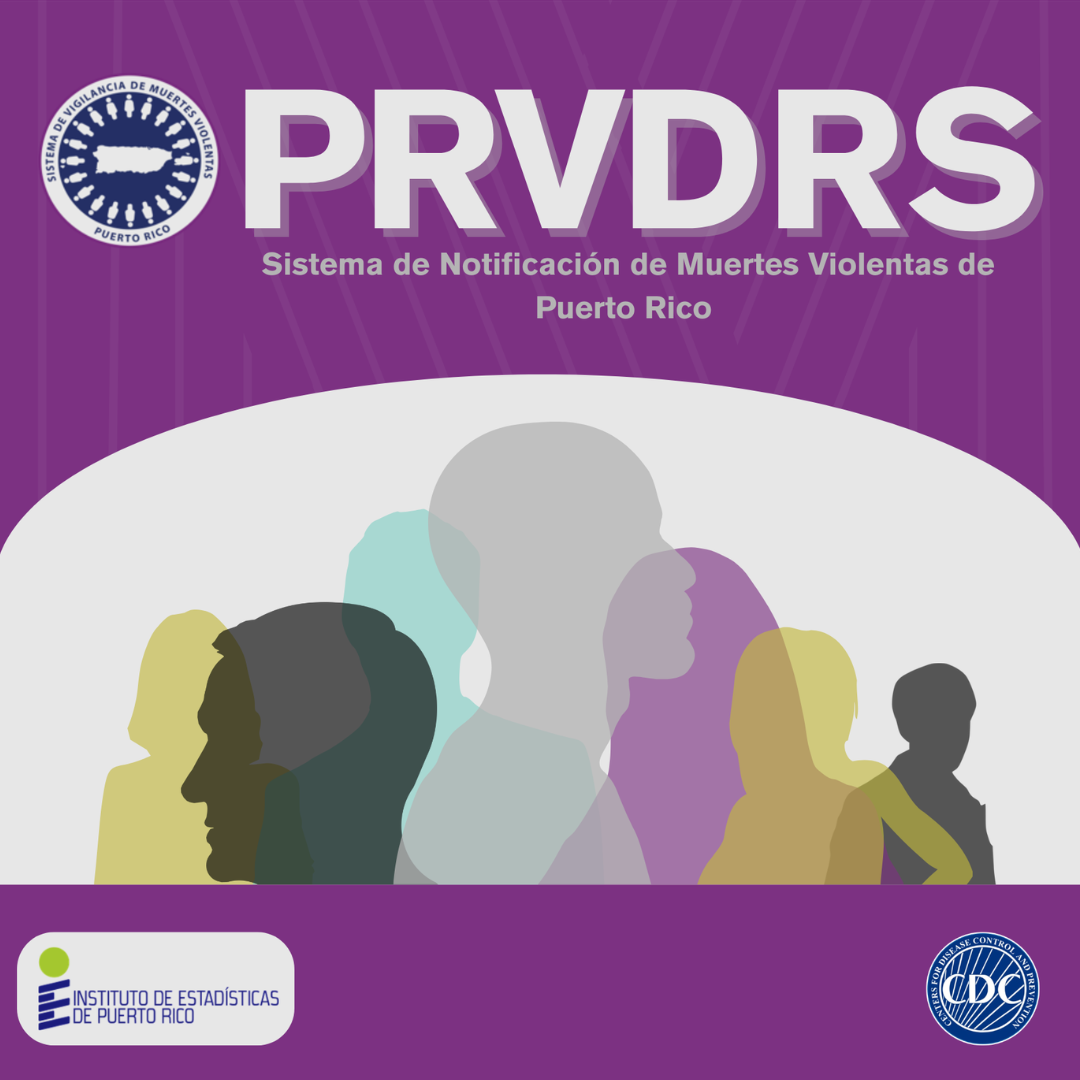

Puerto Rico Institute Statistics launches Digital Platform for the Violent Death Notification System

Announcements
PRVDRS
26 February 2026

More than 4,300 Homicides and 1,600 Suicides Since 2017: Digital Platform Allows Exploration of Violent Deaths in Puerto Rico

From 2017 to 2023, Puerto Rico has recorded 4,304 homicides and 1,685 suicides.These figures reflect a complex phenomenon that impacts families, communities,and public safety and health throughout the archipelago.

With the goal of promoting a deeper and more accessible understanding of this reality, the Puerto Rico Violent Death Reporting System (PRVDRS) developed a digital platform that allows for a detailed and contextualized examination ofthe data.

“The public policy formulation process requires reliable data and rigorous analysis. This tool allows us to measure the magnitude of violent deaths in Puerto Rico and better understand the circumstances surrounding these incidents. Evidence-based decision-making is fundamental to effectively addressing this public health and safety issue,” expressed Planner Mario O. Font Martin, Statistical Projects Manager and Coordinator of the PRVDRS.

Data to Help Understand the Phenomenon

The PRVDRS integrates information from multiple official sources, including the Puerto Rico Police, the Institute of Forensic Sciences, and the Demographic Registry of the Department of Health. By combining these sources into an anonymized database, the system allows for the analysis of not only how many deaths occur but also the circumstances surrounding them.

From the start of data collection in 2017 through 2023, the system has documented:

  • 4,304 homicides
  • 1,685 suicides

This integration allows for the identification of patterns and trends that are not always visible in individual reports.

What Does the Digital Platform Offer?

The tool allows citizens to:

  • Explore historical trends since 2017.
  • Analyze data through interactive visualizations and maps.
  • Examine the classification of violence (e.g., community or collective).
  • Identify the type of weapon involved.
  • Review circumstances associated with the incidents.

Currently, the platform presents official consolidated data through 2023, along withpreliminary data from 2024 to 2026, which will be updated monthly.

A Nationally Integrated Effort

The PRVDRSis part of the National Violent Death Reporting System (NVDRS), coordinated by the Centers for Disease Control and Prevention (CDC). The PRVDRS collects information documented by the Puerto Rico Police, the Institute of Forensic Sciences, and death certificates from the Department of Health's Demographic Registry into an anonymous database with over 600 variables. For more information on the NVDRS, you can access the following link: National Violent Death Reporting System.

This methodology allows for an understanding of not only the cause of death but also the circumstances and factors related to each case, facilitating comparisons with other U.S. jurisdictions.

Public Access

The platform is available through the official portal of the Puerto Rico Institute of Statistics: https://www.estadisticas.pr.gov/productos/sistema-de-notificacion-de-muertes-violentas-de-puerto-rico

Open accessto this data strengthens transparency and fosters informed conversationsregarding violence prevention and public policy. Understanding the data is an essential step toward addressing one of the most complex challenges facing Puerto Rico in an informed manner.

About the Puerto Rico Institute of Statistics

The Institute is an autonomous government entity responsible for coordinating the production of government statistics to ensure that the data collection systems upon which public policies are based are complete, reliable, and provide rapid and universal access.

Share this article:

Visit our Official Activities, and participate with us

Visit our Calls for applications and be part of the new opportunities we have for you.

If you have any questions or just want to contact us, visit the Contact Us section.

We are at your disposal. If you need custom statistics, do not hesitate to contact us.

Sign up for our online workshops. Connect with the experts and discover the power of data!

Visit our Blog and keep up to date with the latest news and topics of interest.

Visit our Press Releases and stay connected to the Institute.

Explore the Publication Calendar and keep up to date with Puerto Rico's statistics.

Complete the form for the selection of our Statistics Coordination Committee

Suscribe to receive news directly to your email.

Listen to the Official PRIS podcast and stay informed with the experts

jueves, 12 de diciembre de 2019

Comunicado de Prensa

Instituto de Estadísticas publica el Perfil de Salud y Seguridad del Estudiante en Puerto Rico: Años 2015-2017

El 41.5% de los estudiantes en duodécimo grado afirmaron haber tenido relaciones sexuales en algún momento en sus vidas y un 33.4% informaron estar activos sexualmente.

El 41.5% de los estudiantes de duodécimo grado, en escuela superior en el sector público, informaron haber tenido relaciones sexuales en algún momento en sus vidas y el 33.4% informaron estar activos sexualmente.  Además, el 13.7% de los estudiantes de escuela superior, en el sector público, intentaron suicidarse en una o más ocasiones.  Estos son parte de los resultados del informe titulado “Perfil de Salud y Seguridad del Estudiante en Puerto Rico: Años 2015-2017”, publicado hoy por el Instituto de Estadísticas de Puerto Rico.  El informe presenta un perfil estadístico de aspectos relacionados a la salud y a la seguridad de los estudiantes en Puerto Rico para los años 2015 y 2017.  El documento incluye estadísticas sobre el acoso escolar, acoso electrónico, comportamiento violento, comportamiento sexual, uso de drogas y sobre los hábitos alimentarios de los estudiantes de escuela superior en escuelas públicas.  Por otro lado, el informe incluye también estadísticas sobre incidentes delictivos en las instituciones postsecundarias públicas y privadas.  Los datos fueron obtenidos de bases de datos secundarias como lo son el Youth Risk Behavior Surveillance System (YRBSS) y el Campus Safety and Security Data (CSSD).

“Para que el proceso educativo sea efectivo, es imprescindible que ocurra dentro de un ambiente seguro, libre de intimidaciones o de riesgos explícitos o implícitos.  De igual forma, un estudiante que no está física o mentalmente saludable tendrá mayor dificultad en cumplir con las exigencias académicas.  Conocer este perfil del estudiante nos brinda la información necesaria, para tomar las acciones pertinentes, hacia un ambiente educativo que propicie el aprendizaje y para promover un estilo de vida saludable en nuestros estudiantes”, señaló el Dr. Orville M. Disdier, autor principal del informe y Director Ejecutivo Interino del Instituto de Estadísticas de Puerto Rico.  

Por su parte, Dharma R. Rodríguez, coautora del informe y participante del Programa de Internado del Instituto, agregó que "el perfil de salud y seguridad nos alerta a cerca de la necesidad de repensar las medidas o políticas públicas establecidas para trabajar la seguridad y salud (física y mental) de los estudiantes. Por tanto, hay una clara urgencia de brindar más herramientas y recursos a los profesionales responsables de lograr la mejoría que los estudiantes merecen".

A continuación, se presentan algunos de los hallazgos generales y más sobresalientes, sobre los estudiantes de escuela superior del sector público:

  • El 17.1% de los estudiantes sufrieron acoso en la escuela en el año 2017.
  • El acoso en la escuela fue mayor para los estudiantes del sexo femenino (20.2% en el año 2017), que para los estudiantes del sexo masculino (13.6% en el año 2017).
  • Los datos demuestran un aumento en la prevalencia de acoso electrónico, alcanzando 13.2% en el año 2017.
  • El acoso electrónico fue mayor para los estudiantes del sexo femenino (17.0% en el año 2017), que para los estudiantes del sexo masculino (9.0% en el año 2017).
  • En el año 2017 más del 45% de los estudiantes del sexo femenino se sintieron tristes o desesperanzados, lo que representa un aumento con relación al año 2015.
  • La cantidad de estudiantes que consideraron seriamente suicidarse aumentó de 12.3% en el año 2015 a 17.1% en el año 2017.
  • La prevalencia de estudiantes que fuman cigarrillos o cigarros aumentó de 7.4% en el año 2015 a 8.9% en el año 2017.
  • La prevalencia de consumo de marihuana aumentó de 6.0% en el año 2015 a 7.9% en el año 2017.
  • En cuanto al consumo de alcohol, en el 2015 el 21.2% de los estudiantes afirmaron consumir alcohol, mientras que para el año 2017 este porcentaje aumentó a 23.8%.
  • Para el año 2017, prácticamente el 17% de los estudiantes de escuela superior indicaron estar actualmente activos sexualmente, pero el 25.5% indicó haber tenido relaciones sexuales en algún momento en sus vidas.
  • El 41.5% de los estudiantes en duodécimo grado, afirmaron haber tenido relaciones sexuales en algún momento en sus vidas y un 33.4% informaron estar activos sexualmente.
  • Casi el 60% de los estudiantes indicaron que no desayunan todos los días (59.3% en el año 2017).
  • La prevalencia de estudiantes que no consumen frutas o toman jugos 100% de frutas aumentó de 10.2% en el año 2015 a 14.3% en el año 2017.
  • Por su parte, la prevalencia de estudiantes que no consumen vegetales aumentó de 15.5% en el año 2015 a 16.5% en el año 2017.
  • Prácticamente el 80% de los estudiantes consumen bebidas carbonatadas o refrescos (79.7% en el año 2017).
  • Para el año 2017, el 79.5% de los estudiantes no estuvo físicamente activo.
  • En el año 2017, el 33.6% de los estudiantes de escuela superior jugó videojuegos tres o más horas por día.
  • La prevalencia de obesidad en los estudiantes aumentó de 10.7% en el año 2015 a 11.2% en el año 2017.

Para sector postsecundario público y privado:

  • Entre las ofensas criminales más frecuentes a estudiantes, dentro de instituciones o recintos postsecundarios, se encuentran los robos, asaltos y robos de vehículos de motor.
  • Las ofensas criminales más frecuentes a estudiantes, fuera de instituciones o recintos postsecundarios, fueron los robos de vehículos de motor y los asaltos agravados.

Para acceder a este informe o para conocer más sobre el Instituto de Estadísticas, pueden acceder la página web: www.estadisticas.pr.gov.  En las redes sociales a través de las cuentas de Facebook (@estadisticas.pr), Twitter (@EstadisticasPR) y Linkedin (Instituto de Estadísticas de Puerto Rico).

###

Contactos:

Idia M. Martínez, R-28

787-603-3200

Lourdes Burgos, R-27

787-562-2932

Free workshops and webinars at the Puerto Rico Institute of Statistics

Free workshops and webinars at the Puerto Rico Institute of Statistics

For government officials and the general public

Starting today, Wednesday, February 22, 2023, pre-registration begins for the free offer of workshops and webinars offered by the Statistics Institute of Puerto Rico. This virtual offer of nine workshops with 16 sessions and three webinars seeks to provide solutions in the access, management and analysis of government statistical data and is carried out with rigor and quality in the development of content that is carried out by specialists.

The online format offers the opportunity to participate to government officials and the general public, since the format is asynchronous, that is, within the time available to the participant. In the same way, multiple sessions are included, allowing participants the flexibility to enroll on those dates that are most convenient. Interested individuals can complete pre-enrollment at Academy

The topics included are:

      • R statistical analysis software: one of the most commonly used open-access and user-friendly software for Data analytics and Data Science.
        • R basic: introductory workshop to help publicize and facilitate the adoption of this programming language for people interested in strengthening their resources for the processing, analysis, visualization and presentation of their statistical research.
        • RStudio: introduction to the integrated development environment (IDE, in English) for managing R, in the analysis, visualization and presentation of statistical analyses.
        • Tidycensus: R library that facilitates the access and processing of data from the U.S. Census Bureau, such as the Census, population estimates and the Community Survey.
      • Tableau Public: free platform that allows the use of interface commands to explore, create and publish data and visualizations online.
      • Resources from the U.S. Census Bureau:
        • Population and housing data: presentation and performance of practical exercises on the tool https://data.census.gov/ to search for data on population and housing in Puerto Rico.
        • Access to microdata from the Community Survey: tool for customizing variable crosses for the analysis of population and housing data in Puerto Rico.
        • QGIS for analyzing data by geographical regions: QGIS is an open source Geographic Information System (GIS). Together with data from the U.S. Census Bureau, maps can be generated to analyze housing, economic, social and demographic issues.
      • Resources from the Puerto Rico Institute of Statistics:
        • Cost of Living Index and Calculator: presentation of a publication and Web App that allows us to compare the cost of living in Puerto Rico and different urban areas of the United States.
        • The Violent Death Surveillance System in Puerto Rico: project presentation and publication of data on violent deaths from a health perspective.

On the other hand, webinars are live sessions, in which participants can connect via the Internet to a platform where they can see and hear the speaker and ask the speaker questions after the session is completed.

The topics of the three webinars, with a capacity of 1,000 participants each, are:

  • Dominican population in Puerto Rico and its contrasts with the Puerto Rican population, 2015-2019: exposure to the microdata files of the U.S. Census Bureau and an example of their application to the study of the sociodemographic profile of the Dominican population living in Puerto Rico.
  • Geographic Delimitations of the U.S. Census Bureau: guidance on the various geographical levels used by the U.S. Census Bureau for the presentation of its data.
  • Violence and Femicide in Puerto Rico - Concepts and Statistics: aimed at advising participants on the importance of statistics on gender-based violence and femicide from a health perspective.

To access all the details of the Academies and Workshops Program, see Here.

The Puerto Rico Statistics Institute is a governmental entity in the executive branch, with fiscal and administrative autonomy, whose main purpose is to ensure that Puerto Rico has complete, reliable statistics that are quickly and universally accessible. To learn more about the Institute of Statistics, you can access the website: www.estadisticas.pr.gov. On social media through Facebook accounts (@statistics.pr), Twitter (@EstadisticasPR), Instagram (@institutodeestadisticas) and LinkedIn (Puerto Rico Institute of Statistics).

Statistics Institute Creates Resource Section on COVID-19

PRESS RELEASE

Statistics Institute creates resource section on COVID-19

The section includes sources from Puerto Rico and other jurisdictions around the world

San Juan, Puerto Rico, May 11, 2020 — The website of the Puerto Rico Statistics Institute (Institute) has a new section where you can access data and information related to the impact of COVID-19 in Puerto Rico and other jurisdictions around the world. As reported by the executive director, Dr. Orville M. Disdier, the objective is to provide access to the information that various organizations have been producing on this subject from a single electronic portal.

At the moment, the section has information on topics such as tests, positive and negative cases, mortality, demographic and socioeconomic data, surveillance and response, among others. It is contained in links that direct the user to information or data portals of institutions such as the Puerto Rico Department of Health, Red Cross, Johns Hopkins University, U.S. Department of Health and Human Services. Department of State, Federal Emergency Management Agency, Center for Disease Control and Prevention and several private entities.

Disdier clarified that the content of the section, which can be found on the page www.estadisticas.pr.gov, in the COVID-19 section and under the name COVID-19 Resources, is solely for reference and research on this topic and has not necessarily been reviewed or evaluated by the Institute, so they cannot guarantee that all information is complete or reliable. The section will be reviewed periodically to add new sources.

About the Puerto Rico Institute of Statistics

The Puerto Rico Statistics Institute is an autonomous governmental entity tasked with coordinating the government's statistical production service to ensure that the data collection and statistics systems, on which public policies are based, are complete, reliable, and accessible quickly and universally. In addition, as the leading entity of the SDC in Puerto Rico, the Institute manages the SDC portal, which contains the main statistical reports and publications of the U.S. Census Bureau about Puerto Rico, specifically those that are most in demand, such as annual population estimates, the Puerto Rico Community Survey (Puerto Rico Community Survey) and official statistics on Puerto Rico's 10-year population and housing censuses, among others. The Puerto Rico SDC portal can be accessed through: https://censo.estadisticas.pr/.

For more information you can visit the website: https://estadisticas.pr.gov/. In addition, you can follow the Institute on social networks, through Facebook (@estadisticas .pr), Twitter (@EstadisticasPR) and LinkedIn (Institute of Statistics of Puerto Rico) accounts.

##

Press Contact:

Idia Martínez

787-603-3200

imartinez@upfrontpr.net