
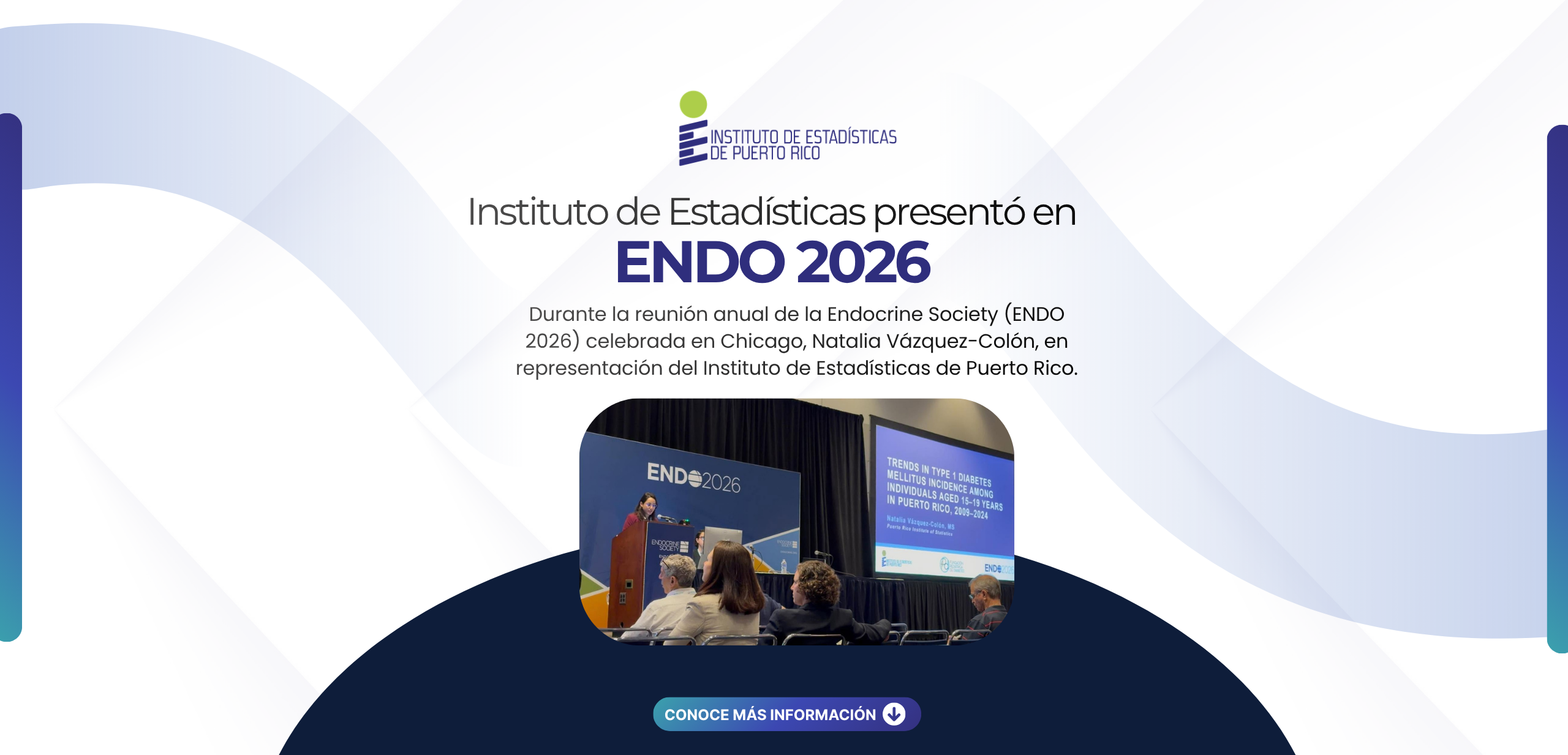

During the annual meeting of the Endocrine Society (ENDO 2026) held in Chicago, Natalia Vázquez-Colón, representing the Puerto Rico Institute of Statistics, presented original research on the incidence of type 1 diabetes in adolescents aged 15 to 19 in Puerto Rico.
The results showed an upward trend in incidence during the 2009–2024 period. The analysis identified a significant average annual growth of 4.1%.
The research was conducted through a collaboration between the Institute of Statistics and the Pediatric Diabetes Foundation. Participation in ENDO 2026 allowed for sharing scientific evidence generated in Puerto Rico with a highly prestigious national and international audience of researchers, academics, and clinicians.
Access a copy of the presentation at: Trends in Type 1 Diabetes Mellitus Among Individuals Aged 15-19 Years in Puerto Rico.


January 21, 2018
The executive director of the Puerto Rico Institute of Statistics, Dr. Mario Marazzi-Santiago, today questioned the purpose of consolidating this public entity, with the sole purpose of outsourcing it later, as proposed in Reorganization Plan No. 1 referring to the Department of Economic Development and Commerce (DDEC) for the Puerto Rico Statistics Institute.
To expedite the proposal to “outsource” the Institute's functions, the Government could simply propose a bill to amend the Institute's Organic Law. Another alternative could be to consider including your outsourcing proposal in an existing legislative vehicle, such as Senate Bill 236 (Open Data Act). But, in this case, it was proposed to merge for the sole purpose of 'externalizing' its functions. It is a proposal that seems strange to us. I don't want to think of it as a mechanism designed to prevent the Legislative Assembly from discharging its function of analyzing and finally approving the reorganizations of entities created by law, such as the Institute.
On January 8, 2018, at a press conference from La Fortaleza, the Secretary of Public Affairs and Public Policy, Lcdo. Ramón Rosario Cortés, presented a proposal to reorganize the DDEC and consolidate several public entities, including the Institute. In the case of the Institute, it is proposed to consolidate it with the DDEC, with the sole purpose of outsourcing its functions, in order to guarantee its “real independence” since, as recognized by Rosario Cortés himself that day, the Institute since its creation, “although it has had independence, it depends on appointments from the Governor, including Executive officials who are part of that Board”.
For his part, Dr. Marazzi-Santiago thanked the recognition that statistical functions must be performed without political interference. “We are ready to study alternative mechanisms that allow the selection of members of the Institute's Board of Directors without the need for the incumbent Government to interfere. Recent experiences with this issue provide compelling evidence to support the desirability of this change in public policy,” said the Executive Director of the Institute.
The Institute was created as a public instrument with so much administrative and fiscal autonomy that it already allows it to operate outside the Government, almost like a private company. As La Fortaleza is already aware, the Institute does not consult its contracts or appointments with La Fortaleza or with the Office of Management and Budget, but rather makes these decisions as in private companies, based on professional and technical criteria that ensure adequate governance of our institution.
Marazzi assured that this governance model has not only proven to be successful, but that the Institute's objectivity and professionalism have been recognized by numerous users of its services and interested individuals, most recently by the Congressional Task Force created under the Puerto Rico Oversight, Management, and Economic Stabilization Act (PROMESA) of 2016, which specifically recommended that the Institute continue to protect its independence.
-
The Puerto Rico Statistics Institute is an autonomous governmental entity responsible for coordinating the Government's statistical production service to ensure that the data collection and statistics systems, on which public policies are based, are complete, reliable, and have quick and universal access. The Institute has in its inventory, accessible through www.estadisticas.pr.gov, more than 300 statistical products. In addition, it is a guardian and provides access to over 100 data sets or “data sets” through www.data.pr.gov and to over 40 tables and more than 6 thousand indicators through: www.indicadores.pr.
For more information you can visit our website: www.estadisticas.pr.gov. In addition, you can follow us on social networks through Facebook (estadisticas.pr), Twitter (@EstadisticasPR) and LinkedIn (Institute of Statistics of Puerto Rico) accounts.
Press Contact: Sandra Morales Blanes (787) 688-0401.

The executive director attacked the measure and invited the Government to take statistics seriously at this time of fiscal crisis
San Juan, PR, January 25, 2018 — The American Statistical Association, known as the American Statistical Association (ASA) today released a cyber petition entitled Clear Accounts: Let's Preserve the Autonomy and Impartiality of the Puerto Rico Statistics Institute in which he calls on both Governor Ricardo Rosselló and members of the Legislature to desist from transferring the functions of the Puerto Rico Statistics Institute (IEPR) to the Puerto Rico Department of Economic Development and Trade in order to eventually outsource all the statistical functions of the Government of Puerto Rico.
The ASA request makes specific reference to Reorganization Plan No. 1 And to Senate Bill 809, which was published yesterday and signed by five scientists from prestigious entities such as Harvard T.H. Chan School of Public Health and Yale University.
In addition, he emphasizes that this measure “would dismantle the IEPR and its autonomy, and would jeopardize the transparent and impartial statistical analyses that are critical to the functioning of Puerto Rico and to decision-making in all sectors of society, public and private.”
To this end, the executive director of the Puerto Rico Institute of Statistics, Dr. Mario Marazzi-Santiago, insisted that everywhere in the world there is a recognition of the need for official statistics to be prepared by independent governmental entities so that they can carry out their functions in a manner totally disconnected from political influences.
The Government of Puerto Rico has a long history of producing, disseminating and presenting rigged, outdated, misinterpreted, and incomplete statistics, and then access to sources of information is not provided so that the information can be verified, either by the citizen or by a congressman. The reality is that statistics are a serious issue and it is time for our Government to take them seriously, particularly if it wants to address its own fiscal problem.
Marazzi Santiago assured that there is no way that the proposed reorganization of the Institute of Statistics, as a program within the Department of Economic Development and Trade or outsourced by it, will solve the serious problem of reliability and credibility that the Government of Puerto Rico has with its statistics.
“We appreciate the efforts of the American Statistical Association (ASA) to create a vehicle that allows data users to express themselves publicly about the proposed reorganization,” said Dr. Marazzi-Santiago.
-
The Puerto Rico Statistics Institute is an autonomous governmental entity responsible for coordinating the Government's statistical production service to ensure that the data collection and statistics systems, on which public policies are based, are complete, reliable, and have quick and universal access. The Institute has in its inventory, accessible through www.estadisticas.pr, more than 300 statistical products. In addition, it is a guardian and provides access to over 100 data sets or “data sets” through www.data.pr.gov and to over 40 tables and more than 6 thousand indicators through: www.indicadores.pr.
For more information you can visit our website: www.estadisticas.pr. In addition, you can follow us on social networks through Facebook (estadisticas.pr), Twitter (@EstadisticasPR) and LinkedIn (Institute of Statistics of Puerto Rico) accounts.
San Juan, PR, January 14, 2017 — The Puerto Rico Statistics Institute (Institute) today announced the results of the Adult Human Papillomavirus (HPV) Survey 2014 the first survey related to the topic carried out by the Institute itself at the level of the population of adult women in Puerto Rico.
It focused mainly on the responses of women aged 18 to 44, which corresponds to the adult population of reproductive age. In addition, it collects information related to the knowledge of this population on important aspects such as the following: The existence of vaccines, the prevalence of vaccinated women, diagnostic knowledge with a virus infection and the regularity of medical tests for the possible detection of the virus.
Here are the main results:
The final sample size of interviews was 1,138 households. The response rate of the Adult Human Papillomavirus (HPV) Survey 2014 was 97.4 percent, which is equivalent to 1,108 households. Of these interviews, 665 were conducted on cell phones and 443 on fixed line phones.
HPV is one of the world's most important sexually transmitted infections due to its health implications. However, there was no information on the level of knowledge about HPV and the percentage of vaccination against the virus in the population of adult women living in Puerto Rico and the regularity of medical tests for the possible detection of the virus, among others.
One of the functions of the Puerto Rico Institute of Statistics is to produce its own statistics to complement existing data. To fulfill this function, in 2014, the Institute conducted the Adult HPV Survey for the adult population of men and women in Puerto Rico. This survey was carried out thanks to the collaboration of the Puerto Rico Department of Health's Behavior-Associated Risk Factor Surveillance System (PR‐BRFSS).
In Puerto Rico, the incidence rate of cervical cancer has been increasing. By 2014, Puerto Rico had an age-adjusted rate of 13.9 per 100,000 women. During the period from 2006 to 2014, the first five municipalities with the highest age-adjusted incidence rate of cervical cancer were Sábana Grande (19.4), Aibonito (19.0), Orocovis (18.8), Santa Isabel (18.7) and Lajas (17.2), according to the Puerto Rico Central Cancer Registry. For 2009, the age-adjusted incidence rate of cervical cancer in Puerto Rico (12.6) surpassed the corresponding rate for the population of Hispanic women in the United States (10.7), a trend that continued through 2014.
“The changes observed in rates over the past few years suggest that it is important to have a greater understanding of HPV and the use of its vaccine in Puerto Rico. This first survey seeks to begin to address this need,” said Dr. Idania R. Rodríguez Ayuso, co-author of the report on the Survey and senior manager of statistical projects at the Institute.
The Puerto Rico Statistics Institute is an autonomous governmental entity responsible for coordinating the Government's statistical production service to ensure that the data collection and statistics systems, on which public policies are based, are complete, reliable, and have quick and universal access. The IEPR has in its inventory, accessible through www.estadisticas.pr.gov, about 300 statistical products. In addition, it is a custodian and provides access to over 100 data sets or “data sets” through www.data.pr.gov and to over 40 tables and more than 6 thousand indicators through: www.indicadores.pr.
In addition, as the leading entity of the Puerto Rico SDC, the IEPR manages the SDC portal, where you can find the main statistical reports and publications of the U.S. Census Bureau on Puerto Rico, specifically those that are most in demand, such as annual population estimates; the Puerto Rico Community Survey (Puerto Rico Community Survey) and official statistics on Puerto Rico's 10-year population and housing censuses, among others. The Puerto Rico SDC portal can be accessed through: https://censo.estadisticas.pr/.
For more information you can visit our website: www.estadisticas.pr.gov. In addition, you can follow us on social networks through Facebook (estadisticas.pr), Twitter (@EstadisticasPR) and LinkedIn (Institute of Statistics of Puerto Rico) accounts.
##
Press Contact: Sandra Morales Blanes/ 787-688-0401
San Juan, PR — El U.S. Census Bureau released today the most recent annual population estimates for Puerto Rico. These statistics refer to July 1, 2017 and include the components of annual population change since July 1, 2010 that support the population estimate since the beginning of the decade. As the leading entity of the Network State Data Center (SDC) of the U.S. Census Bureau in Puerto Rico, the Puerto Rico Statistics Institute (Institute) presents this brief summary of the findings of the new annual population estimates for 2017:
More statistics on Puerto Rico's annual population estimates can be obtained at: https://censo.estadisticas.pr. Information on the methodology used to produce the estimates can be accessed hither.
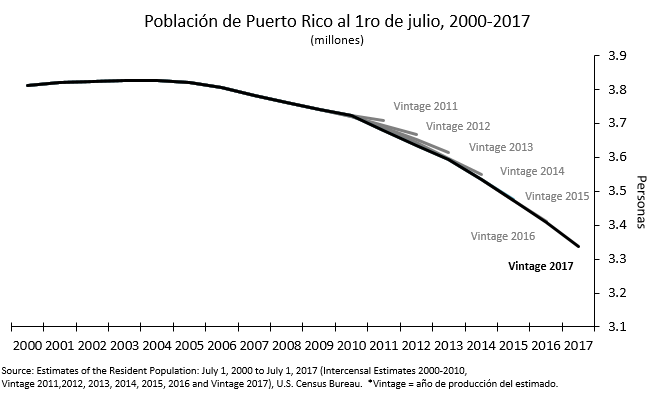
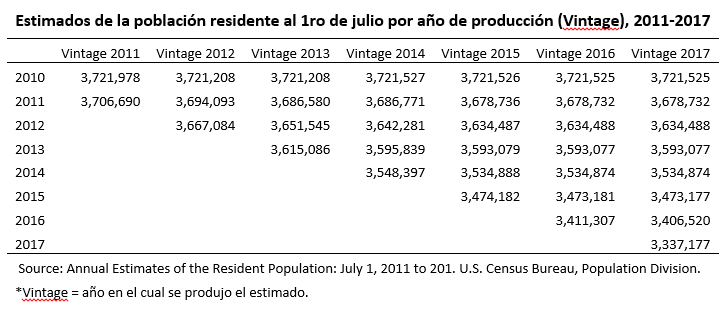
After conducting a decennial Census, such as the 2010 Census, the U.S. Census Bureau prepare the annual population estimates before the next Census. These estimates are prepared by analyzing data on births, deaths and migration. As a result, with each new publication of the estimates, adjustments are made to the previously estimated years. For example, with the publication of the 2017 estimates announced in this release, the estimates already published for 2011, 2012, 2013, 2014, 2015 and 2016 were revised. Each publication is distinguished according to the year in which they were produced and are named as Vintage.
The Puerto Rico Statistics Institute is an autonomous governmental entity responsible for coordinating the Government's statistical production service to ensure that the data collection and statistics systems, on which public policies are based, are complete, reliable, and have quick and universal access. The Institute has in its inventory, accessible through www.estadisticas.pr.gov, over 300 statistical products. In addition, it is a custodian and provides access to over 100 data sets or Data sets by means of www.data.pr.gov and to over 40 tables and more than 6 thousand indicators through: www.indicadores.pr
In addition, as the leading entity of the SDC in Puerto Rico, the Institute manages the SDC portal, which contains the main statistical reports and publications of the U.S. Census Bureau on Puerto Rico, specifically those that are most in demand, such as annual population estimates; the Puerto Rico Community Survey (Puerto Rico Community Survey) and official statistics on Puerto Rico's 10-year population and housing censuses, among others.
For more information you can visit our website: www.estadisticas.pr.gov. In addition, you can follow us on social networks through Facebook accounts (statistics.government.pr), Twitter (@EstadisticasPR) and LinkedIn (Institute of Statistics of Puerto Rico).
##
Press Contact: Sandra Morales Blanes: (787) 688-0401
Federal data on passenger departures and arrivals on domestic flights confirm this
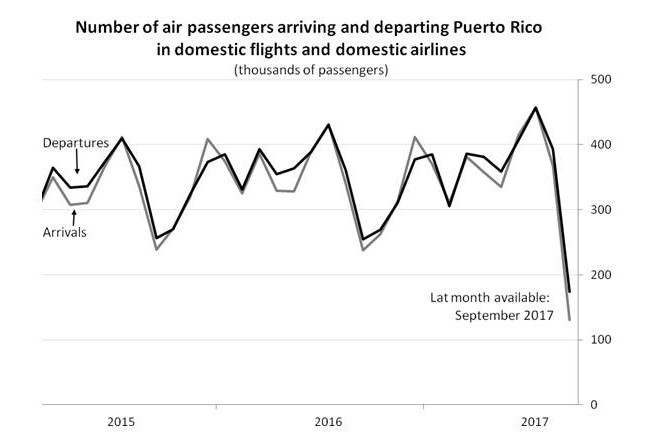
San Juan, PR, December 19, 2017 — Recently, the U.S. Bureau of Transportation Statistics (BTS) published the statistics on air traffic in the United States and Puerto Rico, known as Air Carrier Statistics, for the month of September 2017. These data are provided by airlines to BTS on a monthly basis and represent the first official data published by the federal Government on the movement of air passengers following the passage of hurricanes Irma and María over Puerto Rico. The Puerto Rico Statistics Institute (Institute) presents this brief summary of several findings from this disclosure:
1) Compared to September 2016, the number of air passengers arriving in Puerto Rico dropped by 45 percent, from 238 thousand passengers to only 131 thousand. In the same way, passenger departures from Puerto Rico fell from 254,000 passengers to 173,000 for a decrease of 32 percent.
2) All major destinations and origins of flights from Puerto Rico were affected. The states that experienced the largest percentage reductions in passenger arrivals from Puerto Rico were: Florida, Connecticut, Texas, Georgia, and Illinois. The states with the largest percentage reductions in passenger departures to Puerto Rico were: Florida, Illinois, Connecticut, Texas and Maryland.
3) In 2016, 88,000 net people left Puerto Rico on domestic flights. In recent months, this figure had shown signs of diminishing, falling to almost 60,000 net passengers. With the data just released, this number once again expanded to 93,000 passengers for the 12-month period between October 2016 and September 2017.

Note: Flights within Puerto Rico (intra-island) are excluded. States that received less than a thousand passengers from Puerto Rico in September 2016 are excluded, so the sum of the states is slightly different from the total reported in the table.
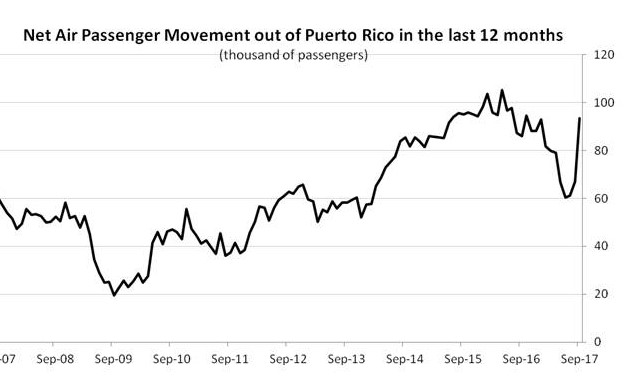
Regarding the movement of passengers, Alberto L. Velázquez-Estrada, manager of Statistical Projects at the Institute, said: “The net movement of passengers in the last 12 months allows us to approximate the behavior of the migratory trend, which in itself is volatile. Data released as of September 2017 are beginning to validate the repercussions after the natural event. First, a decline in air passenger flow due to airport interruptions and second, an increase in more people leaving than returning to the island. In other words, the figure for September 2017 predicts a new increase in emigration, which in itself has fluctuated for more than a decade at high values compared to the size of the population of Puerto Rico.”
More details on data from the U.S. Bureau of Transportation Statistics can be obtained at: https://www.transtats.bts.gov/. You can also access the air flight dataset with cargo and passenger information at https://datos.estadisticas.pr.
The Puerto Rico Statistics Institute is an autonomous governmental entity responsible for coordinating the Government's statistical production service to ensure that the data collection and statistics systems, on which public policies are based, are complete, reliable, and have quick and universal access. The Institute has in its inventory, accessible through statistics.pr.gov, over 300 statistical products. In addition, it is a custodian and provides access to over 100 data sets or “data sets” through www.data.pr.gov and to over 40 tables and more than 6 thousand indicators through: www.indicadores.pr. For more information you can visit our website: www.estadisticas.pr. In addition, you can follow us on social networks through Facebook (estadisticas.pr), Twitter (@EstadisticasPR) and LinkedIn (Institute of Statistics of Puerto Rico) accounts.
##
Press Contact: Sandra Morales Blanes/ (787) 688-0401
We thank the Puerto Rico Senate for the approval of Senate Bill 236, which to create the Puerto Rico Open Data Act. In its original version, the measure was drafted by researchers from the Institute and was later endorsed by the Institute's Board of Directors last year. The implementation of this Act does not cost the public purse an additional penny and, for the first time, mandates specific proactive data disclosure actions, which are essential elements of a culture of openness as a government custom (open by default). For example, for the first time, the publication of data in open computer-readable formats is mandated, one of the elements that gave Puerto Rico the most difficulty the last time Open Knowledge International evaluated the opening of our databases.
The amendments incorporated by the Senate Governance Committee address core aspects of the measure that ultimately complement and strengthen the measure. For example, for the first time, publicly funded official travel reports will be released. This in itself is a more effective way to control official travel expenses than the administrative control schemes that all governments use.
At the same time, as in any measure, there are always specific issues that could be improved. We are looking forward to the consideration of this measure in the House of Representatives. We are aware of the commitment of [Speaker of the House, Hon. Carlos “Johnny” Méndez Núñez, and the president of the House Governance Committee, Hon. Jorge Navarro Suárez, with the issues of transparency and access to public data, so we are sure that the House will give high priority to this measure.
In short, the Open Data Act proposed by the Institute of Statistics is a cornerstone in achieving the cost-effective, agile and transparent Government that we all want.
Please let us know your satisfaction level with our services.
Visit our Official Activities, and participate with us
Visit our Calls for applications and be part of the new opportunities we have for you.
If you have any questions or just want to contact us, visit the Contact Us section.
We are at your disposal. If you need custom statistics, do not hesitate to contact us.
Sign up for our online workshops. Connect with the experts and discover the power of data!
Visit our Blog and keep up to date with the latest news and topics of interest.
Visit our Press Releases and stay connected to the Institute.
Explore the Publication Calendar and keep up to date with Puerto Rico's statistics.
Complete the form for the selection of our Statistics Coordination Committee
Suscribe to receive news directly to your email.
Listen to the Official PRIS podcast and stay informed with the experts

.png)
.png)
.png)
.png)

-p-130x130q80.png)
.png)
.png)
.png)
.png)
.png)
.png)
.png)
.png)
.png)
.png)
.png)