
Passenger movement disrupted after hurricanes

Announcements
IEPR
29 December 2025

PRESS RELEASE

DISRUPTED THE MOVEMENT OF PASSENGERS AFTER HURRICANES

Federal data on passenger departures and arrivals on domestic flights confirm this

San Juan, PR, December 19, 2017 — Recently, the U.S. Bureau of Transportation Statistics (BTS) published the statistics on air traffic in the United States and Puerto Rico, known as Air Carrier Statistics, for the month of September 2017. These data are provided by airlines to BTS on a monthly basis and represent the first official data published by the federal Government on the movement of air passengers following the passage of hurricanes Irma and María over Puerto Rico. The Puerto Rico Statistics Institute (Institute) presents this brief summary of several findings from this disclosure:

1) Compared to September 2016, the number of air passengers arriving in Puerto Rico dropped by 45 percent, from 238 thousand passengers to only 131 thousand. In the same way, passenger departures from Puerto Rico fell from 254,000 passengers to 173,000 for a decrease of 32 percent.

2) All major destinations and origins of flights from Puerto Rico were affected. The states that experienced the largest percentage reductions in passenger arrivals from Puerto Rico were: Florida, Connecticut, Texas, Georgia, and Illinois. The states with the largest percentage reductions in passenger departures to Puerto Rico were: Florida, Illinois, Connecticut, Texas and Maryland.

3) In 2016, 88,000 net people left Puerto Rico on domestic flights. In recent months, this figure had shown signs of diminishing, falling to almost 60,000 net passengers. With the data just released, this number once again expanded to 93,000 passengers for the 12-month period between October 2016 and September 2017.
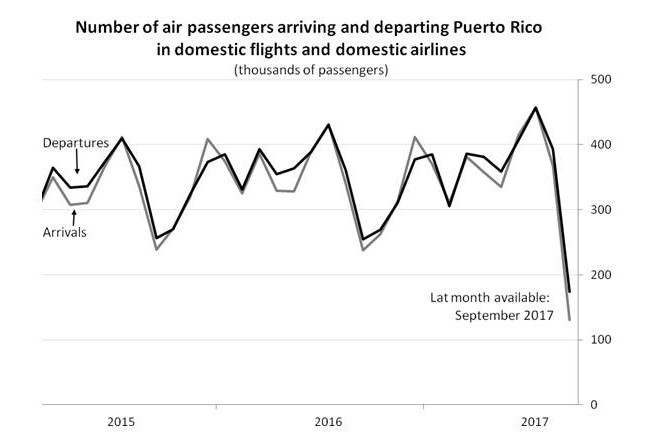
Source: U.S. Bureau of Transportation Statistics, Air Carrier Statistics, T-100 Domestic Segment (U.S. Carriers).

Note: Flights within Puerto Rico (intra-island) are excluded. States that received less than a thousand passengers from Puerto Rico in September 2016 are excluded, so the sum of the states is slightly different from the total reported in the table.
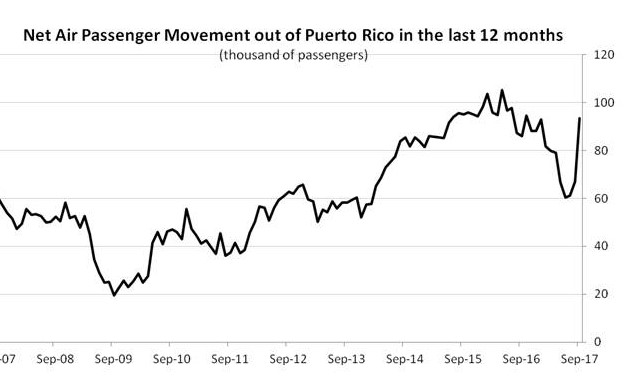
Source: U.S. Bureau of Transportation Statistics, Air Carrier Statistics, T-100 Domestic Segment (U.S. Carriers).

Regarding the movement of passengers, Alberto L. Velázquez-Estrada, manager of Statistical Projects at the Institute, said: “The net movement of passengers in the last 12 months allows us to approximate the behavior of the migratory trend, which in itself is volatile. Data released as of September 2017 are beginning to validate the repercussions after the natural event. First, a decline in air passenger flow due to airport interruptions and second, an increase in more people leaving than returning to the island. In other words, the figure for September 2017 predicts a new increase in emigration, which in itself has fluctuated for more than a decade at high values compared to the size of the population of Puerto Rico.”

More details on data from the U.S. Bureau of Transportation Statistics can be obtained at: https://www.transtats.bts.gov/. You can also access the air flight dataset with cargo and passenger information at https://datos.estadisticas.pr.

The Puerto Rico Statistics Institute is an autonomous governmental entity responsible for coordinating the Government's statistical production service to ensure that the data collection and statistics systems, on which public policies are based, are complete, reliable, and have quick and universal access. The Institute has in its inventory, accessible through statistics.pr.gov, over 300 statistical products. In addition, it is a custodian and provides access to over 100 data sets or “data sets” through www.data.pr.gov and to over 40 tables and more than 6 thousand indicators through: www.indicadores.pr. For more information you can visit our website: www.estadisticas.pr. In addition, you can follow us on social networks through Facebook (estadisticas.pr), Twitter (@EstadisticasPR) and LinkedIn (Institute of Statistics of Puerto Rico) accounts.

##

Press Contact: Sandra Morales Blanes/ (787) 688-0401

Share this article:

Visit our Official Activities, and participate with us

Visit our Calls for applications and be part of the new opportunities we have for you.

If you have any questions or just want to contact us, visit the Contact Us section.

We are at your disposal. If you need custom statistics, do not hesitate to contact us.

Sign up for our online workshops. Connect with the experts and discover the power of data!

Visit our Blog and keep up to date with the latest news and topics of interest.

Visit our Press Releases and stay connected to the Institute.

Explore the Publication Calendar and keep up to date with Puerto Rico's statistics.

Complete the form for the selection of our Statistics Coordination Committee

Suscribe to receive news directly to your email.

Listen to the Official PRIS podcast and stay informed with the experts

Statistics Institute and Department of Education announce agreement to improve quality and access to non-confidential school statistics

Statistics Institute and Department of Education announce agreement to improve quality and access to non-confidential school statistics

Data presented from the Report on Violent Deaths in Puerto Rico

Data presented from the Report on Violent Deaths in Puerto Rico

631 homicides and 229 suicides were reported in Puerto Rico in 2019

The Puerto Rico Violent Death Notification System (PRVDRS) established at the Puerto Rico Institute of Statistics, presented data from the 2019 Report on Violent Deaths in Puerto Rico. The report reports that in 2019 there were 828 incidents of violent deaths, with a total of 894 fatalities. Of the total number of violent deaths, 631 were homicides and 229 were suicides. According to the PRVDRS, violent deaths occur primarily by suicide or homicide.

In 2019, 70.6% of victims of violent deaths were reported in single or multiple homicide incidents and 25.6% were suicide incidents. Five homicide-suicide incidents were reported, resulting in 10 fatalities. In addition, during this period, 10 (1.1%) violent deaths attributed to legal intervention (death in which a person is killed or killed by a law enforcement officer acting in the line of duty) and 20 violent deaths with undetermined intent (2.2%) were documented. Deaths with undetermined intent are those that result from the use of force or power, against oneself or another person, in which evidence indicates that one way of death is no more convincing than another form of death, according to the judgment of medico-legal researchers.

In 2019, approximately 9 out of 10 victims of violent deaths (89.7%) were men. The crude homicide rate was 19.8 per 100,000 inhabitants, 38.9 in men and 2.4 in women. The primary mechanism of the homicides was firearms. 91.7% of the 631 homicides are documented as related to the context of community violence. The victims of these incidents are mainly men (n=558, 96.4%), between 15 and 49 years of age (n=497, 89.1%). The most common criminal circumstances of homicides in Puerto Rico are related to illegal drug trafficking and organized crime (53.5%). In Puerto Rico, according to the report, 91.0% of homicides are committed with firearms, more than double the global average of 42.7%.

In 2019, 29 fatal victims of family violence were reported. Most of these cases were related to violence in an intimate or former partner environment (17 cases, 58.6%). While violence between family members (12 cases, 41.4%), occurred mainly during an argument (63.6%). The vast majority of victims of intimate partner violence were women (n= 15, 88.2%). The two main mechanisms of all homicides of intimate partners were firearms (41.2%) and a sharp instrument (35.3%). More than half of these women were victims of their current spouse or partner (53.3%), while 46.7% were victims of their former spouse or former partner. In addition, 5 of the 17 fatal cases of intimate partner violence were homicide-suicide incidents (29.4%).

As for suicides in Puerto Rico, the report highlights that the frequency is lower than that of homicides. However, as in homicides, suicides are more frequent in men (80.8%). In 2019, the crude suicide rate was 7.2 per 100,000 inhabitants, 12.2 in men (1 of 112 men) and 2.6 in women (1 of 494 women). The main mechanism was asphyxiation.

Mariluz Bezares Salinas, manager of statistical projects at the Institute of Statistics and co-principal investigator of the Report on Violent Deaths in Puerto Rico, explained that the collection of this type of data could involve fieldwork that takes more than two years from the time the incident occurs until the collection and review of the data is completed. For his part, Dr. Diego Zavala, epidemiologist and co-principal investigator of the PRVDRS, said that “this system is a reliable, complete and unique reference source that helps describe the context of violent deaths in the victim-aggressor relationship and the magnitude, trend and characteristics of violent deaths in Puerto Rico.”

The PRVDRS is an epidemiological surveillance system affiliated with the Institute of Statistics and designed to obtain a complete and standardized census of violent deaths in Puerto Rico. The PRVDRS began its participation in the National Violent Death Notification System (National Violent Death Reporting System, NVDRS) in September 2016, through a collaborative agreement granted by the Centers for Disease Control and Prevention (CDC) of the United States Department of Health and Human Services. The 2019 Report on Violent Deaths in Puerto Rico is available through the following link: Puerto Rico Violent Death Notification System.

The Puerto Rico Statistics Institute is an autonomous governmental entity tasked with coordinating the government's statistical production service to ensure that the data collection and statistics systems, on which public policies are based, are complete, reliable, and accessible quickly and universally.

For technical questions about this report, you can send an email to: preguntas@estadisticas.pr.

To learn more about the Institute of Statistics, you can access the website: www.estadisticas.pr.gov. On social media through Facebook accounts (@statistics.pr), Twitter (@EstadisticasPR), Instagram (@institutodeestadisticas) and LinkedIn (Puerto Rico Institute of Statistics).

Number of high school graduate students in Puerto Rico's public system will be below 20,000 in 2020

Number of high school graduate students in Puerto Rico's public system will be below 20,000 in 2020