
Puerto Rico's population is around 3.3 million in 2017

Announcements
IEPR
29 December 2025

PUERTO RICO'S POPULATION IS AROUND 3.3 MILLION IN 2017

It has fallen by 10% since the most recent 2010 Decennial Census

San Juan, PR — El U.S. Census Bureau released today the most recent annual population estimates for Puerto Rico. These statistics refer to July 1, 2017 and include the components of annual population change since July 1, 2010 that support the population estimate since the beginning of the decade. As the leading entity of the Network State Data Center (SDC) of the U.S. Census Bureau in Puerto Rico, the Puerto Rico Statistics Institute (Institute) presents this brief summary of the findings of the new annual population estimates for 2017:

  1. The population of Puerto Rico was estimated at 3,337,177 people as of July 1, 2017.
  2. In contrast to the last 2010 Census when the official population count resulted in 3,725,789 people, the new estimate points to a cumulative population decrease in the current decade of 10 percent up to 2017. That is, a population decline at a rate of -1.5% each year on average (annualized rate).
  3. As for the resident population of 18 years of age or older, this was estimated at 2,680.381 million, comprising 80% of the resident population of Puerto Rico.
  4. The components of population change considered for the estimates assume that, between July 1, 2016 and July 1, 2017, there were 28,000 births and 29,000 deaths in Puerto Rico. For the first time, annual population estimates reflected natural population growth (the number of births minus the number of deaths) that results in more deaths than births. Regarding migration, the net balance was close to -68 thousand people during the same period.

More statistics on Puerto Rico's annual population estimates can be obtained at: https://censo.estadisticas.pr. Information on the methodology used to produce the estimates can be accessed hither.
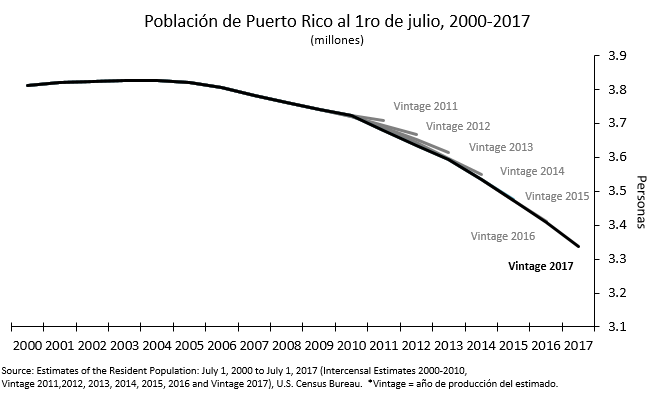
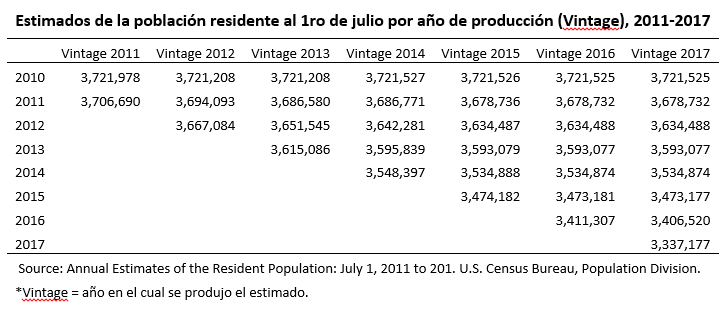
After conducting a decennial Census, such as the 2010 Census, the U.S. Census Bureau prepare the annual population estimates before the next Census. These estimates are prepared by analyzing data on births, deaths and migration. As a result, with each new publication of the estimates, adjustments are made to the previously estimated years. For example, with the publication of the 2017 estimates announced in this release, the estimates already published for 2011, 2012, 2013, 2014, 2015 and 2016 were revised. Each publication is distinguished according to the year in which they were produced and are named as Vintage.


The Puerto Rico Statistics Institute is an autonomous governmental entity responsible for coordinating the Government's statistical production service to ensure that the data collection and statistics systems, on which public policies are based, are complete, reliable, and have quick and universal access. The Institute has in its inventory, accessible through www.estadisticas.pr.gov, over 300 statistical products. In addition, it is a custodian and provides access to over 100 data sets or Data sets by means of www.data.pr.gov and to over 40 tables and more than 6 thousand indicators through: www.indicadores.pr

In addition, as the leading entity of the SDC in Puerto Rico, the Institute manages the SDC portal, which contains the main statistical reports and publications of the U.S. Census Bureau on Puerto Rico, specifically those that are most in demand, such as annual population estimates; the Puerto Rico Community Survey (Puerto Rico Community Survey) and official statistics on Puerto Rico's 10-year population and housing censuses, among others.

For more information you can visit our website: www.estadisticas.pr.gov. In addition, you can follow us on social networks through Facebook accounts (statistics.government.pr), Twitter (@EstadisticasPR) and LinkedIn (Institute of Statistics of Puerto Rico).

##

Press Contact: Sandra Morales Blanes: (787) 688-0401

Share this article:

Visit our Official Activities, and participate with us

Visit our Calls for applications and be part of the new opportunities we have for you.

If you have any questions or just want to contact us, visit the Contact Us section.

We are at your disposal. If you need custom statistics, do not hesitate to contact us.

Sign up for our online workshops. Connect with the experts and discover the power of data!

Visit our Blog and keep up to date with the latest news and topics of interest.

Visit our Press Releases and stay connected to the Institute.

Explore the Publication Calendar and keep up to date with Puerto Rico's statistics.

Complete the form for the selection of our Statistics Coordination Committee

Suscribe to receive news directly to your email.

Listen to the Official PRIS podcast and stay informed with the experts

All migration indicators from Puerto Rico reach new records

All migration indicators from Puerto Rico reach new records

Puerto Rico Institute Statistics launches Digital Platform for the Violent Death Notification System

More than 4,300 Homicides and 1,600 Suicides Since 2017: Digital Platform Allows Exploration of Violent Deaths in Puerto Rico

From 2017 to 2023, Puerto Rico has recorded 4,304 homicides and 1,685 suicides.These figures reflect a complex phenomenon that impacts families, communities, and public safety and health throughout the archipelago.

With the goal of promoting a deeper and more accessible understanding of this reality, the Puerto Rico Violent Death Reporting System (PRVDRS) developed a digital platform that allows for a detailed and contextualized examination of the data.

“The public policy formulation process requires reliable data and rigorous analysis. This tool allows us to measure the magnitude of violent deaths in Puerto Rico and better understand the circumstances surrounding these incidents. Evidence-based decision-making is fundamental to effectively addressing this public health and safety issue,” expressed Planner Mario O. Font Martin, Statistical Projects Manager and Coordinator of the PRVDRS.

Data to Help Understand the Phenomenon

The PRVDRS integrates information from multiple official sources, including the Puerto Rico Police, the Institute of Forensic Sciences, and the Demographic Registry of the Department of Health. By combining these sources into an anonymized database, the system allows for the analysis of not only how many deaths occur but also the circumstances surrounding them.

From the start of data collection in 2017 through 2023, the system has documented:

  • 4,304 homicides
  • 1,685 suicides

This integration allows for the identification of patterns and trends that are not always visible in individual reports.

What Does the Digital Platform Offer?

The tool allows citizens to:

  • Explore historical trends since 2017.
  • Analyze data through interactive visualizations and maps.
  • Examine the classification of violence (e.g., community or collective).
  • Identify the type of weapon involved.
  • Review circumstances associated with the incidents.

Currently, the platform presents official consolidated data through 2023, along with preliminary data from 2024 to 2026, which will be updated monthly.

A Nationally Integrated Effort

The PRVDRsis part of the National Violent Death Reporting System (NVDRS), coordinated by the Centers for Disease Control and Prevention (CDC). The PRVDRS collects information documented by the Puerto Rico Police, the Institute of Forensic Sciences, and death certificates from the Department of Health's Demographic Registry into an anonymous database with over 600 variables. For more information on the NVDRS, you can access the following link: National Violent Death Reporting System.

This methodology allows for an understanding of not only the cause of death but also the circumstances and factors related to each case, facilitating comparisons with other U.S. jurisdictions.

Public Access

The platform is available through the official portal of the Puerto Rico Institute of Statistics: Puerto Rico Violent Death Notification System (PRVDRS) interactive tool

Open access to this data strengthens transparency and fosters informed conversations regarding violence prevention and public policy. Understanding the data is an essential step toward addressing one of the most complex challenges facing Puerto Rico in an informed manner.

About the Puerto Rico Institute of Statistics

The Institute is an autonomous government entity responsible for coordinating the production of government statistics to ensure that the data collection systems upon which public policies are based are complete, reliable, and provide rapid and universal access.

Strong increase in households with people aged 65 and over in Puerto Rico
PRESS RELEASE
PUERTO RICO STATE DATA CENTER NETWORK (SDC-PR)
Puerto Rico Institute of Statistics

Strong increase in households with people aged 65 and over in Puerto Rico

It is estimated that in 50 municipalities, four out of ten households have this trait.

San Juan, PR, December 8, 2022 — The U.S. Census Bureau released today the most recent data from the Puerto Rico Community Survey. These statistics refer to information collected over a period of five years, from 2017 to 2021. The new publication provides data on demographic, social, economic and housing characteristics for Puerto Rico and municipalities, as well as for specific geographical levels such as neighborhoods and census tracts. As part of the U.S. State Data Center Network. Census Bureau in Puerto Rico, the Puerto Rico Statistics Institute (Institute) presents several interesting results:

  1. During the period 2017-2021, four out of ten households in fifty municipalities had one or more people aged 65 or older. This trait was reflected in only twelve municipalities in the period 2012-2016.
  2. In a comparison of the previous five-year period 2012-2016, compared to the most recent period 2017-2021, estimates indicate that:
    • Among the total number of households in Puerto Rico, the percentage of households with one or more people aged 65 years or older increased from 35.1% to 40.6%, this change being statistically significant.
    • At the municipal level, the 78 municipalities showed an increase in this trait of households with one or more people aged 65 and over.
      • It should be noted that in 69 of the 78 municipalities, the increases were statistically significant.
      • The municipalities of Las Marías, Naranjito, Comerío, Aguada and Corozal showed the highest increase in this characteristic, this change being close to or greater than 10 percentage points.
    • On the other hand, the median income in Puerto Rico was reflected between periods;
      • A decrease in household income of 0.8% or from $22,136 to $21,967, not a statistically significant difference.
      • An increase in household income of 1.2% or from $26,439 to $26,745, a difference not statistically significant.

“The population aged 65 and over is increasingly present in the homes of our jurisdiction; this is partly a reflection of the peak of births that occurred in Puerto Rico in the 1940s and 1960s. Those generations active in our society require and will require support and services for their needs in the present and near future, whether from the immediate family circle, as well as from government programs aimed at this population, said Alberto L. Velázquez-Estrada, Senior Manager of Statistical Projects at the Institute.

Tables with interesting characteristics can be accessed in the data dissemination tool of the U.S. Census Bureau data.census.gov. In addition, as the leading entity of the State Data Center of Puerto Rico, the Institute manages the SDC portal, which contains the main statistical reports and publications of the U.S. Census Bureau on Puerto Rico, specifically those that are most in demand, such as municipal profiles, estimated annual population; the Puerto Rico Community Survey (Puerto Rico Community Survey) and official statistics on Puerto Rico's decennial population and housing censuses, among others. The Puerto Rico SDC portal can be accessed through: censo.estadisticas.pr.

Puerto Rico Statistics Institute is an autonomous governmental entity tasked with coordinating the Government's statistical production service to ensure that the data collection and statistics systems, on which public policies are based, are complete, reliable and have quick and universal access.

For more information you can visit the website: www.estadisticas.pr.gov or write to preguntas@estadisticas.pr They can also follow social networks through Facebook (@estadisticas .pr), Twitter (@EstadisticasPR), LinkedIn (Institute of Statistics of Puerto Rico) and Instagram (@institutodeestadisticas) accounts.