
To create the "Act on the Ethical Use of Artificial Intelligence in Educational Institutions of Puerto Rico"; to require the Puerto Rico Department of Education, as well as all private educational institutions, to establish policies incorporating ethical standards for the use of artificial intelligence; and for other related purposes.

San Juan, PR, May 22, 2025 — The Puerto Rico Statistics Institute (Institute) published the Demographic Observatory, a summary table with graphs on demographic aspects of Puerto Rico. The tool visualizes a series of statistical indicators by demographic components, combining in a single instance the main sources of information that are usually separated. Through simple navigation, you can view recent statistics on Annual Population Estimates, Decennial Censuses, Vital Statistics with Fertility and Mortality indicators, as well as estimates of Migration by various characteristics.
El Demographic Observatory contains a total of twenty-three (23) graphics displayed in the following sections:
El Demographic Observatory is available on the Institute's Census Data and Information page (SDC-PR) at https://censo.estadisticas.pr/node/535. “Fulfilling our mission to guarantee complete, reliable statistics with quick and universal access, we have created a series of simple visualizations that allow us to observe the demographic behavior of the jurisdiction, thus promoting informed and evidence-based decision-making,” said Lanselotte Oliveras, Assistant for Statistical Projects at the Institute.
For his part, Alberto L. Velázquez-Estrada, Senior Manager of Statistical Projects at the Institute, said, “The Demographic Observatory manages to visually centralize several demographic trends in Puerto Rico as conceptualized. In this sense, people can directly consult the behavior of relevant demographic traits that are frequently requested.”
As the leading entity of the State Data Center of Puerto Rico, the Institute manages the SDC portal, which contains the main statistical reports and publications of the U.S. Census Bureau about Puerto Rico, specifically those that are most in demand, such as annual population estimates; the Puerto Rico Community Survey (Puerto Rico Community Survey) and official statistics on Puerto Rico's decennial population and housing censuses, among others. The Puerto Rico SDC portal can be accessed through: https://censo.estadisticas.pr.
The Puerto Rico Statistics Institute is an autonomous governmental entity responsible for coordinating the Government's statistical production service to ensure that the data collection and statistics systems, on which public policies are based, are complete, reliable, and have quick and universal access.
For more information you can visit the website: www.estadisticas.pr or write to preguntas@estadisticas.pr. They can also follow social networks through Facebook (@estadisticas .pr), X (@EstadisticasPR), LinkedIn (Institute of Statistics of Puerto Rico) and Instagram (@institutodeestadisticas) accounts.
Date: May 22, 2025 P. of C. 562: To amend Article 2.01 of Chapter 2 of Act No. 122-2017, known as the “New Government of Puerto Rico Act”, and the first paragraph of Article 3 of Act No. 209-2003, as amended, known as the “Puerto Rico Statistics Institute Act”, for the purpose of including the Puerto Rico Statistics Institute among the entities exempt from the provisions of the above-mentioned Act No. 122 and to express such exclusion in such laws, in order to preserve nature of the Institute of Statistics of Puerto Rico as an autonomous administrative and fiscally independent entity of the Executive Branch of the Government of Puerto Rico; and make technical corrections.
Carolina, Puerto Rico. May 12, 2025. The Puerto Rico Statistics Institute held the forum “From Violence to Dialogue: Understanding and Preventing the Social Crisis”, an event that brought together leading professionals from various disciplines to analyze, from an evidence-based approach, the multiple expressions of violence faced by Puerto Rico.
The program included presentations on armed violence, drug trafficking, intimate partner violence, femicide, education, social inequality and suicide. Each presentation was based on statistical evidence and proposals to strengthen public policies aimed at prevention.
The keynote speech was given by Dr. César A. Rey Hernández, who presented a sociological perspective on the links between inequality, education and violence. In his presentation “Whoever opens a school door closes a prison”, Dr. Rey highlighted that Puerto Rico is facing a profound crisis of school dropout, youth migration, child poverty and the deterioration of the social fabric. He said that in Puerto Rico there are more drug outlets than public schools, reflecting the limited opportunities available to young people and the impact of an expanding informal and illegal economy. Dr. Rey emphasized the urgency of an educational project with a humanistic approach, capable of responding to the ethical and social challenges of the present.
Another of the forum's outstanding topics was suicide prevention, in which demographer Raúl Figueroa Rodríguez, consultant to the Commission for Suicide Prevention, offered an analysis of recent trends, revealing that Puerto Rico reports an annual average of 265 suicides, of which 85% are men, pointing out that the highest rates are recorded in municipalities in central Puerto Rico and in its island municipalities, and that more than 50% of cases are among people over 50 years of age. Figueroa presented the Puerto Rico Socioeconomic Vulnerability Index for Suicide (IVSS-PR), a tool developed to guide community interventions, resource allocation and evidence-based public policy formulation.
During the event, issues such as domestic violence, feminicide, possession of weapons, drug trafficking and the role of public health in preventing violence were also addressed. The program included the participation of experts in epidemiology, criminal justice, demography and officials from state and federal agencies, who shared updated data and multisectoral strategies.
“The purpose of this forum was to provide in-depth and rigorous analysis that serves as a basis for making informed decisions. Our responsibility as an Institute is to ensure that data is at the service of the life, security and dignity of all people in Puerto Rico,” said Dr. Orville M. Disdier Flores, Executive Director of the Institute of Statistics, who added that “this forum reinforces the Institute's commitment to continue generating and disseminating reliable information that allows us to understand the roots of violence, promote social dialogue and strengthen the formulation of evidence-based public policies.”
The Puerto Rico Statistics Institute is an autonomous governmental entity responsible for coordinating the Government's statistical production service to ensure that the data collection and statistics systems, on which public policies are based, are complete, reliable, and have quick and universal access.
For more information you can write to preguntas@estadisticas.pr. They can also follow social networks through Facebook (@estadisticas .pr), X (@EstadisticasPR), LinkedIn (Institute of Statistics of Puerto Rico) and Instagram (@institutodeestadisticas) accounts.
Date: May 12, 2025 P. of C. 561: To amend Article 3 of Law No. 209-2003, as amended, known as the “Puerto Rico Statistics Institute Act”, and Article 5 of Law No. 3-2017, as amended, known as the “Act to Address the Economic, Fiscal and Budgetary Crisis to Ensure the Functioning of the Government of Puerto Rico”, in order to preserve and guarantee the administrative and fiscal autonomy of the Puerto Rico Statistics Institute; update certain legal provisions and make some technical corrections.
Forum “From Violence to Dialogue: Understanding and Preventing the Social Crisis”
On May 12, 2025, the Puerto Rico Institute of Statistics held the forum entitled “From Violence to Dialogue: Understanding and Preventing the Social Crisis”, an event that brought together renowned experts from various disciplines to analyze, based on data, the multiple expressions of violence currently faced by Puerto Rico. The main objective of the meeting, held in Carolina, was to promote an informed dialogue that contributes to the understanding and prevention of violence in all its forms. The forum program included presentations on topics such as armed violence, drug trafficking, intimate partner violence, feminicide, education, social inequality and suicide. Each paper was supported by rigorous statistical evidence, as well as proposals aimed at strengthening public policies aimed at preventing these social problems.
The initiative:
The forum “From Violence to Dialogue: Understanding and Preventing the Social Crisis” focused on the importance of creating a space in which the context of current violence in Puerto Rico was addressed, where the intersection of various types of violence requires a comprehensive and evidence-based analysis. This multidisciplinary meeting not only allowed us to examine the different manifestations of violence, but it also established an important precedent in the use of statistical data for the development of public prevention policies. The participation of experts in different fields contributed to a deeper understanding of the magnitude of violence and the social challenges faced by Puerto Rico for the development of effective strategies that promote a safer and more equitable society.
Special Guest Presentations:
Puerto Rico Institute of Statistics
Materials:
Video Summary
Forum “From Violence to Dialogue: Understanding and Preventing the Social Crisis”
On May 12, 2025, the Puerto Rico Institute of Statistics held the forum entitled “From Violence to Dialogue: Understanding and Preventing the Social Crisis”, an event that brought together renowned experts from various disciplines to analyze, based on data, the multiple expressions of violence currently faced by Puerto Rico. The main objective of the meeting, held in Carolina, was to promote an informed dialogue that contributes to the understanding and prevention of violence in all its forms. The forum program included presentations on topics such as armed violence, drug trafficking, intimate partner violence, feminicide, education, social inequality and suicide. Each paper was supported by rigorous statistical evidence, as well as proposals aimed at strengthening public policies aimed at preventing these social problems.
The initiative:
The forum “From Violence to Dialogue: Understanding and Preventing the Social Crisis” focused on the importance of creating a space in which the context of current violence in Puerto Rico was addressed, where the intersection of various types of violence requires a comprehensive and evidence-based analysis. This multidisciplinary meeting not only allowed us to examine the different manifestations of violence, but it also established an important precedent in the use of statistical data for the development of public prevention policies. The participation of experts in different fields contributed to a deeper understanding of the magnitude of violence and the social challenges faced by Puerto Rico for the development of effective strategies that promote a safer and more equitable society.
Special Guest Presentations:
Puerto Rico Institute of Statistics
Materials:
Please let us know your satisfaction level with our services.
Visit our Official Activities, and participate with us
Visit our Calls for applications and be part of the new opportunities we have for you.
If you have any questions or just want to contact us, visit the Contact Us section.
We are at your disposal. If you need custom statistics, do not hesitate to contact us.
Sign up for our online workshops. Connect with the experts and discover the power of data!
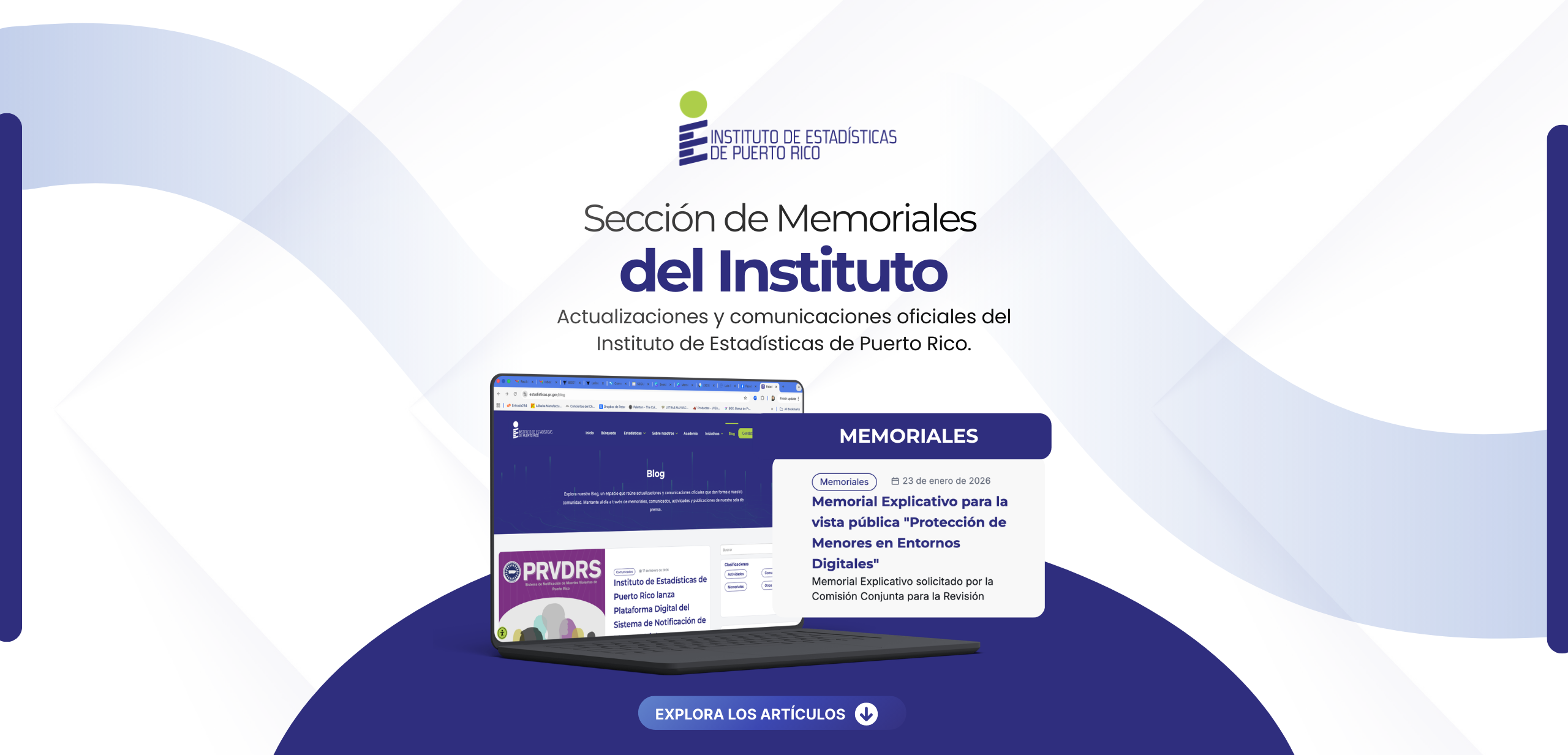
Visit our Blog and keep up to date with the latest news and topics of interest.
Visit our Press Releases and stay connected to the Institute.
Explore the Publication Calendar and keep up to date with Puerto Rico's statistics.
Complete the form for the selection of our Statistics Coordination Committee
Suscribe to receive news directly to your email.
Listen to the Official PRIS podcast and stay informed with the experts

.png)
.png)
.png)
.png)

-p-130x130q80.png)
.png)
.png)
.png)
.png)
.png)
.png)
.png)
.png)
.png)
.png)
.png)