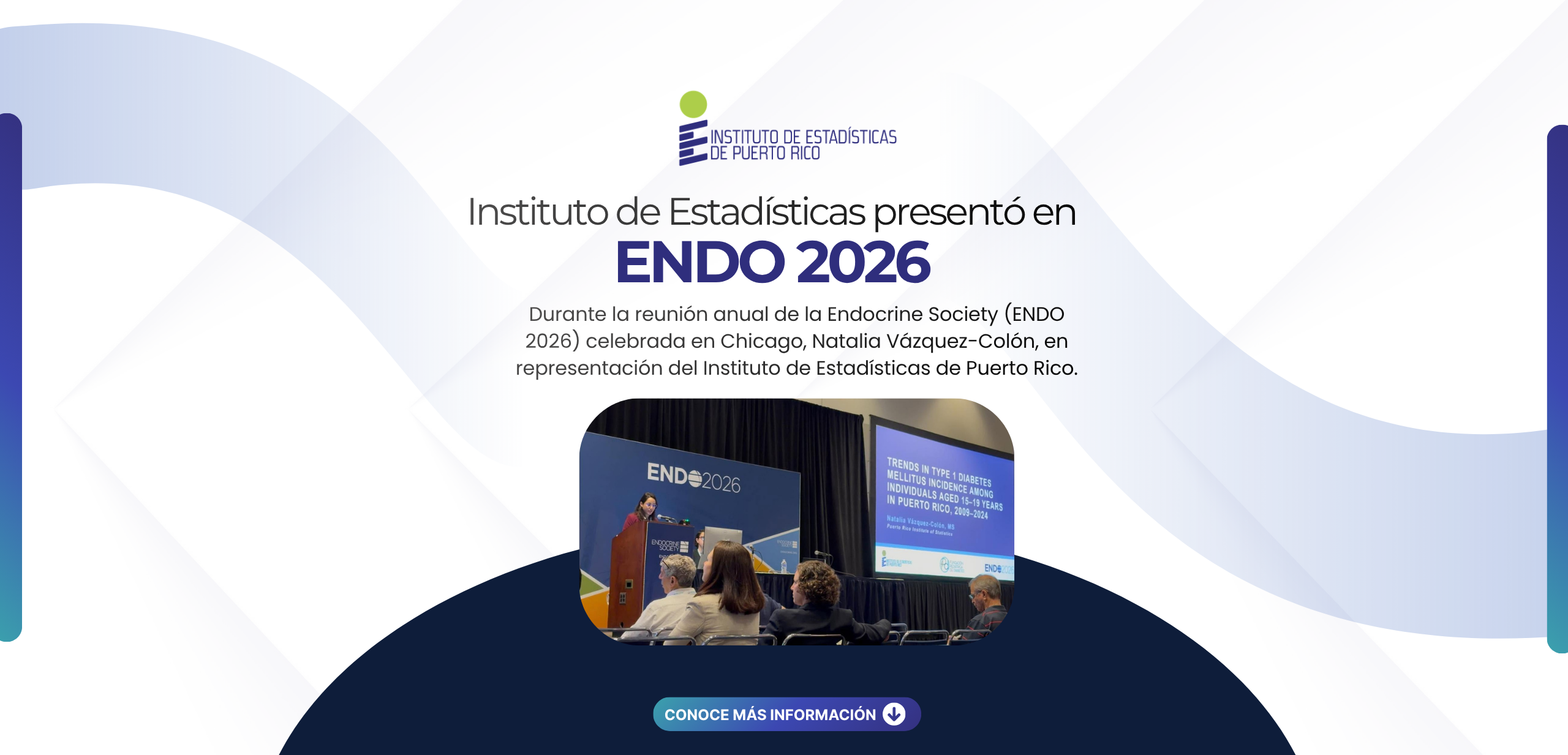

During the annual meeting of the Endocrine Society (ENDO 2026) held in Chicago, Natalia Vázquez-Colón, representing the Puerto Rico Institute of Statistics, presented original research on the incidence of type 1 diabetes in adolescents aged 15 to 19 in Puerto Rico.
The results showed an upward trend in incidence during the 2009–2024 period. The analysis identified a significant average annual growth of 4.1%.
The research was conducted through a collaboration between the Institute of Statistics and the Pediatric Diabetes Foundation. Participation in ENDO 2026 allowed for sharing scientific evidence generated in Puerto Rico with a highly prestigious national and international audience of researchers, academics, and clinicians.
Access a copy of the presentation at: Trends in Type 1 Diabetes Mellitus Among Individuals Aged 15-19 Years in Puerto Rico.

PRESS RELEASE
DR. MARIO MARAZZI-SANTIAGO
EXECUTIVE DIRECTOR
The decision makes it easier for the Planning Board to comply with the methodological changes
required for Puerto Rico's economy to be included in that of the United States
San Juan, PR, July 6, 2018 — The Puerto Rico Statistics Institute (Institute) announced today that its Board of Directors recently approved continuing to financially support the work of the Roadmap for the Modernization of Puerto Rico's Economic Accounts, work plan agreed between the Planning Board (JP) and the Institute for necessary improvements to Puerto Rico's macroeconomic accounting methodologies.
East Roadmap includes the need to invest in the information systems used by JP to prepare Puerto Rico's economic accounting statistics. In fact, the Institute has been investing in these systems for more than a year. Specifically, in 2016 it was entrusted to the company Wovenware the migration of information systems from a technology based on Oracle products to one based on Microsoft SQL. This is because Oracle discontinued technological support for Softwares that JP uses, which caused processing problems in that agency.
The recent decision, for example, extends this agreement to the next fiscal year, during which it is expected that Wovenware complete final phases 3 and 4 for which the Institute will be investing more than $300,000. The project, which began in 2016 and is expected to end in 2019, will allow the database to be updated automatically, duplicate data to be eliminated and processes to be improved as well as the accessibility of JP statistics.
“As part of our mission to objectively support public administration, the Institute's Board of Directors has done its part to continue the necessary improvements in government, at times of great uncertainty. It is also a project supported by the employees of the JP and the President of the JP that will allow this agency to evolve and for which we are investing more than 10% of the Institute's budget,” said the executive director of the Institute, Dr. Mario Marazzi-Santiago.
“It is worth noting that this project implements some of the methodological changes adopted by the Institute's Board of Directors in the Resolution No. 2014-02, so that Puerto Rico's national accounts are more reliable, comparable and quickly and universally accessible. At the same time, we are complying with the federal government's requirements for Puerto Rico's economy to be included in the statistics of the United States economy,” added Dr. Marazzi-Santiago.
A recent report from the Government Accountability Office (GAO), entitled Puerto Rico: Limited Federal Data Hinder Analysis of Economic Condition and Dol's 2016 Overtime Rule, found that the lack of federal data on Puerto Rico's economy had made it difficult to analyze the impact of a labor standard proposed by former President of the United States, Barack Obama, on overtime pay for certain types of jobs.
“For statistics on the Puerto Rico economy to be included in those of the United States economy, the Government of Puerto Rico must do its part as well. Since 2011, the federal Government has written down the methodological changes that need to be made to the Planning Board. It is important that this agenda be continued. The Institute's Board of Directors has done its part, because it has the expertise, professionalism, seriousness and independence of judgment that are necessary to understand that this is an agenda that is too important to be derailed,” said Dr. Marazzi-Santiago.
The Puerto Rico Statistics Institute is an autonomous governmental entity responsible for coordinating the Government's statistical production service to ensure that the data collection and statistics systems, on which public policies are based, are complete, reliable, and have quick and universal access. The Institute has in its inventory, accessible through https://estadisticas.pr.gov, about 300 statistical products. In addition, it is a custodian and provides access to over 100 data sets or “data sets” through https://data.pr.gov and to over 40 tables and more than 6 thousand indicators through: https://www.indicadores.pr.
In addition, as the leading entity of the State Data Center (SDC) of Puerto Rico, the Institute manages the SDC portal, which contains the main statistical reports and publications of the U.S. Census Bureau on Puerto Rico, specifically those that are most in demand, such as annual population estimates; the Puerto Rico Community Survey (Puerto Rico Community Survey) and official statistics on Puerto Rico's 10-year population and housing censuses, among others. The Puerto Rico SDC portal can be accessed through: https://censo.estadisticas.pr.
For more information you can visit our website: https://estadisticas.pr.gov. In addition, you can follow us on social networks through Facebook accounts (https://www.facebook.com/estadisticas.pr), Twitter (https://twitter.com/estadisticaspr) and LinkedIn (https://www.linkedin.com/company/instituto-de-estadisticas-de-puerto-rico).
##
Press Contact: Sandra Morales Blanes (787) 688-0401
PRESS RELEASE
DR. MARIO MARAZZI-SANTIAGO
EXECUTIVE DIRECTOR
AUTHORIZED STATEMENTS BY THE EXECUTIVE DIRECTOR OF THE INSTITUTE OF STATISTICS REGARDING THE FINAL APPROVAL OF P. C. 1403 BY THE LEGISLATIVE ASSEMBLY OF PUERTO RICO
Last night, the Legislative Assembly agreed on the Conference Committee and approved the House Project 1403 after deleting Chapter XII related to the Puerto Rico Institute of Statistics.
We thank and congratulate both the House and the Senate for having completed the approval of the reorganization of the Department of Economic Development and Commerce, after having accepted our recommendation as well as the request of thousands of individuals and scientists, 47 world-renowned scientific organizations, 16 congressmen, the Puerto Rican National Agenda, the Private Sector Coalition, the Transparency Network, the Network of Foundations, the Academy for the Advancement of the Sciences, the American Statistical Association, the Royal Statistical Society, among many others, who publicly called for the Puerto Rico Institute of Statistics to remain an autonomous entity of the Government of Puerto Rico.
We reiterate our best willingness to hold an open dialogue regarding the future of the Institute of Statistics, its role within the Government of Puerto Rico and our society, so that we are allowed to continue working to ensure that the systems for collecting data and statistics, on which public policies are based, are complete, reliable and accessible quickly and universally.
##
Press Contact: Sandra Morales Blanes (787) 688-0401
PRESS RELEASE
DR. MARIO MARAZZI-SANTIAGO
EXECUTIVE DIRECTOR
RESIDENT COMMISSIONER LAUNCHES CONGRESSIONAL BILL TO PROMOTE PUERTO RICO'S INCLUSION IN FEDERAL STATISTICS
The bill also requires that the Fiscal Oversight Board submit to Congress
an annual report on the budget allocated to the Puerto Rico Institute of Statistics
San Juan, PR, June 28, 2018 — The resident commissioner, Hon. Jennifer A. González Colón, filed this week in the United States Congress the H.R. 6211 project, better known as the Puerto Rico Data Collection Equality Act of 2018, which seeks to improve the collection and publication of statistics related to Puerto Rico, through the inclusion of Puerto Rico in federal statistics.
The project was created to follow up on the recommendations made in the Final report of the Task Force bipartisan congressional representative created under the federal PROMESA Act of December 2016, some of which are based on recommendations made by the Puerto Rico Institute of Statistics (Institute). For example, that report recommended that the Chief Statistician of the United States to develop a plan, in coordination with the Interagency Council on Statistical Policy, to collect and publish statistics on Puerto Rico, in a similar way as is done for states. He also recommended including Puerto Rico in several surveys of the U.S. Census Bureau, such as the Government Census, the American Housing Survey, among others, and at the same time proposed to seek to include Puerto Rico in the statistics prepared by several federal agencies, including the National Center for Education Statistics, The National Center for Health Statistics, The National Agricultural Statistical Service, the Bureau of Justice Statistics, The Energy Information Administration, among others.
As for the Institute, the above-mentioned congressional report recommended that it remain an independent entity of the Government of Puerto Rico and that its budget be increased, in accordance with its important duties. For these purposes, the new project filed by the Resident Commissioner requires that the Fiscal Oversight Board (JSF) provide the United States Congress with an annual report on the budget allocated to the Institute, specifically justifying the level of funds it provided for the Institute, in the general budget of the Government of Puerto Rico.
“We congratulate the Resident Commissioner for the initiation of this important project. In Washington, they are attentive to the actions being taken in Puerto Rico regarding the future of the Institute and its budget, because the problem with Puerto Rico's statistics also affects the United States. It would be counterproductive to deepen the crisis of credibility of our Government by consolidating the Institute within the Government,” said Dr. Mario Marazzi-Santiago, executive director of the Institute.
In the coming days, the Senate and House of Representatives of Puerto Rico will seek to agree on a version of consensus regarding P. de la C. 1403, which consolidates the Institute within the Department of Economic Development and Commerce (DDEC). This project eliminates all of the Institute's independent governance structures, and in effect eliminates the Institute by converting it into the DDEC Statistics Program. In addition, the project orders the DDEC to outsource Puerto Rico's statistics system.
Thousands of people and scientists, 47 world-renowned scientific organizations, 16 congressmen, the Private Sector Coalition, the Transparency Network, the National Academy for the Advancement of the Sciences, the American Statistical Association, the Royal Statistical Society and the JSF, among many others, have recommended that the Institute be maintained as an independent entity of the Government of Puerto Rico, free from political intervention.
The Puerto Rico Statistics Institute is an autonomous governmental entity responsible for coordinating the Government's statistical production service to ensure that the data collection and statistics systems, on which public policies are based, are complete, reliable, and have quick and universal access. The Institute has in its inventory, accessible through www.estadisticas.pr.gov, about 300 statistical products. In addition, it is a custodian and provides access to over 100 data sets or “data sets” through www.data.pr.gov and to over 40 tables and more than 6 thousand indicators through: www.indicadores.pr.
In addition, as the leading entity of the State Data Center (SDC) of Puerto Rico, the Institute manages the SDC portal, which contains the main statistical reports and publications of the U.S. Census Bureau on Puerto Rico, specifically those that are most in demand, such as annual population estimates; the Puerto Rico Community Survey (Puerto Rico Community Survey) and official statistics on Puerto Rico's 10-year population and housing censuses, among others. The Puerto Rico SDC portal can be accessed through: https://censo.estadisticas.pr/.
For more information you can visit our website: www.estadisticas.pr.gov. In addition, you can follow us on social networks through Facebook (estadisticas.pr), Twitter (@EstadisticasPR) and LinkedIn (Institute of Statistics of Puerto Rico) accounts.
##
Press Contact: Sandra Morales Blanes (787) 688-0401
PRESS RELEASE June 26th, 2018
DR. MARIO MARAZZI-SANTIAGO
EXECUTIVE DIRECTOR
AUTHORIZED STATEMENTS BY THE EXECUTIVE DIRECTOR OF THE INSTITUTE OF STATISTICS REGARDING THE APPROVAL OF P. C. 1403 BY THE LEGISLATIVE ASSEMBLY OF PUERTO RICO
We are waiting to hear the results of the conference committees so that we can know what will be approved. However, we take the liberty of making some statements in general terms about our feelings.
We are struck by the lack of legislation to advance the transparency agenda in this session. Added to that is the possible approval of P. de la C. 1403 with which, far from promoting greater transparency, the Legislative Assembly would seem to take several steps backwards on that important agenda.
In recent days, we have seen how municipal governments, on their own, have begun to take steps towards greater transparency in the way they manage public funds. It leaves deafening silence the months and years that the central government has ignored the possibility of participating free of charge in the same Puerto Rico Financial Transparency System, which municipal governments are now beginning to adopt.
In the same way, even though there is a virtual global scientific consensus in favor of allowing the Institute of Statistics to continue to carry out its functions independently, the Government also seems to ignore it.
On this occasion, not only in Puerto Rico but in the world, they are observing the steps taken by the Legislative Assembly in the coming days with respect to P. de la C. 1403. With the recent experience of the incomplete count of deaths caused by Hurricane Maria, the Government's commitment to transparency will once again be called into question with the approval of P. de la C. 1403.
It's important for me to stress that:
The approval of P. de la C. 1403 is a serious mistake. The Legislative Assembly should not participate in eliminating what it once created to protect the same legislators from being manipulated with erroneous or incomplete information that the Executive Branch controls to ensure that the measures that the current Government wishes are approved. Legislators have the floor.
##
Press Contact: Sandra Morales Blanes (787) 688-0401
PRESS RELEASE
DR. MARIO MARAZZI‐SANTIAGO
EXECUTIVE DIRECTOR
This represents a new record, as revealed by the most recent Migrant Profile published by the Puerto Rico Institute of Statistics.
San Juan, PR, June 20, 2018 — In 2016 89,000 people immigrated to the United States, thus maintaining the same record level as last year, while there was an increase of 3,000 compared to 2015, for a total of -67,000 people, who emigrated in net terms. This represents a new immigration record for Puerto Rico.
This was revealed in the 2016 Migrant Profile, which was released today and presents a look at the migratory movement of Puerto Rico in the 2016 calendar year using the Survey on the Community of U.S. Census Bureau, as well as the net movement data of air passengers from the U.S. Bureau of Transportation Statistics (BTS) and the Ports Authority. Here are some of the report's other key findings:
4. Between 2015 and 2016, the profile of the population that migrated between Puerto Rico and the United States changed in several ways:
“Among the characteristics examined in 2016, a remarkable 57% of emigrants aged 25 and over had some education greater than high school. In addition, the percentage of emigrants outside the labor force once mobilized in the United States was 37%, compared to 55% with a similar characteristic in Puerto Rico. This picture makes clear the lack of opportunities on the island to allow more people to be inserted into the labor sector, even though more than half of the adults who decided to emigrate have some preparation and potential to be employed. One wonders if we are considering these types of indicators and their trends in order to counteract this pattern,” said Alberto L. Velázquez-Estrada, manager of statistical projects at the Institute.
The full report, as well as previous publications of the profile, are available on the Institute's portal at www.estadisticas.pr.gov, you can also access the various publications in the profile via direct link hither.
The Puerto Rico Statistics Institute is an autonomous governmental entity responsible for coordinating the Government's statistical production service to ensure that the data collection and statistics systems, on which public policies are based, are complete, reliable, and have quick and universal access. The Institute has in its inventory, accessible through www.estadisticas.pr.gov, about 300 statistical products. In addition, it is a custodian and provides access to over 100 data sets or “data sets” through www.data.pr.gov and to over 40 tables and more than 6 thousand indicators through: www.indicadores.pr.
In addition, as the leading entity of the SDC in Puerto Rico, the Institute manages the SDC portal, which contains the main statistical reports and publications of the U.S. Census Bureau on Puerto Rico, specifically those that are most in demand, such as annual population estimates; the Puerto Rico Community Survey (Puerto Rico Community Survey) and official statistics on Puerto Rico's 10-year population and housing censuses, among others. The Puerto Rico SDC portal can be accessed through: https://censo.estadisticas.pr/.
For more information you can visit our website: www.estadisticas.pr.gov. In addition, you can follow us on social networks through Facebook (estadisticas.pr), Twitter (@EstadisticasPR) and LinkedIn (Institute of Statistics of Puerto Rico) accounts.
##
Press Contact: Sandra Morales Blanes/(787) 688-0401
Dr. Mario Marazzi presents at regional economic development forum
Please let us know your satisfaction level with our services.
Visit our Official Activities, and participate with us
Visit our Calls for applications and be part of the new opportunities we have for you.
If you have any questions or just want to contact us, visit the Contact Us section.
We are at your disposal. If you need custom statistics, do not hesitate to contact us.
Sign up for our online workshops. Connect with the experts and discover the power of data!
Visit our Blog and keep up to date with the latest news and topics of interest.
Visit our Press Releases and stay connected to the Institute.
Explore the Publication Calendar and keep up to date with Puerto Rico's statistics.
Complete the form for the selection of our Statistics Coordination Committee
Suscribe to receive news directly to your email.
Listen to the Official PRIS podcast and stay informed with the experts

.png)
.png)
.png)
.png)

-p-130x130q80.png)
.png)
.png)
.png)
.png)
.png)
.png)
.png)
.png)
.png)
.png)
.png)