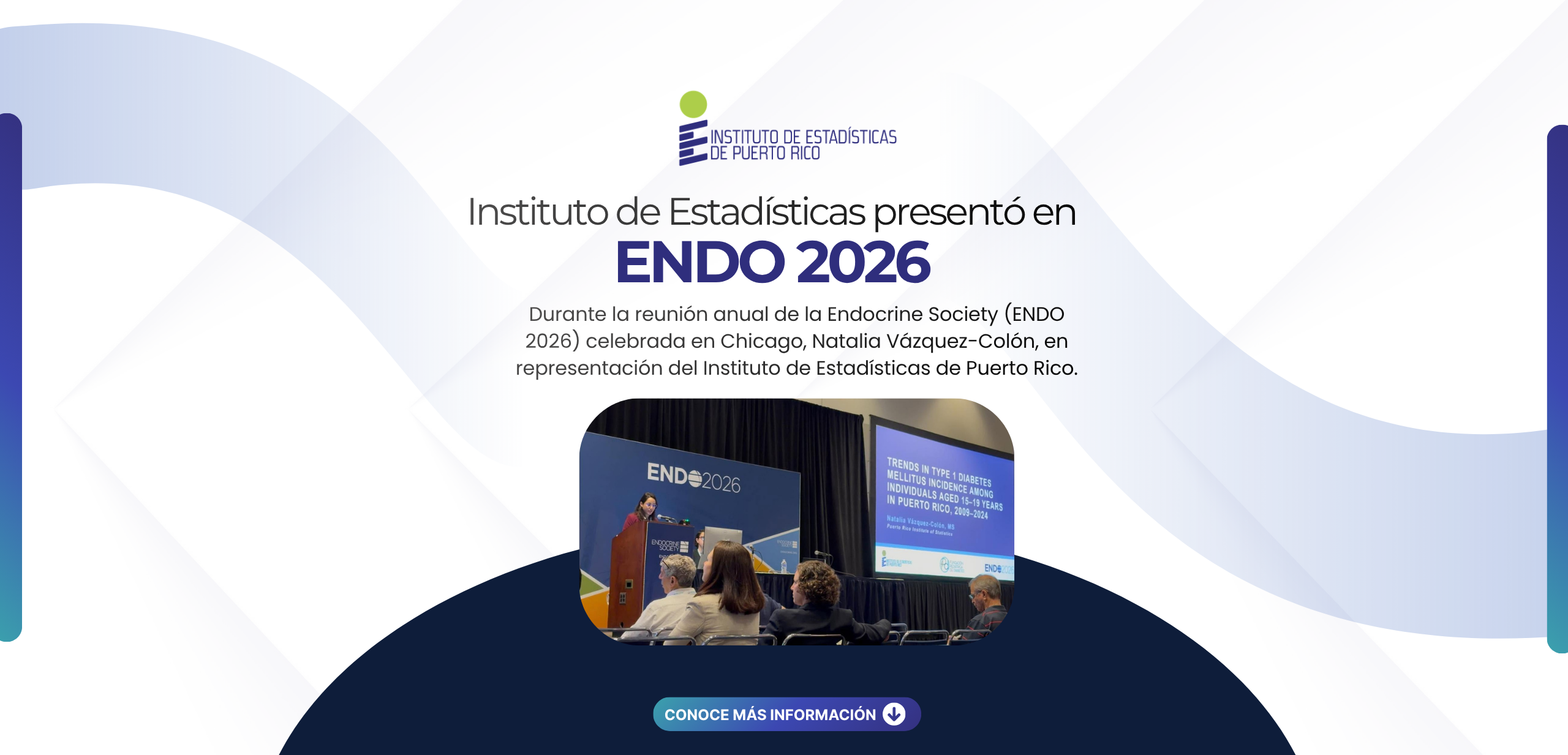

During the annual meeting of the Endocrine Society (ENDO 2026) held in Chicago, Natalia Vázquez-Colón, representing the Puerto Rico Institute of Statistics, presented original research on the incidence of type 1 diabetes in adolescents aged 15 to 19 in Puerto Rico.
The results showed an upward trend in incidence during the 2009–2024 period. The analysis identified a significant average annual growth of 4.1%.
The research was conducted through a collaboration between the Institute of Statistics and the Pediatric Diabetes Foundation. Participation in ENDO 2026 allowed for sharing scientific evidence generated in Puerto Rico with a highly prestigious national and international audience of researchers, academics, and clinicians.
Access a copy of the presentation at: Trends in Type 1 Diabetes Mellitus Among Individuals Aged 15-19 Years in Puerto Rico.

Statistics Institute urges companies to complete the Economic Census questionnaire on or before June 12
San Juan, PR, June 6, 2018 — The 2017 Economic Census of Puerto Rico, the main source of data on the structure and functioning of the country's economy, has already begun in Puerto Rico with the sending of questionnaires by post to companies, which will have until June 12 to fill it out.
This was reported by the Puerto Rico Statistics Institute (Institute), representative and coordinator of the activities of the U.S. Census Bureau in Puerto Rico, while urging business owners to complete the questionnaire online (https://portal.census.gov), as soon as possible, to ensure timely compliance, required by federal law.
Specifically, this time, the questionnaire sent by post includes instructions and a unique code that participants can use to complete it online. That way, respondents can complete it securely. Companies also have the option of filling out the printed questionnaire that was included in the mailing. If you have any questions or need assistance completing the questionnaire, companies can call 1-888-872-8390, Monday through Friday, from 8:30 a.m. to 6:00 p.m.
The mailing of Puerto Rico's 2017 Economic Census questionnaires began in early May. Title 13 of the United States Code requires each company to complete the questionnaire. The answers are confidential. By law, the U.S. Census Bureau you have a duty to keep information private and secure. Federal law protects the responses of all companies and ensures that data can only be used for statistical purposes.
“Puerto Rico's 2017 Economic Census is already taking place. Companies should have already started receiving the questionnaire by post. For the first time, a mechanism will be offered to complete the Economic Census by electronic means. The collaboration of all companies with this Census is extremely important, because it is expected that this will be the first Economic Census to be used for the purpose of preparing the gross product statistics of Puerto Rico's economy,” said Dr. Mario Marazzi-Santiago, executive director of the Institute.
The results of Puerto Rico's 2017 Economic Census will be available in December 2020 and will include aggregated information at the industrial and municipal levels on the number of establishments, revenues, sales, payroll, number of employees, goods and services produced, and other topics specific to each industry. For the previous results of the Economic Census, visit the following link: https://www.census.gov/programs-surveys/economic-census/about/island-areas.html.
El U.S. Census Bureau measures the population of Puerto Rico once every 10 years. In addition, every 5 years, it conducts the Puerto Rico Economic Census. This Census is used by trade associations, economic development agencies, governments and individual companies for business decision-making and public policy formulation. In addition, as recommended by the U.S. Bureau of Economic Analysis (BEA) to the Government of Puerto Rico, this should be used as a reference when estimating statistics on the gross product of the economy, which is expected to be achieved for the first time with the 2017 Economic Census.
The Puerto Rico Statistics Institute is an autonomous governmental entity responsible for coordinating the Government's statistical production service to ensure that the data collection and statistics systems, on which public policies are based, are complete, reliable, and have quick and universal access. The Institute has in its inventory, accessible through www.estadisticas.pr.gov, about 300 statistical products. In addition, it is a custodian and provides access to over 100 data sets or “data sets” through www.data.pr.gov and to over 40 tables and more than 6 thousand indicators through: www.indicadores.pr.
In addition, as the leading entity of the SDC in Puerto Rico, the Institute manages the SDC portal, which contains the main statistical reports and publications of the U.S. Census Bureau on Puerto Rico, specifically those that are most in demand, such as annual population estimates; the Puerto Rico Community Survey (Puerto Rico Community Survey) and official statistics on Puerto Rico's 10-year population and housing censuses, among others. The Puerto Rico SDC portal can be accessed through: https://censo.estadisticas.pr/.
For more information you can visit our website: www.estadisticas.pr.gov. In addition, you can follow us on social networks through Facebook (estadisticas.pr), Twitter (@EstadisticasPR) and LinkedIn (Institute of Statistics of Puerto Rico) accounts.
##
Press Contact: Sandra Morales Blanes/(787) 688-0401
To create the “Puerto Rico Tourism Satellite Account System Act” to present fundamental economic information on the impact of tourism in relation to Gross Domestic Product, gross value added, employment, taxation and the direct and indirect value that tourism brings to the economy of Puerto Rico, in order to develop policies aimed at boosting and developing the tourism sector in Puerto Rico.
Entre las exigencias se incluye proveer un archivo digital diario con información detallada de las muertes ocurridas desde 2017
San Juan, PR, 1 de junio de 2018 – El Instituto de Estadísticas de Puerto Rico (Instituto) anunció la radiación de una demanda ante el Tribunal de Primera Instancia de San Juan para que se ordene al Secretario de Salud y a la Directora del Registro Demográfico a cumplir con la Orden de Requerimiento de Información Núm. 2018-17 emitida por el Instituto para implantar la Resolución 2018-03, aprobada por la Junta de Directores del Instituto el pasado 24 de abril.
Según expone la demanda, el cuerpo rector del Instituto determinó y ordenó en la Resolución 2018-03, entre otras cosas, lo siguiente:
Tras la aprobación de la mencionada Resolución, el Instituto emitió y dirigió una Solicitud de Información y, posteriormente, la Orden de Requerimiento de Información Núm. 2018-17 al secretario de Salud, Rafael Rodríguez Mercado y a la directora del Registro Demográfico, Wanda del C. Llovet Díaz, para obtener la información necesaria que permita implantar y poner en vigor la Resolución 2018-03.
“A pesar de ello, tanto el Secretario de Salud como la Directora del Registro Demográfico han hecho caso omiso… La omisión de ambos funcionarios ha provocado que, a esta fecha, el Departamento de Salud esté en incumplimiento con su obligación de entregar los datos e información estadística que el Instituto le ha requerido”, establece la demanda. “El Instituto acude ante este Honorable Tribunal, a tenor con las disposiciones de su Ley Orgánica, para que se ordene con urgencia al Secretario de Salud y a la Directora del Registro Demográfico a cumplir cabalmente… so pena de desacato civil”, señala el recurso legal.
Por su parte, el director ejecutivo del Instituto, Dr. Mario Marazzi-Santiago, expuso: “Estamos usando nuestra autoridad en ley para procurar que nuestro gobierno haga el mejor uso de la tecnología, que ya tiene a su disposición, para que sea más abierto y oportuno en la publicación de sus datos de mortalidad”.
Agregó que de esa manera Puerto Rico estará mejor preparado para prevenir las muertes luego del próximo huracán, independientemente de la regularidad del servicio eléctrico. Esto, a su vez, permitiría que científicos en otras partes del mundo, con electricidad, puedan acceder los mismos, analizarlos y poner el conocimiento adquirido al servicio de la recuperación de un futuro huracán, de tal manera que se eviten muertes prevenibles.
“Habíamos anticipado que utilizaríamos nuestros poderes en Ley, de ser necesario, para hacer valer la Orden de la Junta de Directores del Instituto para implantar esta medida de transparencia. Luego de la experiencia vivida con el huracán María, y con la nueva temporada de huracanes comenzando, resulta urgente configurar los servicios públicos de información para que luego de un próximo huracán, fluya la información sobre las muertes que se van registrando en Puerto Rico de manera abierta”, concluyó el Dr. Marazzi-Santiago.
El Instituto de Estadísticas de Puerto Rico es una entidad gubernamental autónoma con la encomienda de coordinar el servicio de producción de estadísticas del Gobierno para asegurar que los sistemas de recopilación de datos y estadísticas, en los que se basan las políticas públicas, estén completos, sean confiables y de acceso rápido y universal. El Instituto posee en su inventario, accesible a través de https://estadisticas.pr.gov/, cerca de 300 productos estadísticos. Además, es custodio y provee acceso a sobre 100 conjuntos de datos o “data sets” por medio de https://data.pr.gov/ y a sobre 40 tablas y más de 6 mil indicadores a través de: https://indicadores.pr/.
Además, como la entidad líder del State Data Center (SDC) de Puerto Rico, el Instituto maneja el portal del SDC, en el cual se encuentran los informes estadísticos principales y las publicaciones del U.S. Census Bureau sobre Puerto Rico, específicamente aquellas que son más solicitadas, tal como los estimados poblacionales anuales; la Encuesta sobre la Comunidad de Puerto Rico (Puerto Rico Community Survey) y las estadísticas oficiales sobre los Censos decenales de población y vivienda de Puerto Rico, entre otras. El portal del SDC de Puerto Rico puede ser accedido a través de: https://censo.estadisticas.pr/.
Para más información puede visitar nuestra página web: https://estadisticas.pr.gov/. Además, puede seguirnos en las redes sociales a través de las cuentas de Facebook (estadisticas.pr), Twitter (@EstadisticasPR) y Linkedin (Instituto de Estadísticas de Puerto Rico).
##
Contacto de Prensa: Sandra Morales Blanes / (787) 688-0401
San Juan, PR, May 24, 2018 — The Puerto Rico Violent Death Surveillance System (PRVDRS, in English) developed and established by the Puerto Rico Statistics Institute (Institute), thanks to a proposal approved by the Centers for Disease Control and Prevention (CDC), has been recognized as the best of the new programs established by the Division of Violence Prevention of this entity.
This was announced by the Executive Director of the Institute, Dr. Mario Marazzi-Santiago, who said he was pleased with the recognition and extraordinary work of the team in charge of the Institute, led by Dr. Idania Rodríguez Ayuso, the Institute's senior manager of Statistical Projects, and Dr. Diego E. Zavala, co-researcher of the project. “This important recognition demonstrates that statistical information can be collected in an agile, timely and systematic manner by government entities in Puerto Rico and that it complies with federal requirements. We are grateful for this recognition, which has been the result of the efforts of a committed and excellent work team. We are also grateful for the collaboration of the Demographic Registry of the Department of Health, the Puerto Rico Police and the Forensic Science Bureau, which, with the provision of the necessary data for its operation, are also part of this important achievement,” said Dr. Marazzi-Santiago.
The PRVDRS is an active, continuous epidemiological surveillance system that collects information on violent deaths. It uses multiple sources of data and incorporates them into a single database, using the ecological model of public health. It began in September 2016 and began collecting data on violent deaths starting in January 2017. The proposal, funded by the CDC, lasts 5 years.
Data is collected in a systematic way to be a single reference base with complete and accurate data. They are obtained from the Puerto Rico Police Bureau, the Forensic Science Bureau and the Department of Health's Demographic Registry. The system seeks to achieve standardization using specific definitions and providing comprehensive information on the context in which deaths occur. This will help identify risk factors (e.g. job loss, mental health problems, family problems and other stressors).
The PRVDRS will also provide data related to the magnitude of violence and trends at different geographical levels. All of this will be essential to support the monitoring and evaluation of violence prevention programs and strategies in Puerto Rico. The PRVDRS has an Advisory Board and a Review Group. The latter discusses the discrepancies found in data collection. In addition, it is part of the Institute and currently has three employees assigned to it and a total of 12 people in total working on the project.
Based on data from the Bureau of Forensic Sciences, the homicide rate in Puerto Rico in 2014 was 20.11 per 100,000 inhabitants, four times higher than the equivalent rate for the United States (4.8). The latest data available for the United States is from 2014 and is based on information provided by 18 states, representing 22.5% of the United States population. For more information about the CDC's NVDRS you can access the following link: https://www.cdc.gov/violenceprevention/nvdrs/stateprofiles.html
The Puerto Rico Statistics Institute is an autonomous governmental entity responsible for coordinating the Government's statistical production service to ensure that the data collection and statistics systems, on which public policies are based, are complete, reliable, and have quick and universal access. The Institute has in its inventory, accessible through https://estadisticas.pr.gov, about 300 statistical products. In addition, it is a custodian and provides access to over 100 data sets or “data sets” through https://data.pr.gov and to over 40 tables and more than 6 thousand indicators through: https://www.indicadores.pr.
In addition, as the leading entity of the SDC in Puerto Rico, the Institute manages the SDC portal, which contains the main statistical reports and publications of the U.S. Census Bureau on Puerto Rico, specifically those that are most in demand, such as annual population estimates; the Puerto Rico Community Survey (Puerto Rico Community Survey) and official statistics on Puerto Rico's 10-year population and housing censuses, among others. The Puerto Rico SDC portal can be accessed through: https://censo.estadisticas.pr/.
For more information you can visit our website: https://estadisticas.pr.gov. In addition, you can follow us on social networks through Facebook accounts (https://www.facebook.com/estadisticas.pr), Twitter (https://twitter.com/estadisticaspr) and LinkedIn (https://www.linkedin.com/company/instituto-de-estadisticas-de-puerto-rico).
##
Contact: Sandra Morales Blanes (787) 688-0401
This is the second statistical report made on the subject and it shows that the largest number of related establishments (59%) has between 1 and 4 employees
San Juan, PR, May 17, 2018 — The Puerto Rico Statistics Institute (Institute) released today Creative Industries in Puerto Rico 2016, which is the second publication that presents statistics on creative industries, with the purpose of supporting their development, in accordance with Law No. 173 of October 13, 2014, also known as the Law to Promote Creative Industries.
The purpose of this second report is to capture some indicators that in the long term serve as metrics of the execution of Creative Industries in the production of goods and services for the local market and their export. There is currently no consensus on the type of industries that should be classified as “creative”. However, Article 3 of Law 173-2014 defines creative industries based on the following list of industries:
The published compendium presents all the statistics already available on these industries. But, in addition, statistics are presented on several additional industries that have been classified as “creative” in previous UNESCO studies, among others, and these, together with those defined by Law 173-2014, are referred to in the report as “Law 173+”:
Below are some of the publication's key findings:
1) The largest concentration of Creative Industries in the Ley 173+ group took place in establishments with 1 to 4 employees, who brought together 58.5% of them. An experience that was most strongly repeated in the sectors of Law 173, which comprised 71.7% of the establishments (County Business Patterns, CBP). In the case of 173+ sectors, those dedicated to Jewelry, followed by Computer system design and Advertising agencies (in that order) were the ones with the highest number of establishments in the sources consulted. In the specific case of Law 173, it was the establishments dedicated to System design Computer scientists and Computer Programming Services (CBP and Quarterly Census of Employment and Wages, QCEW).
2) The line of number of employees by industry, for the sectors of Law 173+, followed the same pattern as the previous line, with establishments dedicated to Jewelry, Computer system design and Agencies of publicity (in that order) those who employed the largest number of employees. The second of these, Computer system design, was the one who occupied the first position under Law 173, followed by Computer Programming Services (QCEW).
3) In the analysis of number of employees by occupation The first position in the entirety of Law 173+ corresponds to Wired telecommunications service operators with 3,148 employees, followed by those dedicated to Computer system design, with 2,030 employees. For Law 173, specifically, people employed in Computer system design (2,030) and Services of computer programming (1,842) ranked first and second (QCEW).
4) In the distribution of employees by sex, the industry of the Ley 173+ group with the highest percentage of employed women was Libraries and archives (87%) and in the lower position was the Sound industry with 12%. The most even distribution by sex occurred in Advertising Industries with 50%. In the case of jobs grouped under Law 173, the jobs of Editing and dissemination of content over the internet and search services was the one with the highest percentage of female participation (62%). The jobs of Software publishing was the one with the most even distribution (42%), being those of the Sound industry, mentioned above, those with the lowest female participation (Public Use Microdata Sample of the Puerto Rico Community Survey, PRCS-PUMS).
5) For both Law 173+ and Law 173 sectors, the Average revenue by industry The highest was $118,665 for the line of Software publishing (QCEW).
6) For both Law 173+ and Law 173 sectors, the Average annual wage by occupation The highest corresponded to System software developers with $67,530 (Occupational Employment Statistics, OES).
7) In the presentation of creative establishments per inhabitant for the Ley 173+ group The median number of establishments grouped under the creative industries by municipalities It was 2 establishments per 10,000 inhabitants. San Juan had approximately 25 establishments per 10,000 inhabitants (QCEW).
8) As for the value of imports and exports of assets of the Creative Industries in the Law 173+ sectors, in 2016 there was a trade balance of -$200 million (Institute).
To view the full report you can visit: Creative-Industries-of-Puerto Rico-2016.
In this second edition of the Creative Industries in Puerto Rico report, the secondary data sources and methodologies developed in the first report continued to be used. Industrias_Creativas_en_Puerto_Rico_2014.pdf. Since most of the available sources provide data up to 2016, it was decided to title this report with that reference date.
The Puerto Rico Statistics Institute is an autonomous governmental entity responsible for coordinating the Government's statistical production service to ensure that the data collection and statistics systems, on which public policies are based, are complete, reliable, and have quick and universal access. The IEPR has in its inventory, accessible through https://estadisticas.pr.gov, about 300 statistical products. In addition, it is a custodian and provides access to over 100 data sets or “data sets” through https://data.pr.gov and to over 40 tables and more than 6 thousand indicators through: https://www.indicadores.pr.
In addition, as the leading entity of the Puerto Rico SDC, the IEPR manages the SDC portal, where you can find the main statistical reports and publications of the U.S. Census Bureau on Puerto Rico, specifically those that are most in demand, such as annual population estimates; the Puerto Rico Community Survey (Puerto Rico Community Survey) and official statistics on Puerto Rico's 10-year population and housing censuses, among others. The Puerto Rico SDC portal can be accessed through: https://censo.estadisticas.pr.
For more information you can visit our website: https://estadisticas.pr.gov. In addition, you can follow us on social networks through Facebook accounts (https://www.facebook.com/estadisticas.pr), Twitter (https://twitter.com/estadisticaspr) and LinkedIn (https://www.linkedin.com/company/instituto-de-estadisticas-de-puerto-rico).
##
Press Contact: Sandra Morales Blanes/(787) 688-0401
To amend Article 115, Law 187-2015, as amended, known as the “Interagency Validation Portal Act for the Granting of Incentives for the Economic Development of Puerto Rico”, for the purpose of modifying and extending the postponement of the effectiveness of the Act; relieving any agency, agency or instrument of the Government of Puerto Rico, municipality or public corporation, that is considered an Issuing-Certifying Agency or Receiver-Granting Agency, to comply with Articles 6 to 10 and Articles 14 to 112 of the Act in everything anything related to the Certification of Compliance, retroactively from November 17, 2015 to January 1, 2019...
Please let us know your satisfaction level with our services.
Visit our Official Activities, and participate with us
Visit our Calls for applications and be part of the new opportunities we have for you.
If you have any questions or just want to contact us, visit the Contact Us section.
We are at your disposal. If you need custom statistics, do not hesitate to contact us.
Sign up for our online workshops. Connect with the experts and discover the power of data!
Visit our Blog and keep up to date with the latest news and topics of interest.
Visit our Press Releases and stay connected to the Institute.
Explore the Publication Calendar and keep up to date with Puerto Rico's statistics.
Complete the form for the selection of our Statistics Coordination Committee
Suscribe to receive news directly to your email.
Listen to the Official PRIS podcast and stay informed with the experts

.png)
.png)
.png)
.png)

-p-130x130q80.png)
.png)
.png)
.png)
.png)
.png)
.png)
.png)
.png)
.png)
.png)
.png)