Dr. Mario Marazzi presents at regional economic development forum


Please let us know your satisfaction level with our services.
Visit our Official Activities, and participate with us
Visit our Calls for applications and be part of the new opportunities we have for you.
If you have any questions or just want to contact us, visit the Contact Us section.
We are at your disposal. If you need custom statistics, do not hesitate to contact us.
Sign up for our online workshops. Connect with the experts and discover the power of data!
Visit our Blog and keep up to date with the latest news and topics of interest.
Visit our Press Releases and stay connected to the Institute.
Explore the Publication Calendar and keep up to date with Puerto Rico's statistics.
Complete the form for the selection of our Statistics Coordination Committee
Suscribe to receive news directly to your email.
Listen to the Official PRIS podcast and stay informed with the experts
Free workshops and webinars at the Puerto Rico Institute of Statistics
For government officials and the general public
Starting today, Wednesday, February 22, 2023, pre-registration begins for the free offer of workshops and webinars offered by the Statistics Institute of Puerto Rico. This virtual offer of nine workshops with 16 sessions and three webinars seeks to provide solutions in the access, management and analysis of government statistical data and is carried out with rigor and quality in the development of content that is carried out by specialists.
The online format offers the opportunity to participate to government officials and the general public, since the format is asynchronous, that is, within the time available to the participant. In the same way, multiple sessions are included, allowing participants the flexibility to enroll on those dates that are most convenient. Interested individuals can complete pre-enrollment at Academy
The topics included are:
On the other hand, webinars are live sessions, in which participants can connect via the Internet to a platform where they can see and hear the speaker and ask the speaker questions after the session is completed.
The topics of the three webinars, with a capacity of 1,000 participants each, are:
To access all the details of the Academies and Workshops Program, see Here.
The Puerto Rico Statistics Institute is a governmental entity in the executive branch, with fiscal and administrative autonomy, whose main purpose is to ensure that Puerto Rico has complete, reliable statistics that are quickly and universally accessible. To learn more about the Institute of Statistics, you can access the website: www.estadisticas.pr.gov. On social media through Facebook accounts (@statistics.pr), Twitter (@EstadisticasPR), Instagram (@institutodeestadisticas) and LinkedIn (Puerto Rico Institute of Statistics).
The Puerto Rico Statistics Institute (Institute) today released the Statistical Yearbook of the Puerto Rico Education System 2013-2014.
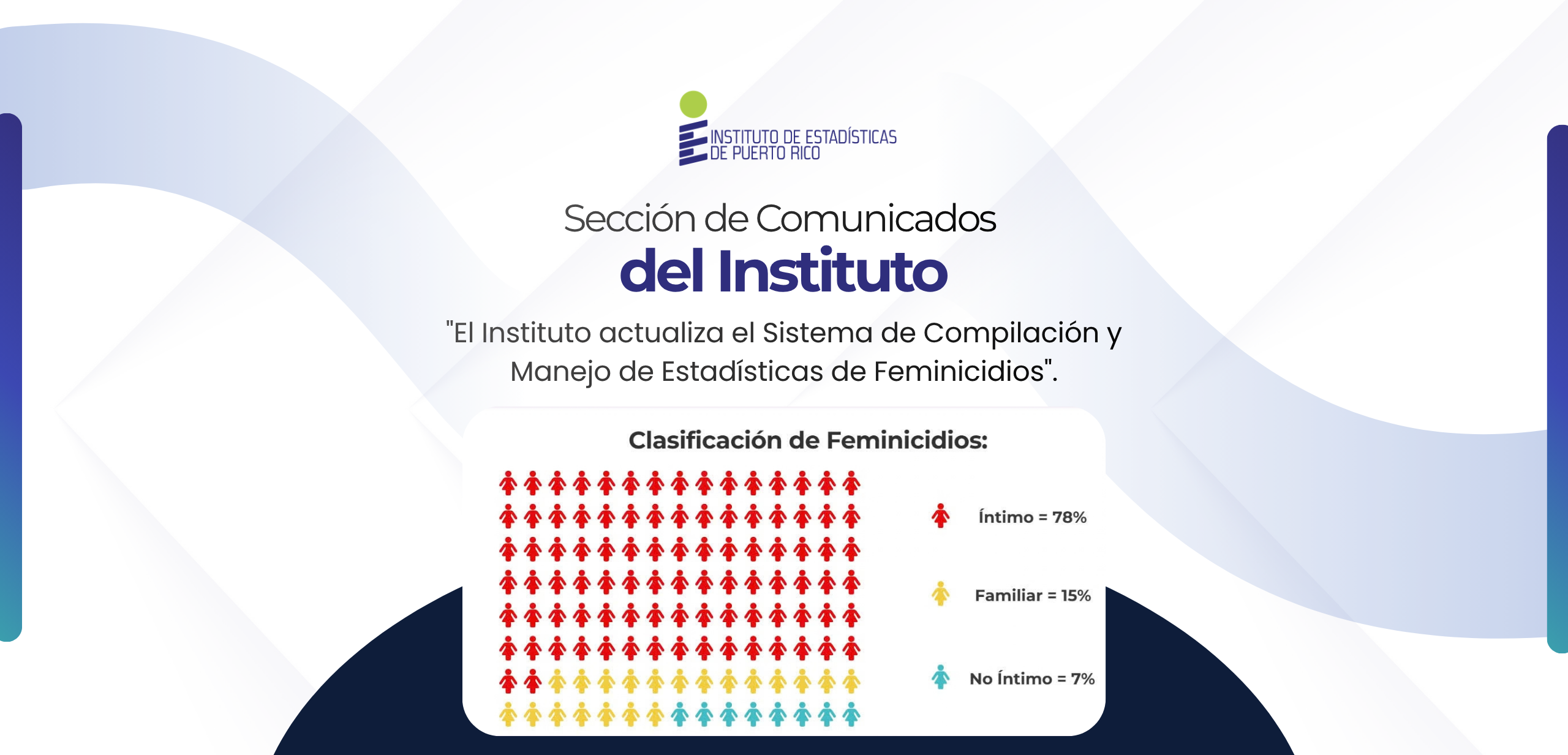
Of the 128 identified femicides, 119 were classified as intimate or familial, according to updated data from the Puerto Rico Institute of Statistics.
Of the 263 homicides of women recorded in Puerto Rico between 2021 and August 2026, 128 (48.7%) were classified as femicides. This data is derived from the update to the Puerto Rico Institute of Statistics' Femicide Statistics Compilation and Management System.
The update also reveals that 119 of the 128 femicides (93.0%) were classified as intimate or familial. In these cases, the perpetrator was the victim's partner or a family member, according to the system's classification. The portal incorporates data for 2026 and new indicators regarding the annual total of femicides and cases followed by the perpetrator's suicide. Additionally, it presents a new infographic on femicides recorded between 2021 and 2025 and a redesigned interface to facilitate data consultation and understanding. These data reflect that a significant proportion of femicides occur within the context of close relationships, highlighting the importance of examining gender-based violence and its manifestations within intimate partner and family settings.
Mariluz Bezares Salinas, Statistical Project Manager at the Institute of Statistics, stated, "This data reminds us that femicidal violence continues to claim lives in Puerto Rico and that addressing it requires a sustained response. That is why it is important to continue collecting and analyzing information that helps us better understand these cases, identify patterns, and recognize the factors associated with this issue. Continuing our research allows us to seek more effective ways to prevent and respond to these situations."
Additionally, a new infographic has been added to the femicide dashboard. It presents further information on the context of femicides that occurred during the 2021–2025 period, including the profile of the victims and the mechanism of death, among other variables. The infographic also includes sections dedicated to intimate femicides and femicides followed by the perpetrator's suicide, with specific information on the characteristics of these events.
"Continuing to make this data accessible is crucial to raising awareness of the magnitude of this problem and providing authorities and organizations with evidence-based tools that lead us toward the eradication of violence and saving lives," said Dr. Orville M. Disdier, Executive Director of the Puerto Rico Institute of Statistics.
The platform, featuring the most recent data and resources to facilitate the understanding of femicide statistics, is available on the official website of the Puerto Rico Institute of Statistics, in the Femicide Statistics Compilation and Management System section at the following link: https://www.estadisticas.pr.gov/productos/portal-del-sistema-de-compilacion-de-datos-de-feminicidios-en-puerto-rico.

.png)
.png)
.png)
.png)

-p-130x130q80.png)
.png)
.png)
.png)
.png)
.png)
.png)
.png)
.png)
.png)
.png)
.png)