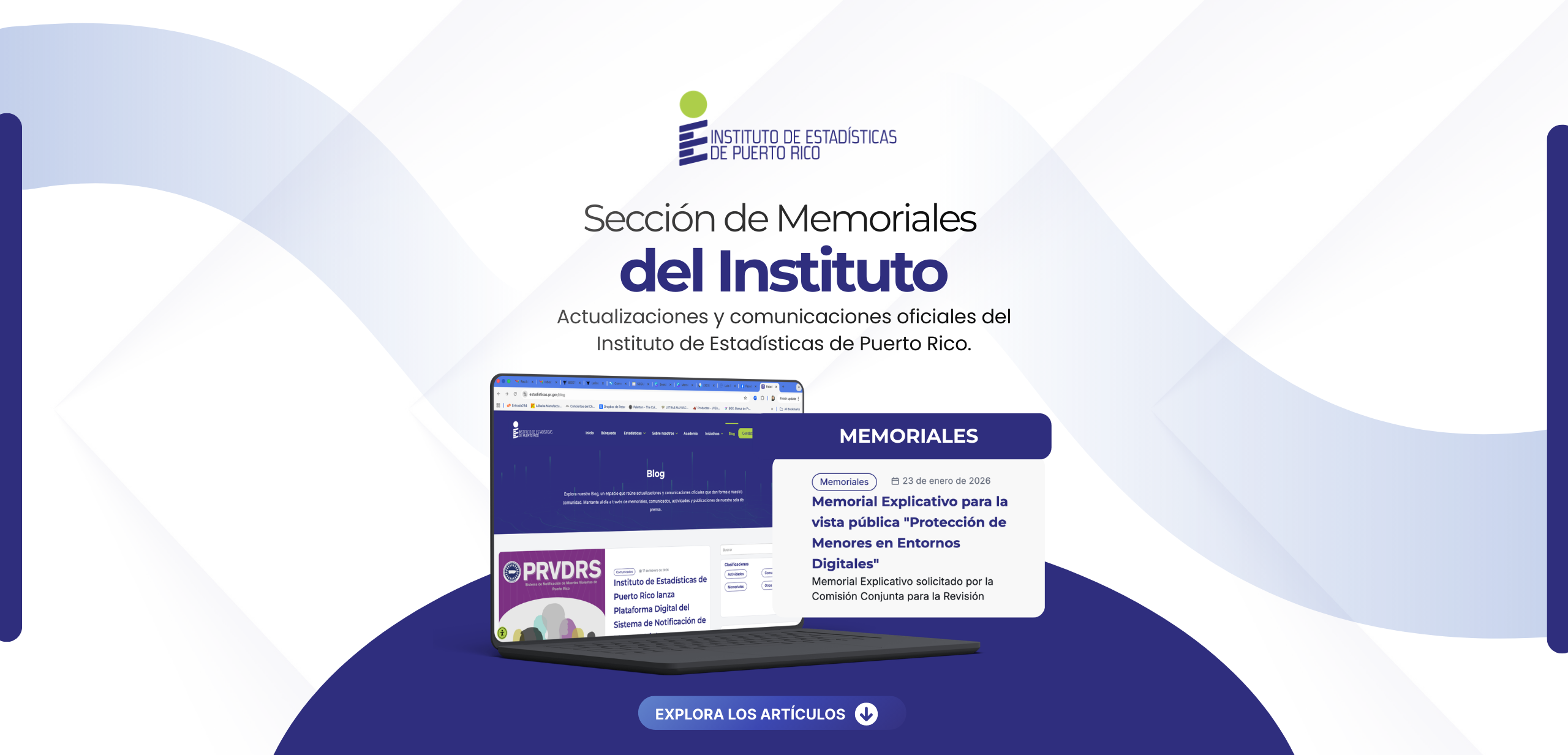


Blog

Explore our Blog, a space that brings together updates and official communications that shape our community. Stay up to date through memorials, announcements, activities and publications in our newsroom.
Representative Blog ImageImagen Representativa de Blog
Memorials
April 1, 2026
P. del S. 298

To create the Puerto Rico Human Trafficking Observatory under the Puerto Rico Civil Rights Commission, to dispose of its powers and prerogatives, to provide for its organization, to create the position of Director of the Puerto Rico Human Trafficking Observatory, to grant it functions and duties, to require the creation and development of a Strategic Plan to combat human trafficking in Puerto Rico, as well as to establish the public policy of the Government of Puerto Rico; and for other purposes.

Representative Blog ImageImagen Representativa de Blog
Announcements
July 20, 2020
Mayors are urged to mobilize resources for the 2020 Census

PRESS RELEASE

Office of the President

Vital for the country that mayors mobilize to obtain

Responses to the 2020 Census

President of the Board of Directors of the Institute of Statistics made an urgent appeal to municipal officials given the low participation of only 25% of the response

The president of the Board of Directors of the Puerto Rico Institute of Statistics, economist and university professor Nicolás Muñoz-Muñoz, urged all mayors to mobilize the resources of municipal agencies to visit street by street, combing all communities to alert families to the importance of filling out the 2020 Population Census form. I am taking all preventive and protective measures as far as COVID-19 is concerned.

As of July 13, only 25% of families had answered the Census. This, according to Muñoz, represents half of those who had answered the Census in 2010. In mid-July, the level of response in municipalities ranged from 14 to 31 percent. “It is vital for municipalities and their inhabitants that the federal funds that arrive are not reduced by 25% or more. Without downplaying the exercise of the democratic right to vote, designating resources to help citizens complete the Census should be considered as meritorious as the efforts being made for the primary and electoral process,” Muñoz said.

“If mobilization were not promoted to encouraging communities to dedicate 15 minutes to answering the form, we would add another disaster to the chain of events that have occurred in the country since the earthquake in January to the present. In this case, a disaster whose consequences would last 10 years,” said Muñoz.

The economist explained that, if 25% of the population does not answer, Puerto Rico could result in a population of less than 3 million and could receive 25% less federal funding, equivalent to $5 billion annually or $50 billion over 10 years, if we consider an average current allocation of $20 billion annually. This is without considering additional special allocations in the case of natural disasters.

It was also reported that more than 300 federal programs base the distribution of funds on population data. These programs include federal funding for road construction, agriculture, rural development, housing, urban development, solid waste management, telecommunications infrastructure, drinking water, protection of coastal resources, assistance for paying household rent, education, justice, nutrition assistance programs, school breakfasts, child care, workforce development under the WIOA Act (among other laws), assistance for the elderly and health, including Medicaid, and other programs.

“The economic situation of municipalities will worsen if access to federal funds allocated by Congress is reduced. Every Puerto Rican who can read and write can fill out the Census form. It can be filled out “online” or on paper. Each neighbor can help another neighbor who can't read and write or how to fill it out, particularly older adults. It's everyone's job, but mayors, who are the officials closest to the needs of citizens, must exercise their leadership in this vital priority for Puerto Rico,” Muñoz concluded.

##

Press Contact:

Idia M. Martínez

787-603-3200

imartinez@upfrontpr.net

Representative Blog ImageImagen Representativa de Blog
Announcements
July 15, 2020
It is urgent to answer the 2020 Census

PRESS RELEASE

PUERTO RICO STATE DATA CENTER NETWORK (SDC-PR)

It is urgent to answer the 2020 Census

Only one in four households in Puerto Rico has responded

San Juan, PR, July 15, 2020 — The Puerto Rico Statistics Institute reported that, as of July 13, only 25% of households in Puerto Rico had responded to the 2020 Decennial Census. This percentage places Puerto Rico in the lowest response position compared to other jurisdictions. In addition, it indicates that Puerto Rico is 29 percentage points lower than the self-employed response to the previous Census in 2010 (54%).

During the months of April and June, field personnel from the Federal Census Bureau delivered the questionnaire and invitation to complete it to homes. The information that residents must provide is of paramount importance for the immediate future of Puerto Rico and its municipalities. Completing the 2020 Census, among many other aspects of social and economic planning, allows:

  • Find out how many there are specifically in Puerto Rico
  • that children have the necessary services for their development
  • that our elderly population get their proper care
  • a correct and adequate distribution of funds for our population

Currently, in municipalities, the level of response ranges from 14 to 31 percent. Among the lowest levels are Culebra, Vieques, Rincón Guánica and Luquillo. On the other hand, the highest percentages at the moment indicate that they are those in the municipalities of Hormigueros, Guaynabo, Bayamón, Sabana Grande and Caguas. Detailed response information by town can be accessed at censo.estadisticas.pr.

“Just by taking 10 to 15 minutes to complete it, residents of each household can significantly improve their response to the 2020 Census. They can do it either by Internet, paper or telephone,” said Alberto L. Velázquez-Estrada, manager of statistical projects at the Institute.

Answering the Census is a constitutional mandate. Census data influences daily life, providing information for making important decisions about funding community services and infrastructure, including health care, senior centers, jobs, political representation, roads, schools and businesses. In other words, it serves as a guide so that communities can obtain the fair funds they need, as well as supporting companies to make decisions based on data that encourage the economy. For more details, data and information about the 2020 Census you can access to: https://2020census.gov/es.html.

About the Puerto Rico Institute of Statistics

The Puerto Rico Statistics Institute is an autonomous governmental entity tasked with coordinating the government's statistical production service to ensure that the data collection and statistics systems, on which public policies are based, are complete, reliable, and accessible quickly and universally. In addition, as the leading entity of the SDC in Puerto Rico, the Institute manages the SDC portal, which contains the main statistical reports and publications of the U.S. Census Bureau about Puerto Rico, specifically those that are most in demand, such as annual population estimates, the Puerto Rico Community Survey (Puerto Rico Community Survey) and official statistics on Puerto Rico's 10-year population and housing censuses, among others. The Puerto Rico SDC portal can be accessed through: https://censo.estadisticas.pr/.

For more information you can visit the website: https://estadisticas.pr.gov/. In addition, you can follow the Institute on social networks, through Facebook (@estadisticas .pr), Twitter (@EstadisticasPR) and LinkedIn (Institute of Statistics of Puerto Rico) accounts.

##

Press Contact:

Idia Martínez

787-603-3200

imartinez@upfrontpr.net

Representative Blog ImageImagen Representativa de Blog
Announcements
June 25, 2020
Population under 18 has fallen by 36% over the decade

PRESS RELEASE

RED STATE DATA CENTER OF PUERTO RICO (SDC‐PR)

Population under 18 has fallen by 36% over the decade

According to new estimates of the population by age and sex 2010-2019

San Juan, PR, June 25, 2020 — The U.S. Census Bureau today released the most recent Annual Population Estimates by age and sex characteristics for municipalities, Puerto Rico and counties in the United States. These statistics refer to July 1, 2019 and include population estimates by age group for each municipality.

On behalf of the State Data Center Network of the U.S. Census Bureau in Puerto Rico, the Puerto Rico Statistics Institute (Institute) reported several findings from the new publication of population estimates for 2019 compared to those of July 1, 2010:

  1. From 2010 to 2019, the population under 18 years of age in Puerto Rico reflected a reduction of 324,293 residents, representing a percentage change of ‐ 36%. As of July 1, 2010, this population was 897,024, nine years later in 2019 it is estimated at 572,731.
  2. In terms of the proportion of large age groups in the population, those under 18 used to represent 24% (2010) in Puerto Rico, now they comprise 18% (2019).
  3. The population structure by age and sex (pyramid) of 2010 compared to that of 2019 shows how the composition has changed rapidly in Puerto Rico. Its base is much narrower, indicating a decline in infants, children and adolescents.
  4. On the other hand, the top of the pyramid reflects a significant increase in age groups aged 65 and over, which translates into an older population.
  5. Puerto Rico's median age is estimated to have increased about six years over the decade, from 37.0 years in 2010 to 43.2 years in 2019.

“The estimates by demographic characteristics of age and sex allow us to detail the population trend in Puerto Rico. For example, the drastic decline in births has a direct influence and is reflected at the base of the population pyramid. As of 2010, the population in age groups between 0-4 and 5-9 years comprised about 3% of women and men, respectively. In 2019, the base shrank with percentages close to or below 2%,” said Alberto L. Velázquez-Estrada, Manager of Statistical Projects at the Institute.

The 2019 annual population estimates for Puerto Rico and its municipalities can be accessed on the census data and information page on Puerto Rico of the SDC‐PR network at: https://censo.estadisticas.pr/EstimadosPoblacionales, and more details on the annual estimates at: census.gov/programs‐surveys/popest.html.

The Institute is an autonomous governmental entity tasked with coordinating the Government's statistical production service to ensure that the systems for collecting data and statistics, on which public policies are based, are complete, reliable and accessible quickly and universally. In addition, as the leading entity of the SDC in Puerto Rico, the Institute manages the SDC portal, which contains the main statistical reports and publications of the U.S. Census Bureau on Puerto Rico, specifically those that are most in demand, such as annual population estimates; the Puerto Rico Community Survey (Puerto Rico Community Survey) and official statistics on Puerto Rico's 10-year population and housing censuses, among others. The Puerto Rico SDC portal can be accessed at: https://censo.estadisticas.pr/.

For more information you can visit the website: www.estadisticas.pr. In addition, you can follow the Institute on social networks through Facebook (@estadisticas .pr), Twitter (@EstadisticasPR) and LinkedIn (Institute of Statistics of Puerto Rico) accounts.

##

Press Contact:

Idia Martínez

787‐603‐3200

imartinez@upfrontpr.net

Representative Blog ImageImagen Representativa de Blog
Memorials
June 18, 2020
R. of S. 95

Date: June 18, 2020

To order the Commissions on Social Welfare and Family Affairs; and for the Development of Community Initiatives of the Senate of Puerto Rico to carry out exhaustive research on programs of the Government of Puerto Rico such as “Back to Life” and the rehabilitation programs in the United States to which the Government of Puerto Rico sends those addicted to controlled substances, the coordination process with these programs, their effectiveness, the number of people who have been sent to the United States, the follow-up given to them and the reason for sending these people out of Puerto Rico, as well as identifying the funds used to finance transportation to other states.

Representative Blog ImageImagen Representativa de Blog
Announcements
June 17, 2020
Statistics Institute publishes new section on economic indicators

PRESS RELEASE

Statistics Institute publishes new section on economic indicators

The executive director of the Puerto Rico Statistics Institute (Institute), Dr. Orville M. Disdier, announced the availability of a new section of some economic indicators on its website, presented through interactive graphics.

“Fulfilling our mission of providing citizens with universal and rapid access to statistics, we created this section that will serve as a reference for government and private enterprise, in economic terms. In the same way, as the section is nourished with new data, it could eventually help outline plans for economic recovery due to COVID-19,” said Disdier.

The section currently has interactive graphics covering the period from March 2017 to May 2020, which will be updated as the Institute receives information from the agencies or entities concerned. The first of them, Puerto Rico Manufacturing Purchasing Managers Index (PRM-PMI), is an indicator that measures the short-term productive side of Puerto Rico's economy, specifically manufacturing, and includes employment indicators, supplier deliveries, inventories, new orders and production.

In the graph, Production and Consumption of Electric Energy in Puerto Rico, information can be obtained from indicators, such as active customers, net generation in millions of kilowatt-hours (mKWh), total consumption (mKWh), cost per kWh purchased, and total income, among others.

Users of the page will also be able to access the graph, Total Non-Agricultural Wage Employment, adjusted and without seasonal adjustment.

In the fourth graph that the section currently has, you can obtain data on the number of initial Unemployment Insurance claims, which they receive at the Department of Labor and Human Resources in Puerto Rico.

The new economic indicators section can be found at www.estadisticas.pr.gov and can be accessed directly at the following Internet address: https://cutt.ly/2uv06YI.

“We call on agencies and the private sector that work with updated data or statistics that impact the Puerto Rico economy, both agriculture, international trade, and goods and services industries (manufacturing, tourism, construction, finance, consumption, among others), to contact us so that we can continue to add economy-related indicators that serve as a reference for decision-making for the well-being of Puerto Rico,” said Ana Gabriela Jara Castro, Manager of Statistical Projects.

About the Institute of Statistics

The Puerto Rico Statistics Institute is an autonomous governmental entity responsible for coordinating the Government's statistical production service to ensure that the data collection and statistics systems, on which public policies are based, are complete, reliable, and have quick and universal access.

For more information you can visit the website www.estadisticas.pr.gov or surveys on the social networks of Facebook (@estadisticas .pr), Twitter (@EstadisticasPR) and LinkedIn (Institute of Statistics of Puerto Rico).

##

Press Contacts:

Idia Martinez/787-603-3200/ imartinez@upfrontpr.net

Lourdes Burgos/787-562-2932/ lourdesburgos09@gmail.com

Representative Blog ImageImagen Representativa de Blog
Announcements
June 10, 2020
Statistics Institute and Instituto Nueva Escuela manage to include Montessori schools and questions about the impact of Hurricane Maria in an important school survey

PRESS RELEASE

Statistics Institute and Instituto Nueva Escuela manage to include Montessori schools and questions about the impact of Hurricane Maria in an important school survey

The 2019 edition of the YRBSS for Puerto Rico included students from Montessori schools for the first time and asked about the effects of the hurricane on these students

The Puerto Rico Statistics Institute joined forces with the Instituto Nueva Escuela, achieving for the first time that Montessori schools are included in the 2019 edition of the survey Youth Risk Behavior Surveillance System (YBSS). The YRBSS is a survey conducted every two years to students in grades 9, 10, 11 and 12 across the United States and its jurisdictions, including Puerto Rico. The questions cover various topics related to students' health and risk behaviors, and as a result, statistics are produced on bullying, electronic harassment, violent behavior, sexual behavior, drug use and on students' eating habits, among others.

In addition, it was possible to include five additional questions, related to the impact of Hurricane Maria on students, from all the schools participating in the study in Puerto Rico. Approximately 1,498 students from public schools in Puerto Rico participated in the self-administered survey, and of these, a total of 110 students belonged to Montessori schools, of which 53% were male, 47% female, and 27.2%, 54.5%, 16.0% and 2.3% were in grades 9, 10, 11 and 12, respectively. Although it is expected that by the end of this year the Institute of Statistics and the Instituto Nueva Escuela will produce an official and detailed statistical report on the results of this survey, here are some preliminary results regarding hurricane questions in students under the Montessori philosophy:

  • 80.4% of students reported that they spent a month or more without electricity in their homes.
  • 98.9% of students reported feeling sad or hopeless after the impact of Hurricane Maria and due to the lack of electricity.
  • 47.1% of students reported that they spent a month or more without drinking water service in their homes.
  • 100% of the students reported feeling sad or hopeless after the impact of Hurricane Maria and due to the lack of drinking water.
  • 77.7% of students reported that they were unable to attend school for a month or more because it was closed or unable to reach or access it.

“These preliminary results show us the enormous impact that the passage of Hurricane Maria had on these Montessori school students. In previous editions, these students, under the Montessori philosophy, were left out of this important survey. However, thanks to the teamwork of both institutes, we have been able to make them visible,” said Dr. Orville M. Disdier, executive director of the Institute of Statistics.

For their part, Dr. Ana María García Blanco, executive director of the Instituto Nueva Escuela, and Mr. Cesar Ostolaza of the Evaluation and Research Division said: “We are very happy with the invitation from Dr. Orville M. Disdier to participate in this study. It is important to have reliable data in the face when making decisions about the practices and services we will provide to our students. Their voices are essential in defining the public policies for which we are choosing. It is imperative to take into account the emotional state of young people, especially based on the natural and social phenomena they have been through when it comes to “building” a school. It is with them and from them that we must build it.”

The Instituto Nueva Escuela is a non-profit entity that seeks to transform the public education system in Puerto Rico through Montessori philosophy and methodology. For its part, the Statistics Institute of Puerto Rico is a governmental entity with fiscal and administrative autonomy with the mission of coordinating the statistical production service of government entities. To learn more about the Instituto Nueva Escuela you can access the website: www.inepr.com. To learn more about the Institute of Statistics, you can access the website: www.estadisticas.pr.gov. On social media through Facebook (@estadisticas .pr), Twitter (@EstadisticasPR) and LinkedIn (Institute of Statistics of Puerto Rico) accounts.

###

Contacts: Idia M. Martínez, R‐28, 787‐603‐3200, and Lourdes Burgos, R‐27, 787‐562‐2932

Classifications
Thank you! Your submission has been received!
Oops! Something went wrong while submitting the form.

Visit our Official Activities, and participate with us

Visit our Calls for applications and be part of the new opportunities we have for you.

If you have any questions or just want to contact us, visit the Contact Us section.

We are at your disposal. If you need custom statistics, do not hesitate to contact us.

Sign up for our online workshops. Connect with the experts and discover the power of data!

Visit our Blog and keep up to date with the latest news and topics of interest.

Visit our Press Releases and stay connected to the Institute.

Explore the Publication Calendar and keep up to date with Puerto Rico's statistics.

Complete the form for the selection of our Statistics Coordination Committee

Suscribe to receive news directly to your email.

Listen to the Official PRIS podcast and stay informed with the experts