

Some variables are easier to measure than others, but certain questions require special care, both in how they are formulated and in the instruments are used to collect them. One of the most complex is without a doubt, that related to people's ethnic and cultural origin, and also the skin color. In the most recent newsletter of the Puerto Rico State Data Center (SDC-PR) network brief notes are shared about the research on ethnic-racial identification and colorism that has been carried out from the Institute's. Access the current newsletter here, or explore previous newsletters and press releases from the SDC-PR network.

They add data on adult health conditions to the interactive map on school and community profiles
Based on data from the Centers for Disease Control and Prevention (CDC) “Behavioral Risk Factor Surveillance System (BRFSS)” annual survey
August 2, 2022: The executive director of the Puerto Rico Institute of Statistics, Dr. Orville M. Disdier, announced that a new layer has been added to the interactive map on school and community profiles, known as the “School Community Profile: The Interactive Map”. This time, the new layer deals with aspects of adult health. This new layer presents statistics on several health conditions in the adult population (18 years and older), such as diabetes, asthma, heart disease, arthritis, and cancer, among others. The data are based on information collected by the annual “Behavioral Risk Factor Surveillance System (BRFSS)” survey, conducted by the Centers for Disease Control and Prevention (CDC), in collaboration with the Puerto Rico Department of Health. This particular layer is entitled “Behavioral Risk Surveillance System 2020 (CDC)” and must be activated using the “layers” menu. The data correspond to the calendar year 2020 and the statistics are available at the regional level, segregated into the following six (6) regions: Arecibo, Bayamón, Caguas, Mayagüez, Metro-Fajardo and Ponce.
“These data allow us to geo-correlate the regional prevalence of health characteristics of adult residents of those regions, with the rest of the diverse characteristics of schools, students and the communities that are located within them,” explained Dr. Disdier.
Some aspects that this new layer allows us to observe are, for example, that the prevalence of diabetes for 2020 was 19.3% for the Arecibo region, while for the Metro-Fajardo region it was 13%. On the other hand, for the Arecibo region, the prevalence of kidney disease was 3.3%, and for the Caguas region it was 2.6%. “The contrasts between the health aspects of the regions with the rest of the characteristics of the students, and their communities in those regions, could help improve health promotion and health risk prevention strategies within each community,” emphasized Dr. Disdier.
The School Community Profile: The Interactive Map”, with this new layer and all the others, resides on the Puerto Rico Institute of Statistics website and can be accessed at any time by interested parties at the following e-mail address: School community profile.
For technical questions about this tool, you can send an email to: preguntas@estadisticas.pr.
#estadisticaspr
About the Puerto Rico Institute of Statistics
To learn more about the Institute of Statistics, you can access the website: www.estadisticas.pr.gov. On social media through Facebook accounts (@statistics.pr), Twitter (@EstadisticasPR), Instagram (@institutodeestadisticas) and LinkedIn (Puerto Rico Institute of Statistics).
Date: August 3, 2022
To amend Article 5 of Law 143-2014, “Protocol Act to Ensure Effective Communication Between the Security Components of the Commonwealth of Puerto Rico and the Criminal Justice Information System”, to include the Executive Director of the Puerto Rico Statistics Institute as a member of the Intergovernmental Committee on the Criminal Justice Information System; and for other necessary and related purposes.
PRESS RELEASE
Statistics Institute releases first results on the Study of the Needs of the Deaf Community in Puerto Rico
84% of totally deaf people surveyed who needed public safety services and 75% of those who needed services in government agencies faced barriers
July 21, 2022: The executive director of the Puerto Rico Statistics Institute (Institute), Dr. Orville M. Disdier, presented the first results of the Study of the Needs of the Deaf Community in Puerto Rico, through an interactive digital report. This new product, called “Study of the Needs of the Deaf Community: Interactive Report”, presents the first results of the Population Survey that the Institute conducted, both to deaf and partially deaf people, and to the general public. In addition, the interactive report presents the results of focus group interviews with teachers of students with hearing difficulties. The platform presents, for both deaf and partially deaf people, data and statistics on socio-demographic aspects, on the difficulties presented when requesting services, both governmental and non-governmental, on the communication methods used by this community and on the difficulties in accessing information offered by various means of communication, among other findings.
“The data and statistics presented in this interactive report serve as an empirical basis to justify various initiatives and the development of new public policies that promote quality services and better integration of deaf people into the rest of society, while promoting equity and social justice,” said Dr. Disdier.
Some of the most relevant results of the Deaf Community Needs Study:
In the same way, the educators who participated in the focus groups agreed that in general, parents and/or guardians are not given the necessary support at the time the child is diagnosed. Dr. Disdier explained that the final sample of the survey consisted of 739 adults, 18 years of age or older, living in Puerto Rico, and it was accessible for more than sixty (60) days. A total of 21 educators were part of several focus groups, in which in-depth conversations were held about the needs of deaf students. In this regard, Dr. Disdier argued that “The data collected by educators of deaf students alert us that, like deaf adults, deaf children and adolescents also face challenges and needs, and that these challenges and needs are different and require actions adapted to that demographic sector.”
For his part, Manuel Mangual, Evaluation Specialist, who managed the study, explained that there are still some survey questions that are being processed and whose data will eventually be added to the interactive report. Likewise, in the coming weeks, additional focus group interviews will be conducted, whose results will also be included in the report, expanding and strengthening it. “Working on this project, for the benefit of deaf and partially deaf people, has been a lot of learning, enthusiasm and pride. The study participants gave us the confidence to be part of one voice when it came to their needs. During the next phases, we will continue to produce information aimed at promoting a more inclusive society,” emphasized Mangual.
The Study of the Needs of the Deaf Community: Interactive Report, resides on the website of the Puerto Rico Institute of Statistics and can be accessed at any time by interested parties at the following e-mail address: Outcomes and Needs Deaf Community.
For technical questions about this report, you can send an email to: preguntas@estadisticas.pr.
To learn more about the Institute of Statistics, you can access the website: www.estadisticas.pr.gov. On social media through Facebook accounts (@statistics.pr), Twitter (@EstadisticasPR), Instagram (@institutodeestadisticas) and LinkedIn (Puerto Rico Institute of Statistics).
Date: June 10, 2022
“To order the Government Committee and the Committee on Youth Affairs of the House of Representatives of the Commonwealth of Puerto Rico to carry out comprehensive research on juvenile violence in Puerto Rico; the rates of violent deaths among young people; the risk factors that reproduce this tragic and sustained phenomenon with multiple social consequences; as well as to prepare public policy recommendations based on available evidence and aimed at reducing the rates of violent deaths among young people in a coherent and coherent manner coordinated; and for other related purposes.”
A new episode of “The Institute of Statistics: The Podcast” is now available. In this one, Episode 3, we explain what's new Child Abuse Profile, the Interactive Report, and how to access and explore it.
Access Episode 3 and previous episodes through the following link: https://anchor.fm/instituto-de-estadsticas-de-puerto-rico.
The Institute of Statistics: The Podcast is a quick and convenient way to obtain information through a digital audio format. The audios can be listened to at any time, from anywhere, through various platforms on the Internet.
Date: June 1, 2022
To order the Department of the Family, the Department of Education, the Mental Health and Counteraddiction Administration, the Department of Health and the Puerto Rico Police to establish, within a period of no more than 60 days, an emergency plan to address the crisis of child abuse and abuse in Puerto Rico, including a continuing education campaign in the media and on the social networks of the agencies; to order the Statistics Institute of Puerto Rico to enter into collaboration agreements with the Department of the Family and the Puerto Rico Police to publish an Annual Child Abuse Profile, within 180 days; to order the Puerto Rico Telecommunications Bureau to call on technology companies and telecommunications providers to take steps to ensure the safety of children in cyberspace, provide children with access to toll-free helplines, use their platforms to promote campaigns to prevent child abuse and abuse; order the Department of Housing to start educational campaigns and offer workshops on guidance on child abuse and maltreatment for all residents and participants in their programs; and for other purposes.
Please let us know your satisfaction level with our services.
Visit our Official Activities, and participate with us
Visit our Calls for applications and be part of the new opportunities we have for you.
If you have any questions or just want to contact us, visit the Contact Us section.
We are at your disposal. If you need custom statistics, do not hesitate to contact us.
Sign up for our online workshops. Connect with the experts and discover the power of data!
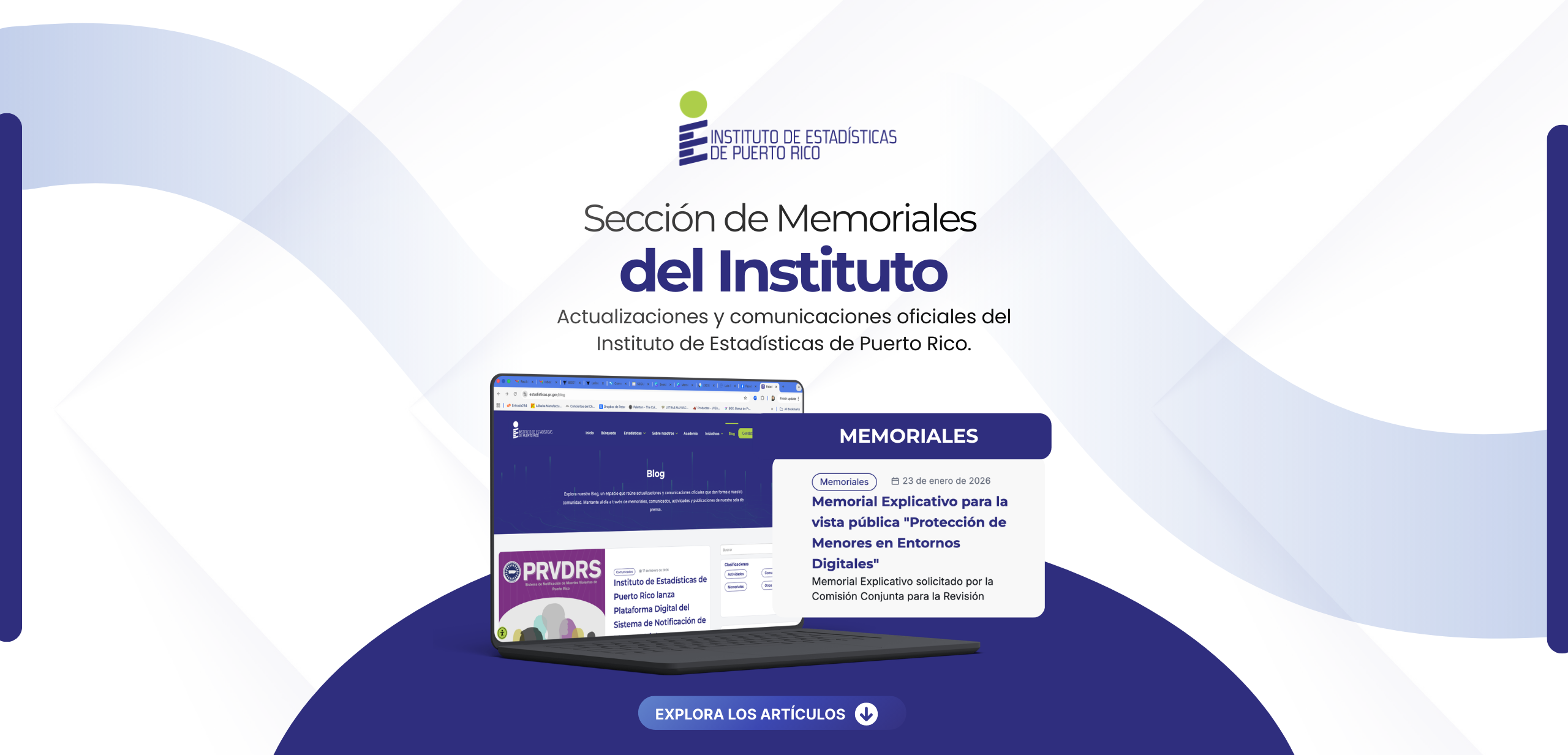
Visit our Blog and keep up to date with the latest news and topics of interest.
Visit our Press Releases and stay connected to the Institute.
Explore the Publication Calendar and keep up to date with Puerto Rico's statistics.
Complete the form for the selection of our Statistics Coordination Committee
Suscribe to receive news directly to your email.
Listen to the Official PRIS podcast and stay informed with the experts

.png)
.png)
.png)
.png)

-p-130x130q80.png)
.png)
.png)
.png)
.png)
.png)
.png)
.png)
.png)
.png)
.png)
.png)