

Some variables are easier to measure than others, but certain questions require special care, both in how they are formulated and in the instruments are used to collect them. One of the most complex is without a doubt, that related to people's ethnic and cultural origin, and also the skin color. In the most recent newsletter of the Puerto Rico State Data Center (SDC-PR) network brief notes are shared about the research on ethnic-racial identification and colorism that has been carried out from the Institute's. Access the current newsletter here, or explore previous newsletters and press releases from the SDC-PR network.

Date: February 14, 2023
To order the Finance, Federal Affairs and Fiscal Oversight Board of the Senate of Puerto Rico to conduct an exhaustive investigation, of an ongoing nature, on the administration, use and expenditure of public funds allocated and administered by the public agencies and instruments of the Commonwealth of Puerto Rico, as well as the execution and compliance of the strategic plans of each public instrument; in order to evaluate whether the economic resources provided to the agencies and instruments to meet the needs of citizens and to be able to determine if it is necessary to take legislative or administrative measures that promote efficient functioning and ensure the adequate budget of public agencies and instruments for the benefit of citizens.
9 de diciembre de 2022: El Instituto de Estadísticas de Puerto Rico publicó el Compendio Estadístico de Escuelas Privadas PK-12 en Puerto Rico 2021-2022, y el Compendio Estadístico de Instituciones Postsecundarias Técnico-Vocacionales en Puerto Rico 2021-2022. Ambos compendios fueron producidos en colaboración con la Oficina de Registro y Licenciamiento de Instituciones de Educación, la cual forma parte del Departamento de Estado del Gobierno de Puerto Rico. Estos compendios proveen información estadística importante, como lo es la matrícula, cantidad de docentes, tasa de promoción, graduación o egresados, entre otros.
Se destacan como resultados relevantes del Compendio Estadístico 2021-2022 del sector de Educación Básica (PK-12) Privada:
Asimismo, se destacan como resultados relevantes del Compendio Estadístico 2021-2022 de sector de Instituciones Postsecundarias Técnico-Vocacionales:
“Durante la pasada década, el sistema educativo ha experimentado importantes cambios en todos los niveles. Estos cambios no solo se reflejan en el sector público, sino también en el sector privado de prekínder a duodécimo grado y en el sector postsecundario técnico-vocacional. Contar con información cuantitativa sobre estos cambios es primordial para, ante estos retos, tomar decisiones basadas en la evidencia, y planificar las acciones a futuro”, expresó el Dr. Orville M. Disdier.
Damaris Nolasco, directora de la Oficina de Registro y Licenciamiento de Instituciones de Educación del Departamento de Estado, expresó que, “Aunque la matrícula de estudiantes del sector privado PK-12 demostró un aumento en comparación con el año anterior 2020-2021, es importante esperar a los próximos compendios, pues, debido a la pandemia, el año 2020-2021 fue uno atípico y confirmar si esta tendencia de aumento se mantiene. Definitivamente, es importante recopilar, producir y publicar los compendios estadísticos en colaboración con el Instituto de Estadísticas de Puerto Rico”.
Tanto el Compendio Estadístico de Escuelas Privadas PK-12 en Puerto Rico, como el Compendio Estadístico de Instituciones Postsecundarias Técnico-Vocacionales en Puerto Rico 2021-2022, se puede acceder, en cualquier momento a través de la siguiente dirección electrónica:
Compendios estadísticos sobre la educación privada no universitaria
Para preguntas técnicas sobre este informe, pueden enviar un correo electrónico a: preguntas@estadisticas.pr.
Para conocer más sobre el Instituto de Estadísticas, pueden acceder la página web: www.estadisticas.pr.gov. En las redes sociales a través de las cuentas de Facebook (@estadisticas.pr), Twitter (@EstadisticasPR), Instagram (@institutodeestadisticas) y LinkedIn (Instituto de Estadísticas de Puerto Rico).
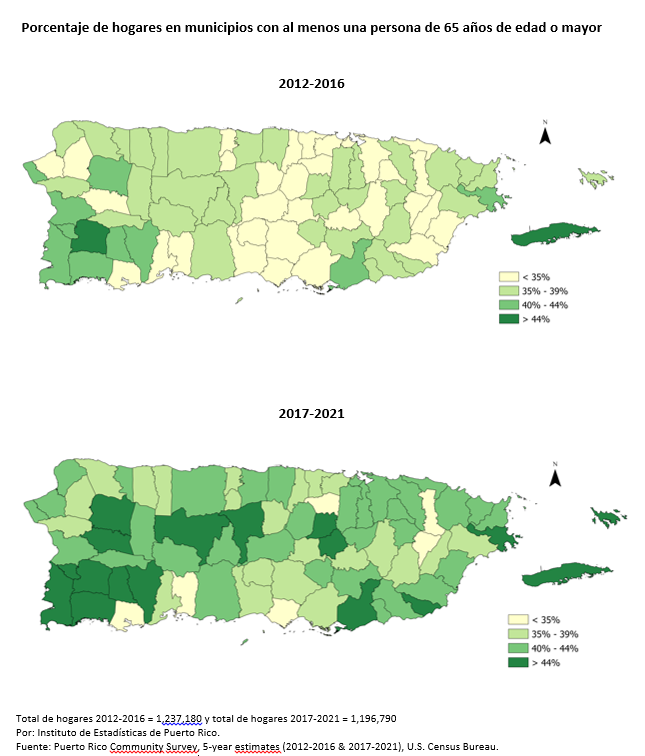
It is estimated that in 50 municipalities, four out of ten households have this trait.
San Juan, PR, December 8, 2022 — The U.S. Census Bureau released today the most recent data from the Puerto Rico Community Survey. These statistics refer to information collected over a period of five years, from 2017 to 2021. The new publication provides data on demographic, social, economic and housing characteristics for Puerto Rico and municipalities, as well as for specific geographical levels such as neighborhoods and census tracts. As part of the U.S. State Data Center Network. Census Bureau in Puerto Rico, the Puerto Rico Statistics Institute (Institute) presents several interesting results:
“The population aged 65 and over is increasingly present in the homes of our jurisdiction; this is partly a reflection of the peak of births that occurred in Puerto Rico in the 1940s and 1960s. Those generations active in our society require and will require support and services for their needs in the present and near future, whether from the immediate family circle, as well as from government programs aimed at this population, said Alberto L. Velázquez-Estrada, Senior Manager of Statistical Projects at the Institute.
Tables with interesting characteristics can be accessed in the data dissemination tool of the U.S. Census Bureau data.census.gov. In addition, as the leading entity of the State Data Center of Puerto Rico, the Institute manages the SDC portal, which contains the main statistical reports and publications of the U.S. Census Bureau on Puerto Rico, specifically those that are most in demand, such as municipal profiles, estimated annual population; the Puerto Rico Community Survey (Puerto Rico Community Survey) and official statistics on Puerto Rico's decennial population and housing censuses, among others. The Puerto Rico SDC portal can be accessed through: censo.estadisticas.pr.

Puerto Rico Statistics Institute is an autonomous governmental entity tasked with coordinating the Government's statistical production service to ensure that the data collection and statistics systems, on which public policies are based, are complete, reliable and have quick and universal access.
For more information you can visit the website: www.estadisticas.pr.gov or write to preguntas@estadisticas.pr They can also follow social networks through Facebook (@estadisticas .pr), Twitter (@EstadisticasPR), LinkedIn (Institute of Statistics of Puerto Rico) and Instagram (@institutodeestadisticas) accounts.
Date: December 5, 2022
To establish the “Act to Declare a State of Emergency for Child Violence in Puerto Rico”, for the purpose of declaring a state of emergency for child violence, in accordance with the provisions and terms established by this Act; and for other related purposes.
Date: November 9, 2022
To order the Integrated Development and Public Funds Oversight Commission of the Western Region of the House of Representatives of Puerto Rico to conduct an investigation in relation to the population density in the municipalities of Mayagüez and San Germán, the birth rate compared to other decades and the emigration of people from these towns to other places in Puerto Rico or outside the island; in order to verify if there is depopulation, depopulation or any other phenomenon; if there is, identify governmental or legislative alternatives to prevent population loss in these towns and their communities; and for other related purposes.
Data presented from the Report on Violent Deaths in Puerto Rico
631 homicides and 229 suicides were reported in Puerto Rico in 2019
The Puerto Rico Violent Death Notification System (PRVDRS) established at the Puerto Rico Institute of Statistics, presented data from the 2019 Report on Violent Deaths in Puerto Rico. The report reports that in 2019 there were 828 incidents of violent deaths, with a total of 894 fatalities. Of the total number of violent deaths, 631 were homicides and 229 were suicides. According to the PRVDRS, violent deaths occur primarily by suicide or homicide.
In 2019, 70.6% of victims of violent deaths were reported in single or multiple homicide incidents and 25.6% were suicide incidents. Five homicide-suicide incidents were reported, resulting in 10 fatalities. In addition, during this period, 10 (1.1%) violent deaths attributed to legal intervention (death in which a person is killed or killed by a law enforcement officer acting in the line of duty) and 20 violent deaths with undetermined intent (2.2%) were documented. Deaths with undetermined intent are those that result from the use of force or power, against oneself or another person, in which evidence indicates that one way of death is no more convincing than another form of death, according to the judgment of medico-legal researchers.
In 2019, approximately 9 out of 10 victims of violent deaths (89.7%) were men. The crude homicide rate was 19.8 per 100,000 inhabitants, 38.9 in men and 2.4 in women. The primary mechanism of the homicides was firearms. 91.7% of the 631 homicides are documented as related to the context of community violence. The victims of these incidents are mainly men (n=558, 96.4%), between 15 and 49 years of age (n=497, 89.1%). The most common criminal circumstances of homicides in Puerto Rico are related to illegal drug trafficking and organized crime (53.5%). In Puerto Rico, according to the report, 91.0% of homicides are committed with firearms, more than double the global average of 42.7%.
In 2019, 29 fatal victims of family violence were reported. Most of these cases were related to violence in an intimate or former partner environment (17 cases, 58.6%). While violence between family members (12 cases, 41.4%), occurred mainly during an argument (63.6%). The vast majority of victims of intimate partner violence were women (n= 15, 88.2%). The two main mechanisms of all homicides of intimate partners were firearms (41.2%) and a sharp instrument (35.3%). More than half of these women were victims of their current spouse or partner (53.3%), while 46.7% were victims of their former spouse or former partner. In addition, 5 of the 17 fatal cases of intimate partner violence were homicide-suicide incidents (29.4%).
As for suicides in Puerto Rico, the report highlights that the frequency is lower than that of homicides. However, as in homicides, suicides are more frequent in men (80.8%). In 2019, the crude suicide rate was 7.2 per 100,000 inhabitants, 12.2 in men (1 of 112 men) and 2.6 in women (1 of 494 women). The main mechanism was asphyxiation.
Mariluz Bezares Salinas, manager of statistical projects at the Institute of Statistics and co-principal investigator of the Report on Violent Deaths in Puerto Rico, explained that the collection of this type of data could involve fieldwork that takes more than two years from the time the incident occurs until the collection and review of the data is completed. For his part, Dr. Diego Zavala, epidemiologist and co-principal investigator of the PRVDRS, said that “this system is a reliable, complete and unique reference source that helps describe the context of violent deaths in the victim-aggressor relationship and the magnitude, trend and characteristics of violent deaths in Puerto Rico.”
The PRVDRS is an epidemiological surveillance system affiliated with the Institute of Statistics and designed to obtain a complete and standardized census of violent deaths in Puerto Rico. The PRVDRS began its participation in the National Violent Death Notification System (National Violent Death Reporting System, NVDRS) in September 2016, through a collaborative agreement granted by the Centers for Disease Control and Prevention (CDC) of the United States Department of Health and Human Services. The 2019 Report on Violent Deaths in Puerto Rico is available through the following link: Puerto Rico Violent Death Notification System.
The Puerto Rico Statistics Institute is an autonomous governmental entity tasked with coordinating the government's statistical production service to ensure that the data collection and statistics systems, on which public policies are based, are complete, reliable, and accessible quickly and universally.
For technical questions about this report, you can send an email to: preguntas@estadisticas.pr.
To learn more about the Institute of Statistics, you can access the website: www.estadisticas.pr.gov. On social media through Facebook accounts (@statistics.pr), Twitter (@EstadisticasPR), Instagram (@institutodeestadisticas) and LinkedIn (Puerto Rico Institute of Statistics).
Please let us know your satisfaction level with our services.
Visit our Official Activities, and participate with us
Visit our Calls for applications and be part of the new opportunities we have for you.
If you have any questions or just want to contact us, visit the Contact Us section.
We are at your disposal. If you need custom statistics, do not hesitate to contact us.
Sign up for our online workshops. Connect with the experts and discover the power of data!
Visit our Blog and keep up to date with the latest news and topics of interest.
Visit our Press Releases and stay connected to the Institute.
Explore the Publication Calendar and keep up to date with Puerto Rico's statistics.
Complete the form for the selection of our Statistics Coordination Committee
Suscribe to receive news directly to your email.
Listen to the Official PRIS podcast and stay informed with the experts

.png)
.png)
.png)
.png)

-p-130x130q80.png)
.png)
.png)
.png)
.png)
.png)
.png)
.png)
.png)
.png)
.png)
.png)