

¿Cómo cierra el Purchasing Managers Index (PMI) en el 2025?

Other
Ronald G. Hernández Maldonado
05 February 2026

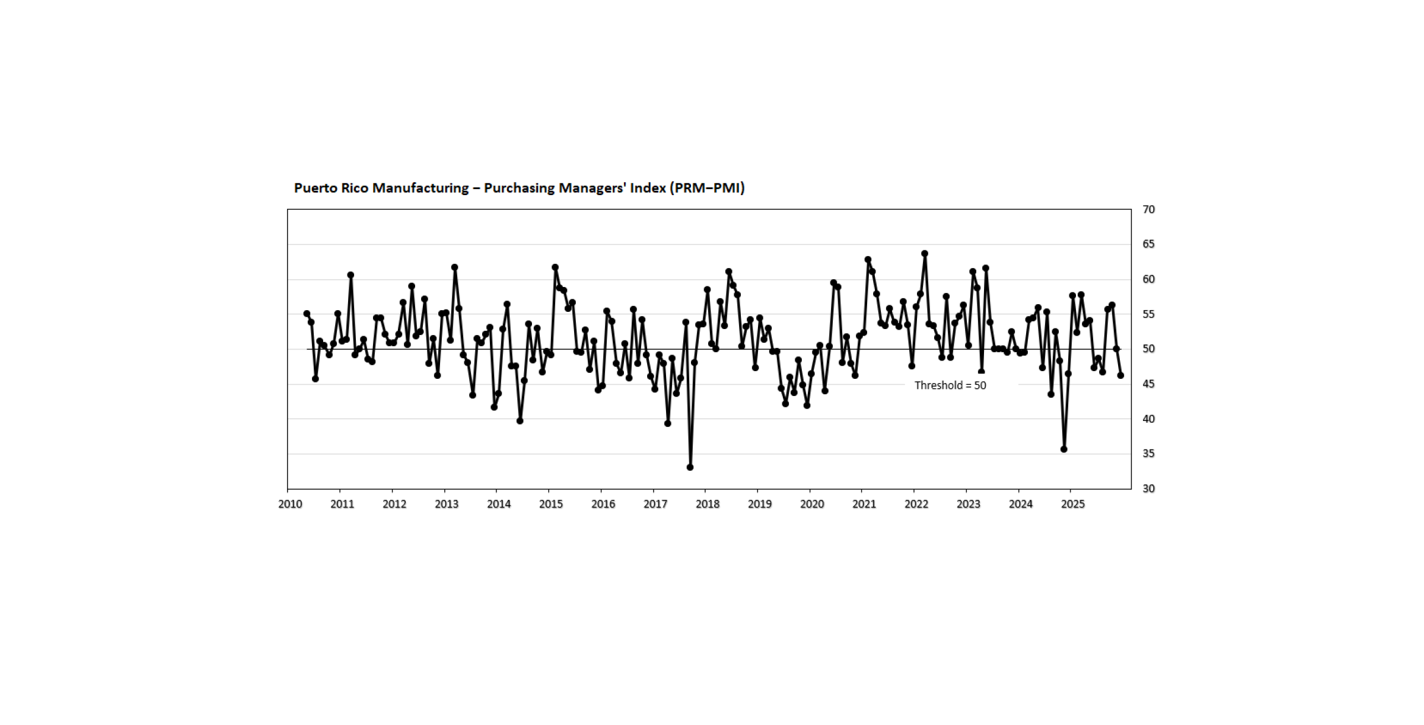
El Purchasing Managers Index (PMI) de la manufactura en Puerto Rico, principal indicador adelantado del desempeño del sector manufacturero, registró un valor de 46.2 en diciembre de 2025, lo que indica una contracción del sector en relación con el mes anterior. Un valor inferior a 50 señala una disminución de la actividad manufacturera respecto al período previo.

El PMI es el principal indicador del desempeño de la manufactura en Puerto Rico y se publica con frecuencia mensual. El Instituto de Estadísticas de Puerto Rico produce y divulga este indicador como parte de su compromiso institucional de ofrecer información estadística objetiva, confiable e independiente, en apoyo al análisis económico y la toma de decisiones informadas.

Durante diciembre, aunque el índice general se mantuvo por debajo del umbral de 50, algunos de sus componentes registraron resultados distintos. En particular, los componentes de empleo y entregas de suplidores se ubicaron en o por encima de ese nivel, lo que refleja una evolución distinta de estos componentes respecto al índice general. Asimismo, los inventarios propios aumentaron en comparación con el mes anterior.

Como parte de una encuesta suplementaria a establecimientos manufactureros, los principales retos identificados durante el mes se concentraron en tres áreas. En el ámbito operacional, se destacaron los costos, las limitaciones en la disponibilidad de materias primas, las entregas de suplidores, la logística de la cadena de suministro y las ventas. En el área de recursos humanos, el principal reto reportado fue el ausentismo laboral. Asimismo, se señalaron problemas relacionados con la confiabilidad del suministro de energía eléctrica.

Desde el inicio de la encuesta, el PMI de la manufactura en Puerto Rico se ha ubicado en o por encima del umbral de expansión en 116 de los 187 meses observados, lo que permite contextualizar el resultado de diciembre dentro de su trayectoria histórica.

Acceda aquí al informe completo y el conjunto de datos del PMI:

https://www.estadisticas.pr.gov/en-us/productos/puerto-rico-manufacturing---purchasing-managers-index-pmi

Share this article:

Visit our Official Activities, and participate with us

Visit our Calls for applications and be part of the new opportunities we have for you.

If you have any questions or just want to contact us, visit the Contact Us section.

We are at your disposal. If you need custom statistics, do not hesitate to contact us.

Sign up for our online workshops. Connect with the experts and discover the power of data!

Visit our Blog and keep up to date with the latest news and topics of interest.

Visit our Press Releases and stay connected to the Institute.

Explore the Publication Calendar and keep up to date with Puerto Rico's statistics.

Complete the form for the selection of our Statistics Coordination Committee

Suscribe to receive news directly to your email.

Listen to the Official PRIS podcast and stay informed with the experts

Transparency and Data: Understanding the Statistical Publication Schedule

Francisco J. Pesante González

Statistical Project Manager

(created with https://gemini.google.com)


In the world of data analysis and decision-making, uncertainty is our greatest enemy. Knowing what the data says is vital, but knowing when it will be available is what allows us to plan with certainty. This is where a fundamental tool for transparency in Puerto Rico comes into play: the Calendar for the publication of statistics.

What exactly is this Calendar?

In simple terms, the Statistics Release Schedule is the official itinerary that governs the publication of statistics for Puerto Rico. It's not just a list of dates; it's a document that details the formal commitment that government entities have to us, the users, about when their statistics will be made public.

This instrument is not optional. It is the duty of the Statistics Institute, enshrined in its enabling law (Act No. 209 of 2003, as amended), to establish strict schedules and ensure that government agencies comply with them.

Beyond Dates: Measuring Efficiency

The interesting thing about this Calendar is that it works as an accountability tool using specific metrics. The Institute records three key moments for evaluating performance:

  1. Reference date: when the statistical event or period occurred.
  2. Anticipated date: The day the agency committed to publishing.
  3. Date of receipt: the current day the information is made available.

From these dates, something critical called the Opportunity Interval (IO) is calculated. The IO measures the number of days that pass from when the statistic occurs until it is finally published.

Why does IoT matter? Because it serves as the basic measure of data “opportunity”. Also known as data lag, this interval directly affects how investors and economists can take advantage of information to make decisions. If we see IoT on the rise, it's a clear sign that the work processes in that unit of government need improvement.

The relevance: why do we need this Calendar?

The existence and compliance of this Calendar are vital for five main reasons:

  1. Encourages updating: urges the Government to keep its statistics up to date, allowing us to measure the regularity of publications.
  2. It empowers the user: it provides a frame of reference that ensures that we have up-to-date data, greatly facilitating the planning of our work.
  3. It guarantees continuous flow: it promotes regular and constant statistical production, supporting the management of these processes within the government.
  4. Transparency and accountability: makes data transparent and anticipated, serving as an instrument to monitor access to public information.
  5. Quality and standardization: it advances the accreditation of statistics based on quality criteria such as timeliness (shortness between the event and publication) and punctuality (lack of delay compared to what was planned).

Conclusion

The Statistical Publication Schedule is more than an administrative agenda; it is the guarantee that Puerto Rico is governed by the same data dissemination standards used by jurisdictions such as Germany, Mexico or the U.S. Census Bureau. At the end of the day, greater regularity and frequency in publication allows us to make better use of statistical information to build a better future. Access this product at: https://www.estadisticas.pr.gov/calendario-de-publicacion


Puerto Rico Toxic Emissions Profile 2016

The Puerto Rico Toxic Emissions Profile, the first of its kind conducted by the Institute, summarizes data from the Toxic Emissions Inventory (TRI) published annually by the U.S. Environmental Protection Agency (EPA) since 1987. Its purpose is to publicize what toxic waste establishments in Puerto Rico emit in order to help the public understand how their communities and environments may be affected.

¿Cómo cierra el Purchasing Managers Index (PMI) en el 2025?

El Purchasing Managers Index (PMI) de la manufactura en Puerto Rico, principal indicador adelantado del desempeño del sector manufacturero, registró un valor de 46.2 en diciembre de 2025, lo que indica una contracción del sector en relación con el mes anterior. Un valor inferior a 50 señala una disminución de la actividad manufacturera respecto al período previo.

El PMI es el principal indicador del desempeño de la manufactura en Puerto Rico y se publica con frecuencia mensual. El Instituto de Estadísticas de Puerto Rico produce y divulga este indicador como parte de su compromiso institucional de ofrecer información estadística objetiva, confiable e independiente, en apoyo al análisis económico y la toma de decisiones informadas.

Durante diciembre, aunque el índice general se mantuvo por debajo del umbral de 50, algunos de sus componentes registraron resultados distintos. En particular, los componentes de empleo y entregas de suplidores se ubicaron en o por encima de ese nivel, lo que refleja una evolución distinta de estos componentes respecto al índice general. Asimismo, los inventarios propios aumentaron en comparación con el mes anterior.

Como parte de una encuesta suplementaria a establecimientos manufactureros, los principales retos identificados durante el mes se concentraron en tres áreas. En el ámbito operacional, se destacaron los costos, las limitaciones en la disponibilidad de materias primas, las entregas de suplidores, la logística de la cadena de suministro y las ventas. En el área de recursos humanos, el principal reto reportado fue el ausentismo laboral. Asimismo, se señalaron problemas relacionados con la confiabilidad del suministro de energía eléctrica.

Desde el inicio de la encuesta, el PMI de la manufactura en Puerto Rico se ha ubicado en o por encima del umbral de expansión en 116 de los 187 meses observados, lo que permite contextualizar el resultado de diciembre dentro de su trayectoria histórica.

Acceda aquí al informe completo y el conjunto de datos del PMI:

https://www.estadisticas.pr.gov/en-us/productos/puerto-rico-manufacturing---purchasing-managers-index-pmi