


Durante el año 2025, las importaciones de chocolate y demás preparaciones alimenticias que contengan cacao (HTS 1806) en Puerto Rico mostraron una tendencia creciente durante la segunda mitad del año. A partir de julio, cuando se registraron $8.5 millones, el valor de las importaciones aumentó progresivamente, alcanzando $9.2 millones en agosto, $10.5 millones en septiembre y un máximo de $12.5 millones en octubre. Este comportamiento coincide con el periodo previo a las festividades de Halloween, cuando estos productos suelen tener una mayor presencia en el mercado.
Las estadísticas de comercio exterior permiten conocer el comportamiento de los bienes que ingresan a Puerto Rico, identificar tendencias y analizar sus países de origen. Estos datos ayudan a las empresas a planificar sus operaciones, anticipar cambios en el mercado e identificar oportunidades de negocio a partir del comportamiento de las importaciones.
Fuente: Comercio Exterior - Instituto de Estadísticas de Puerto Rico
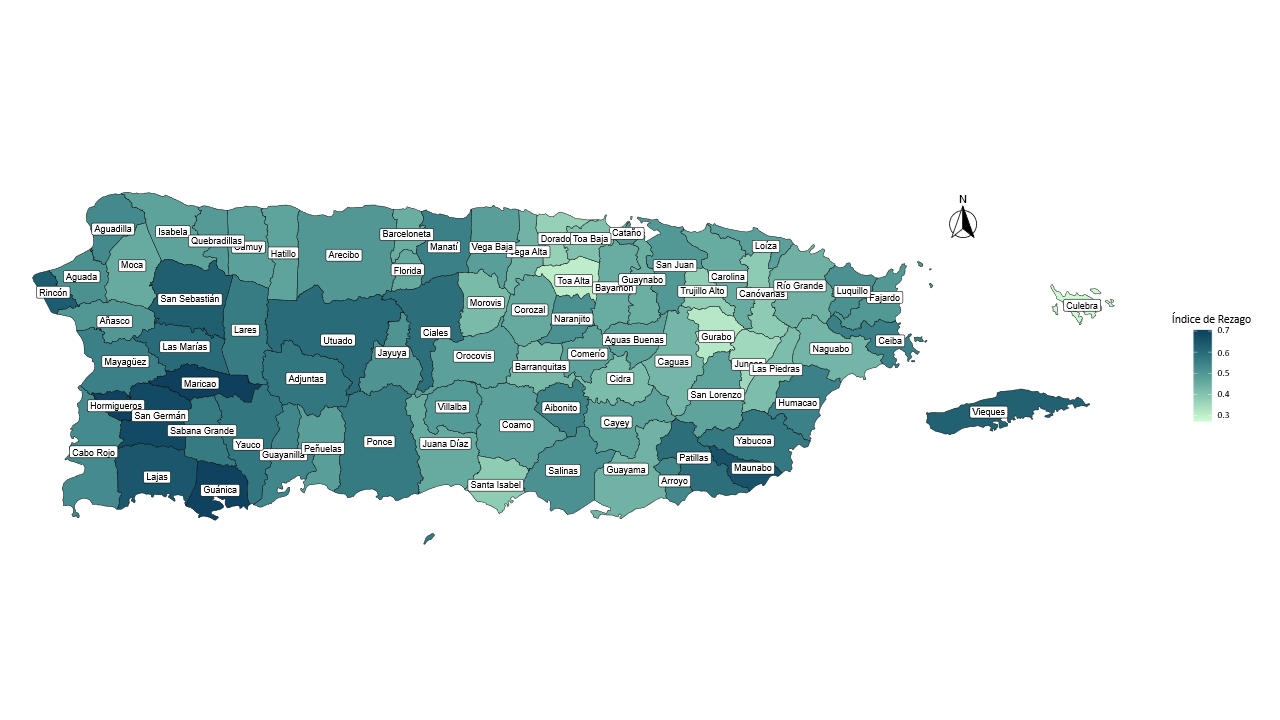
San Juan, Puerto Rico — November 6, 2025 — The Institute of Statistics released the results of the Backwater Index for Puerto Rico, a study that offers a comprehensive look at the social and economic situation of Puerto Rico's municipalities. This index constitutes an analysis and planning tool that seeks to promote dialogue, reflection and informed action for the benefit of Puerto Rico's socioeconomic development.
El Lagging Index measures a multidimensional phenomenon using a summary data that allows us to compare the relative performance of municipalities in two dimensions: Economic Mobility and Demography. Five main variables were considered in its design: the percentage of people below the poverty level, the unemployment rate, the percentage of high school graduates (in a population aged 18 and over), the dependency rate by age and the median age.
The index was calculated for two comparative periods: 2014-2018 and 2019-2023, allowing us to observe changes in scores and relative positions of municipalities over time. Index values fluctuate between 0 and 1, with a higher score representing a higher relative level of lagging.
The analysis reveals that 42 municipalities showed a decrease in their score of the Lagging Index, which suggests a relative improvement in the conditions measured by the indicator. Of these, 22 municipalities registered a reduction of more than 5%. In the same way, there are concentrations of municipalities with higher scores —indicating greater relative lagging— in the center, south, southwest and southeast regions of Puerto Rico, while several municipalities in the metropolitan area and adjacent to it showed progress compared to the rest of the archipelago.
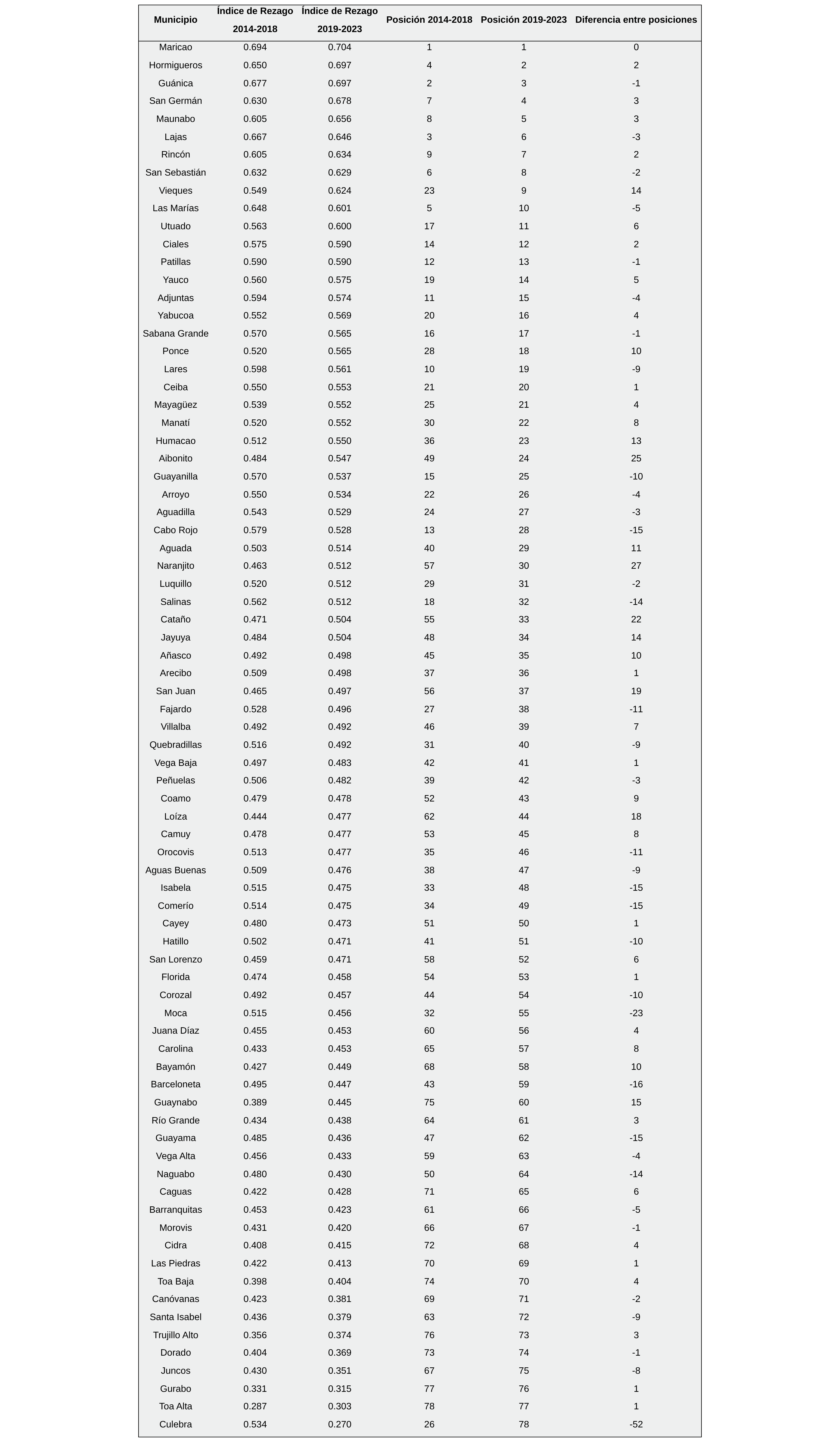
The municipalities of Culebra, Toa Alta, Gurabo, Juncos, Dorado, Trujillo Alto, Santa Isabel, Canóvanas, Toa Baja and Las Piedras performed better in their relative index in the last period analyzed (2019-2023). However, the Institute stresses that the index is a relative measure and not an absolute measure, so the results must be analyzed within the context and used as a basis for the development of more specific analyses.
“The value of the index is not in pointing out which municipality is better or worse, but in providing an objective basis for analysis, planning and decision-making. It is an opportunity for mayors and officials who participate in decision-making to know their social and economic reality and to develop strategies that respond to the specific needs of their municipalities,” said Dr. Ronald Hernández, Manager of Statistical Projects at the Institute of Statistics of Puerto Rico.
For the elaboration of the Lagging Index, the Institute applied rigorous statistical methods —including exploratory factor analysis, normalization and aggregation of variables—using data from the five-year estimates of the Community Survey of the U.S. Census Bureau And the Bureau of Labor Statistics.
Data
Table 1 shows the results of the Lagging Index at the municipal level for the periods 2014 - 2018 and 2019 - 2023. The table is ordered according to the position of the municipalities based on their index value for the period 2019 — 2023. The higher the index score, the worse or less favorable the outcome of the phenomenon.
Table 1: Lagging Index Results
According to Dr. Hernández, the results of the study highlight the need to design comprehensive public policies that address both the economic aspects and the demographic transformations of Puerto Rico. “The improvements seen in several municipalities are encouraging, but it is essential that socio-economic development efforts are integrated with strategies to respond to the ongoing demographic transition. This includes strengthening geriatric health services, care policies, retention of young people and urban planning adapted to long-lived communities,” said the Institute.”
Hernández indicated that, the Municipal Backwater Index seeks to promote an evidence-based dialogue between the different sectors of Puerto Rico. Its purpose is to serve as a planning and evaluation instrument, which facilitates the identification of areas of opportunity and guides investment decisions, municipal planning and public policy at the central and local levels.”
The full report of the Municipal Backwater Index is available in: Backwater Index for Puerto Rico
The Puerto Rico Statistics Institute is an autonomous governmental entity responsible for coordinating the Government's statistical production service to ensure that the data collection and statistics systems, on which public policies are based, are complete, reliable, and have quick and universal access.
For more information you can write to preguntas@estadisticas.pr. They can also follow social networks through Facebook (@estadisticas .pr), X (@EstadisticasPR), LinkedIn (Institute of Statistics of Puerto Rico) and Instagram (@institutodeestadisticas) accounts.

To amend Article 3 of Law 209-2003, as amended, known as the “Puerto Rico Statistics Institute Act” to provide that the Office of the Comptroller extends the term of audits of the accounts and operations of the Puerto Rico Statistics Institute to three (3) years; and for other related purposes.
Date: November 3, 2025
To create the Puerto Rico Media and Digital Literacy Act to ensure that students in the public education system develop media and digital literacy skills that promote the responsible use of technology and artificial intelligence (AI), and strengthen citizen resilience to disinformation and digital manipulation; and for other related purposes.
Expo Statistics 2025
The Puerto Rico Institute of Statistics celebrated on October 17, 2025. This is the masterful event that the Puerto Rico Institute of Statistics celebrates every five (5) years. The program of this activity addressed topics such as artificial intelligence and statistics, academic statistics programs in Puerto Rico and data needs in the public and private sectors, among other topics.
The initiative:
This initiative focuses on the use of quality data to drive change and is part of World Statistics Day, as proclaimed by the United Nations (UN).
Invited-Special Presentations
Data Panel
Quality data panel transcription
Puerto Rico Institute of Statistics
Materials:
Date: October 14, 2025
To order the Puerto Rico Department of Health to amend regulation 9184, to require doctors who provide direct health services in the emergency room, in hospitals or the primary level, three (3) credit hours in each period of continuing education on issues of sexual violence.
Date: September 29, 2025
To order the Committee on Economic Development, Small Businesses, Banking, Commerce, Insurance and Cooperativism of the Senate of Puerto Rico to conduct an exhaustive investigation into the implementation, compliance and results of laws, programs and public policies aimed at economic development in Puerto Rico; to listen to the granting of incentives to young entrepreneurs, local industries, investments, industrial development, the insurance sector; to scrutinize trade, its local development and exchange with the outside world; evaluate the support for sectors such as microentrepreneurs, small and medium-sized enterprises; investigate local and international banking and the performance of the banking system; study the current conditions of cooperatives and the insurance industry in Puerto Rico; study the performance of government entities that oversee or promote the development of financial institutions in Puerto Rico; examine the inclusion, development or encouragement of cooperatives in areas such as agriculture, energy, housing, industry and workers, among others; enquire about issues related to the business development of small and medium-sized businesses, including training programs, direct technical advice and financing, as well as new business opportunities and competitiveness; and review any other issue that allows defining, implementing, directing, managing, supervising, establishing and enacting public policy on any issue aimed at sustainable and cutting-edge economic development for Puerto Rico.
Please let us know your satisfaction level with our services.
Visit our Official Activities, and participate with us
Visit our Calls for applications and be part of the new opportunities we have for you.
If you have any questions or just want to contact us, visit the Contact Us section.
We are at your disposal. If you need custom statistics, do not hesitate to contact us.
Sign up for our online workshops. Connect with the experts and discover the power of data!
Visit our Blog and keep up to date with the latest news and topics of interest.
Visit our Press Releases and stay connected to the Institute.
Explore the Publication Calendar and keep up to date with Puerto Rico's statistics.
Complete the form for the selection of our Statistics Coordination Committee
Suscribe to receive news directly to your email.
Listen to the Official PRIS podcast and stay informed with the experts