

Some variables are easier to measure than others, but certain questions require special care, both in how they are formulated and in the instruments are used to collect them. One of the most complex is without a doubt, that related to people's ethnic and cultural origin, and also the skin color. In the most recent newsletter of the Puerto Rico State Data Center (SDC-PR) network brief notes are shared about the research on ethnic-racial identification and colorism that has been carried out from the Institute's. Access the current newsletter here, or explore previous newsletters and press releases from the SDC-PR network.

This is detailed in the most recent Migrant Profile 2021-2022
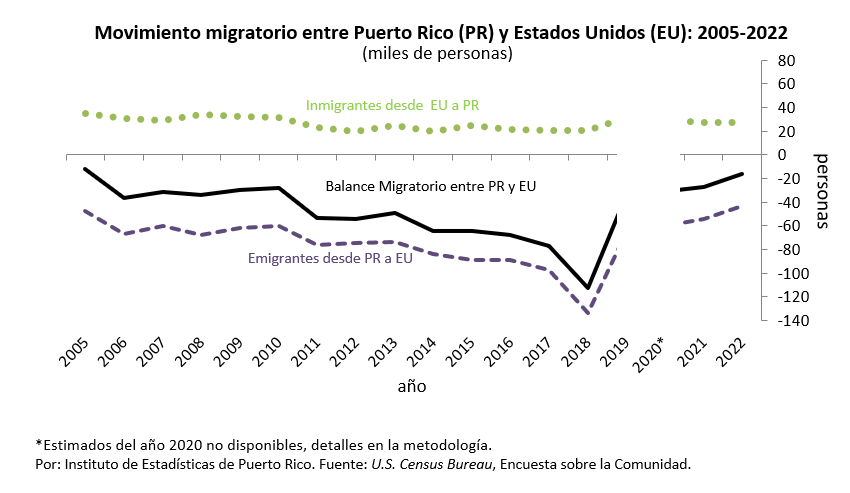
San Juan, PR, December 11, 2023 — During the calendar years 2021 and 2022, data from the Community Survey indicate that the net migration balance between Puerto Rico and the United States decreased from -27 to -16 thousand people emigrating or by -41%. This was revealed by the 2021-2022 Migrant Profile, which was published today by the Puerto Rico Institute of Statistics, and which presents an overview of the migratory movement in Puerto Rico in the calendar year 2021 and 2022. On the other hand, the values continue to reflect more people leaving than entering the jurisdiction in both years. Here are several key findings:
“The indicators indicate a reduction in net emigration in recent years. In other words, a decline has been identified in the notorious net migratory flows that prevailed from 2011 to 2019, where net emigration represented between 1.1% and 3.5% of the total annual population of Puerto Rico. Net emigration in 2021 and 2022 represented 0.8% and 0.5% of the total population, respectively. On the other hand, we cannot lose sight of the fact that more people continue to leave than those who enter, which continues to alter the demographic composition of our jurisdiction,” said Alberto L. Velázquez-Estrada, Senior Manager of Statistical Projects at the Institute.
(A graph is included with the series of migration estimates (2005-2022) according to the Community Survey and link to the visualization of the Puerto Rican population in the United States in recent decades as part of the Introduction to the Migrant Profile And to the Maps with the distribution of emigrants by Profile states.)
For more details and information on the full report of the 2021-2022 Migrant Profile, as well as previous publications, you can access the Publications section of the Puerto Rico Institute of Statistics at the link: https://estadisticas.pr/en/publicaciones.
As the lead entity of Puerto Rico's SDC program, the Institute manages the SDC page, which contains the main statistical reports and publications of the U.S. Census Bureau on Puerto Rico, specifically those that are most in demand, such as annual population estimates; the Puerto Rico Community Survey (Puerto Rico Community Survey) and official statistics on Puerto Rico's decennial population and housing censuses, among others.
The Puerto Rico Statistics Institute is an autonomous governmental entity responsible for coordinating the Government's statistical production service to ensure that the data collection and statistics systems, on which public policies are based, are complete, reliable, and have quick and universal access.
For more information you can visit the website: www.estadisticas.pror on social networks through Facebook (@estadisticas .pr), Twitter (@EstadisticasPR) and LinkedIn (Institute of Statistics of Puerto Rico) accounts.
###
Contacts:
Lourdes Burgos, R-27, 787-562-2932
Idia M. Martinez, R-28, 787-603-3200
Only 22% of the women surveyed hold a supervisory position
This is according to the results of the study on the needs of working women, in which 13,283 people participated.
San Juan, Puerto Rico. December 6, 2023 - The Puerto Rico Institute of Statistics and the Office of the Women's Attorney presented the results of the study on the Needs of Working Women, a collaboration that involved the participation of 13,283 people surveyed. This joint effort aimed at identifying the needs and challenges of working women, basing the conclusions on empirical evidence and thus providing a basis for identifying possible solutions to the different situations faced by working women in Puerto Rico.
Under the slogan “We are all working women”, the electronic questionnaire was aimed at working women in different sectors, including the public and private sectors, housewives, caregivers, businesswomen and those who work independently. Participation was voluntary and anonymous. The topics addressed in the survey included the work situation, work environment, breastfeeding, motherhood, household structure and needs, quality of life, physical and emotional health.
From the results of the study, which is available by accessing https://estadisticas.pr/en/Necesidades-Mujer the following are highlighted:
Employment status:
Breastfeeding:
Maternity:
Structures and needs of the house and home:
Need for a caregiver:
Quality of life, physical and emotional health:
Gender-based violence:
Socio-demographic characteristics:
“I am grateful to the thousands of women who participated in this important study. Its detailed input will allow us to take action and create initiatives aimed at companies and employers so that they can improve and reinforce the areas of greatest need. In our office, we continue to be in the best position to help women and ensure that their rights are fulfilled in the personal and work environment,” said the acting attorney, Madeline Bermudez.
“The data collected in this study are essential to help us understand the realities that women face in the workplace. Statistical objectivity is essential for the progress of our society, and these data are a valuable tool for evidence-based decision-making. This information could help to effectively understand the specific needs of working women, thus contributing to the construction of more equitable and just working environments,” said Dr. Orville M. Disdier Flores, Executive Director of the Puerto Rico Institute of Statistics.
They reveal an increasing trend in the incidence of Type 1 Diabetes in the
pediatric population in Puerto Rico
At the launch of the first Pediatric Type 1 Diabetes Platform in Puerto Rico
The incidence rate of Type 1 Diabetes in the pediatric population (new cases per 100,000 people between 0 and 18 years of age) shows a tendency to increase over the years, with 2009 being the year with the lowest rate (20.5), and 2021 the year with the highest rate (38.4). Although there are variations, on average, the incidence rate shows an increasing trend of 1% per year. In the most recent available year, 2022, the incidence rate was 34.2 new cases per 100,000 people between 0 and 18 years old. These data were revealed during the presentation of the first Pediatric Type 1 Diabetes Platform in Puerto Rico, developed by the Statistics Institute of Puerto Rico in partnership with the Pediatric Diabetes Foundation. This platform provides essential statistical data for understanding and addressing Type 1 Diabetes in Puerto Rico and is available at: https://estadisticas.pr/en/diabetes-tipo-1.
“These data are essential to be able to establish public policies for management, allocation of funds and resources, for researchers, doctors and for the families of patients living with diabetes. We needed an entity such as the Puerto Rico Statistics Institute with the expertise and willingness to help us with the statistical process, which resulted in an important alliance of will between the Foundation and the Institute. Today we can present the result of the collaboration between the Foundation and the Institute,” said Bernardo Maldonado, president of the Board of Directors of the Puerto Rico Pediatric Diabetes Foundation.
According to the executive director of the Institute of Statistics, Dr. Orville M. Disdier, this platform represents an essential advance in the understanding and management of Type 1 Diabetes in the pediatric population. “These findings, presented for the first time on an interactive platform, provide a detailed view of the situation of Type 1 Pediatric Diabetes in Puerto Rico, which is essential for guiding public health policies and resource allocation,” said Dr. Disdier.
The findings detailed on the platform reveal significant data for the period from 2009 to 2022. Among these, the following stand out:
In addition, Mariana Benítez Hilera, executive director of the Pediatric Diabetes Foundation, emphasized the Foundation's work in collecting unique data since 2008. This is thanks to a collaborative alliance with the hospitals where these patients are diagnosed and pediatric endocrinologists. “Once a child is diagnosed with diabetes, the first help they receive at the hospital is from our Foundation, which in turn helps us to have contact with their family right from the start and help them throughout the education process,” said Benítez Hilera.
Dr. Marina Ruiz, a pediatric endocrinologist, emphasized that Type 1 Diabetes is the type of diabetes that most affects the pediatric population. “It's an autoimmune condition that has no cure and can't be prevented. The condition requires a multidisciplinary team, such as the one found at the Pediatric Diabetes Foundation, to achieve successful management. This is the first time that statistics on diabetes in children aged 0 to 18 have been generated in Puerto Rico, which will help position our island on the world map with validated and reliable data. This will lead to the development of clinical studies in the near future to continue expanding our knowledge of the condition. In addition, it helps to carry the message to communities so that they have symptoms present and thus avoid acute and/or chronic complications.” said Ruiz.
Updated data on femicide in Puerto Rico
Fifty-nine femicides were reported in Puerto Rico between 2021 and 2023
November 9, 2023. San Juan, Puerto Rico. The Puerto Rico Statistics Institute (Institute), updated the data on femicide in Puerto Rico, presented in the section entitled “Femicide Statistics”, through its Platform for Statistics and Indicators on Gender Violence (See: https://estadisticas.pr/en/Comite-Pare). According to Mariluz Bezares, Manager of Statistical Projects at the Institute and Coordinator of the Puerto Rico Violent Death Notification System (PRVDRS), in 2023, six (6) of every 10 homicides of women were femicides (60%). Other highlights from this update include:
The data collected and presented by the Institute arise in part as a result of collaboration with various entities, including the Puerto Rico Police Bureau, the Institute of Forensic Sciences and the Demographic Registry of the Department of Health.
The Puerto Rico Statistics Institute is a governmental entity in the executive branch, with fiscal and administrative autonomy, whose main purpose is to ensure that Puerto Rico has complete, reliable statistics with quick and universal access. To learn more about the Institute of Statistics, you can access the website: www.estadisticas.pr. On social media through Facebook (@estadisticas .pr), Twitter (@EstadisticasPR), Instagram (@institutodeestadisticas) and LinkedIn (Institute of Statistics of Puerto Rico) accounts.
Date: November 7, 2023
To amend Article 6.08 of Law 168-2019, as amended, known as the “Puerto Rico Weapons Act of 2020”, to include as a crime to possess or carry “Part of a Firearm” as defined in the law itself.
Date: October 17, 2023
To order the Development Commissions of the Southeast Region; and the Special Committee for the Eradication of Poverty of the Senate of Puerto Rico to conduct research on the impact of poverty on child development in the municipalities of Aibonito; Arroyo; Barranquitas; Cayey; Cidra; Coamo; Comerío; Corozal; Guayama; Juana Díaz; Naranjito; Orocovis; Salinas; Santa Isabel and Villalba, in order to identify strategies to address the socio-economic reality experienced by thousands of children; and to evaluate the results of programs and initiatives established by the Government to combat and eradicate poverty.
Please let us know your satisfaction level with our services.
Visit our Official Activities, and participate with us
Visit our Calls for applications and be part of the new opportunities we have for you.
If you have any questions or just want to contact us, visit the Contact Us section.
We are at your disposal. If you need custom statistics, do not hesitate to contact us.
Sign up for our online workshops. Connect with the experts and discover the power of data!
Visit our Blog and keep up to date with the latest news and topics of interest.
Visit our Press Releases and stay connected to the Institute.
Explore the Publication Calendar and keep up to date with Puerto Rico's statistics.
Complete the form for the selection of our Statistics Coordination Committee
Suscribe to receive news directly to your email.
Listen to the Official PRIS podcast and stay informed with the experts

.png)
.png)
.png)
.png)

-p-130x130q80.png)
.png)
.png)
.png)
.png)
.png)
.png)
.png)
.png)
.png)
.png)
.png)