
The percentage of people with a high school level or higher in Puerto Rico increases

Announcements
IEPR
24 December 2025

PRESS RELEASE

PUERTO RICO STATE DATA CENTER NETWORK (SDC-PR)

The percentage of people with a high school level or higher in Puerto Rico increases

Comparison of the periods 2010-2014 and 2015-2019, indicates that 69 municipalities reflected an increase in this characteristic

San Juan, PR, December 10, 2020 — The U.S. Census Bureau today released the most recent data from the Puerto Rico Community Survey known as the Puerto Rico Community Survey. These statistics refer to information collected over a period of 5 years, from 2015 to 2019. The new publication provides data on demographic, social, economic and housing characteristics for Puerto Rico and municipalities, as well as for specific geographical levels such as neighborhoods, census tracts and block groups. As part of the State Data Center Network of the U.S. Census Bureau in Puerto Rico, the Puerto Rico Statistics Institute (Institute) presents several interesting results:

  1. In a comparison of the previous five-year period 2010-2014, compared to the most recent period 2015-2019, estimates indicate that:
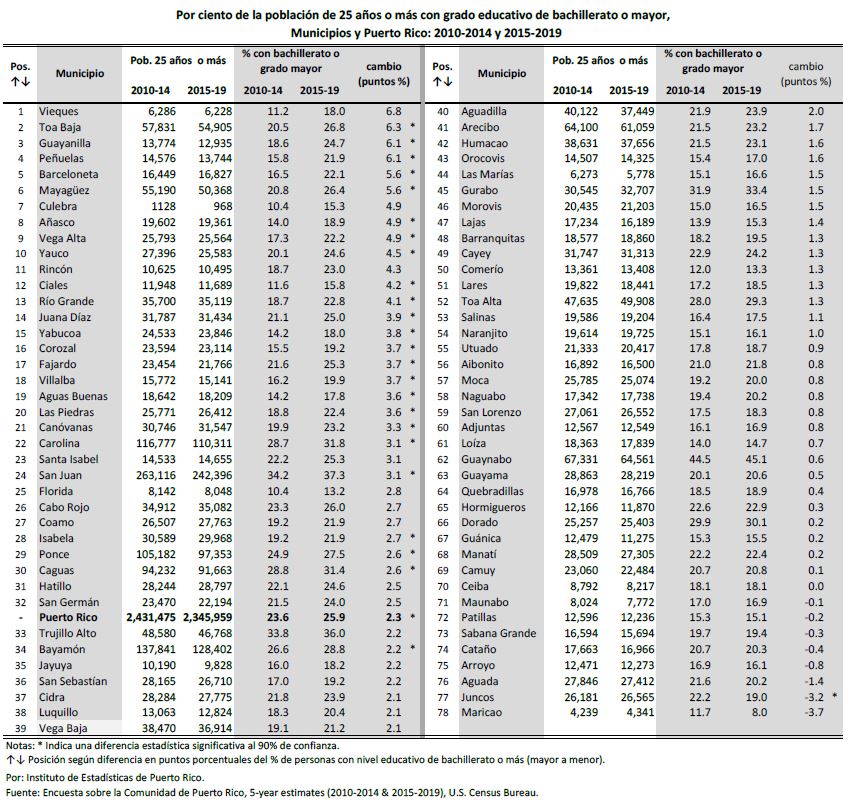
    • In Puerto Rico's population aged 25 and over, the percentage of people with a high school education degree or higher increased from 23.6% to 25.9%, this difference being statistically significant.
    • At the municipal level, some 69 municipalities showed a similar increase in the number of people with at least a high school degree.
      • In 24 of the 69 municipalities, the differences were statistically significant.
      • The municipality of Ceiba showed no change (18.1%) during both periods.
      • On the other hand, the municipalities of Maricao, Juncos, Aguada, Arroyo, Cataño, Sabana Grande, Patillas and Maunabo showed a decrease in this characteristic within the educational level achieved. The difference between the municipality of Juncos was the only statistically significant difference.
  2. In addition, at the level of Puerto Rico during the period 2015-2019, among the social characteristics it was estimated that:
    • 85,573 grandparents live with their grandchildren, of whom 38.6% are responsible for them.
    • Of the households in Puerto Rico (1,192,654), the following types are broken down:
      • 37.8% are from families of married couples,
      • 8.5% are from couples who live together,
      • in 16.3% of households, men are heads of household without a wife/partner (or) present, and of these 11.8% live alone,
      • and in 37.3% of households women are heads of household without a husband/partner (or) present, and of these 16.3% live alone.
    • Regarding the presence of computers and Internet access, 68.6% and 60.4% of households in Puerto Rico have a computer and a broadband Internet subscription, respectively.

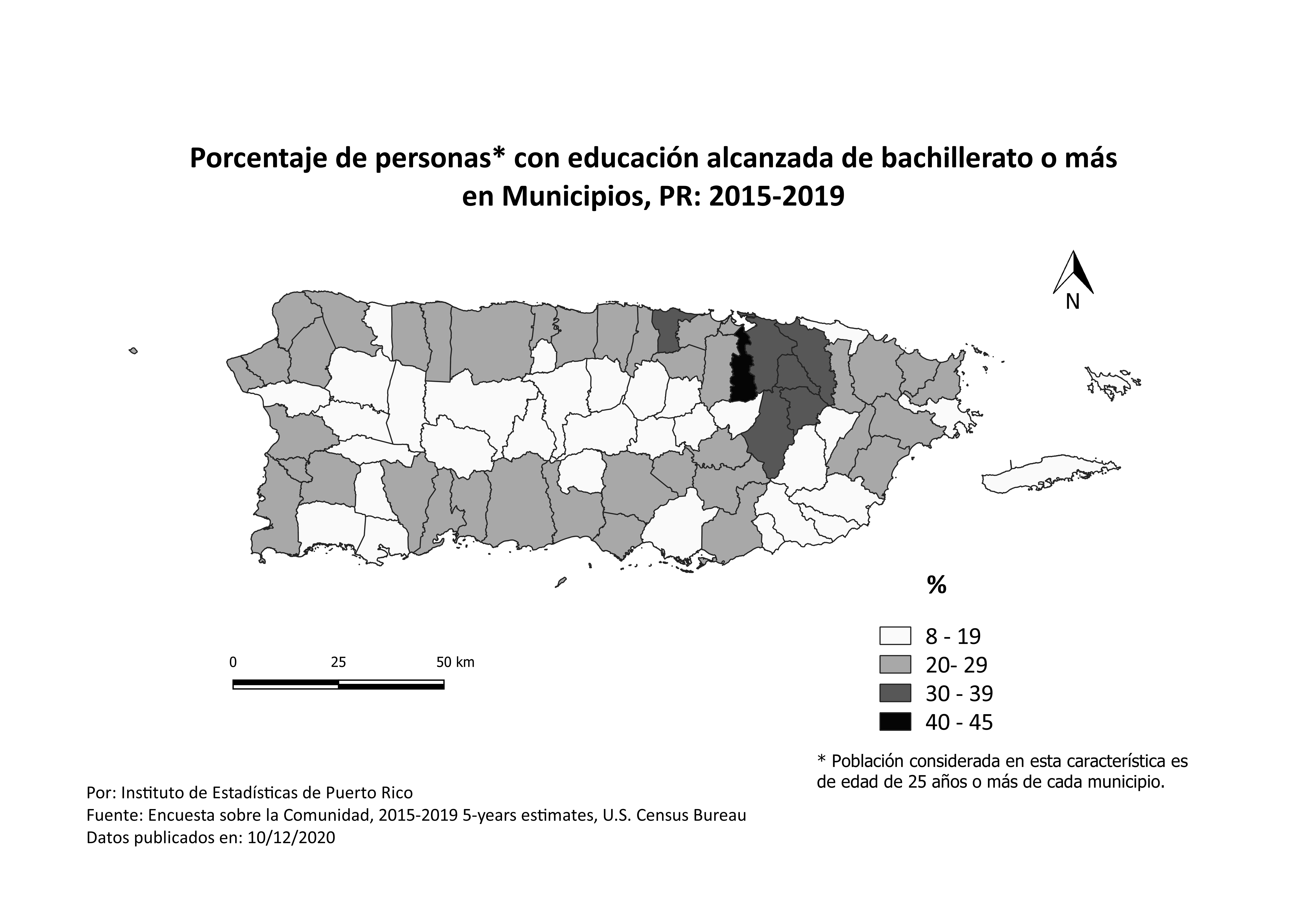
“The comparison of the percentage of people with education, at least at the high school level, shows that most municipalities increased that percentage in the most recent period. However, the considerable differences between municipalities with this characteristic are striking, ranging from 8% in Maricao to 45% in Guaynabo.”, said Alberto L. Velázquez-Estrada, Manager of Statistical Projects at the Institute.

Tables with interesting characteristics can be accessed in the U.S. Census Bureau's data dissemination tool data.census.gov. In addition, as the leading entity of Puerto Rico's SDC, the Institute manages the SDC portal, which contains the main statistical reports and publications of the U.S. Census Bureau on Puerto Rico, specifically those that are most in demand, such as annual population estimates; the Puerto Rico Community Survey and official statistics on Puerto Rico's decennial population and housing censuses, among others. The Puerto Rico SDC portal can be accessed through: censo.estadisticas.pr.
The Puerto Rico Statistics Institute is an autonomous governmental entity responsible for coordinating the Government's statistical production service to ensure that the data collection and statistics systems, on which public policies are based, are complete, reliable, and have quick and universal access.

For more information you can visit our website: www.estadisticas.pr.gov. In addition, you can follow us on social networks through Facebook (@estadisticas .pr), Twitter (@EstadisticasPR) and LinkedIn (Institute of Statistics of Puerto Rico) accounts.

##

For questions:

https://preguntas.estadisticas.pr/

Share this article:

Visit our Official Activities, and participate with us

Visit our Calls for applications and be part of the new opportunities we have for you.

If you have any questions or just want to contact us, visit the Contact Us section.

We are at your disposal. If you need custom statistics, do not hesitate to contact us.

Sign up for our online workshops. Connect with the experts and discover the power of data!

Visit our Blog and keep up to date with the latest news and topics of interest.

Visit our Press Releases and stay connected to the Institute.

Explore the Publication Calendar and keep up to date with Puerto Rico's statistics.

Complete the form for the selection of our Statistics Coordination Committee

Suscribe to receive news directly to your email.

Listen to the Official PRIS podcast and stay informed with the experts

They add data on adult health conditions to the interactive map on school and community profiles

They add data on adult health conditions to the interactive map on school and community profiles

Based on data from the Centers for Disease Control and Prevention (CDC) “Behavioral Risk Factor Surveillance System (BRFSS)” annual survey

August 2, 2022: The executive director of the Puerto Rico Institute of Statistics, Dr. Orville M. Disdier, announced that a new layer has been added to the interactive map on school and community profiles, known as the “School Community Profile: The Interactive Map”. This time, the new layer deals with aspects of adult health. This new layer presents statistics on several health conditions in the adult population (18 years and older), such as diabetes, asthma, heart disease, arthritis, and cancer, among others. The data are based on information collected by the annual “Behavioral Risk Factor Surveillance System (BRFSS)” survey, conducted by the Centers for Disease Control and Prevention (CDC), in collaboration with the Puerto Rico Department of Health. This particular layer is entitled “Behavioral Risk Surveillance System 2020 (CDC)” and must be activated using the “layers” menu. The data correspond to the calendar year 2020 and the statistics are available at the regional level, segregated into the following six (6) regions: Arecibo, Bayamón, Caguas, Mayagüez, Metro-Fajardo and Ponce.

“These data allow us to geo-correlate the regional prevalence of health characteristics of adult residents of those regions, with the rest of the diverse characteristics of schools, students and the communities that are located within them,” explained Dr. Disdier.

Some aspects that this new layer allows us to observe are, for example, that the prevalence of diabetes for 2020 was 19.3% for the Arecibo region, while for the Metro-Fajardo region it was 13%. On the other hand, for the Arecibo region, the prevalence of kidney disease was 3.3%, and for the Caguas region it was 2.6%. “The contrasts between the health aspects of the regions with the rest of the characteristics of the students, and their communities in those regions, could help improve health promotion and health risk prevention strategies within each community,” emphasized Dr. Disdier.

The School Community Profile: The Interactive Map”, with this new layer and all the others, resides on the Puerto Rico Institute of Statistics website and can be accessed at any time by interested parties at the following e-mail address: School community profile.

For technical questions about this tool, you can send an email to: preguntas@estadisticas.pr.

#estadisticaspr

About the Puerto Rico Institute of Statistics

To learn more about the Institute of Statistics, you can access the website: www.estadisticas.pr.gov. On social media through Facebook accounts (@statistics.pr), Twitter (@EstadisticasPR), Instagram (@institutodeestadisticas) and LinkedIn (Puerto Rico Institute of Statistics).

Statistics Institute releases first results on the Study of the Needs of the Deaf Community in Puerto Rico

PRESS RELEASE

Statistics Institute releases first results on the Study of the Needs of the Deaf Community in Puerto Rico

84% of totally deaf people surveyed who needed public safety services and 75% of those who needed services in government agencies faced barriers

July 21, 2022: The executive director of the Puerto Rico Statistics Institute (Institute), Dr. Orville M. Disdier, presented the first results of the Study of the Needs of the Deaf Community in Puerto Rico, through an interactive digital report. This new product, called “Study of the Needs of the Deaf Community: Interactive Report”, presents the first results of the Population Survey that the Institute conducted, both to deaf and partially deaf people, and to the general public. In addition, the interactive report presents the results of focus group interviews with teachers of students with hearing difficulties. The platform presents, for both deaf and partially deaf people, data and statistics on socio-demographic aspects, on the difficulties presented when requesting services, both governmental and non-governmental, on the communication methods used by this community and on the difficulties in accessing information offered by various means of communication, among other findings.

“The data and statistics presented in this interactive report serve as an empirical basis to justify various initiatives and the development of new public policies that promote quality services and better integration of deaf people into the rest of society, while promoting equity and social justice,” said Dr. Disdier.

Some of the most relevant results of the Deaf Community Needs Study:

  • 9% of all respondents indicated that they were completely deaf.
  • 14% of all respondents indicated that they are partially deaf.
  • 62% of the totally deaf people who participated in the survey were deaf at birth, while the remaining 38% became deaf sometime after their birth.
  • 66% of the partially deaf who participated in the survey have a level of severe or profound deafness.
  • 86% of the totally deaf people surveyed said they often feel discriminated against (41% very often and 45% sometimes). On the other hand, 68% of the partially deaf people surveyed said they often feel discriminated against (20% very often and 48% sometimes).
  • 84% of the totally deaf people surveyed, who needed public safety services, faced barriers.
  • 75% of the totally deaf people surveyed, who needed services from government agencies, faced barriers.
  • On the other hand, 53% of the partially deaf people surveyed, who needed services from government agencies, faced barriers.
  • Other places where the totally deaf people surveyed mentioned that they have faced difficulty receiving services, integrating or participating, are:
    • Hospitals (55%)
    • Medical offices (46%)
    • Restaurants (42%)
    • Banks or cooperatives (42%)
    • Place of employment (34%)
    • Cinema or theater (28%)
    • Supermarkets (24%)
    • Concerts or festivals (22%)
    • Gas stations (22%)
  • The communication methods used by the totally deaf people surveyed are:
    • Lip reading (83%)
    • ASL signs (64%)
    • Writing (65%)
    • Verbal (59%)
    • Creole signs (56%)
    • Interpreter (45%)
    • Non-formal signs (26%)
  • On the other hand, the communication methods most used by partially deaf people surveyed are verbal (87%), lip reading (59%) and written (43%).
  • 51% of the totally deaf people surveyed reported using one of the following headphone devices:
    • Behind the ear or behind the ear (64%)
    • CROS hearing aid — BI-CROS (14%)
    • In the ear — Intra shell (11%)
    • Cochlear implant (8%)
    • Open ear — miniature size (3%)
  • 58% of partially deaf people surveyed reported using one of the following headphone devices:
    • Behind the ear or behind the ear (53%)
    • CROS hearing aid — BI-CROS (26%)
    • In the channel — Intracanal (11%)
    • In the ear — Intra shell (5%)
    • Other (6%)
  • 10% of all respondents indicated that they are hearing people (who are not deaf or partially deaf) but who live with a deaf person.
  • 43% of the listeners surveyed, who live with a deaf person, have not taken sign language courses.
  • On the other hand, 42% of all respondents indicated that they are hearing people (who are not deaf or partially deaf) but who know a deaf person.
  • 25% of all respondents indicated that they are hearing people (who are not deaf or partially deaf) who do not live with a deaf person and who do not know a deaf person.
  • In general terms, the educators who participated in the focus groups agreed that there are not many materials adapted for deaf students, so sometimes the teachers themselves have to modify the materials.

In the same way, the educators who participated in the focus groups agreed that in general, parents and/or guardians are not given the necessary support at the time the child is diagnosed. Dr. Disdier explained that the final sample of the survey consisted of 739 adults, 18 years of age or older, living in Puerto Rico, and it was accessible for more than sixty (60) days. A total of 21 educators were part of several focus groups, in which in-depth conversations were held about the needs of deaf students. In this regard, Dr. Disdier argued that “The data collected by educators of deaf students alert us that, like deaf adults, deaf children and adolescents also face challenges and needs, and that these challenges and needs are different and require actions adapted to that demographic sector.”

For his part, Manuel Mangual, Evaluation Specialist, who managed the study, explained that there are still some survey questions that are being processed and whose data will eventually be added to the interactive report. Likewise, in the coming weeks, additional focus group interviews will be conducted, whose results will also be included in the report, expanding and strengthening it. “Working on this project, for the benefit of deaf and partially deaf people, has been a lot of learning, enthusiasm and pride. The study participants gave us the confidence to be part of one voice when it came to their needs. During the next phases, we will continue to produce information aimed at promoting a more inclusive society,” emphasized Mangual.

The Study of the Needs of the Deaf Community: Interactive Report, resides on the website of the Puerto Rico Institute of Statistics and can be accessed at any time by interested parties at the following e-mail address: Outcomes and Needs Deaf Community.

For technical questions about this report, you can send an email to: preguntas@estadisticas.pr.

To learn more about the Institute of Statistics, you can access the website: www.estadisticas.pr.gov. On social media through Facebook accounts (@statistics.pr), Twitter (@EstadisticasPR), Instagram (@institutodeestadisticas) and LinkedIn (Puerto Rico Institute of Statistics).

Institute of Statistics orders publication of mortality data - Puerto Rico Institute of Statistics orders publication of mortality data

PRESS RELEASE
DR. MARIO MARAZZI‐SANTIAGO
EXECUTIVE DIRECTOR

April 25, 2018

INSTITUTE OF STATISTICS ORDERS PUBLICATION OF MORTALITY DATA

The decision of the Board of Directors paves the way for greater transparency to save lives after future hurricanes in Puerto Rico and supports ongoing efforts to review the number of deaths as a result of Hurricane Maria.

The Institute of Statistics of Puerto Rico (Institute) announced today the approval of a series of methodological standards that must be used to measure the number of fatalities from future natural disasters in Puerto Rico, as well as to produce final estimates of the number of deaths as a result of Hurricane Maria in Puerto Rico, a process that still remains incomplete today.

The methodological standards approved by the Institute's Board of Directors include: (1) the need to conduct a case-level epidemiological study to comprehensively measure the number of fatalities from any natural disaster, (2) the sources of information that should be used for this type of epidemiological study, (3) the criteria that will be used to attribute a specific death to a natural disaster, and (4) the set of mortality data that must be published online and updated daily.

The rules were approved in the Resolution No. 2018-03 of the Institute's Board approved this week. The Resolution also orders PRIS staff to take all necessary actions permitted under the Institute Enabling Act to ensure that these methodological standards are adopted and implemented by the Government of Puerto Rico.

For example, under the Resolution No. 2018-03, PRIS expert staff and financial resources are available to ensure that an exhaustive case-level epidemiological study is carried out to complete the review of the number of fatalities from Hurricane Maria. In addition, the Resolution requires that any epidemiological study of cases of disaster-related mortality in Puerto Rico be able to take advantage of information from the following sources: death certificates, medical records, forensic pathology files and the testimony of family members.

In addition, the Resolution adopts the criteria and classification structure developed by the Centers for Disease Control and Prevention (CDC) and the National Center for Health Statistics (NCHS) for the attribution of a specific death to a natural disaster. These criteria are described in the Reference guide for the certification of deaths in the event of a natural, human-induced or chemical/radioactive disaster.

Finally, the Resolution describes the specific data fields that must be published and updated daily for each death on the Puerto Rico Open Data Portal:
https://data.pr.gov/. To do this, the Institute will use its authority, which includes powers such as subpoena, to request the necessary set of data from the Puerto Rico Health Department on a daily basis. The Institute will also be available to train staff from the Puerto Rico Department of Health, so that they can upload the necessary data sets themselves.

“As the next hurricane season approaches, we must work to ensure that Puerto Rico's data infrastructure is better prepared to inform our citizens and the world about conditions in Puerto Rico. In the case of mortality, allowing people on the other side of the world to see our latest death records allows scientists around the world to analyze our data, even when there is no electricity or Internet in Puerto Rico, to identify patterns that can save lives in a timely manner. We owe it to the hundreds, if not the thousands, of people who died as a result of Hurricane Maria, so that we never allow this to happen again,” said Dr. Mario Marazzi-Santiago, executive director of the Institute.

Currently, the Puerto Rico Department of Public Safety attributes only 64 deaths to Hurricane Maria. In December, after several independent researchers discovered that the number of fatalities from Hurricane Maria could be more than a thousand, the Government of Puerto Rico ordered a review of Maria's death toll and stopped providing the public with monthly mortality totals.

The Resolution of the Institute's Board explicitly recognizes that in the 3 months following the passage of hurricanes Irma and María over Puerto Rico, there were higher-than-average deaths in Puerto Rico, amounting to more than a thousand, and that this increase in deaths is probably related to the passage of hurricanes Irma and María over Puerto Rico. The resolution also aims to support the work of a group of independent researchers from George Washington University who were hired by the Government of Puerto Rico to analyze various issues related to mortality after Hurricane Maria.

The Institute's Board had been carefully analyzing and considering the approval of this Resolution, after it was able to restart its work last month. Previously, he had not been able to meet, even before hurricanes Irma and María made landfall in Puerto Rico, due to a legal dispute that arose last summer, after the Governor tried to dismiss several members of the Institute's Board of Directors without due process. The dispute was finally resolved in the first instance last month, following a court ruling that the Governor lacked authority to dismiss Board members without due process.

The Puerto Rico Statistics Institute is an autonomous governmental entity responsible for coordinating the Government's statistical production service to ensure that the data collection and statistics systems, on which public policies are based, are complete, reliable, and have quick and universal access. The Institute has in its inventory, accessible through https://estadisticas.pr.gov/, about 300 statistical products. In addition, it is a custodian and provides access to over 100 data sets or “data sets” through https://data.pr.gov/ and to over 40 tables and more than 6 thousand indicators through: https://www.indicadores.pr/.

In addition, as the leading entity of Puerto Rico's SDC, the Institute manages the SDC portal, which contains the main statistical reports and publications of the U.S. Census Bureau on Puerto Rico, specifically those that are most in demand, such as annual population estimates; the Puerto Rico Community Survey and official statistics on Puerto Rico's decennial population and housing censuses, among others. The Puerto Rico SDC portal can be accessed through: https://censo.estadisticas.pr/.

For more information you can visit our website: https://estadisticas.pr.gov/. In addition, you can follow us on social networks through Facebook accounts (statistics.pr), Twitter (@EstadisticasPR) and LinkedIn (Puerto Rico Institute of Statistics).


##


Press Contact: Sandra Morales Blanes/ (787) 688-0401