PRESS RELEASE DR. MARIO MARAZZI‐SANTIAGO EXECUTIVE DIRECTOR
May 24, 2018
The Puerto Rico Violent Death Surveillance System developed by the Institute is recognized as the best new program by the Division of Violence Prevention from the Centers for Disease Control and Prevention
San Juan, PR, May 24, 2018 — The Puerto Rico Violent Death Surveillance System (PRVDRS, in English) developed and established by the Puerto Rico Statistics Institute (Institute), thanks to a proposal approved by the Centers for Disease Control and Prevention (CDC), has been recognized as the best of the new programs established by the Division of Violence Prevention of this entity.
This was announced by the Executive Director of the Institute, Dr. Mario Marazzi-Santiago, who said he was pleased with the recognition and extraordinary work of the team in charge of the Institute, led by Dr. Idania Rodríguez Ayuso, the Institute's senior manager of Statistical Projects, and Dr. Diego E. Zavala, co-researcher of the project. “This important recognition demonstrates that statistical information can be collected in an agile, timely and systematic manner by government entities in Puerto Rico and that it complies with federal requirements. We are grateful for this recognition, which has been the result of the efforts of a committed and excellent work team. We are also grateful for the collaboration of the Demographic Registry of the Department of Health, the Puerto Rico Police and the Forensic Science Bureau, which, with the provision of the necessary data for its operation, are also part of this important achievement,” said Dr. Marazzi-Santiago.
The PRVDRS is an active, continuous epidemiological surveillance system that collects information on violent deaths. It uses multiple sources of data and incorporates them into a single database, using the ecological model of public health. It began in September 2016 and began collecting data on violent deaths starting in January 2017. The proposal, funded by the CDC, lasts 5 years.
Data is collected in a systematic way to be a single reference base with complete and accurate data. They are obtained from the Puerto Rico Police Bureau, the Forensic Science Bureau and the Department of Health's Demographic Registry. The system seeks to achieve standardization using specific definitions and providing comprehensive information on the context in which deaths occur. This will help identify risk factors (e.g. job loss, mental health problems, family problems and other stressors).
The PRVDRS will also provide data related to the magnitude of violence and trends at different geographical levels. All of this will be essential to support the monitoring and evaluation of violence prevention programs and strategies in Puerto Rico. The PRVDRS has an Advisory Board and a Review Group. The latter discusses the discrepancies found in data collection. In addition, it is part of the Institute and currently has three employees assigned to it and a total of 12 people in total working on the project.
Based on data from the Bureau of Forensic Sciences, the homicide rate in Puerto Rico in 2014 was 20.11 per 100,000 inhabitants, four times higher than the equivalent rate for the United States (4.8). The latest data available for the United States is from 2014 and is based on information provided by 18 states, representing 22.5% of the United States population. For more information about the CDC's NVDRS you can access the following link: https://www.cdc.gov/violenceprevention/nvdrs/stateprofiles.html
The Puerto Rico Statistics Institute is an autonomous governmental entity responsible for coordinating the Government's statistical production service to ensure that the data collection and statistics systems, on which public policies are based, are complete, reliable, and have quick and universal access. The Institute has in its inventory, accessible through https://estadisticas.pr.gov, about 300 statistical products. In addition, it is a custodian and provides access to over 100 data sets or “data sets” through https://data.pr.gov and to over 40 tables and more than 6 thousand indicators through: https://www.indicadores.pr.
In addition, as the leading entity of the SDC in Puerto Rico, the Institute manages the SDC portal, which contains the main statistical reports and publications of the U.S. Census Bureau on Puerto Rico, specifically those that are most in demand, such as annual population estimates; the Puerto Rico Community Survey (Puerto Rico Community Survey) and official statistics on Puerto Rico's 10-year population and housing censuses, among others. The Puerto Rico SDC portal can be accessed through: https://censo.estadisticas.pr/.
DISRUPTED THE MOVEMENT OF PASSENGERS AFTER HURRICANES
Federal data on passenger departures and arrivals on domestic flights confirm this
San Juan, PR, December 19, 2017 — Recently, the U.S. Bureau of Transportation Statistics (BTS) published the statistics on air traffic in the United States and Puerto Rico, known as Air Carrier Statistics, for the month of September 2017. These data are provided by airlines to BTS on a monthly basis and represent the first official data published by the federal Government on the movement of air passengers following the passage of hurricanes Irma and María over Puerto Rico. The Puerto Rico Statistics Institute (Institute) presents this brief summary of several findings from this disclosure:
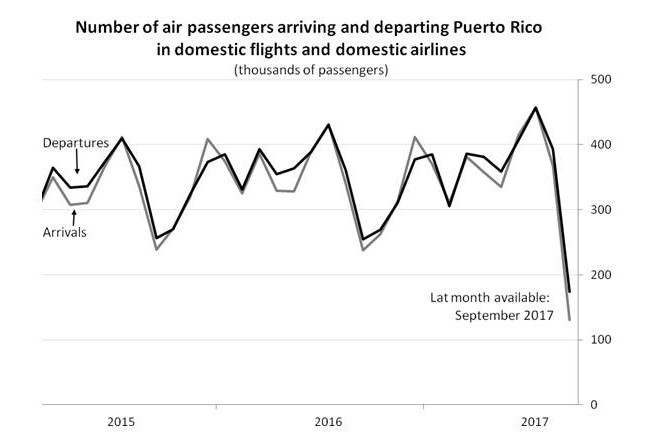
1) Compared to September 2016, the number of air passengers arriving in Puerto Rico dropped by 45 percent, from 238 thousand passengers to only 131 thousand. In the same way, passenger departures from Puerto Rico fell from 254,000 passengers to 173,000 for a decrease of 32 percent.
2) All major destinations and origins of flights from Puerto Rico were affected. The states that experienced the largest percentage reductions in passenger arrivals from Puerto Rico were: Florida, Connecticut, Texas, Georgia, and Illinois. The states with the largest percentage reductions in passenger departures to Puerto Rico were: Florida, Illinois, Connecticut, Texas and Maryland.
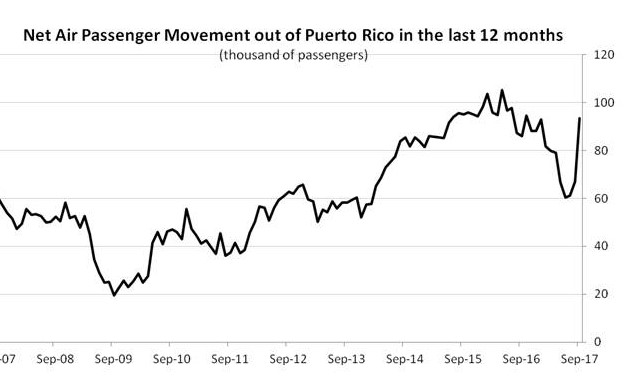
3) In 2016, 88,000 net people left Puerto Rico on domestic flights. In recent months, this figure had shown signs of diminishing, falling to almost 60,000 net passengers. With the data just released, this number once again expanded to 93,000 passengers for the 12-month period between October 2016 and September 2017.
Source: U.S. Bureau of Transportation Statistics, Air Carrier Statistics, T-100 Domestic Segment (U.S. Carriers).
Source: U.S. Bureau of Transportation Statistics, Air Carrier Statistics, T-100 Domestic Segment (U.S. Carriers).
Note: Flights within Puerto Rico (intra-island) are excluded. States that received less than a thousand passengers from Puerto Rico in September 2016 are excluded, so the sum of the states is slightly different from the total reported in the table.
Source: U.S. Bureau of Transportation Statistics, Air Carrier Statistics, T-100 Domestic Segment (U.S. Carriers).
Regarding the movement of passengers, Alberto L. Velázquez-Estrada, manager of Statistical Projects at the Institute, said: “The net movement of passengers in the last 12 months allows us to approximate the behavior of the migratory trend, which in itself is volatile. Data released as of September 2017 are beginning to validate the repercussions after the natural event. First, a decline in air passenger flow due to airport interruptions and second, an increase in more people leaving than returning to the island. In other words, the figure for September 2017 predicts a new increase in emigration, which in itself has fluctuated for more than a decade at high values compared to the size of the population of Puerto Rico.”
The Puerto Rico Statistics Institute is an autonomous governmental entity responsible for coordinating the Government's statistical production service to ensure that the data collection and statistics systems, on which public policies are based, are complete, reliable, and have quick and universal access. The Institute has in its inventory, accessible through statistics.pr.gov, over 300 statistical products. In addition, it is a custodian and provides access to over 100 data sets or “data sets” through www.data.pr.gov and to over 40 tables and more than 6 thousand indicators through: www.indicadores.pr. For more information you can visit our website: www.estadisticas.pr. In addition, you can follow us on social networks through Facebook (estadisticas.pr), Twitter (@EstadisticasPR) and LinkedIn (Institute of Statistics of Puerto Rico) accounts.



-p-130x130q80.png)
.png)
.png)
.png)
.png)
.png)
.png)
.png)
.png)
.png)
.png)
.png)


.png)
.png)
.png)
.png)