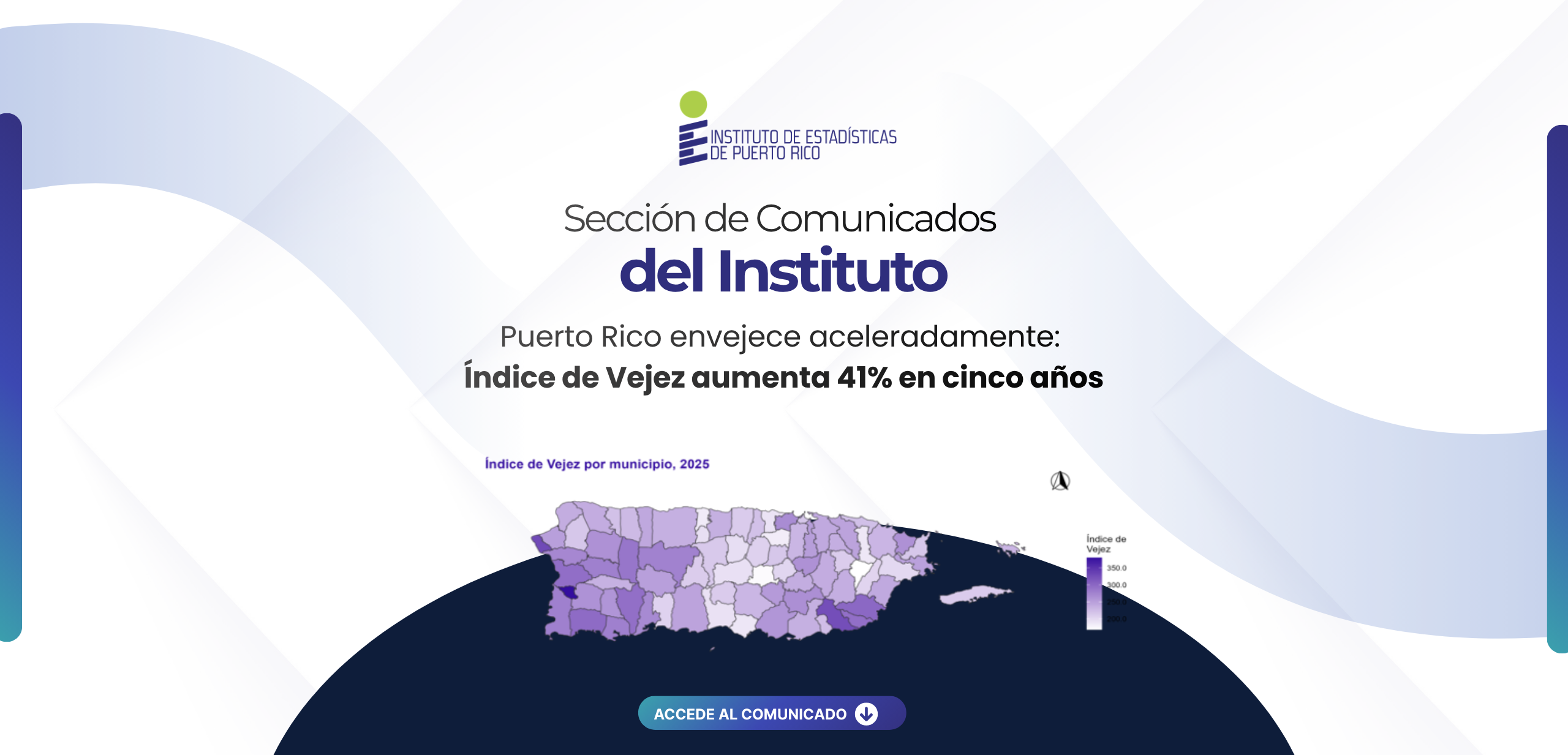

Puerto Rico is aging rapidly: Aging Index increases 41% in five years
Demographic, migration, and health trends are among the key findings in the Puerto Rico Institute of Statistics' 2025-2026 Results Report
Puerto Rico is aging rapidly, experiencing significant shifts in migration patterns, and facing health trends that pose new challenges for service planning and public policy. The Aging Index rose 41% between 2020 and 2025, while recent estimates pointed to a slowdown in net emigration, with fewer residents leaving combined with stable numbers of people arriving in Puerto Rico. Added to this are findings related to type 1 diabetes in adolescents and other social and health indicators that help define the profile of a population in transition.
These findings are part of the work developed, analyzed, or released by the Puerto Rico Institute of Statistics during the 2025-2026 fiscal year, a period in which the entity strengthened its tools for documenting demographic changes, health conditions, economic statistics, and other issues of social impact. The work carried out during this period is compiled in its 2025-2026 Results Report.
One of the most significant changes is observed in the age composition. Puerto Rico's Aging Index went from 168 in 2020 to 237 in 2025, representing a 41% increase in just five years. This means that there are currently about 237 people aged 65 or older for every 100 people under 15, and the index increased in all 78 municipalities. This transformation is occurring simultaneously with a sustained reduction in the young and working-age population.
The population estimate for Puerto Rico stood at 3,184,835 inhabitants as of July 1, 2025, while most regions continue to show a loss of working-age population. Vital indicators add another dimension to the phenomenon. Data released by the Institute show that births in Puerto Rico fell 70% between 2000 and 2025, dropping from 59,460 to 18,003. Since 2016, deaths have consistently exceeded births, consolidating a negative natural population growth.
“The data is showing us a different Puerto Rico than just a few years ago. A rapidly aging population, accompanied by changes in its composition and needs, requires us to think and act differently in how we plan health services, the care of our elderly, and the development of our communities. The 2025-2026 Results Report captures part of the work we have done to generate, analyze, and make accessible information that allows us to better understand these transformations. Having reliable statistics allows us to anticipate these changes and make evidence-based decisions,” said Dr. Orville M. Disdier Flores, Executive Director of the Puerto Rico Institute of Statistics.
Health indicators that require attention
In the area of health, one of the notable findings during the period is related to type 1 diabetes among adolescents aged 15 to 19. The Type 1 Pediatric Diabetes platform, developed in conjunction with the Pediatric Diabetes Foundation, gathers information corresponding to the 2009-2024 period and identified an upward trend in the incidence rate of this condition among adolescents. The results were presented during the Endocrine Society's annual conference, ENDO 2026, held in Chicago.
The Institute also continued to expand the information available on other issues affecting the health and safety of the population. Among these are statistics on violent deaths, gender-based violence, and femicides. During the fiscal year, the Gender-Based Violence Statistics Platform was expanded, and femicide statistics for the years 2021 to 2025 were published. Among the data examined regarding domestic violence, the Danger Assessment analysis found that extreme and constant jealousy is the most frequently identified risk factor, present in 50% of the cases analyzed. Meanwhile, one in four women filing a complaint (25%) was in severe or extreme danger of suffering a femicide. Likewise, the Puerto Rico Violent Death Reporting System strengthened its capabilities during the fiscal year to collect and analyze information on homicides and suicides. The system developed a statistical data platform and published periodic bulletins with updated data on violent deaths. The system integrates data from the Puerto Rico Police, the Institute of Forensic Sciences, and the Demographic Registry, and during the period, it incorporated spatial analysis to identify areas of higher and lower incidence of violent deaths.
Data to anticipate Puerto Rico's needs
The 2025-2026 Results Report also documents the development and strengthening of tools to make this data more accessible. Among these are the Demographic Observatory, which integrates indicators of population, fertility, mortality, and migration, as well as new interactive platforms related to violent deaths and femicides.
“Our goal is not only to produce statistics, but to ensure that this data becomes useful knowledge. When we can identify how our population is aging, what is happening with certain health conditions, or where populations with particular needs exist, we put information into the hands of Puerto Rico that can help direct resources and develop better responses,” added Disdier.
As part of this work, during the 2025-2026 fiscal year, the Institute also developed priority research, including the Profile of Sexual Aggression Behavior against Minors in Puerto Rico, the first Registry of the Deaf Community in Puerto Rico, as well as the strengthening of the Needs Study of the Deaf Community. The latter seeks to expand the database to understand the characteristics and needs of this population and contribute to the planning of accessible services.
Essential statistics to face economic challenges
The Institute published the study Tariffs in Puerto Rico 2025, which revealed that total import tariffs reached $919.7 million (an increase of $683.1 million compared to 2024, equivalent to a year-over-year growth of 288.7%) and a record effective tariff rate of 4.81%, with the greatest burden concentrated in key sectors such as construction, manufacturing, and food. Likewise, the Lag Index for Puerto Rico was published, a multidimensional tool based on economic mobility and demographic indicators that showed relative improvement in 42 municipalities.
Specialized training to improve statistics
The Institute held 14 online workshops and offered 7 webinars to more than 1,000 people, the recordings of which were published on YouTube to expand their reach. It also provided a specialized workshop on “R for Economic Statistics” to the statistical staff of the Puerto Rico Department of Economic Development, which resulted in improvements in the efficiency and effectiveness of their statistical processes.
The 2025-2026 Results Report compiles these and other initiatives developed by the Institute in ten strategic areas and is available in the “Results Report” section at: 2025-2026 Results Report.
-p-130x130q80.png)
.png)
.png)
.png)
.png)
.png)
.png)
.png)
.png)
.png)
.png)
.png)


.png)
.png)
.png)
.png)