Pan American Health Organization works with the Institute of Statistics to collect statistics on Puerto Rico's mental health system


Download the Document
Pan American Health Organization works with the Institute of Statistics to collect statistics on Puerto Rico's mental health system
Please let us know your satisfaction level with our services.
-p-130x130q80.png)
Visit our Official Activities, and participate with us
.png)
Visit our Calls for applications and be part of the new opportunities we have for you.
.png)
If you have any questions or just want to contact us, visit the Contact Us section.
.png)
We are at your disposal. If you need custom statistics, do not hesitate to contact us.
.png)
Sign up for our online workshops. Connect with the experts and discover the power of data!
.png)
Visit our Blog and keep up to date with the latest news and topics of interest.
.png)
Visit our Press Releases and stay connected to the Institute.
.png)
Explore the Publication Calendar and keep up to date with Puerto Rico's statistics.
.png)
Complete the form for the selection of our Statistics Coordination Committee
.png)
Suscribe to receive news directly to your email.
.png)
Listen to the Official PRIS podcast and stay informed with the experts
.png)
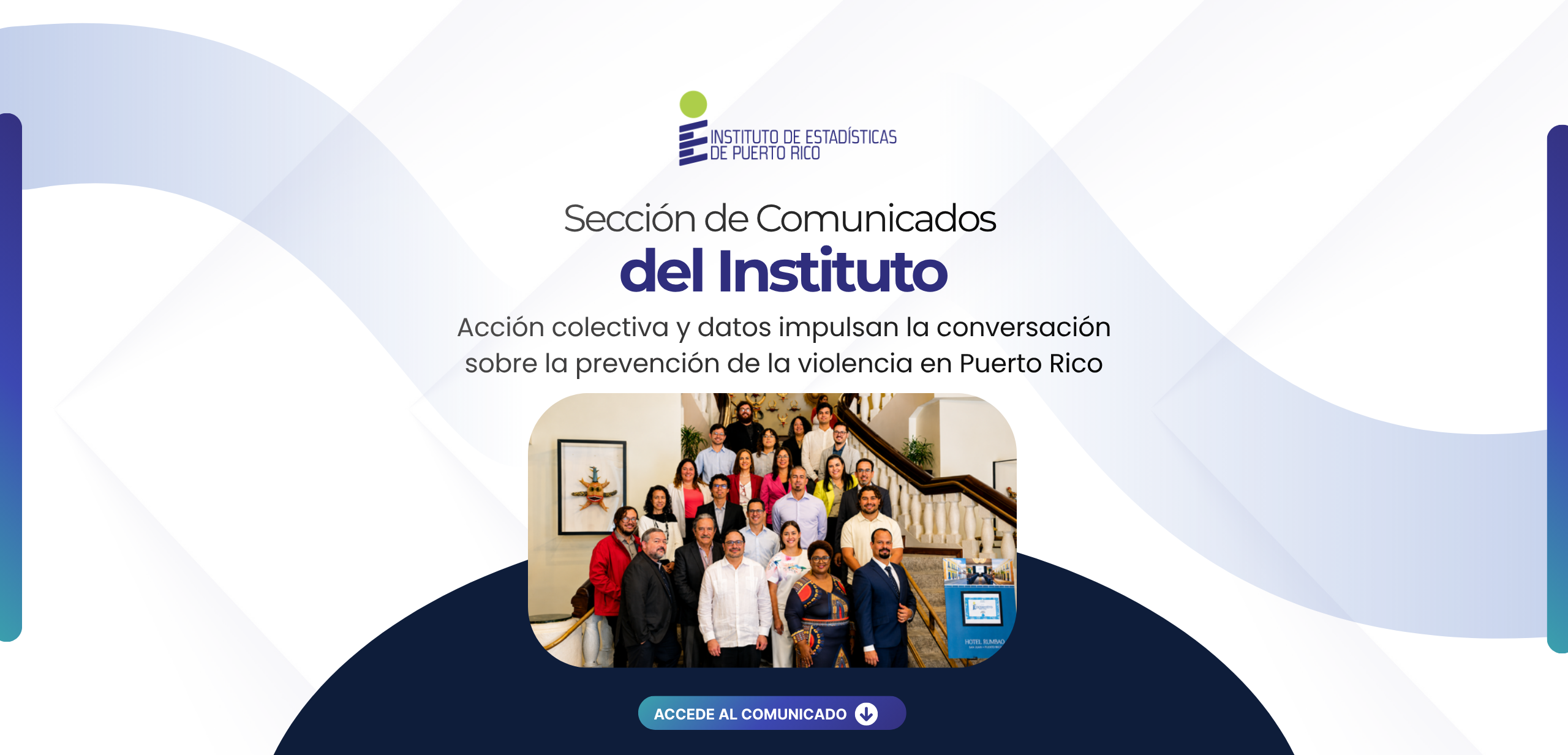
Collective Action for Violence Prevention
Collective action and data drive the conversation about violence prevention in Puerto Rico
Experts analyzed statistics showing over 30 million controlled substance dispensations to nearly 2 million unique patients in Puerto Rico since 2019
The Puerto Rico Institute of Statistics hosted the symposium "Collective Action for Violence Prevention: Transforming Realities Through Prevention and Collective Action," a gathering that brought together researchers, public health professionals, justice system representatives, community organizations, and government officials to analyze trends, risk factors, and strategies aimed at preventing violence in Puerto Rico.
During the event, presentations and panels were held, including "Current Landscape of Violence Among Infants and Youth: Data and Trends," "Public Policy and Substance Use Prevention: Where Are We and Where Are We Going?," and "Multi-sectoral Action for the Protection of Women and the Eradication of Sexual Violence," all of which addressed various factors contributing to violence and opportunities for its prevention through multi-sector collaboration.
Among the data presented during the symposium, it was highlighted that since 2019, over 30 million controlled substance dispensations have been recorded for nearly 2 million unique patients in Puerto Rico. Participants also discussed statistics related to homicides, gun violence, domestic violence, sexual assault, and substance use prevention, as well as early intervention strategies and community action.
In the panel on substance use prevention, it was highlighted that benzodiazepines currently account for 66.2% of controlled substance dispensations in Puerto Rico, while opioids make up 15.9%. Furthermore, the recorded growth in prescribed fentanyl dispensations was discussed, as well as the role of the Controlled Substance Monitoring Program (PDMP) as a tool to promote responsible prescribing, strengthen prevention, and support informed decision-making in the healthcare system.
Presentations on violence among infants and youth revealed that between 2017 and 2024, 4,813 homicides were reported in Puerto Rico, and 92.3% of the victims were men. Experts also highlighted that firearm homicides are the leading cause of death among youth aged 1 to 19 in Puerto Rico. It was also reported that 54% of homicides among men aged 15 to 44 are related to manifestations of collective violence, including organized crime and drug trafficking.
Meanwhile, the panel on the protection of women and the eradication of sexual violence presented statistics showing that during 2024 and 2025, the Puerto Rico Police investigated 17,695 incidents of domestic violence. Furthermore, it was highlighted that, according to the Risk Assessment Form, one in four female complainants evaluated during the second half of 2024 faced an imminent risk of death, and nearly one in five had survived a non-fatal strangulation episode, one of the main indicators associated with the risk of femicide.
Participating experts agreed that many manifestations of violence are rooted in adverse childhood experiences, including abuse, emotional neglect, and early exposure to trauma. They also emphasized the importance of strengthening early interventions, mentorship, community programs, and coordination among health, education, security, and justice systems to address the causes of violence before it occurs.
"This symposium reaffirms the importance of using data to better understand the challenges we face as a society and to guide concrete prevention actions. Violence cannot be addressed by a single sector. It requires collaboration, evidence, and the commitment of multiple stakeholders to identify its causes, intervene promptly, and protect our communities," said Dr. Orville M. Disdier, Executive Director of the Puerto Rico Institute of Statistics.
Statistics Institute requests information stipulated by law from government agencies
PRESS RELEASE
Statistics Institute asks government agencies
information stipulated by law
Statistical information was requested from 38 government agencies
San Juan, PR, August 5, 2020 — The Puerto Rico Statistics Institute (Institute) reported that it recently requested in writing from 38 government agencies specific statistical information, as established in multiple laws in Puerto Rico. The initiative aims to ensure compliance with Article 13 of the Institute's Organic Law, Act No. 209 of August 28, 2003, as amended, which provides that all government agencies have the obligation to regularly and constantly send to the Institute any publication of statistical products they produce, in order to be incorporated into the Inventory of Statistics and to make them available to all citizens.
The Inventory of Statistics, specified by Article 5 (f) of the Institute's Organic Law, is where most of the statistical information collected by the Institute is kept and made available to the public, and is located online at: Inventory-of-statistics. It is the main source for those looking for official statistical information that describes, estimates or analyzes the characteristics of Puerto Rico and its society. The Inventory contains all important statistical activities carried out or planned to be carried out by government agencies, as well as information on how to obtain statistical reports for Puerto Rico that are prepared by government agencies and public corporations in Puerto Rico, municipalities and any other jurisdiction in the United States. Statistical reports from the private sector are also included in the Inventory.
The deadline given to agencies to respond is 20 calendar days, but agencies can request an extension, particularly if they receive multiple requests for statistical information. This is the case of agencies to which numerous laws that specify the generation of statistical information that is of great legislative interest apply, such as the Department of Education, the Department of Natural and Environmental Resources, the Department of Health and the Department of Public Safety. However, most of the government agencies contacted will receive few requests for statistical information and are not considered less important by the Institute. It should be noted that the Institute has tried to make the process for submitting the requested statistical products as efficient as possible, making it one that can be carried out completely online.
“We urge all government agencies contacted to provide the requested statistical information. The collaboration of government agencies will help the Puerto Rico Statistics Institute expand and keep its Statistics Inventory up to date. In addition, since these are statistical products specified by legal provisions, the information requested is particularly relevant to the decision-making processes of the Government of Puerto Rico,” said Jacobo M. Orenstein-Cardona, special assistant to the Institute's executive director and coordinator of this initiative.
About the Puerto Rico Institute of Statistics
The Puerto Rico Statistics Institute is an autonomous governmental entity tasked with coordinating the government's statistical production service to ensure that the data collection and statistics systems, on which public policies are based, are complete, reliable, and accessible quickly and universally.
For more information you can visit the website: https://estadisticas.pr.gov/. In addition, you can follow the Institute on social networks, through Facebook (@estadisticas .pr), Twitter (@EstadisticasPR) and LinkedIn (Institute of Statistics of Puerto Rico) accounts.
Statistics Institute to offer free virtual course for students and teachers in Puerto Rico
Statistics Institute to offer free virtual course for students and teachers in Puerto Rico

.png)
.png)
.png)
.png)