BOARD OF DIRECTORS OF THE INSTITUTE OF STATISTICS ANNOUNCES THE ELECTION OF ARNALDO CRUZ, CO-FOUNDER OF ABRE PUERTO RICO, AS ITS NEW PRESIDENT
San Juan, PR, August 1, 2018 — The Board of Directors of the Puerto Rico Statistics Institute (Institute) today announced the unanimous election of Arnaldo Cruz, co-founder of Abre Puerto Rico and director of Research and Analysis of Foundation for Puerto Rico, as the new president of the organization.
Cruz was elected at the first meeting of the Institute's Board of Directors held yesterday afternoon and in accordance with the provisions of Section VII of the Institute's Internal Regulations. It establishes that the members who will occupy seats on the Executive Committee, composed of the President, Vice President and Secretary of the Board, will be elected during the first meeting of the Board of Directors at the beginning of each fiscal year and by a majority vote of those present.
“I am grateful for the opportunity given to me to work with an excellent team such as the Institute of Statistics, under the executive direction of Dr. Mario Marazzi-Santiago,” said the new President of the Board of Directors of the Institute, who holds a master's degree in Public Policy from Harris School of Public Policy Studies, from the University of Chicago.
“I accept this great challenge, aware of the great need that our government has to improve the accessibility and quality of its statistics and the enormous fiscal challenges for these purposes. At the Institute of Statistics, we are available to support the Government of Puerto Rico and achieve important goals of common interest, such as the quality of public data and government transparency, in all aspects,” Cruz said.
On the other hand, the position of vice-president of the Board of Directors of the Institute will be occupied by the doctor in Economics, Antonio J. Fernós, who served as president for the past 2 years and the position of secretary by the Lcdo. Alex López, who is currently serving as an advisor to the Puerto Rico Senate.
Meanwhile, Ana L. Dávila, PhD in Demography and professor of the Demography Program at the University of Puerto Rico (UPR), Medical Sciences Campus, Ana L. Dávila and the PhDs in Statistics and professors from the Faculty of Business Administration of the UPR, Recinto de Río Piedras, Marta Álvarez and Sonia C. Balet, will continue as members of the Board of Directors.
The Puerto Rico Statistics Institute is an autonomous governmental entity responsible for coordinating the Government's statistical production service to ensure that the data collection and statistics systems, on which public policies are based, are complete, reliable, and have quick and universal access. The Institute has in its inventory, accessible through https://estadisticas.pr.gov, about 300 statistical products. In addition, it is a custodian and provides access to over 100 data sets or “data sets” through https://data.pr.gov and to over 40 tables and more than 6 thousand indicators through: https://www.indicadores.pr.
In addition, as the leading entity of the State Data Center (SDC) of Puerto Rico, the Institute manages the SDC portal, which contains the main statistical reports and publications of the U.S. Census Bureau on Puerto Rico, specifically those that are most in demand, such as annual population estimates; the Puerto Rico Community Survey (Puerto Rico Community Survey) and official statistics on Puerto Rico's 10-year population and housing censuses, among others. The Puerto Rico SDC portal can be accessed through: https://censo.estadisticas.pr/.
PUERTO RICO'S POPULATION IS AROUND 3.3 MILLION IN 2017
It has fallen by 10% since the most recent 2010 Decennial Census
San Juan, PR — El U.S. Census Bureau released today the most recent annual population estimates for Puerto Rico. These statistics refer to July 1, 2017 and include the components of annual population change since July 1, 2010 that support the population estimate since the beginning of the decade. As the leading entity of the Network State Data Center (SDC) of the U.S. Census Bureau in Puerto Rico, the Puerto Rico Statistics Institute (Institute) presents this brief summary of the findings of the new annual population estimates for 2017:
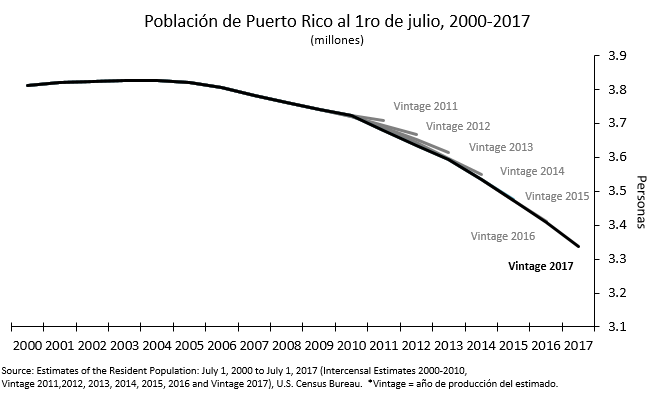
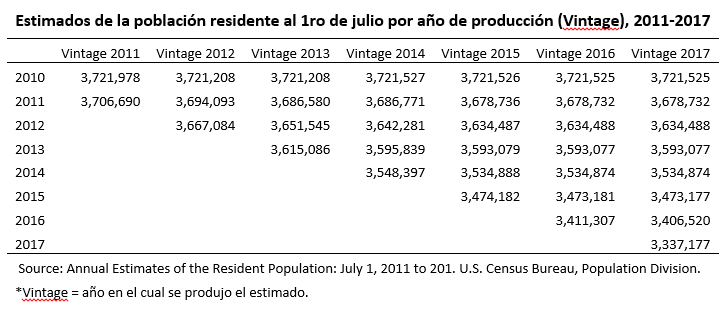
The population of Puerto Rico was estimated at 3,337,177 people as of July 1, 2017.
In contrast to the last 2010 Census when the official population count resulted in 3,725,789 people, the new estimate points to a cumulative population decrease in the current decade of 10 percent up to 2017. That is, a population decline at a rate of -1.5% each year on average (annualized rate).
As for the resident population of 18 years of age or older, this was estimated at 2,680.381 million, comprising 80% of the resident population of Puerto Rico.
The components of population change considered for the estimates assume that, between July 1, 2016 and July 1, 2017, there were 28,000 births and 29,000 deaths in Puerto Rico. For the first time, annual population estimates reflected natural population growth (the number of births minus the number of deaths) that results in more deaths than births. Regarding migration, the net balance was close to -68 thousand people during the same period.
More statistics on Puerto Rico's annual population estimates can be obtained at: https://censo.estadisticas.pr. Information on the methodology used to produce the estimates can be accessed hither.
After conducting a decennial Census, such as the 2010 Census, the U.S. Census Bureau prepare the annual population estimates before the next Census. These estimates are prepared by analyzing data on births, deaths and migration. As a result, with each new publication of the estimates, adjustments are made to the previously estimated years. For example, with the publication of the 2017 estimates announced in this release, the estimates already published for 2011, 2012, 2013, 2014, 2015 and 2016 were revised. Each publication is distinguished according to the year in which they were produced and are named as Vintage.
The Puerto Rico Statistics Institute is an autonomous governmental entity responsible for coordinating the Government's statistical production service to ensure that the data collection and statistics systems, on which public policies are based, are complete, reliable, and have quick and universal access. The Institute has in its inventory, accessible through www.estadisticas.pr.gov, over 300 statistical products. In addition, it is a custodian and provides access to over 100 data sets or Data sets by means of www.data.pr.gov and to over 40 tables and more than 6 thousand indicators through: www.indicadores.pr
In addition, as the leading entity of the SDC in Puerto Rico, the Institute manages the SDC portal, which contains the main statistical reports and publications of the U.S. Census Bureau on Puerto Rico, specifically those that are most in demand, such as annual population estimates; the Puerto Rico Community Survey (Puerto Rico Community Survey) and official statistics on Puerto Rico's 10-year population and housing censuses, among others.
For more information you can visit our website: www.estadisticas.pr.gov. In addition, you can follow us on social networks through Facebook accounts (statistics.government.pr), Twitter (@EstadisticasPR) and LinkedIn (Institute of Statistics of Puerto Rico).


-p-130x130q80.png)
.png)
.png)
.png)
.png)
.png)
.png)
.png)
.png)
.png)
.png)
.png)

.png)
.png)
.png)
.png)