They add data on substance use by students to the interactive map on school and community profiles
Based on the Mental Health and Addiction Services Administration (ASSMCA) “Youth Consultation” study
May 23, 2022: The executive director of the Puerto Rico Institute of Statistics, Dr. Orville M. Disdier, announced that a new layer, on substance use by students living in Puerto Rico, has been added to the interactive map on school and community profiles, known as the “School Community Profile: The Interactive Map”. This new layer consists mainly of data on the prevalence of substance use, risk and protective factors, access to substances, risk perception, and violent behavior, among others. The tool also contains a copy of the official report from which the data were obtained. This particular layer is entitled “Youth Consultation 2018-2020 (ASSMCA)” and must be activated using the “layers” menu.
“These data are based on the Youth Consultation survey conducted during the 2018-2019 and 2019-2020 academic years and measures the prevalence of substance use among students from seventh to twelfth grade, both in public and private schools in Puerto Rico. In particular, this new layer is divided into ten (10) service areas or regions grouped into: Metro Area, Arecibo, Bayamón, Caguas, Fajardo, Guayama, Mayaguez, Moca, Ponce and Utuado,” explained Dr. Disdier.
Some aspects that this new layer allows us to observe are, for example, that, in the area or region of Utuado, 7.8% of students ever used marijuana, 5.3% used unprescribed pills, 51.6% (of those who used cocaine) started using cocaine when they were less than 12 years old, and 36.8% lived in a conflicted family environment, among other statistics. In the same way, by concurrently activating the Public School Directory layer, it can be seen that most schools in that geographical area of Utuado have a three (3) star rating. “This is just one example of many geospatial observations and/or analyses that could be carried out,” emphasized Dr. Disdier.
The School Community Profile: The interactive map, with this new layer, resides on the Puerto Rico Institute of Statistics website and interested parties can access it at any time through the following e-mail address: School-community profile.
To learn more about the Institute of Statistics, you can access the website: www.estadisticas.pr.gov. On social media through Facebook accounts (@statistics.pr), Twitter (@EstadisticasPR), Instagram (@institutodeestadisticas) and LinkedIn (Puerto Rico Institute of Statistics).
THREE MUNICIPALITIES HAVE 70% OR MORE OF THEIR HOMES WITH INTERNET ACCESS
San Juan, PR — El U.S. Census Bureau released today the most recent data from the Puerto Rico Community Survey known as Puerto Rico Community Survey at the municipal level. These statistics refer to information collected from 2013 to 2017, a period of 5 years. The new publication provides data on social, economic and housing characteristics for Puerto Rico and municipalities, as well as for specific geographical levels such as neighborhoods, census tracts and block groups. As the leading entity of the Network State Data Center Of U.S. Census Bureau in Puerto Rico, the Puerto Rico Statistics Institute (Institute) presents this summary with several interesting results:
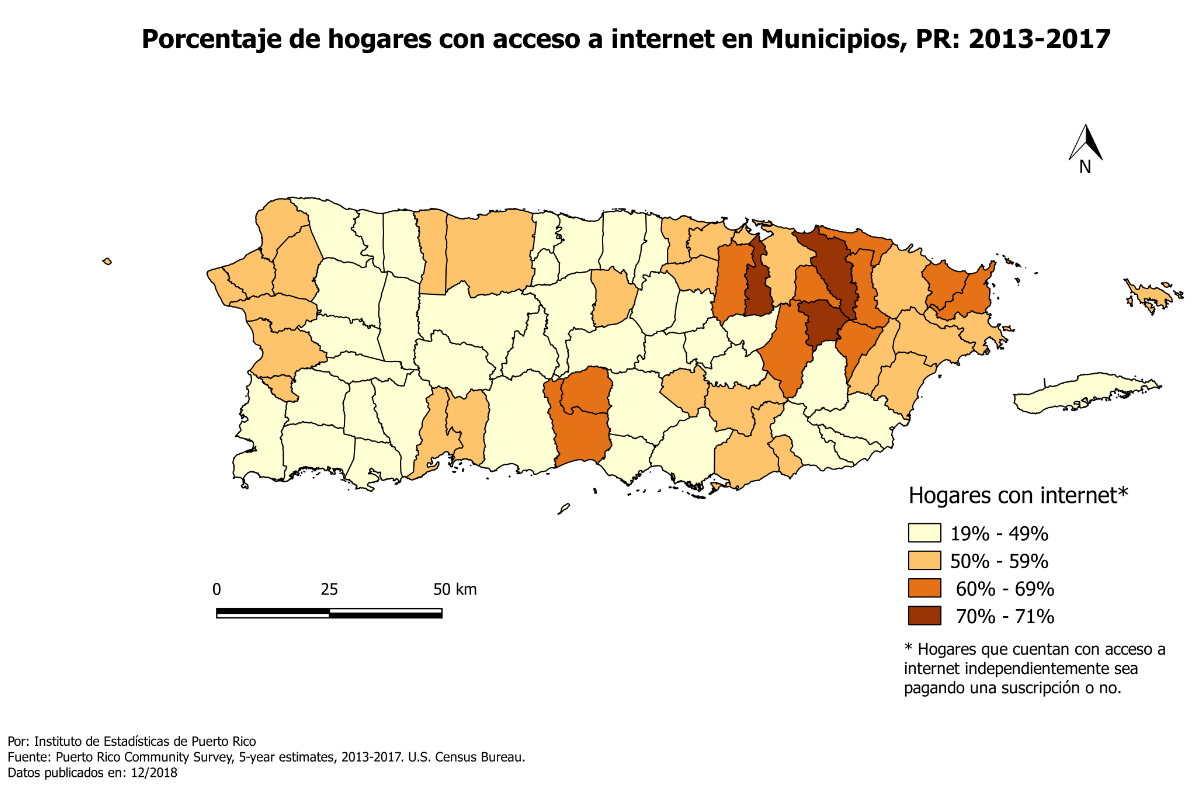
During the 5-year period (2013-2017), Guaynabo, Carolina and Gurabo were found to have the highest percentage of households (70%-71%), with internet connection, among all municipalities. With 60% to 69% of households with internet access, the municipalities of Juana Diaz and Villalba stand out outside the metropolitan area and east of Puerto Rico. On the other hand, some 38 municipalities had less than 50% of their homes with internet connection, mostly municipalities in the central and southwestern areas. In Puerto Rico, estimates indicate that about 54% of households had internet access.
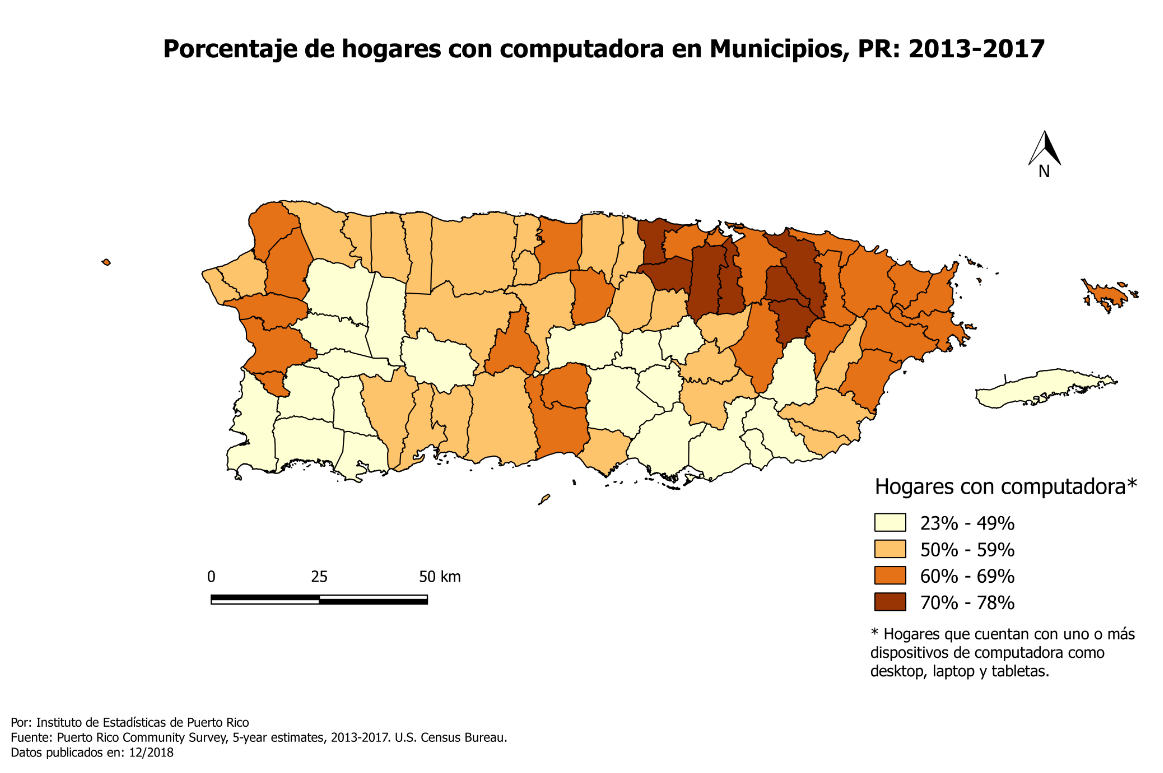
As for households with one or more computer devices (laptop, desktop, tablets), the geographical distribution indicates that the highest percentages (60%-78%) are concentrated in the metropolitan area and coastal municipalities from Dorado, in the northeastern area, and to Humacao in the east. It is worth highlighting several municipalities with the same characteristics such as Aguadilla, Moca, Añasco, Mayagüez and Hormigueros in the west as well as Morovis, Jayuya, Villalba in the center. For Puerto Rico, it is estimated that about 62% of households had a computer device.
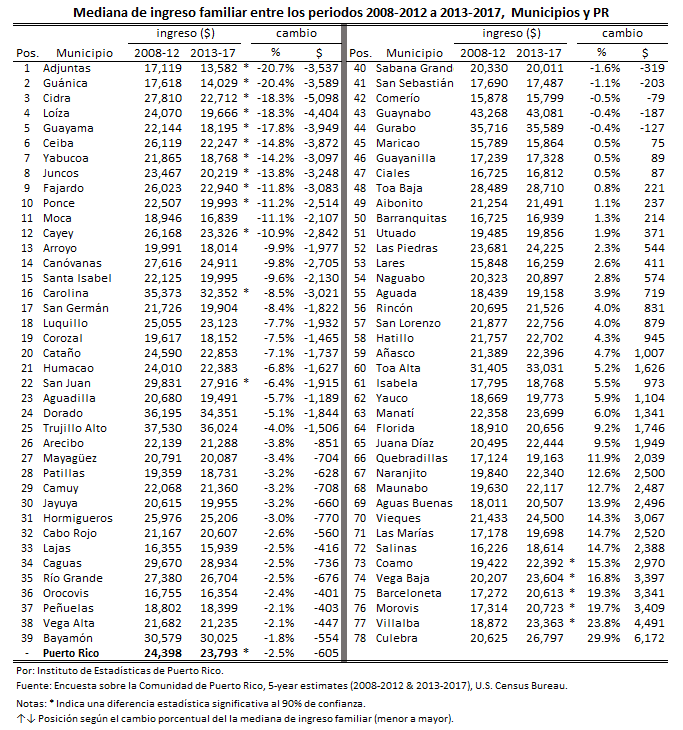
As for the median family income, comparing the two five-year periods (2008-12 vs. 2013-17), at the level of Puerto Rico it showed a reduction of -2.5% from $24,398 to $23,793.
At the municipal level:
In 44 municipalities, there was a decrease in the median family income, and in 13 of these municipalities the change was statistically significant, with a confidence level of 90%.
The 6 municipalities that showed the highest decrease according to the percentage change in family income were: Adjuntas, Guánica, Cidra, Loíza, Guayama and Ceiba.
On the other hand, the 6 municipalities that showed the highest increase according to the percentage change in family income were: Culebra, Villalba, Morovis, Barceloneta, Vega Baja and Coamo. Of all these, Culebra appears to be the municipality with the greatest change, but its difference is not statistically significant.
As highlighted by Dr. Orville M. Disdier, Acting Executive Director of the Institute, in this new report the U.S. Census Bureau data are integrated on the use of computers and internet in homes in Puerto Rico, by municipality. “This is the first time, since this information began to be collected in the Survey in 2013, that we can know the estimates at a more detailed geographical level, as are all municipalities.”
For his part, Alberto L. Velázquez-Estrada, Manager of Statistical Projects at the Institute, added: “Information related to internet access and computers expands the areas of research and analysis. For example, looking at the geographical pattern of fewer homes with computers and internet access in municipalities in the southwestern area of Puerto Rico, it alerts us to a possible association between the elderly population and computer and internet access. On the other hand, the reduction in family income at the Puerto Rico level translates to about $600 less during the most recent five-year period 2013-2017 compared to the previous 2008-2012. In other words, during the most recent period, there was less money in the family nucleus, complicating the socio-economic scenario faced by most families and their members in Puerto Rico.”
More statistics on the Community Survey estimates can be obtained at: http://factfinder2.census.gov/. If you need assistance using this tool to obtain data, you may find the self-study guide for using this available tool useful: https://censo.estadisticas.pr/fact-finder . Information on the methodology used to produce the estimates can be accessed hither.
In addition, as the leading entity of the Puerto Rico SDC, the IEPR manages the SDC portal, where you can find the main statistical reports and publications of the U.S. Census Bureau on Puerto Rico, specifically those that are most in demand, such as annual population estimates; the Puerto Rico Community Survey (Puerto Rico Community Survey) and official statistics on Puerto Rico's 10-year population and housing censuses, among others. The Puerto Rico SDC portal can be accessed through: https://censo.estadisticas.pr/.
The Puerto Rico Statistics Institute is an autonomous governmental entity responsible for coordinating the Government's statistical production service to ensure that the data collection and statistics systems, on which public policies are based, are complete, reliable, and have quick and universal access. The Institute has in its inventory, accessible through www.estadisticas.pr.gov, over 300 statistical products. In addition, it is a custodian and provides access to over 100 data sets or “data sets” through www.data.pr.gov and to over 40 tables and more than 6 thousand indicators through: www.indicadores.pr.
For more information you can visit our website: www.estadisticas.pr.gov. In addition, you can follow us on social networks through Facebook (estadisticas.pr), Twitter (@EstadisticasPR) and LinkedIn (Institute of Statistics of Puerto Rico) accounts.


-p-130x130q80.png)
.png)
.png)
.png)
.png)
.png)
.png)
.png)
.png)
.png)
.png)
.png)

.png)
.png)
.png)
.png)