Statistics Institute obtains approval of federal funds to develop Puerto Rico's Violent Death Surveillance System


Statistics Institute obtains approval of federal funds to develop Puerto Rico's Violent Death Surveillance System
Please let us know your satisfaction level with our services.
Visit our Official Activities, and participate with us
Visit our Calls for applications and be part of the new opportunities we have for you.
If you have any questions or just want to contact us, visit the Contact Us section.
We are at your disposal. If you need custom statistics, do not hesitate to contact us.
Sign up for our online workshops. Connect with the experts and discover the power of data!
Visit our Blog and keep up to date with the latest news and topics of interest.
Visit our Press Releases and stay connected to the Institute.
Explore the Publication Calendar and keep up to date with Puerto Rico's statistics.
Complete the form for the selection of our Statistics Coordination Committee
Suscribe to receive news directly to your email.
Listen to the Official PRIS podcast and stay informed with the experts
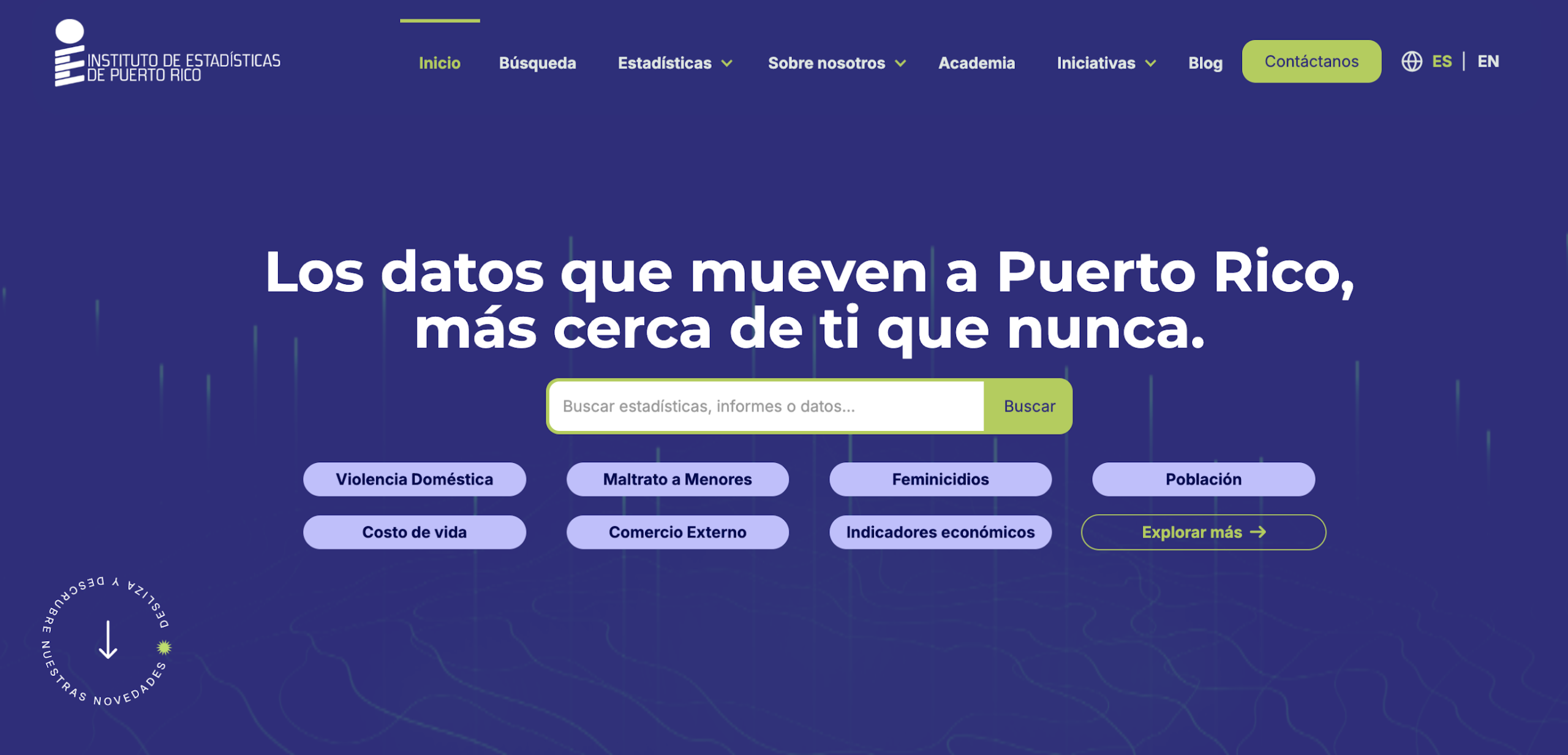
San Juan, Puerto Rico. January 2, 2026. The Puerto Rico Statistics Institute announced the launch of its new website, a digital platform framed by the transparency and accessibility of critical statistics for Puerto Rico. The new website, available through: https://www.estadisticas.pr.gov, focuses on a better user experience with a better search engine, allowing for more intuitive navigation. The more than 300 statistical products contained in the new platform are rigorously organized by categories that make it easier to find information. This logical architecture makes it easier for students, researchers and citizens to locate specific indicators on economy, health, education or demography, among other topics, consolidating in a single access point the vast production of data and interactive dashboards that were previously more dispersed.
On the other hand, the new portal launches a dynamic blog section designed as an institutional chronicle center that includes, among others: press releases, recent activities, explanatory memorials, and notifications of importance to Puerto Rico. Another important aspect of the new website is that it has been designed to the highest standards to guarantee access for people with disabilities or with diverse access needs. In the same way, the cybersecurity of the portal was substantially improved. “With the creation of this new website, the Institute consolidates its leadership in providing Puerto Rico with quick and universal access to statistics, eliminating barriers and reaffirming that statistical knowledge is a right for the entire population,” said Dr. Orville M. Disdier, executive director of the Institute.
Anyone who has questions about the functionality of the new page or has difficulty finding any data or information on the page, can write to preguntas@estadisticas.pr. They can also follow social networks through Facebook (@estadisticas .pr), X (@EstadisticasPR), LinkedIn (Institute of Statistics of Puerto Rico) and Instagram (@institutodeestadisticas) accounts.
The Puerto Rico Statistics Institute is an autonomous governmental entity responsible for coordinating the Government's statistical production service to ensure that the data collection and statistics systems, on which public policies are based, are complete, reliable, and have quick and universal access.
Statistics Institute and Instituto Nueva Escuela manage to include Montessori schools and questions about the impact of Hurricane Maria in an important school survey
The 2019 edition of the YRBSS for Puerto Rico included students from Montessori schools for the first time and asked about the effects of the hurricane on these students
The Puerto Rico Statistics Institute joined forces with the Instituto Nueva Escuela, achieving for the first time that Montessori schools are included in the 2019 edition of the survey Youth Risk Behavior Surveillance System (YBSS). The YRBSS is a survey conducted every two years to students in grades 9, 10, 11 and 12 across the United States and its jurisdictions, including Puerto Rico. The questions cover various topics related to students' health and risk behaviors, and as a result, statistics are produced on bullying, electronic harassment, violent behavior, sexual behavior, drug use and on students' eating habits, among others.
In addition, it was possible to include five additional questions, related to the impact of Hurricane Maria on students, from all the schools participating in the study in Puerto Rico. Approximately 1,498 students from public schools in Puerto Rico participated in the self-administered survey, and of these, a total of 110 students belonged to Montessori schools, of which 53% were male, 47% female, and 27.2%, 54.5%, 16.0% and 2.3% were in grades 9, 10, 11 and 12, respectively. Although it is expected that by the end of this year the Institute of Statistics and the Instituto Nueva Escuela will produce an official and detailed statistical report on the results of this survey, here are some preliminary results regarding hurricane questions in students under the Montessori philosophy:
“These preliminary results show us the enormous impact that the passage of Hurricane Maria had on these Montessori school students. In previous editions, these students, under the Montessori philosophy, were left out of this important survey. However, thanks to the teamwork of both institutes, we have been able to make them visible,” said Dr. Orville M. Disdier, executive director of the Institute of Statistics.
For their part, Dr. Ana María García Blanco, executive director of the Instituto Nueva Escuela, and Mr. Cesar Ostolaza of the Evaluation and Research Division said: “We are very happy with the invitation from Dr. Orville M. Disdier to participate in this study. It is important to have reliable data in the face when making decisions about the practices and services we will provide to our students. Their voices are essential in defining the public policies for which we are choosing. It is imperative to take into account the emotional state of young people, especially based on the natural and social phenomena they have been through when it comes to “building” a school. It is with them and from them that we must build it.”
The Instituto Nueva Escuela is a non-profit entity that seeks to transform the public education system in Puerto Rico through Montessori philosophy and methodology. For its part, the Statistics Institute of Puerto Rico is a governmental entity with fiscal and administrative autonomy with the mission of coordinating the statistical production service of government entities. To learn more about the Instituto Nueva Escuela you can access the website: www.inepr.com. To learn more about the Institute of Statistics, you can access the website: www.estadisticas.pr.gov. On social media through Facebook (@estadisticas .pr), Twitter (@EstadisticasPR) and LinkedIn (Institute of Statistics of Puerto Rico) accounts.
###
Contacts: Idia M. Martínez, R‐28, 787‐603‐3200, and Lourdes Burgos, R‐27, 787‐562‐2932
PRESS RELEASE
Office of the President
Vital for the country that mayors mobilize to obtain
Responses to the 2020 Census
President of the Board of Directors of the Institute of Statistics made an urgent appeal to municipal officials given the low participation of only 25% of the response
The president of the Board of Directors of the Puerto Rico Institute of Statistics, economist and university professor Nicolás Muñoz-Muñoz, urged all mayors to mobilize the resources of municipal agencies to visit street by street, combing all communities to alert families to the importance of filling out the 2020 Population Census form. I am taking all preventive and protective measures as far as COVID-19 is concerned.
As of July 13, only 25% of families had answered the Census. This, according to Muñoz, represents half of those who had answered the Census in 2010. In mid-July, the level of response in municipalities ranged from 14 to 31 percent. “It is vital for municipalities and their inhabitants that the federal funds that arrive are not reduced by 25% or more. Without downplaying the exercise of the democratic right to vote, designating resources to help citizens complete the Census should be considered as meritorious as the efforts being made for the primary and electoral process,” Muñoz said.
“If mobilization were not promoted to encouraging communities to dedicate 15 minutes to answering the form, we would add another disaster to the chain of events that have occurred in the country since the earthquake in January to the present. In this case, a disaster whose consequences would last 10 years,” said Muñoz.
The economist explained that, if 25% of the population does not answer, Puerto Rico could result in a population of less than 3 million and could receive 25% less federal funding, equivalent to $5 billion annually or $50 billion over 10 years, if we consider an average current allocation of $20 billion annually. This is without considering additional special allocations in the case of natural disasters.
It was also reported that more than 300 federal programs base the distribution of funds on population data. These programs include federal funding for road construction, agriculture, rural development, housing, urban development, solid waste management, telecommunications infrastructure, drinking water, protection of coastal resources, assistance for paying household rent, education, justice, nutrition assistance programs, school breakfasts, child care, workforce development under the WIOA Act (among other laws), assistance for the elderly and health, including Medicaid, and other programs.
“The economic situation of municipalities will worsen if access to federal funds allocated by Congress is reduced. Every Puerto Rican who can read and write can fill out the Census form. It can be filled out “online” or on paper. Each neighbor can help another neighbor who can't read and write or how to fill it out, particularly older adults. It's everyone's job, but mayors, who are the officials closest to the needs of citizens, must exercise their leadership in this vital priority for Puerto Rico,” Muñoz concluded.
##
Press Contact:
Idia M. Martínez
787-603-3200
imartinez@upfrontpr.net

.png)
.png)
.png)
.png)

-p-130x130q80.png)
.png)
.png)
.png)
.png)
.png)
.png)
.png)
.png)
.png)
.png)
.png)