
Generosity Report 2015-2023

Announcements
IEPR
15 May 2026

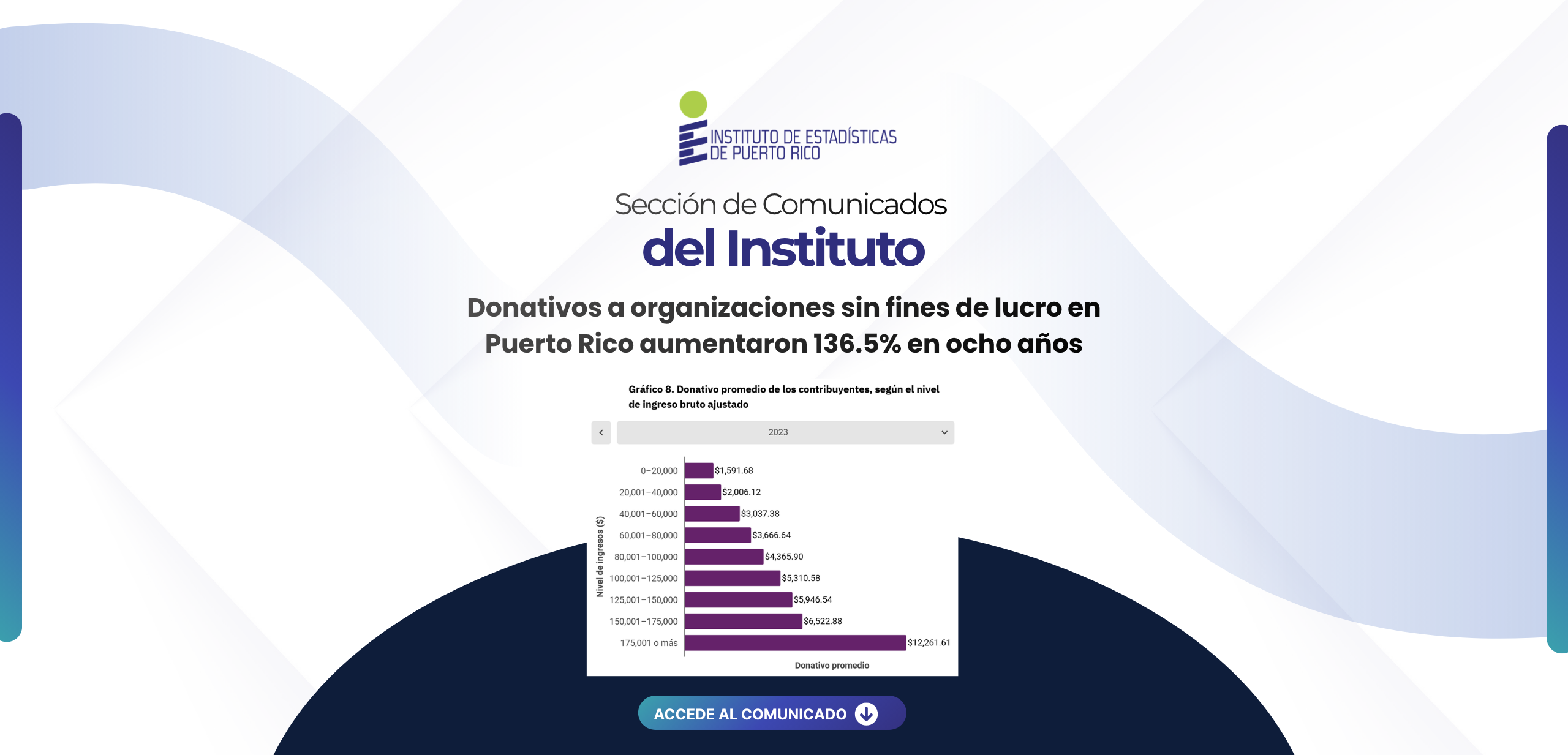
Donations to non-profit organizations in Puerto Rico increased 136.5% in eight years

Report from the Institute of Statistics and UPR reveals that donations deducted from payroll exceeded $329 million in 2023

The Puerto Rico Institute of Statistics and the Graduate School of Public Administration (EGAP) of the University of Puerto Rico published the new Generosity Report 2015-2023, an analysis that reveals sustained growth in monetary donations reported by taxpayers in Puerto Rico over the past eight years.

The report, based on official data from the Department of Treasury on deductions claimed for donations to non-profit organizations, shows that total monetary donations increased from $139.5 million in 2015 to $329.8 million in 2023, representing a cumulative increase of 136.5%.

The analysis also reveals that, during the period studied, taxpayers in Puerto Rico claimed an average of $231.9 million annually in deductions for donations. The largest annual increase occurred between 2020 and 2021, when deductions grew 19.6%, a behavior that coincides with the period after the pandemic and multiple emergencies that impacted Puerto Rico.

“The report confirms that in Puerto Rico there is a culture of support and solidarity that deserves to be documented and studied in greater depth. This data allow us to begin to measure Puerto Rico's philanthropic behavior, using official and comparable information,” said Dr. Luz Mairym López-Rodríguez, associate professor at EGAP and project manager.

The doctor added that “the preparation of this report represents an opportunity for Puerto Rico to join the discussion on generosity, particularly in the context of Latin America and the Caribbean. In addition, it will make it possible to promote academic research based on concrete data.” He also expressed his gratitude to Omar Álvarez González, the Institute's statistical project assistant, for his collaboration in the development of the report.

“In many jurisdictions around the world, there are efforts to measure and document the ecosystem of generosity. In Puerto Rico, there is still little statistical information on this topic, so this report represents an important step in generating comparable data and bringing a new dimension to the economic and social analysis of Puerto Rico,” said Dr. Orville M. Disdier Flores, executive director of the Institute of Statistics.

Disdier also mentioned that “non-profit organizations and philanthropy are an important part of the social and economic fabric of Puerto Rico, and having official statistics on generosity allows us to better understand how people support community, educational, cultural and health causes, among others. That is why we welcomed the collaboration proposed by Dr. Luz Mairym López-Rodríguez to develop this analysis.”

The report also includes interactive graphics and maps that allow us to visualize trends and compare the behavior of deductions for donations over time. Although the total amount of donations increased, the study points out that the number of taxpayers who claimed deductions for donations showed a reduction during the period analyzed, suggesting that the average contributions claimed are higher than a decade ago.

The report is available at: Generosity Report 2015-2023.

Share this article:
Download the Document
Generosity Report 2015-2023

Visit our Official Activities, and participate with us

Visit our Calls for applications and be part of the new opportunities we have for you.

If you have any questions or just want to contact us, visit the Contact Us section.

We are at your disposal. If you need custom statistics, do not hesitate to contact us.

Sign up for our online workshops. Connect with the experts and discover the power of data!

Visit our Blog and keep up to date with the latest news and topics of interest.

Visit our Press Releases and stay connected to the Institute.

Explore the Publication Calendar and keep up to date with Puerto Rico's statistics.

Complete the form for the selection of our Statistics Coordination Committee

Suscribe to receive news directly to your email.

Listen to the Official PRIS podcast and stay informed with the experts

Instituto publica el Compendio Estadístico sobre la Educación Superior de Puerto Rico 2019-2020

Compendio Estadístico sobre la Educación Superior de Puerto Rico 2019-2020

Continúa la disminución en la matrícula en el sistema de educación superior de Puerto Rico. Accede al informe en su totalidad a través del siguiente enlace: https://tinyurl.com/25kd58cf

Guánica lost 29% of its population according to the 2020 Census

PRESS RELEASE

PUERTO RICO STATE DATA CENTER NETWORK (SDC-PR)

Guánica lost 29% of its population according to the 2020 Census

A comparison of the 2010-2020 Decennial Censuses also indicates that 74 of the 78 municipalities lost at least 5% of their population in the past decade

San Juan, PR, August 12, 2021 — The U.S. Census Bureau today released more results of the official population enumeration, also known as the 2020 Decennial Census. The published data are related to the information necessary to begin electoral redistribution work in the jurisdictions of the states, Washington DC and Puerto Rico. These contain a little more detail compared to the total population data released last April. The data includes the total population, by characteristics of race and Hispanic origin at the level of states, municipalities, by age 18 and over and for more specific geographical areas such as census tracts and others. The results are as of April 1, 2020, which is the reference date of the Decennial Census. As part of the State Data Center Network of the U.S. Census Bureau in Puerto Rico, the Puerto Rico Statistics Institute (Institute) presents several initial findings from the results of the 2020 Census:

  1. In a comparison between the 2010 Decennial Census and the 2020 Decennial Census, the results indicate that in percentage terms:
    • All municipalities in Puerto Rico reflected the loss of their resident population, with percentage changes ranging from -0.1% to 29.0%.
    • The municipalities with the highest population loss were Guánica (29%), Maricao (24%), Loíza (21%) and Yabucoa (20%).
    • On the other hand, the municipalities with the lowest population loss were Rincón (-0.1%), Culebra (1%), Naranjito and Barranquitas with about 4%.
    • In summary, some 74 municipalities showed a reduction in their resident population of at least 5% over the decade.
  1. In addition, the population aged 18 and over changed between the Decennial Censuses:
    • At the Puerto Rico level, from 2,822,494 (2010) to 2,724,903 (2020), translating into a reduction of 97,591 people or -3.5% within that age group.
    • At the level of municipalities:
      • 24 municipalities reflected an increase in this population group (18+) that ranged from 0.1% to 9.2%,
      • The remaining 54 municipalities reflected a population reduction (18+) of between -0.1% and -21.3%
      • Population reductions (18+) occurred in the following municipalities, Guánica (21%), Maricao (17%), Mayagüez (13%), Loíza (12%), Yabucoa and Yauco with 10%.
  2. Regarding housing units, the results published at the Puerto Rico level indicate the following totals:
    • 1,598,159 housing units
      • 1,340,534 were busy
      • 257,625 were vacant

“Broadly speaking, population changes in municipalities range from mild or moderate reductions to drastic reductions, with population losses of 10% or more, in most municipalities, in a single decade. The new publication of Census 2020 results begins to highlight changes that have occurred over the past decade. The data, in turn, give way to the beginning of countless possible analyses and comparisons that must be considered when making socioeconomic decisions in Puerto Rico, its regions and within municipalities,” said Alberto L. Velázquez-Estrada, Manager of Statistical Projects at the Institute.

Tables with published characteristics will not yet be published in the U.S. Census Bureau's data dissemination tool data.census.gov. Various data released today from the 2020 Census can be accessed through:

Visualizations available at:

https://www.census.gov/programs-surveys/decennial-census/decade/2020/2020-visualizations.html

widget Quick Facts In:

https://www.census.gov/quickfacts/fact/table/US/PST045219

In addition, as the leading entity of Puerto Rico's SDC, the Institute manages the SDC portal, which contains the main statistical reports and publications of the U.S. Census Bureau on Puerto Rico, specifically those that are most in demand, such as annual population estimates; the Puerto Rico Community Survey and official statistics on Puerto Rico's decennial population and housing censuses, among others. The Puerto Rico SDC portal can be accessed through: censo.estadisticas.pr.

The Puerto Rico Statistics Institute is an autonomous governmental entity responsible for coordinating the Government's statistical production service to ensure that the data collection and statistics systems, on which public policies are based, are complete, reliable, and have quick and universal access.

For more information you can visit our website: www.estadisticas.pr.gov. In addition, you can follow us on social networks through Facebook (@estadisticas .pr), Twitter (@EstadisticasPR) and LinkedIn (Institute of Statistics of Puerto Rico) accounts.

##

For questions:

preguntas@estadisticas.pr

Statistics Institute participates in the Reach Higher FAFSA Meeting at the White House

Statistics Institute participates in the Reach Higher FAFSA Meeting at the White House