
Strong increase in households with people aged 65 and over in Puerto Rico

Announcements
IEPR
22 December 2025
PRESS RELEASE
PUERTO RICO STATE DATA CENTER NETWORK (SDC-PR)
Puerto Rico Institute of Statistics

Strong increase in households with people aged 65 and over in Puerto Rico

It is estimated that in 50 municipalities, four out of ten households have this trait.

San Juan, PR, December 8, 2022 — The U.S. Census Bureau released today the most recent data from the Puerto Rico Community Survey. These statistics refer to information collected over a period of five years, from 2017 to 2021. The new publication provides data on demographic, social, economic and housing characteristics for Puerto Rico and municipalities, as well as for specific geographical levels such as neighborhoods and census tracts. As part of the U.S. State Data Center Network. Census Bureau in Puerto Rico, the Puerto Rico Statistics Institute (Institute) presents several interesting results:

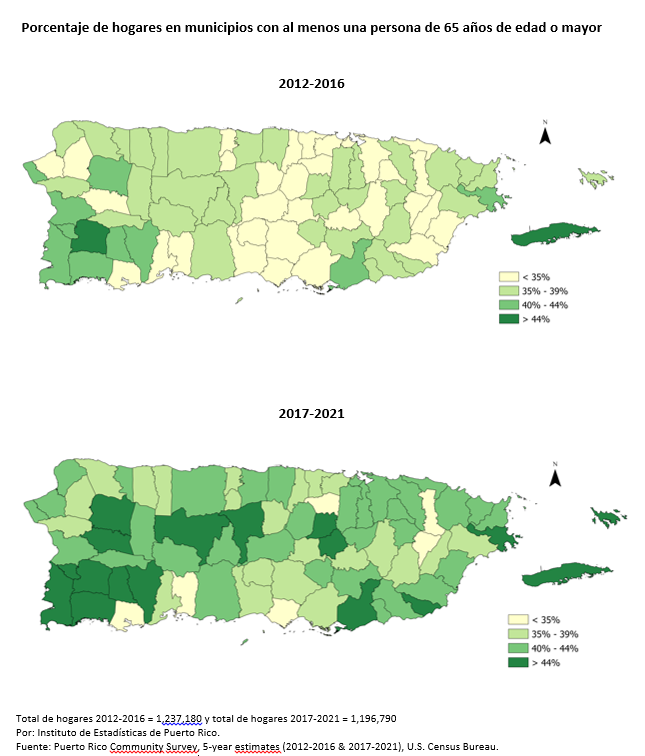
  1. During the period 2017-2021, four out of ten households in fifty municipalities had one or more people aged 65 or older. This trait was reflected in only twelve municipalities in the period 2012-2016.
  2. In a comparison of the previous five-year period 2012-2016, compared to the most recent period 2017-2021, estimates indicate that:
    • Among the total number of households in Puerto Rico, the percentage of households with one or more people aged 65 years or older increased from 35.1% to 40.6%, this change being statistically significant.
    • At the municipal level, the 78 municipalities showed an increase in this trait of households with one or more people aged 65 and over.
      • It should be noted that in 69 of the 78 municipalities, the increases were statistically significant.
      • The municipalities of Las Marías, Naranjito, Comerío, Aguada and Corozal showed the highest increase in this characteristic, this change being close to or greater than 10 percentage points.
    • On the other hand, the median income in Puerto Rico was reflected between periods;
      • A decrease in household income of 0.8% or from $22,136 to $21,967, not a statistically significant difference.
      • An increase in household income of 1.2% or from $26,439 to $26,745, a difference not statistically significant.

“The population aged 65 and over is increasingly present in the homes of our jurisdiction; this is partly a reflection of the peak of births that occurred in Puerto Rico in the 1940s and 1960s. Those generations active in our society require and will require support and services for their needs in the present and near future, whether from the immediate family circle, as well as from government programs aimed at this population, said Alberto L. Velázquez-Estrada, Senior Manager of Statistical Projects at the Institute.

Tables with interesting characteristics can be accessed in the data dissemination tool of the U.S. Census Bureau data.census.gov. In addition, as the leading entity of the State Data Center of Puerto Rico, the Institute manages the SDC portal, which contains the main statistical reports and publications of the U.S. Census Bureau on Puerto Rico, specifically those that are most in demand, such as municipal profiles, estimated annual population; the Puerto Rico Community Survey (Puerto Rico Community Survey) and official statistics on Puerto Rico's decennial population and housing censuses, among others. The Puerto Rico SDC portal can be accessed through: censo.estadisticas.pr.
Puerto Rico Statistics Institute is an autonomous governmental entity tasked with coordinating the Government's statistical production service to ensure that the data collection and statistics systems, on which public policies are based, are complete, reliable and have quick and universal access.

For more information you can visit the website: www.estadisticas.pr.gov or write to preguntas@estadisticas.pr They can also follow social networks through Facebook (@estadisticas .pr), Twitter (@EstadisticasPR), LinkedIn (Institute of Statistics of Puerto Rico) and Instagram (@institutodeestadisticas) accounts.

Share this article:

Visit our Official Activities, and participate with us

Visit our Calls for applications and be part of the new opportunities we have for you.

If you have any questions or just want to contact us, visit the Contact Us section.

We are at your disposal. If you need custom statistics, do not hesitate to contact us.

Sign up for our online workshops. Connect with the experts and discover the power of data!

Visit our Blog and keep up to date with the latest news and topics of interest.

Visit our Press Releases and stay connected to the Institute.

Explore the Publication Calendar and keep up to date with Puerto Rico's statistics.

Complete the form for the selection of our Statistics Coordination Committee

Suscribe to receive news directly to your email.

Listen to the Official PRIS podcast and stay informed with the experts

59% of visitors to Puerto Rico were women and 63% are Puerto Ricans residing in other jurisdictions

59% of visitors to Puerto Rico were women and 63% are Puerto Ricans residing in other jurisdictions

This is according to the Visitor Profile for Fiscal Year 2023-2024 published by the Puerto Rico Institute of Statistics in collaboration with the Tourism Company

San Juan, Puerto Rico. December 9, 2024. The Puerto Rico Statistics Institute (Institute) in collaboration with the Puerto Rico Tourism Company (CTPR) published the Visitor Profile Fiscal Year 2023-2024. This Profile includes the findings of the Traveler Survey conducted from July 2023 to June 2024. This survey was conducted at Luis Muñoz Marín airports in Carolina, Mercedita in Ponce and Rafael Hernández airports in Aguadilla, as well as at the tourist docks of Old San Juan. The term “visitor” includes all non-resident travelers staying in hotels, hostels, rented apartments, homes of family and/or friends, own home, guesthouse, and others.

“The main statistical product of traveler surveys are estimates of visitor expenses, which are included in Puerto Rico's Balance of Payments as income for our economy. In addition, these surveys contribute to the determination of Gross Product and generate statistics on the characteristics of travelers, characteristics that are necessary for decision-making both at the governmental level and by the private sector,” explained Dr. Orville M. Disdier Flores, Executive Director of the Institute.

For his part, the executive director of the CTPR, Carlos Mercado Santiago, highlighted that “the new Traveler Survey questionnaires were specifically designed to respond to the data needs identified by the CTPR, Discover Puerto Rico, the Department of Economic Development and Commerce, the Puerto Rico Planning Board and Aerostar Airport Holdings, LLC. This strategic adaptation allowed us to collect key information for the planning, execution and evaluation of short and long-term promotion strategies, in addition to meeting the main objectives of economic statistics.”

The Visitor Profile provides information about visitors regarding their place of origin, gender, age, education, occupation, income level, the purpose of their trip, type of accommodation, places visited, average number of days spent, activities carried out, the quality of the services offered at airports, their satisfaction with their visit and their expenses in various categories. It should be noted that several reported analyses were broken down between Puerto Rican visitors and other types of visitors, allowing for certain contrasts. Among the most significant findings from this study are the following:

  • 93% of visitors come from other jurisdictions in the United States.
  • 63% of the people who visit us are Puerto Ricans who reside in other jurisdictions.
  • 59% of the visitors were women.
  • Puerto Rican women between 40 and 59 years of age represent Puerto Rico's most frequent visitor profile.
  • The majority of visitors are highly educated, with 53% having a baccalaureate or higher degree.
  • More than 50% of Puerto Rican visitors reported annual family incomes greater than $60,000 while most other visitors reported annual family incomes of $80,000 or more.
  • The majority of Puerto Rican visitors visit us for vacations or to visit family and friends (36% and 32%, respectively).
  • 47% of visitors stayed in the private residences of friends or family, followed by hotels (22%) and short-term rentals (20%).
  • The main municipalities where non-Puerto Rican visitors stayed were San Juan, Carolina and Rio Grande. Puerto Rican visitors tended to disperse more across other regions outside the metropolitan area.
  • The Metro region was the most visited in general, by 66% of visitors. This region is particularly popular with non-Puerto Rican visitors (76%).
  • The regions of Porta del Sol, known for its beach tourism, and Porta Cordillera, famous for its mountainous landscapes, showed relatively low visitor values at 28% and 15%, respectively. 20% of the total number of visitors reported visiting Porta Caribe, famous for its culture and history.
  • A low percentage of visitors (17%) participate in ecotourism activities.
  • 95% of visitors were “very satisfied” or “satisfied” with their visit and 96% of visitors stated that they are “very likely” or “likely” to return to Puerto Rico.
  • The total expenditure of air visitors reached $2,546 million, of which 52% were Puerto Rican visitors. Including cruise ship hikers in transit, total spending is close to $2.6 billion, representing approximately 3% of Puerto Rico's Gross Product.

To access the Visitor Profile Fiscal Year 2023-2024, you can visit Visitor profile.

The Puerto Rico Statistics Institute is an autonomous governmental entity responsible for coordinating the Government's statistical production service to ensure that the data collection and statistics systems, on which public policies are based, are complete, reliable, and have quick and universal access.

For more information you can visit the website: www.estadisticas.pr or write to preguntas@estadisticas.pr. They can also follow social networks through Facebook (@estadisticas .pr), X (@EstadisticasPR), LinkedIn (Institute of Statistics of Puerto Rico) and Instagram (@institutodeestadisticas) accounts.

Authorized by the Office of the Electoral Comptroller OCE-SA-2024- 13775

Puerto Rico Commission for Suicide Prevention and Statistics Institute publish statistical report for 2019

PRESS RELEASE

Puerto Rico Commission for Suicide Prevention and Statistics Institute publish statistical report for 2019

For the year 2019, 176 cases of suicide were reported, 67 cases less than in 2018

Dr. Orville M. Disdier, executive director of the Puerto Rico Statistics Institute (Institute) reported that a collaboration with the Commission for Suicide Prevention (CPS), attached to the Puerto Rico Department of Health, resulted in the “Annual Statistical Report on Deaths by Suicide 2019”.

“This report is of great importance for citizens, since it presents data on suicide for 2019 and draws comparisons with previous years. In addition, it collects data not only on fatal suicide events, but it also presents information on calls to the ASSMCA PAS line and, for the first time, includes data on suicide attempts and contemplations attended by the Emergency Medical Corps,” said Myribel Santiago, manager of statistical projects at the Institute and co-author of the publication.

The publication of this report underlines the importance of the Institute in coordinating the statistical production service of government entities. The Institute has the capacity not only to request statistical information from executive branch agencies, but also to provide them with collaboration, advice and the necessary tools to improve the quality of the statistics they produce.

“Despite the extraordinary circumstances we currently live in, we hope to continue collaborating. Today, more than ever, we need reliable and accurate data to facilitate the implementation of a responsible, informed and sensitive public policy to the complex reality we live in,” said Dr. María Isabel Coss, educational coordinator of the CPS and lead author of the publication.

For his part, Dr. Disdier argued that “the results of this collaborative report reflect that in 2019, a crude suicide rate of 5.5 per 100,000 inhabitants was observed, which is the lowest rate since 2000. Without a doubt, this is very positive and it also demonstrates the enormous importance of continuing to support the preparation of this type of report, since it is only with data that we can know if the prevention measures are giving the desired results”.

The CPS is responsible for promoting, developing, implementing, coordinating actions and strategies for suicide prevention, adopting an integrative and interdisciplinary approach aimed at individuals, families, communities at risk, and helping professionals. In addition, it emphasizes research, the development of prevention and intervention programs and

in raising public awareness of the magnitude and seriousness of suicide in Puerto Rico. For its part, the Institute is a governmental entity whose mission is to guarantee Puerto Rico that it has complete, reliable statistics, and quick and universal access.

You can access this annual report and other related reports through the following link: Suicide Statistics.

To learn more about the Institute of Statistics, you can access the website: www.estadisticas.pr.gov. On social media through Facebook (@estadisticas .pr), Twitter (@EstadisticasPR) and LinkedIn (Institute of Statistics of Puerto Rico) accounts.

###

Contacts:

Idia M. Martinez, R-28, 787-603-3200

Lourdes Burgos, R-27, 787-562-2932

The Puerto Rico Institute of Statistics has a new president of its Board of Directors

The Puerto Rico Institute of Statistics has a new president of its Board of Directors

The Puerto Rico Statistics Institute (Institute) has a new president of its Board of Directors. The Board elected Dr. Javier Hernández Acosta as president, after the expiry of the term as board member of the past president, Nicolás Muñoz Muñoz. Dr. Hernández is a professor and director of the School of Arts, Design and Creative Industries at the Sacred Heart University. Similarly, Dr. Hernández is the Founder of Cultural Investment and the Center for Creative Economy, Inc., non-profit organizations that support the development of cultural and creative industries in Puerto Rico. Dr. Hernández has been a member of the Board of Directors since October 2020 and prior to that role he collaborated as a researcher on several projects of the Institute such as the World Values Survey (2018), the Innovation Survey (2015) And the Science and Technology Survey: Research and Development (2015).

Members of the Board of Directors do not earn compensation for their services. The Board is composed, in addition to Dr. Javier Hernández Acosta, Mrs. Carola Ballester Descartes, vice-president, Dr. José A. Jorge Pagán, secretary, Mr. Vicente Feliciano Pérez, Dr. Francisco E. Martínez Aponte and Mr. Manuel Laboy. This Board of Directors, as established in Act 209 of August 28, 2003, is the governing body that establishes the administrative policy of the Institute, which is led by Dr. Orville M. Disdier, Executive Director. “The Institute's relevance increases every day with the need for greater transparency and accessibility to information sources to support decision-making. It is up to us to guarantee its autonomy and fiscal sustainability so that it can continue to expand its impact. It is a great responsibility to support this management from the Board of Directors,” said Dr. Hernández, president of the Board of Directors.

The Puerto Rico Statistics Institute is a governmental entity with fiscal and administrative autonomy with the mission of coordinating the statistical production service of government entities. To learn more about the Institute of Statistics, you can access the website: www.estadisticas.pr.gov. On social media through Facebook (@estadisticas .pr), Instagram (@estadisticas .pr), Twitter (@EstadisticasPR) and LinkedIn (Institute of Statistics of Puerto Rico) accounts.

###

For questions and more information write to the following email: preguntas@estadisticas.pr