Statistics Institute and U.S. Census Bureau announce the inclusion of Puerto Rico in migration statistics between counties or municipalities in the United States
Announcements
IEPR
29 December 2025
Statistics Institute and U.S. Census Bureau announce the inclusion of Puerto Rico in migration statistics between counties or municipalities in the United States
40% higher the price of eggs in the urban area of San Juan-Bayamón-Caguas
Similarly, grocery items are 11.4% more expensive in this area than the average among 295 participating urban areas in the United States
San Juan, Puerto Rico — November 22, 2024. The Puerto Rico Statistics Institute released the results of the Cost of Living Index (COLI) for the third quarter of 2024, corresponding to the months of July, August and September. The data reveals that the urban area of the Metropolitan Statistical Area (MSA) of San Juan-Bayamón-Caguas is ranked number 18 in the supermarket category. In percentage terms, the supermarket items in the San Juan-Bayamón-Caguas MSA are 11.4% more expensive than the average among 295 participating urban areas in the United States.
Within the category of supermarket items, the San Juan-Bayamón-Caguas MSA is positioned as the most expensive urban area in the United States for the cost of eggs, ranking first in the ranking. This means that this product is 40% higher than the average in urban areas of the United States. On the other hand, in the health care category, the visit to the general practitioner is in position number 295, while dental cleaning is in position 293, positioning the urban area as one of the most affordable among the participants in the country for these services.
In terms of the overall Cost of Living, the urban area of Metropolitan Statistical Area San Juan-Bayamón-Caguas is ranked 80th out of 295 in the United States, with a composite index of 102.3. This indicates that the cost of living in this area is 2.3% higher than the average of participating urban areas in the United States.
Below are the indexes and rankings by category for the urban area of the San Juan-Bayamón-Caguas MSA:
Category
Index
Ranking
Utilities
155.3
5/295
Grocery items
111.4
18/295
Housing
102.1
83/295
Transportation
91.1
238/295
Miscellaneous goods and services
92.4
246/295
Health care
70.5
295/295
COLI Index
102.3
80/295
The composite index is derived from six main categories of consumer spending, with high costs in public services and supermarket items highlighted. These are partially offset by relatively low costs in health care and miscellaneous goods and services.
The 15 municipalities that make up the San Juan-Bayamón-Caguas MSA and that meet the characteristics for price collection according to the established methodology are: Bayamón, Caguas, Canóvanas, Carolina, Cataño, Cidra, Dorado, Gurabo, Guaynabo, Rio Grande, San Juan, Toa Alta, Toa Baja, Trujillo Alto and Vega Alta.
“The COLI results for the third quarter of 2024 show that in the San Juan-Bayamón-Caguas MSA, public services, grocery items and housing are, on average, much more expensive than in most participating MSAs in the rest of the United States. The COLI, carried out by the Puerto Rico Statistics Institute, is an essential tool for evidence-based decision-making related to the development and economic growth of Puerto Rico,” explained Dr. Orville M. Disdier, Executive Director of the Institute.
COLI is a crucial tool for understanding regional differences in the costs of consumer goods and services. The indices are calculated based on data collected quarterly in each participating urban area. Since 1968, the Council for Community and Economic Research (C2ER) has developed this widely recognized methodology.
The Puerto Rico Statistics Institute also offers a comparative cost-of-living calculator between the urban area of the San Juan-Bayamón-Caguas MSA and the rest of the participating cities in the United States. This tool is available at: https://apps.estadisticas.pr/coli/.
The Puerto Rico Statistics Institute is an autonomous governmental entity responsible for coordinating the Government's statistical production service to ensure that the data collection and statistics systems, on which public policies are based, are complete, reliable, and have quick and universal access.
For more information you can visit the website: www.estadisticas.pr or write to preguntas@estadisticas.pr. They can also follow social networks through Facebook (@estadisticas .pr), X (@EstadisticasPR), LinkedIn (Institute of Statistics of Puerto Rico) and Instagram (@institutodeestadisticas) accounts.
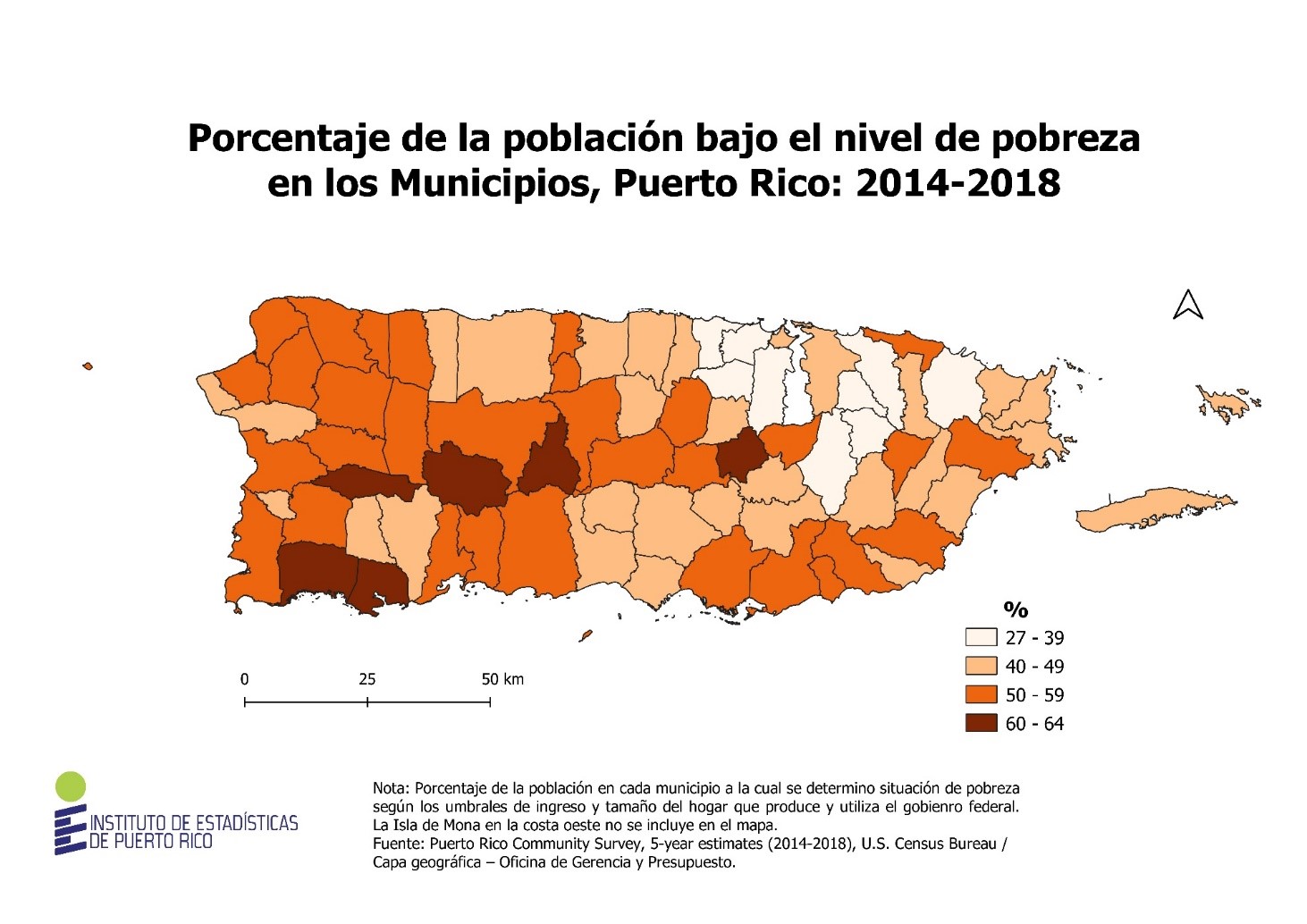
Six municipalities with at least 60% of their population living in poverty
They are located in the center and south-west according to the Map Series of the Puerto Rico Census Data Network
San Juan, PR, November 17, 2020 — The percentage of people living in poverty shows that six municipalities have between 60% and 64% of their population with this characteristic. The geographical distribution shows that they are located in the center and southwest of Puerto Rico, these being Maricao, Guánica, Adjuntas, Lajas, Jayuya and Comerío. La Selected Indicator Map Series includes the information collected during the period 2014-2018 through the Community Survey carried out by U.S. Census Bureau. This series includes ten indicators on demographic, social and economic topics at the level of municipalities and neighborhoods in Puerto Rico.
In addition, with information from the same period (2014-2018), the Socio-Demographic Profiles of Puerto Rico's Electoral Districts Which are divided volume IandII, with the 8 Senate Districts and with the 40 Representative Districts respectively. These provide a detailed photograph of each electoral district with essential information to know the particularities of the population that resides in each of them.
Both new products (Map and Profile Series) are part of the publications of the Puerto Rico Census Data Network (SDC-PR by its acronym in English). All of them can be accessed free of charge on the SDC-PRcenso.estadisticas.pr. As a local liaison entity with the U.S. Census Bureau, the Institute of Statistics shares several findings from the Selected Indicator Map Series:
Among the 10 municipalities with the highest percentage of children under 18, eight of them were in the southern and central region of Puerto Rico. On the other hand, the 4 municipalities with the lowest percentage of minors were Guaynabo, and to the west Rincón, Mayagüez and Hormigueros.
The highest percentages of the 18-64 year old population were in 7 municipalities, these being Toa Alta, Aguada, Morovis, and in the central-eastern area Cidra, Gurabo, Juncos and San Lorenzo. On the other hand, the municipalities with the lowest percentages of the population aged 18-64 are located mainly in the southwest (Hormigueros, San Germán, Sabana Grande, Lajas and Guánica) and to the east (Fajardo, Ceiba and Culebra).
The municipalities with the highest percentage of elderly people (65+) are shown to be in the western area of Hormigueros, San Germán, Lajas and Rincón.
Municipalities with the highest percentages (80%-84%) of people with a higher education level or higher are geographically concentrated in the metropolitan area, in addition to Santa Isabel on the south coast. On the other hand, the two municipalities with the lowest percentage of education attained are located in the midwest (Maricao and Las Marías).
As for the population with disabilities (reported on their own account), 6 of the 10 municipalities with the highest percentages (Cayey, Cidra, Comerío, Aguas Buenas, Naranjito and Orocovis) are geographically concentrated in the central area, and the other 4 municipalities are located in the south-west (Guánica, Sabana Grande, Hormigueros and Yauco). On the other hand, a concentration of municipalities in the south-east region reflected hundreds of children with disabilities (< 15%), with 9 of the 13 municipalities in this category including the island municipalities of Vieques and Culebra.
In the metropolitan region, east and south, most of the municipalities with the highest percentage (50%-74%) of households with access to broadband internet are clustered. In a situation of lower access, some 4 municipalities in the western region showed that they had less than 35% of their homes with internet access, these being Lajas, Cabo Rojo, Maricao and Las Marías.
In percentage terms, the population in 37 municipalities around Puerto Rico was shown to have half of its population or more (50% +) living in poverty. Municipalities with the lowest percentage of people in poverty are located in the metropolitan area with the exception of the municipalities of San Juan and Cataño.
Regarding family income across municipalities, this indicates that about 7 municipalities (Gurabo, Trujillo Alto, Dorado, Carolina, Toa Alta, Culebra and Bayamón) showed a median of between $30,000 and $39,000 in family income. The municipality with the highest median household income was Guaynabo ($44,000).
The highest percentage of people in the workforce (50%-57%) are mostly municipalities in the metropolitan area and the Northeast, where 11 of the 13 municipalities with this characteristic are located, Culebra and Juana Diaz the only ones outside these regions.
“The series of maps provides a geographical perspective on features of interest within Puerto Rico. The behavior of geographical patterns could support government and community management, analysis for decision-making, and stimulate research. In the same sense, the profiles of the electoral districts serve as basic metrics for current and future public policy that affects the residents of these regions.” said Alberto L. Velázquez-Estrada, Manager of Statistical Projects at the Institute.
The Puerto Rico Statistics Institute is an autonomous governmental entity responsible for coordinating the Government's statistical production service to ensure that the data collection and statistics systems, on which public policies are based, are complete, reliable, and have quick and universal access. In addition, as the leading entity of the SDC in Puerto Rico, the Institute manages the SDC portal, which contains the main statistical reports and publications of the U.S. Census Bureau on Puerto Rico, specifically those that are most in demand, such as annual population estimates; the Puerto Rico Community Survey (Puerto Rico Community Survey) and official statistics on Puerto Rico's 10-year population and housing censuses, among others. The Puerto Rico SDC portal can be accessed through: https://censo.estadisticas.pr/.
For more information you can visit our website: www.estadisticas.pr.gov. In addition, you can follow us on social networks through Facebook (@estadisticas .pr), Twitter (@EstadisticasPR) and LinkedIn (Institute of Statistics of Puerto Rico) accounts.