
The Institute launches a new tool: the Municipal Demographic Observatory

Announcements
IEPR
13 October 2026

Thirty-three municipalities have lost 15% or more of their population between 2000 and 2025

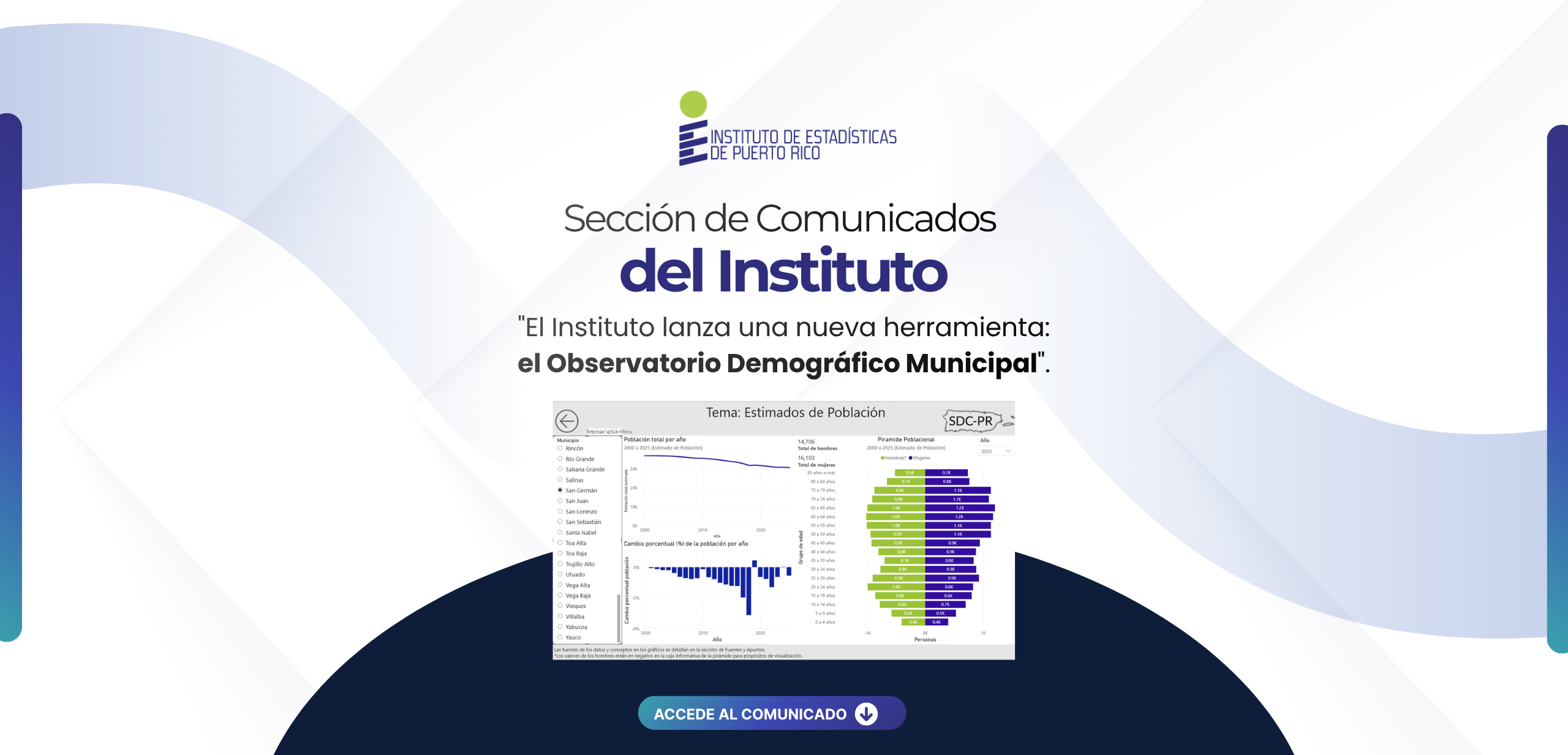
This is among the findings revealed by the new Municipal Demographic Observatory, published by the Institute of Statistics

Between 2000 and 2025, 33 municipalities, or 42%, lost more than 15% of their total population. Among the municipalities with the greatest losses are: Guánica (45.8%), Ceiba (41.0%), Loíza (33.7%), Maricao (32.7%), and Yauco (31.8%). This is part of the results revealed by the new Municipal Demographic Observatory, published by the Puerto Rico Institute of Statistics. This interactive dashboard visualizes indicators for population, aging, birth rates, mortality, and migration. The dashboard is powered by multiple data sources, such as the Decennial Census, Population Estimates, and the Puerto Rico Community Survey from the U.S. Census Bureau, the Birth and Death Registry from the Department of Health's Demographic Registry, and the Planning Board's Population Projections.

Alberto L. Velázquez Estrada, senior statistical project manager for the Demography and Geography area of the Puerto Rico Institute of Statistics, noted that “the Municipal Observatory has the virtue of capturing aspects and trends of demographic dynamics that interact constantly but are usually accessed in separate instances. In this sense, it is an instrument that strengthens rapid access to statistical information at a more granular geographic level, in order to support analysis and decision-making within the jurisdiction.”

“This new tool allows municipalities, and the general public, to quickly access the most relevant demographic statistics for municipal planning and management. For example, if we break it down by age group, all municipalities have lost more than half of their children, people aged 0 to 9. We can see this phenomenon manifesting in other areas of our society: today there are fewer daycares, schools, stores, and establishments oriented toward this group of the population,” commented Lanselotte Oliveras Vega, a statistical project assistant in the Institute's Demography and Geography area.

The tool is available on the website of the Puerto Rico State Data Center (SDC-PR), from the main menu under Demographic Observatory in the Municipal option. Additionally, the SDC-PR website contains the main statistical reports and U.S. Census Bureau publications regarding Puerto Rico, specifically those that are most requested, such as annual population estimates; the Puerto Rico Community Survey; and official statistics on the decennial population and housing censuses of Puerto Rico, among others. The Puerto Rico SDC website can be accessed at: https://censo.estadisticas.pr.

Share this article:

Please let us know your satisfaction level with our services.

‍

Visit our Official Activities, and participate with us

Visit our Calls for applications and be part of the new opportunities we have for you.

If you have any questions or just want to contact us, visit the Contact Us section.

We are at your disposal. If you need custom statistics, do not hesitate to contact us.

Sign up for our online workshops. Connect with the experts and discover the power of data!

Visit our Blog and keep up to date with the latest news and topics of interest.

Visit our Press Releases and stay connected to the Institute.

Explore the Publication Calendar and keep up to date with Puerto Rico's statistics.

Complete the form for the selection of our Statistics Coordination Committee

Suscribe to receive news directly to your email.

Listen to the Official PRIS podcast and stay informed with the experts

New system improves speed and effectiveness when answering questions from citizens about statistical data

Press Release

New system improves speed and effectiveness when answering

Questions from citizens about statistical data

In order to automate and improve the speed and effectiveness of the processes for answering citizens' questions on statistical issues, the Statistics Institute of Puerto Rico developed a new version of the system for answering questions. This new procedure allows managers and assistants of the Institute to see in real time the questions sent by citizens and to speed up the way they answer those questions. Through the tool of Google Analytics, the system allows us to know important aspects such as: demographic data, geographical data, if the user used a computer or a cell phone, the browser or Browser used, the company of Internet, among others.

“Using this new system, we will better know how long it took us to answer questions, what topics are most common among citizens and what resources were required to answer them. In addition, the tool makes it possible to generate quality control metrics, allowing the Institute to streamline processes, make better use of time, human resources and, consequently, public funds,” said Dr. Orville M. Disdier, acting executive director of the Puerto Rico Institute of Statistics.

To use the new question system, people can send an email to preguntas@estadisticas.pr or access the link directly https://www.estadisticas.pr.gov/

Those interested in learning more about the Institute of Statistics can access the website: www.estadisticas.pr.gov. On social media through Facebook (@estadisticas .pr), Twitter (@EstadisticasPR) and LinkedIn (Institute of Statistics of Puerto Rico) accounts.

###

Contacts:

Idia M. Martinez, R-28/787-603-3200

Lourdes Burgos, R-27/787-562-2932

‍

Income is decreasing in Puerto Rico and in 51 of its municipalities.

San Juan, PR — The U.S. Census Bureau today released the most recent data from the Puerto Rico Community Survey known as the Puerto Rico Community Survey (PRCS) at the municipal level. These statistics refer to information collected from 2012 to 2016, a period of 5 years or a five-year period. The new publication provides data on social, economic and housing characteristics for Puerto Rico and for all municipalities, as well as for some specific geographical levels such as neighborhoods, census tracts and block groups. As the leading entity of the U.S. Census Bureau's State Data Center Network in Puerto Rico, the Puerto Rico Statistics Institute (Institute) presents this brief summary of some of the results:

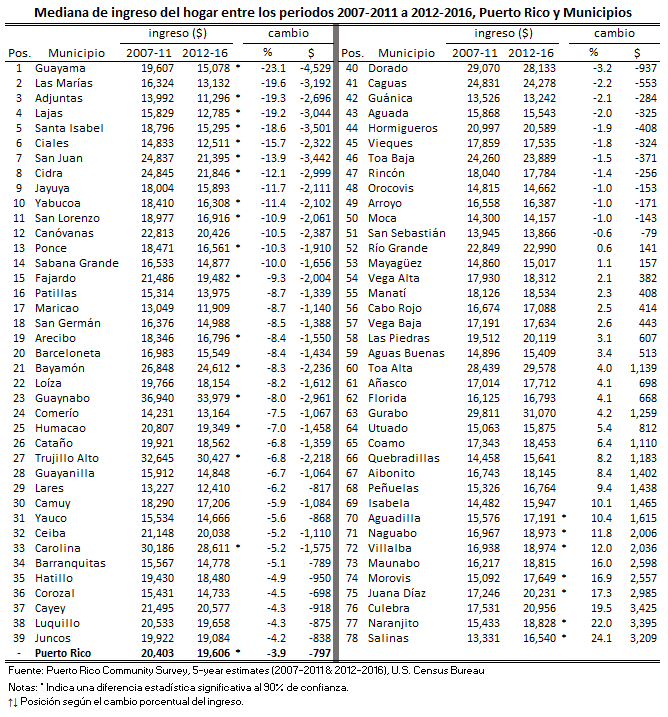
  1. During the 5-year period (2012-16), the median household income in Puerto Rico was $19,606, which decreased by about 4 percent compared to the previous five-year period (2007-11) when the median income was $20,403.
  2. Comparing the two five-year periods (2012-16 vs. 2007-11) at the municipal level:
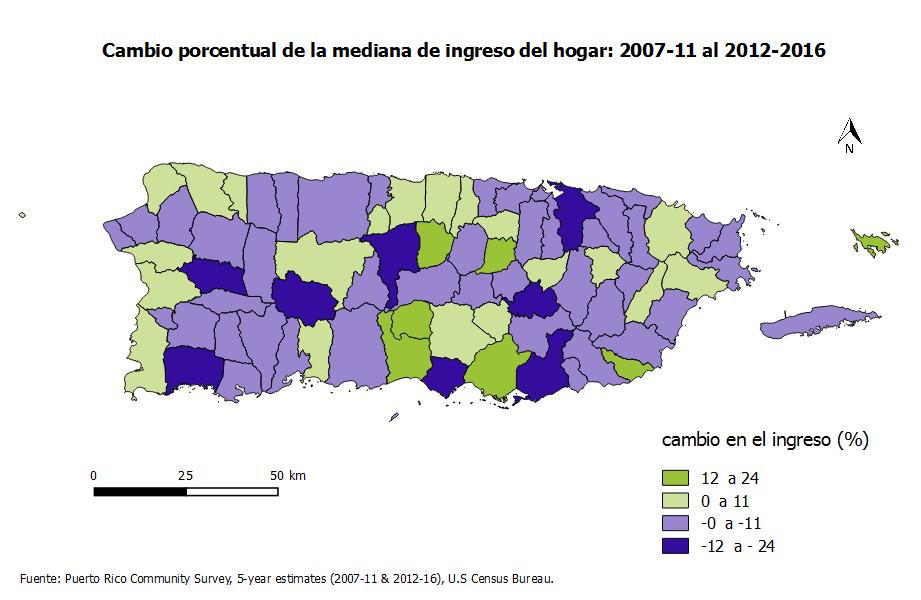
    • In 51 municipalities, there was a decrease in the median household income, and in 17 of these municipalities the change was statistically significant, with a confidence level of 90%.
    • The 5 municipalities that showed the highest decrease according to the percentage change in household income were: Guayama, Las Marías, Adjuntas, Lajas and Santa Isabel.
    • On the other hand, the 5 municipalities that showed the highest increase in household income were: Salinas, Naranjito, Culebra, Juana Díaz and Morovis.

‍

‍

At the Puerto Rico level, data indicate a reduction of about $800 in household income during the most recent five-year period 2012-16 compared to the previous 2007-2011. Looking at income by category, the proportion of households with incomes under $10,000 increased from 28% to 29% between the two periods, pointing to more households with minimum incomes in Puerto Rico. As for municipalities, 65% of these reflected a decrease in the median household income without showing any particular geographical pattern. On the other hand, seven municipalities showed an increase of 12% or more in household income, located in the center, south and east of Puerto Rico,” said Alberto L. Velázquez-Estrada, manager of statistical projects at the Institute.

‍

‍

More statistics on the Community Survey estimates can be obtained at: http://factfinder2.census.gov/. If you need assistance using this tool to get
data, you may find the self-study guide useful for using this available tool: https://censo.estadisticas.pr/fact-finder . Information on the methodology used to produce the estimates can be accessed here.


In addition, as the leading entity of Puerto Rico's SDC, the IEPR manages the SDC portal, which contains the main statistical reports and publications of the U.S. Census Bureau on Puerto Rico, specifically those that are most in demand, such as annual population estimates; the Puerto Rico Community Survey and official statistics on Puerto Rico's decennial population and housing censuses, among others. The Puerto Rico SDC portal can be accessed through: https://censo.estadisticas.pr/.

The Puerto Rico Statistics Institute is an autonomous governmental entity responsible for coordinating the Government's statistical production service to ensure that the data collection and statistics systems, on which public policies are based, are complete, reliable, and have quick and universal access. The Institute has in its inventory, accessible through
https://estadisticas.pr.gov, over 300 statistical products. In addition, it is a custodian and provides access to over 100 data sets or “data sets” through www.data.pr.gov and to over 40 tables and more than 6 thousand indicators through: www.indicadores.pr.


For more information you can visit our website: https://estadisticas.pr.gov. In addition, you can follow us on social networks through Facebook (estadisticas.pr), Twitter (@EstadisticasPR) and LinkedIn (Institute of Statistics of Puerto Rico) accounts.

Press Contact: Sandra Morales Blanes (787) 688-0401

Statements by Dr. Mario Marazzi-Santiago, Executive Director of the Institute, regarding his selection as a member of the Census Scientific Advisory Council attached to the U.S. Census Bureau

STATEMENTS BY DR. MARIO MARAZZI-SANTIAGO, EXECUTIVE DIRECTOR OF THE INSTITUTE REGARDING HIS SELECTION AS A MEMBER OF THE CENSUS SCIENTIFIC ADVISORY COUNCIL ATTACHED TO U.S. CENSUS BUREAU

It is an honor to have been selected in my personal capacity to serve as a member of the Census Scientific Advisory Council. As part of these new functions, we will be advising the Federal Census Bureau on the way to the 2020 Census. We appreciate the trust placed by the acting director of U.S. Census Bureau, Ron Jarmin and the Secretary of Federal Commerce, Wilbur Ross, who have invited, for the first time, a Puerto Rican to be part of this prestigious committee.


Now that the 2020 Census is approaching, so that in the next decade we have the basic information necessary for country decision-making, it is crucial that the planning and execution of a decennial population and housing census take into account the particular circumstances and idiosyncrasies of Puerto Rico.


XXX


Note: For more information about the appointment made by the U.S. Census Bureau and the communication made by the entity can visit the following link: https://www.census.gov/newsroom/press-releases/2018/csac.html.

Press Contact: Sandra Morales Blanes/787-688-0401

‍