
Income is decreasing in Puerto Rico and in 51 of its municipalities.

Announcements
IEPR
29 December 2025

San Juan, PR — The U.S. Census Bureau today released the most recent data from the Puerto Rico Community Survey known as the Puerto Rico Community Survey (PRCS) at the municipal level. These statistics refer to information collected from 2012 to 2016, a period of 5 years or a five-year period. The new publication provides data on social, economic and housing characteristics for Puerto Rico and for all municipalities, as well as for some specific geographical levels such as neighborhoods, census tracts and block groups. As the leading entity of the U.S. Census Bureau's State Data Center Network in Puerto Rico, the Puerto Rico Statistics Institute (Institute) presents this brief summary of some of the results:

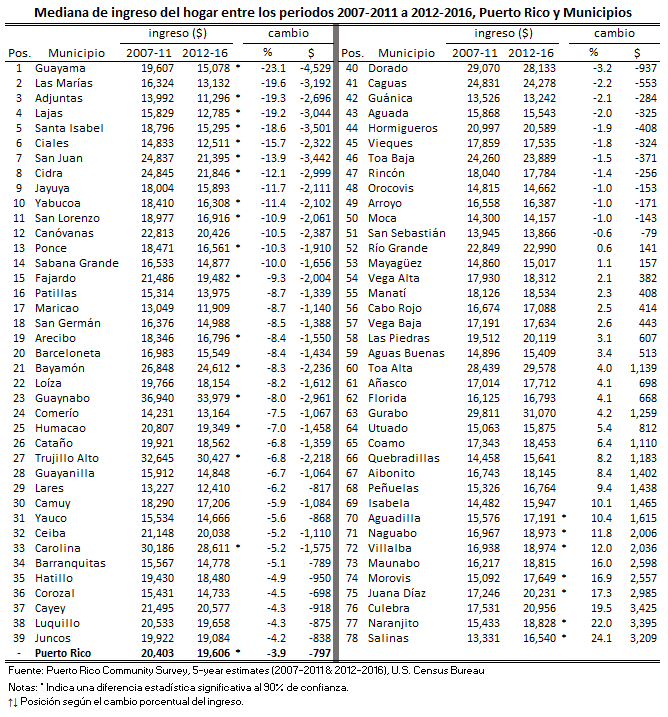
  1. During the 5-year period (2012-16), the median household income in Puerto Rico was $19,606, which decreased by about 4 percent compared to the previous five-year period (2007-11) when the median income was $20,403.
  2. Comparing the two five-year periods (2012-16 vs. 2007-11) at the municipal level:
    • In 51 municipalities, there was a decrease in the median household income, and in 17 of these municipalities the change was statistically significant, with a confidence level of 90%.
    • The 5 municipalities that showed the highest decrease according to the percentage change in household income were: Guayama, Las Marías, Adjuntas, Lajas and Santa Isabel.
    • On the other hand, the 5 municipalities that showed the highest increase in household income were: Salinas, Naranjito, Culebra, Juana Díaz and Morovis.
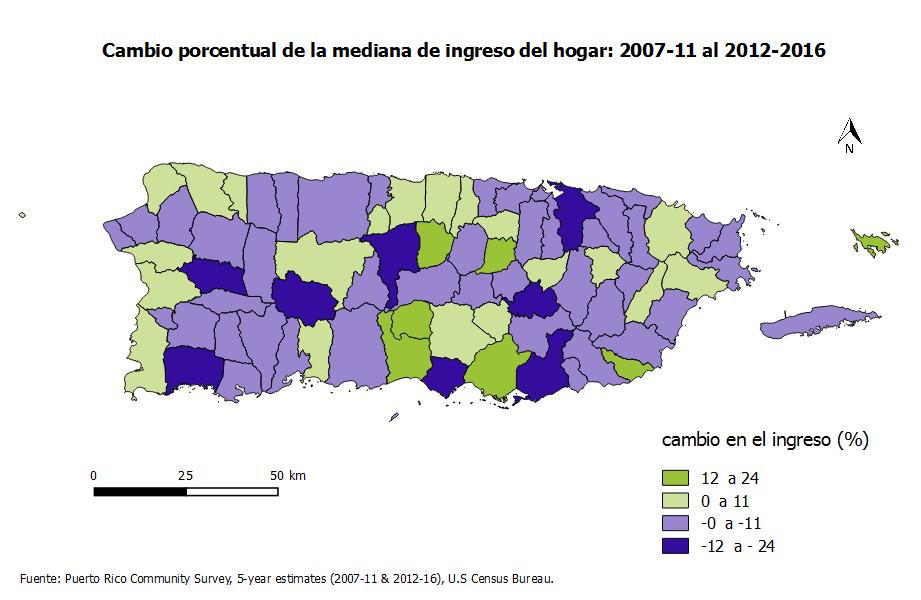
At the Puerto Rico level, data indicate a reduction of about $800 in household income during the most recent five-year period 2012-16 compared to the previous 2007-2011. Looking at income by category, the proportion of households with incomes under $10,000 increased from 28% to 29% between the two periods, pointing to more households with minimum incomes in Puerto Rico. As for municipalities, 65% of these reflected a decrease in the median household income without showing any particular geographical pattern. On the other hand, seven municipalities showed an increase of 12% or more in household income, located in the center, south and east of Puerto Rico,” said Alberto L. Velázquez-Estrada, manager of statistical projects at the Institute.
More statistics on the Community Survey estimates can be obtained at: http://factfinder2.census.gov/. If you need assistance using this tool to get
data, you may find the self-study guide useful for using this available tool: https://censo.estadisticas.pr/fact-finder . Information on the methodology used to produce the estimates can be accessed here.


In addition, as the leading entity of Puerto Rico's SDC, the IEPR manages the SDC portal, which contains the main statistical reports and publications of the U.S. Census Bureau on Puerto Rico, specifically those that are most in demand, such as annual population estimates; the Puerto Rico Community Survey and official statistics on Puerto Rico's decennial population and housing censuses, among others. The Puerto Rico SDC portal can be accessed through: https://censo.estadisticas.pr/.

The Puerto Rico Statistics Institute is an autonomous governmental entity responsible for coordinating the Government's statistical production service to ensure that the data collection and statistics systems, on which public policies are based, are complete, reliable, and have quick and universal access. The Institute has in its inventory, accessible through
https://estadisticas.pr.gov, over 300 statistical products. In addition, it is a custodian and provides access to over 100 data sets or “data sets” through www.data.pr.gov and to over 40 tables and more than 6 thousand indicators through: www.indicadores.pr.


For more information you can visit our website: https://estadisticas.pr.gov. In addition, you can follow us on social networks through Facebook (estadisticas.pr), Twitter (@EstadisticasPR) and LinkedIn (Institute of Statistics of Puerto Rico) accounts.

Press Contact: Sandra Morales Blanes (787) 688-0401

Share this article:

Visit our Official Activities, and participate with us

Visit our Calls for applications and be part of the new opportunities we have for you.

If you have any questions or just want to contact us, visit the Contact Us section.

We are at your disposal. If you need custom statistics, do not hesitate to contact us.

Sign up for our online workshops. Connect with the experts and discover the power of data!

Visit our Blog and keep up to date with the latest news and topics of interest.

Visit our Press Releases and stay connected to the Institute.

Explore the Publication Calendar and keep up to date with Puerto Rico's statistics.

Complete the form for the selection of our Statistics Coordination Committee

Suscribe to receive news directly to your email.

Listen to the Official PRIS podcast and stay informed with the experts

The value of investment in Research and Development in Puerto Rico increases

The value of investment in Research and Development in Puerto Rico increases

Statistics Institute releases first results on the Study of the Needs of the Deaf Community in Puerto Rico

PRESS RELEASE

Statistics Institute releases first results on the Study of the Needs of the Deaf Community in Puerto Rico

84% of totally deaf people surveyed who needed public safety services and 75% of those who needed services in government agencies faced barriers

July 21, 2022: The executive director of the Puerto Rico Statistics Institute (Institute), Dr. Orville M. Disdier, presented the first results of the Study of the Needs of the Deaf Community in Puerto Rico, through an interactive digital report. This new product, called “Study of the Needs of the Deaf Community: Interactive Report”, presents the first results of the Population Survey that the Institute conducted, both to deaf and partially deaf people, and to the general public. In addition, the interactive report presents the results of focus group interviews with teachers of students with hearing difficulties. The platform presents, for both deaf and partially deaf people, data and statistics on socio-demographic aspects, on the difficulties presented when requesting services, both governmental and non-governmental, on the communication methods used by this community and on the difficulties in accessing information offered by various means of communication, among other findings.

“The data and statistics presented in this interactive report serve as an empirical basis to justify various initiatives and the development of new public policies that promote quality services and better integration of deaf people into the rest of society, while promoting equity and social justice,” said Dr. Disdier.

Some of the most relevant results of the Deaf Community Needs Study:

  • 9% of all respondents indicated that they were completely deaf.
  • 14% of all respondents indicated that they are partially deaf.
  • 62% of the totally deaf people who participated in the survey were deaf at birth, while the remaining 38% became deaf sometime after their birth.
  • 66% of the partially deaf who participated in the survey have a level of severe or profound deafness.
  • 86% of the totally deaf people surveyed said they often feel discriminated against (41% very often and 45% sometimes). On the other hand, 68% of the partially deaf people surveyed said they often feel discriminated against (20% very often and 48% sometimes).
  • 84% of the totally deaf people surveyed, who needed public safety services, faced barriers.
  • 75% of the totally deaf people surveyed, who needed services from government agencies, faced barriers.
  • On the other hand, 53% of the partially deaf people surveyed, who needed services from government agencies, faced barriers.
  • Other places where the totally deaf people surveyed mentioned that they have faced difficulty receiving services, integrating or participating, are:
    • Hospitals (55%)
    • Medical offices (46%)
    • Restaurants (42%)
    • Banks or cooperatives (42%)
    • Place of employment (34%)
    • Cinema or theater (28%)
    • Supermarkets (24%)
    • Concerts or festivals (22%)
    • Gas stations (22%)
  • The communication methods used by the totally deaf people surveyed are:
    • Lip reading (83%)
    • ASL signs (64%)
    • Writing (65%)
    • Verbal (59%)
    • Creole signs (56%)
    • Interpreter (45%)
    • Non-formal signs (26%)
  • On the other hand, the communication methods most used by partially deaf people surveyed are verbal (87%), lip reading (59%) and written (43%).
  • 51% of the totally deaf people surveyed reported using one of the following headphone devices:
    • Behind the ear or behind the ear (64%)
    • CROS hearing aid — BI-CROS (14%)
    • In the ear — Intra shell (11%)
    • Cochlear implant (8%)
    • Open ear — miniature size (3%)
  • 58% of partially deaf people surveyed reported using one of the following headphone devices:
    • Behind the ear or behind the ear (53%)
    • CROS hearing aid — BI-CROS (26%)
    • In the channel — Intracanal (11%)
    • In the ear — Intra shell (5%)
    • Other (6%)
  • 10% of all respondents indicated that they are hearing people (who are not deaf or partially deaf) but who live with a deaf person.
  • 43% of the listeners surveyed, who live with a deaf person, have not taken sign language courses.
  • On the other hand, 42% of all respondents indicated that they are hearing people (who are not deaf or partially deaf) but who know a deaf person.
  • 25% of all respondents indicated that they are hearing people (who are not deaf or partially deaf) who do not live with a deaf person and who do not know a deaf person.
  • In general terms, the educators who participated in the focus groups agreed that there are not many materials adapted for deaf students, so sometimes the teachers themselves have to modify the materials.

In the same way, the educators who participated in the focus groups agreed that in general, parents and/or guardians are not given the necessary support at the time the child is diagnosed. Dr. Disdier explained that the final sample of the survey consisted of 739 adults, 18 years of age or older, living in Puerto Rico, and it was accessible for more than sixty (60) days. A total of 21 educators were part of several focus groups, in which in-depth conversations were held about the needs of deaf students. In this regard, Dr. Disdier argued that “The data collected by educators of deaf students alert us that, like deaf adults, deaf children and adolescents also face challenges and needs, and that these challenges and needs are different and require actions adapted to that demographic sector.”

For his part, Manuel Mangual, Evaluation Specialist, who managed the study, explained that there are still some survey questions that are being processed and whose data will eventually be added to the interactive report. Likewise, in the coming weeks, additional focus group interviews will be conducted, whose results will also be included in the report, expanding and strengthening it. “Working on this project, for the benefit of deaf and partially deaf people, has been a lot of learning, enthusiasm and pride. The study participants gave us the confidence to be part of one voice when it came to their needs. During the next phases, we will continue to produce information aimed at promoting a more inclusive society,” emphasized Mangual.

The Study of the Needs of the Deaf Community: Interactive Report, resides on the website of the Puerto Rico Institute of Statistics and can be accessed at any time by interested parties at the following e-mail address: Outcomes and Needs Deaf Community.

For technical questions about this report, you can send an email to: preguntas@estadisticas.pr.

To learn more about the Institute of Statistics, you can access the website: www.estadisticas.pr.gov. On social media through Facebook accounts (@statistics.pr), Twitter (@EstadisticasPR), Instagram (@institutodeestadisticas) and LinkedIn (Puerto Rico Institute of Statistics).

Puerto Rico Statistics Institute publishes Strategic Plan 2022 - 2025

Puerto Rico Statistics Institute publishes Strategic Plan 2022 - 2025

The design took into account the opinion of employees in all sectors of the economy, employees of the Institute and the general public

September 28, 2022: Building on the achievements made in the previous Strategic Plan, the Puerto Rico Statistics Institute published its Strategic Plan 2022 - 2025. In order to achieve a comprehensive plan aligned with the current needs of society, the opinion of users of the Institute's products and services, as well as the opinion of the general public, was taken into consideration. In addition, an internal analysis process was carried out using the SWOT methodology (strengths, opportunities, weaknesses and threats).

“Among the most revealing findings of the analysis, the need for more budget and human resources capable of updating statistics more frequently, improving our technological platforms and achieving fiscal and administrative autonomy for the Institute stand out. We converted this input into goals within our strategic plan to advance our mission of continuing to publish reliable and important statistics for citizens and expanding their reach and dissemination,” said the president of the Institute's Board of Directors, Dr. Javier Hernández.

The new Strategic Plan focuses on the following 10 goals:

  • Maximize the participation and effectiveness of the Statistics Coordination Committee (CCE).
  • Establish and strengthen projects aimed at “filling the various empty spaces” in the various economic, social, environmental and cultural statistics.
  • Strengthen the management structure of statistical projects to expand the capacity to carry out statistical and oversight projects.
  • Strengthen the administrative structure that allows the proper functioning of internal processes.
  • Improve the capacity and quality of technology, information systems, and the Institute's portals.
  • Improve public exposure, marketing and education about our products and services.
  • Strengthen, expand and modernize the Academies and Workshops Program.
  • Establish and strengthen alliances with the scientific community and non-governmental entities.
  • Promote the strengthening of fiscal and administrative autonomy.
  • Move the Institute's physical facilities to a larger infrastructure appropriate to current needs.

Regarding additional services that the Institute could offer, respondents suggested that specialized workshops and training, scientific advice, multisectoral collaboration and community research, among others, be provided.

“Although the Institute already offers some of these services, the survey results indicate that these efforts need to be maintained and strengthened. Hand in hand with that, we must strengthen the Institute's marketing to better publicize the services we offer,” concluded Disdier.

You can access the Strategic Plan at:

Strategic Plan Statistics Institute of Puerto Rico 2022-2025.pdf

About the Puerto Rico Institute of Statistics

To learn more about the Institute of Statistics, you can access the website: www.estadisticas.pr.gov. On social media through Facebook accounts (@statistics.pr), Twitter (@EstadisticasPR), Instagram (@institutodeestadisticas) and LinkedIn (Puerto Rico Institute of Statistics).