Date: August 10, 2015
Recommendations for the adoption of a new version of the Worker Group Survey questionnaire of the Department of Labor and Human Resources


Date: August 10, 2015
Recommendations for the adoption of a new version of the Worker Group Survey questionnaire of the Department of Labor and Human Resources
Please let us know your satisfaction level with our services.
Visit our Official Activities, and participate with us
Visit our Calls for applications and be part of the new opportunities we have for you.
If you have any questions or just want to contact us, visit the Contact Us section.
We are at your disposal. If you need custom statistics, do not hesitate to contact us.
Sign up for our online workshops. Connect with the experts and discover the power of data!
Visit our Blog and keep up to date with the latest news and topics of interest.
Visit our Press Releases and stay connected to the Institute.
Explore the Publication Calendar and keep up to date with Puerto Rico's statistics.
Complete the form for the selection of our Statistics Coordination Committee
Suscribe to receive news directly to your email.
Listen to the Official PRIS podcast and stay informed with the experts
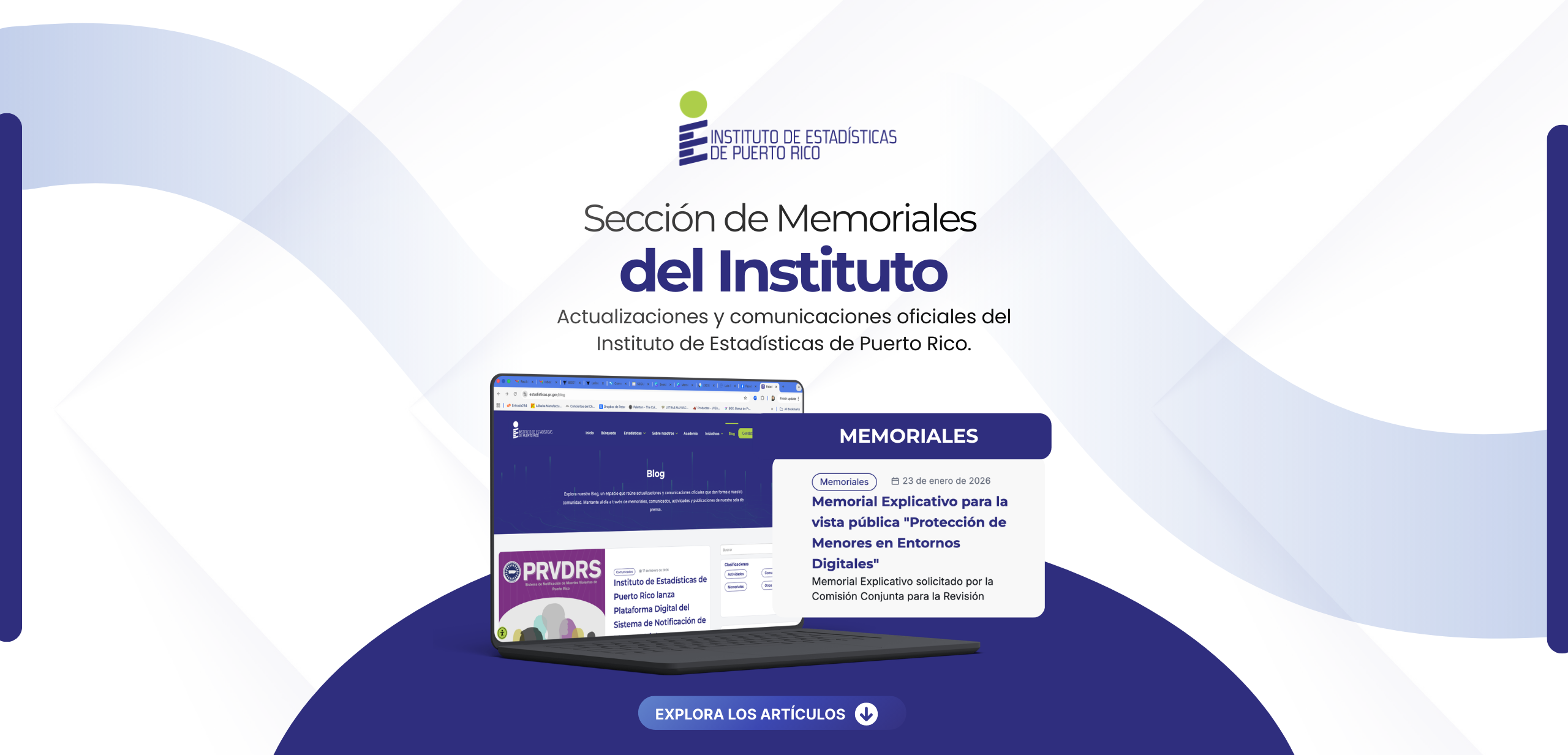
Date: December 13, 2021
To order the Department of the Family, the Puerto Rico Statistics Institute and the Puerto Rico Police Bureau to provide all available statistics on the incidence of child abuse and exploitation in Puerto Rico from March 1, 2020, the month in which the closure and curfew began due to COVID-19, until March 31, 2021; provide the plan of action to address and combat child abuse and exploitation; and for other related purposes.
Date: January 24, 2014
To amend Articles 2, 3, 5, 7, 8, 11 and 58 of Law 246? 2011, known as the “Child Safety, Welfare and Protection Act”, with the purpose of adding “human trafficking” in any of its forms as one of the forms of child abuse contemplated as public policy in this law; adding “human trafficking” as one of the definitions of child sexual abuse; including “human trafficking” as part of the definition of mistreatment and institutional abuse; defining the conduct or concept of “human trafficking”; including prevention against human trafficking as an obligation of both the family such as the State; include human trafficking as one of the instances in which the Department of Justice and the Puerto Rico Police must carry out joint investigations when cases of abuse are referred to or presented; include cases of human trafficking in the Central Register of Protection Cases; include, within the responsibilities of the Department of the Family with regard to
Date: April 3, 2013
To order the Puerto Rico Department of Education to comply with Act No. 165 for no longer than 90 days? 2011, which amended Article 1.03 of Act No. 149 of July 15, 1999, as amended, known as the “Organic Law of the Puerto Rico Department of Education”, which orders the Secretary of Education to provide information to the Puerto Rico Institute of Statistics to create an Early Detection System for Deserters and to submit an annual “School Dropout Report” to the Governor and the Legislative Assembly.

.png)
.png)
.png)
.png)

-p-130x130q80.png)
.png)
.png)
.png)
.png)
.png)
.png)
.png)
.png)
.png)
.png)
.png)