

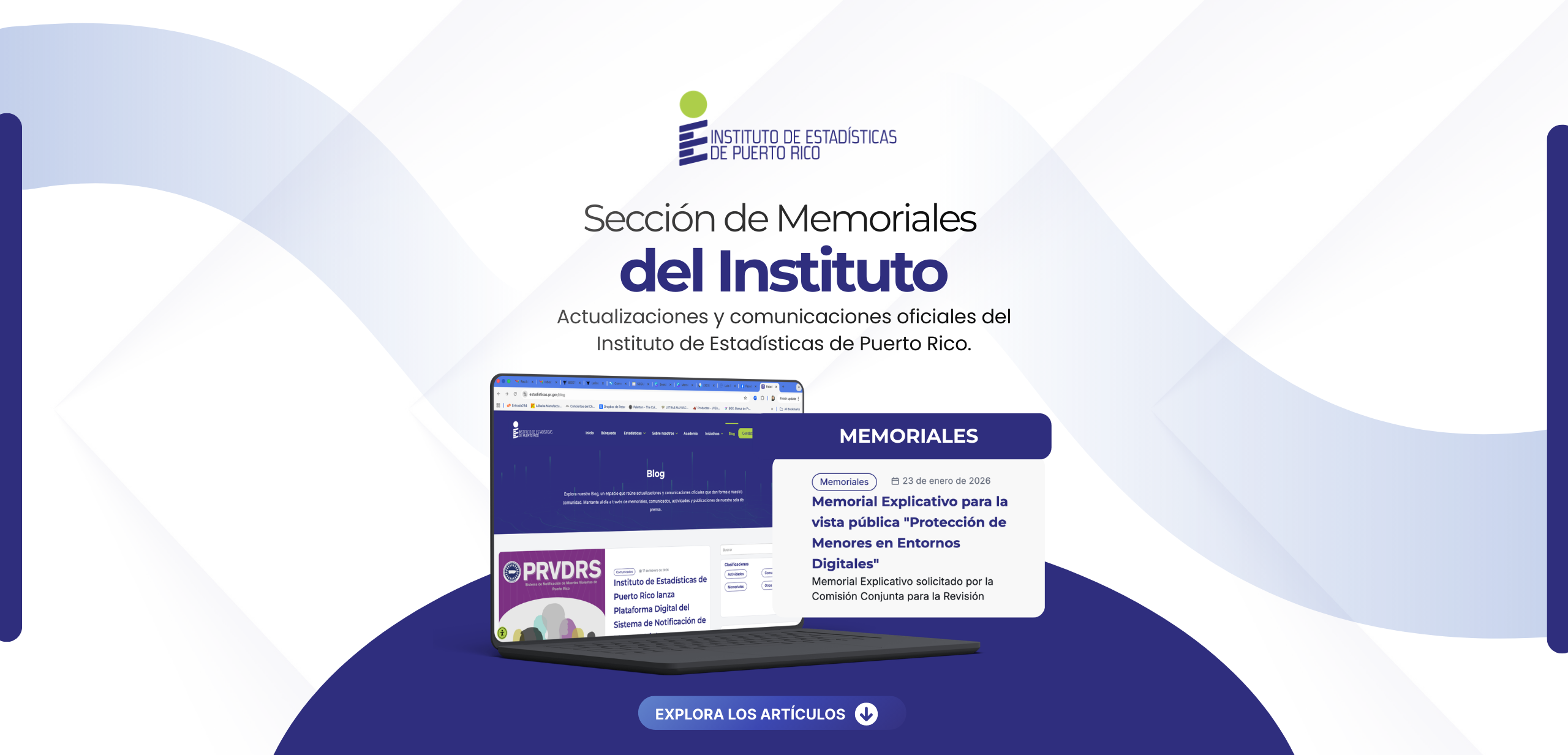
Some variables are easier to measure than others, but certain questions require special care, both in how they are formulated and in the instruments are used to collect them. One of the most complex is without a doubt, that related to people's ethnic and cultural origin, and also the skin color. In the most recent newsletter of the Puerto Rico State Data Center (SDC-PR) network brief notes are shared about the research on ethnic-racial identification and colorism that has been carried out from the Institute's. Access the current newsletter here, or explore previous newsletters and press releases from the SDC-PR network.
To create the “Financial Transparency Act of the Government of Puerto Rico”, with the purpose that all agencies of the Government of Puerto Rico, public corporations and municipalities, sign a collaborative agreement with the Puerto Rico Institute of Statistics to join its financial transparency platform; and for other related purposes.

The Puerto Rico Purchasing Managers Index (PMI) for the manufacturing sector was above the threshold, reaching a value of 54.4 in January 2019, with a difference of 7.1 percentage points, compared to the results of December 2018.
This product is intended to measure the short-term conditions of the manufacturing sector in Puerto Rico. The index is a composite of the subscripts for new orders, production, employment, deliveries to suppliers and inventories. For more information, visit the publication history at Puerto Rico Manufacturing - Purchasing Managers Index (PMI) And your Survey where you will see methodological aspects as well as an interactive graph.
PRESS RELEASE
RED STATE DATA CENTER OF PUERTO RICO
RECRUITING FOR THE 2020 CENSUS BEGINS
San Juan, PR, February 5, 2019 — The Institute of Statistics of Puerto Rico (Institute) announced today that the platform for applying for employment opportunities, related to the next Decennial Census 2020 in Puerto Rico, is now operational. The recruitment carried out by the Federal Census Bureau (U.S. Census Bureau) emerges as part of the planning of the important census operation that is coming. As the leading entity of the Network State Data Center (SDC) of the U.S. Census Bureau in Puerto Rico, the Institute urges all interested persons to complete the employment application. The 2020 Census job application platform is available online at the following email address: https://tinyurl.com/ybsulewp.
To apply for employment with the Census Bureau, applicants must complete three steps: 1) Create an applicant profile, 2) Provide personal information, and 3) Complete an evaluation, depending on employment preference. For general questions about the application process, you can consult the employment applications section at: https://tinyurl.com/yd9hu5vo. If you have questions about the operations of the U.S. Census Bureau in Puerto Rico, you can contact us at: https://estadisticas.pr.gov/contacto.
“Given the complexity of a Decennial Census, activities and projects intensify as we approach the date of the enumeration (April 1, 2020). We are already a little more than a year away from the event, and in this case the application and evaluation phase of candidates for the various positions offered by the Census Bureau begins. Timely recruitment is vital, since the positions involve specialized training that will result in the best possible enumeration of the population,” said Alberto L. Velázquez Estrada, Manager of Statistical Projects at the Institute.
For his part, Dr. Orville M. Disdier, Acting Executive Director, noted that “The preparation of the Decennial Census is a complex and very precise task, which is carried out in a relatively short time. Fortunately, at the Institute we are coordinating and managing all the work processes that need to be completed before April 1, 2020. All of the Institute's demographic and statistical work, vital for the economic and social development of Puerto Rico, is up to date.”
As the leading entity of the Puerto Rico SDC, the Institute manages the SDC portal, which contains the main statistical reports and publications of the U.S. Census Bureau about Puerto Rico, specifically those that are most in demand. These publications include: Annual population estimates, the Puerto Rico Community Survey (Puerto Rico Community Survey), and official statistics on Puerto Rico's 10-year population and housing censuses, among others. The Puerto Rico SDC portal can be accessed through: https://censo.estadisticas.pr/.
The Puerto Rico Statistics Institute is an autonomous governmental entity responsible for coordinating the Government's statistical production service to ensure that the data collection and statistics systems, on which public policies are based, are complete, reliable, and have quick and universal access. The Institute has in its inventory, accessible through www.estadisticas.pr.gov, over 300 statistical products. In addition, it is a custodian and provides access to over 100 data sets or “data sets” through https://data.pr.gov/ and to over 40 tables and more than 6,000 indicators through: www.indicadores.pr.
For more information you can visit our website: www.estadisticas.pr.gov. In addition, you can follow us on cyber social networks through Facebook (estadisticas.pr), Twitter (@EstadisticasPR) and LinkedIn (Institute of Statistics of Puerto Rico) accounts.
To order the Government Committee of the House of Representatives of Puerto Rico to carry out a comprehensive evaluation of the administrative and organizational functioning of the offices, instruments, boards, departments, public corporations and government agencies, as well as the budgetary management and quality of the services they provide to citizens, with the purpose of identifying alternatives and presenting recommendations that will improve the Puerto Rican government system; and for other related purposes.
PRESS RELEASE
RED STATE DATA CENTER OF PUERTO RICO
December 19, 2018
THE POPULATION OF PUERTO RICO IS ESTIMATED AT 3.2 MILLION IN 2018
With the post-hurricane effect, it points to a decrease of 14% since the 2010 Decennial Census
San Juan, PR — El U.S. Census Bureau released today the most recent annual population estimates for Puerto Rico. These statistics refer to July 1, 2017 and include the components of annual population change since July 1, 2010, which support the population estimate since the beginning of the decade. As the leading entity of the Network State Data Center (SDC) of the U.S. Census Bureau in Puerto Rico, the Puerto Rico Statistics Institute (Institute) presents this summary of the findings of the new annual population estimates for 2018:
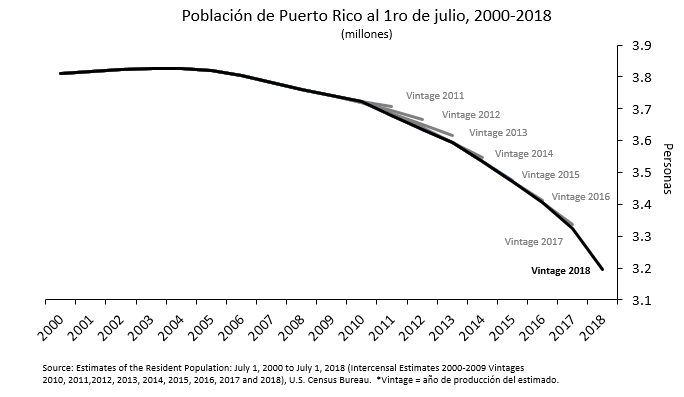
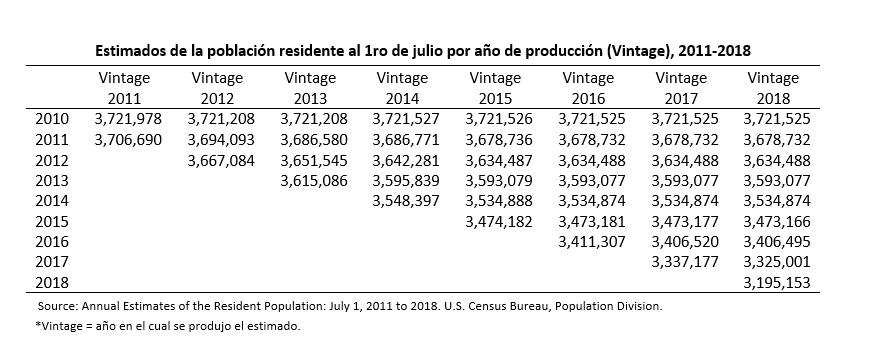
“The 2018 population estimates give a little more detail to the repercussions of the hurricanes of the past year 2017 on the demographic components of Puerto Rico. The combination of a negative natural increase in the population (more deaths than births), combined with the drive of the already high net emigration, points to an impressive population loss of 3.9% in just one year. This presents us with a difficult scenario to assimilate in terms of the speed of the decrease, as well as the direct repercussions it entails on the local scene. On the other hand, the operations of the next Decennial Census 2020 are becoming more important, so that they result in the best possible official enumeration, then you can confirm the drastic demographic changes estimated during the current decade,” said Alberto L. Velazquez Estrada, Manager of Statistical Projects at the Institute.
After the completion of a Decennial Census (such as the 2010 Census) the U.S. Census Bureau prepare the annual population estimates, which allow us to approximate the population during the decade before the next Census. These estimates are prepared by analyzing data on births, deaths and migration. As a result, with each new publication of the estimates, adjustments are made to the previously estimated years. For example, with the publication of the 2018 estimates announced in this release, the estimates already published for 2011, 2012, 2013, 2014, 2015, 2016 and 2017 were revised. Each publication is distinguished according to the year in which they were produced and are named as Vintage.
More statistics on Puerto Rico's annual population estimates can be obtained at: https://censo.estadisticas.pr/EstimadosPoblacionales, in the population estimates section. Information on the methodology used to produce the estimates can be accessed hither.
The Puerto Rico Statistics Institute is an autonomous governmental entity responsible for coordinating the Government's statistical production service to ensure that the data collection and statistics systems, on which public policies are based, are complete, reliable, and have quick and universal access. The Institute has in its inventory, accessible through www.estadisticas.pr.gov, over 300 statistical products. In addition, it is a custodian and provides access to over 100 data sets or Data sets by means of www.data.pr.gov and to over 40 tables and more than 6 thousand indicators through: www.indicadores.pr
For more information you can visit our website: www.estadisticas.pr.gov. In addition, you can follow us on social networks through Facebook accounts (statistics.government.pr), Twitter (@EstadisticasPR) and LinkedIn (Institute of Statistics of Puerto Rico).
###
Press Contact: Sandra Morales Blanes: (787) 688-0401
PRESS RELEASE
DR. ORVILLE M. DISDIER FLORES
INTERIM EXECUTIVE DIRECTOR
Statistics Institute publishes the Creative Industries report 2017
It reveals that the total number of establishments dedicated to Creative Industries was 2,054, the majority (41.7%) belonging to the Arts sector.
San Juan, PR, December 17, 2018 — The Puerto Rico Statistics Institute (Institute) today released its report of Creative Industries in Puerto Rico 2017, as part of public policy aimed at supporting the development of this sector, in accordance with Law No. 173 of October 13, 2014, also known as the Act to Promote Creative Industries. This law summarizes creative industries into the following groups:
Here are some of the publication's key findings:
Francisco Pesante González, author of the report, stated that “despite the fact that Puerto Rico has been in recession for more than 10 years, and has had to face the effects of hurricanes Irma and María, the 2017 indicators reveal consistent growth in exports from creative industries.”
For his part, Dr. Orville M. Disdier, Acting Executive Director, said: “With this third report prepared and published by the Institute of Statistics, we reiterate our commitment to join forces with the Institute of Culture and the Trade and Export Company, aimed at continuing the promotion and support of Creative Industries in Puerto Rico.”
To access the full report you can visit: Creative industries.
The Puerto Rico Statistics Institute is an autonomous governmental entity responsible for coordinating the Government's statistical production service to ensure that the data collection and statistics systems, on which public policies are based, are complete, reliable, and have quick and universal access. The Institute has in its inventory, accessible through www.estadisticas.pr.gov, over 300 statistical products. In addition, it is a custodian and provides access to over 100 data sets or “data sets” through www.data.pr.gov and to over 40 tables and more than 6 thousand indicators through: www.indicadores.pr.
##
Press Contact: Sandra Morales Blanes/(787) 688-0401
Please let us know your satisfaction level with our services.
Visit our Official Activities, and participate with us
Visit our Calls for applications and be part of the new opportunities we have for you.
If you have any questions or just want to contact us, visit the Contact Us section.
We are at your disposal. If you need custom statistics, do not hesitate to contact us.
Sign up for our online workshops. Connect with the experts and discover the power of data!
Visit our Blog and keep up to date with the latest news and topics of interest.
Visit our Press Releases and stay connected to the Institute.
Explore the Publication Calendar and keep up to date with Puerto Rico's statistics.
Complete the form for the selection of our Statistics Coordination Committee
Suscribe to receive news directly to your email.
Listen to the Official PRIS podcast and stay informed with the experts

.png)
.png)
.png)
.png)

-p-130x130q80.png)
.png)
.png)
.png)
.png)
.png)
.png)
.png)
.png)
.png)
.png)
.png)