Culebra's poverty rate exceeds that of Vieques.


Download the Document
Culebra's poverty rate exceeds that of Vieques.
Please let us know your satisfaction level with our services.
-p-130x130q80.png)
Visit our Official Activities, and participate with us
.png)
Visit our Calls for applications and be part of the new opportunities we have for you.
.png)
If you have any questions or just want to contact us, visit the Contact Us section.
.png)
We are at your disposal. If you need custom statistics, do not hesitate to contact us.
.png)
Sign up for our online workshops. Connect with the experts and discover the power of data!
.png)
Visit our Blog and keep up to date with the latest news and topics of interest.
.png)
Visit our Press Releases and stay connected to the Institute.
.png)
Explore the Publication Calendar and keep up to date with Puerto Rico's statistics.
.png)
Complete the form for the selection of our Statistics Coordination Committee
.png)
Suscribe to receive news directly to your email.
.png)
Listen to the Official PRIS podcast and stay informed with the experts
.png)
Platform will measure Puerto Rico's agricultural production index
Platform will measure Puerto Rico's agricultural production index
Thousands of farmers and citizens are expected to benefit from this tool.
April 19, 2023. The Puerto Rico Statistics Institute presented a new tool that will facilitate access to agricultural statistics and will allow us to know which products within local agriculture are in greater or lower demand in Puerto Rico. The platform of Statistics and Indicators of Agricultural Production in Puerto Rico, whose primary source of data was provided by the Department of Agriculture, and which will benefit thousands of farmers and citizens, includes: Production and Demand indices for tubers, meat, farinaceae, fresh fruits, fresh vegetables, milk and dairy products. As for production rates, the platform allows us to know aspects such as export vs. import. The demand indices, on the other hand, include data on per capita consumption vs. per capita production. The tool also includes agricultural statistics such as agricultural activities, losses and producers of small ruminants, as well as a metadata area for the definition of concepts. This platform, as reported, collects data from 1990 to 2021 and its constant updating will allow us to compare how the production of products such as Chinese, bananas, coffee, among others, behaves.
One of the aspects highlighted by the platform of Statistics and Indicators of Agricultural Production in Puerto Rico is the decline in local coffee production. According to data obtained by the Puerto Rico Department of Agriculture, in 1990 local coffee production was 280,000 quintals, while in 2020 production decreased to 28,943 quintals. According to Manuel Mangual Martínez, Data and Statistics Specialist and Project Supervisor at the Institute, this decrease in production could, among other things, be the result of situations such as the passage of Hurricane Maria, which caused significant coffee losses since 2017, reaching its lowest point in 2019 with a production of 12,127 quintals.
“For several reasons, access to agricultural statistical information in Puerto Rico has been an enormous challenge for farmers, researchers and the general public. With this platform, the Institute provides all citizens, and especially farmers, with fast and universal access to data and statistics on food production and demand in Puerto Rico, in one place, accessible 24/7 from anywhere in the world. Access to these statistics will make it easier to make decisions based on empirical evidence, that promote food security in Puerto Rico,” said the Executive Director of the Institute, Dr. Orville M. Disdier Flores. Dr. Disdier also reported that the platform will continue to evolve and will have more information in the future.
The platform of Statistics and Indicators of Agricultural Production in Puerto Rico is available through the following link: Puerto Rico Agricultural Production Statistics and Index.
The Puerto Rico Statistics Institute is a governmental entity in the executive branch, with fiscal and administrative autonomy, whose main purpose is to ensure that Puerto Rico has complete, reliable statistics that are quickly and universally accessible. To learn more about the Institute of Statistics, you can access the website: www.estadisticas.pr.gov. On social media through Facebook accounts (@statistics.pr), Twitter (@EstadisticasPR), Instagram (@institutodeestadisticas) and LinkedIn (Puerto Rico Institute of Statistics).
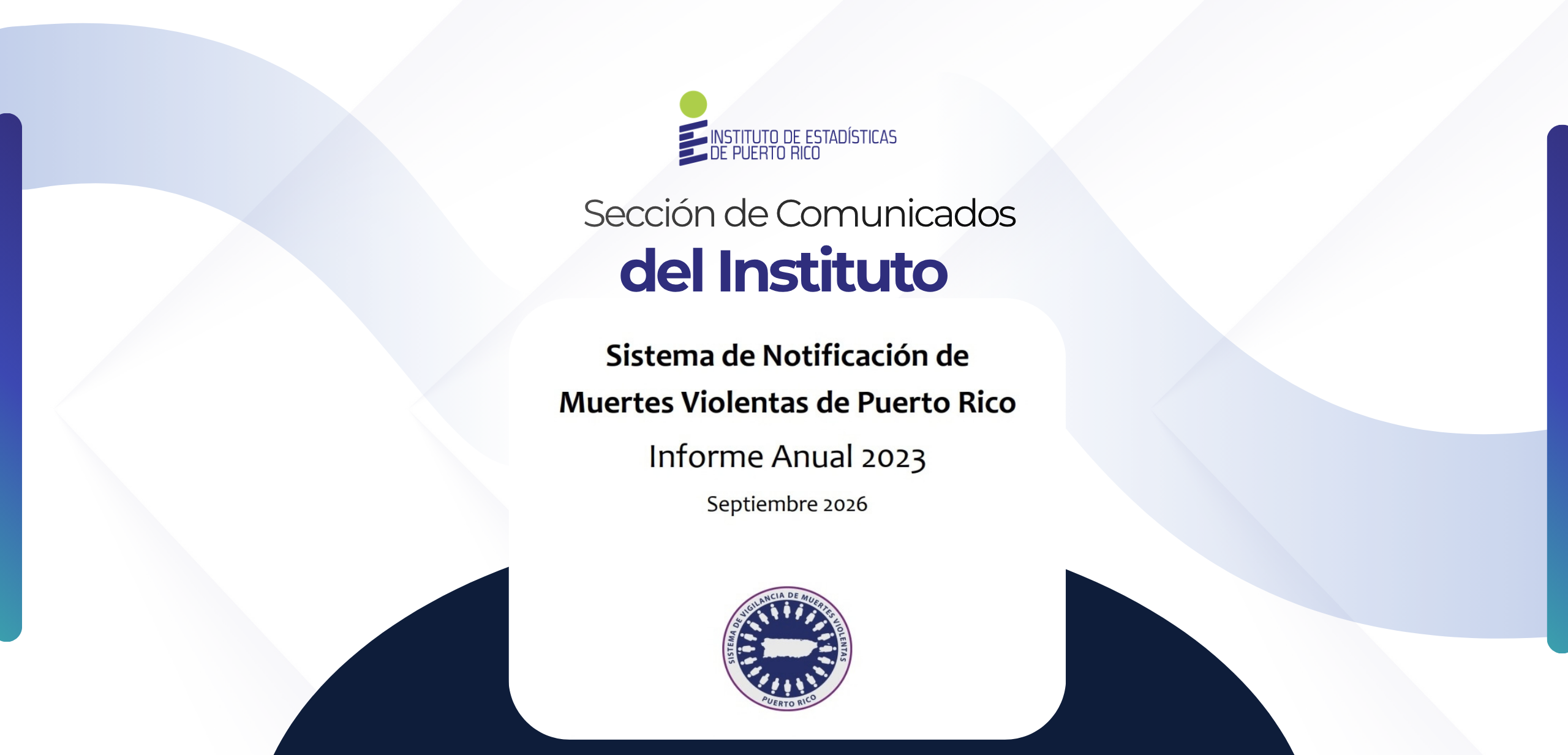
Institute of Statistics publishes the latest report on violent deaths: 733 fatalities in 2023
Institute of Statistics publishes the latest report on violent deaths: 733 fatalities in 2023
Data from the Puerto Rico Violent Death Reporting System reveals 483 homicides and 241 suicides in Puerto Rico
The Puerto Rico Institute of Statistics (Institute), through the Puerto Rico Violent Death Reporting System (PRVDRS), has presented the findings of its latest report for the year 2023. The data reveals that 674 violent death incidents were recorded in Puerto Rico, resulting in 733 fatalities.
Of the total victims reported, 483 were homicides (65.9%), 241 were suicides (32.9%), six were legal interventions (0.8%), and three were deaths of undetermined intent (0.4%), totaling 733 victims. The crude violent death rate stood at 22.9 per 100,000 inhabitants. Men accounted for nearly nine out of every 10 victims (87.4%).
Key findings from the 2023 Report:
• Homicide profile: Violence primarily affected individuals between the ages of 15 and 39. Additionally, 38.5% of homicides (186 cases) occurred in settings of collective violence linked to drug trafficking.
• Gender-based and family violence: 34 fatalities related to family violence were documented. Of the 24 cases related to intimate partner violence, 91.7% (22 victims) were women. In nearly 8 out of 10 of these femicides (77.3%), a firearm was used.
• Mental health: The suicide rate was 7.5 per 100,000 inhabitants (13.1 for men; 2.5 for women), with asphyxiation being the primary method.
• Firearm use: 90.7% of homicides in Puerto Rico were committed with firearms, compared to a global average of 55.8%.
In light of these figures, researchers at the Institute emphasized that the collection and publication of this data should serve as a catalyst for changing strategies in Puerto Rico. "Over nearly 10 years, invaluable data has been collected. This allows us to understand the magnitude of this problem from a public health perspective, identifying the contexts of violence in Puerto Rico to develop evidence-based prevention strategies for both government agencies and community organizations," stated Dr. Diego Zavala, epidemiologist and co-investigator of the PRVDRS.
For his part, Mario O. Font Martin, the PRVDRS coordinator, emphasized that "violence is a phenomenon that cannot be addressed exclusively by law enforcement agencies; it requires a comprehensive and multisectoral approach."
Marking the tenth anniversary of the PRVDRS's affiliation with the Centers for Disease Control and Prevention (CDC), the executive director of the Institute, Dr. Orville M. Disdier, highlighted the importance of the project's trajectory: "Scientific evidence shows us that violence is a modifiable behavior if we understand its causes and take appropriate preventive actions. This report is one of the primary scientific tools for promoting changes in strategy."
The 2023 Puerto Rico Violent Death Report is available on the Institute's website in the official section for the Puerto Rico Violent Death Reporting System: Puerto Rico Violent Death Reporting System - 2023 Annual Report.
The Puerto Rico Statistics Institute and the Puerto Rico Department of Justice signed an agreement
The Puerto Rico Statistics Institute and the Puerto Rico Department of Justice signed an agreement that will enable the use of data, on the level of risk of victims in cases of domestic violence, with the purpose of creating new policies and strategies to prevent intimate femicide.
As part of the “Interagency Agreement for the Disclosure of Sociodemographic Data on Victims of Domestic Violence,” the Department of Justice will share with the Institute the results of the risk assessments that prosecutors carry out on victims of domestic violence to analyze the scale of risk and danger of death they face.
The data and statistics that will be generated, through these epidemiological processes, can be used to identify possible determinants, risk factors and vulnerabilities. As a result of this agreement, the Puerto Rico Statistics Institute will be able to provide complete, reliable statistics with quick and universal access, with the purpose of helping to prevent violence and intimate femicide.

.png)
.png)
.png)
.png)