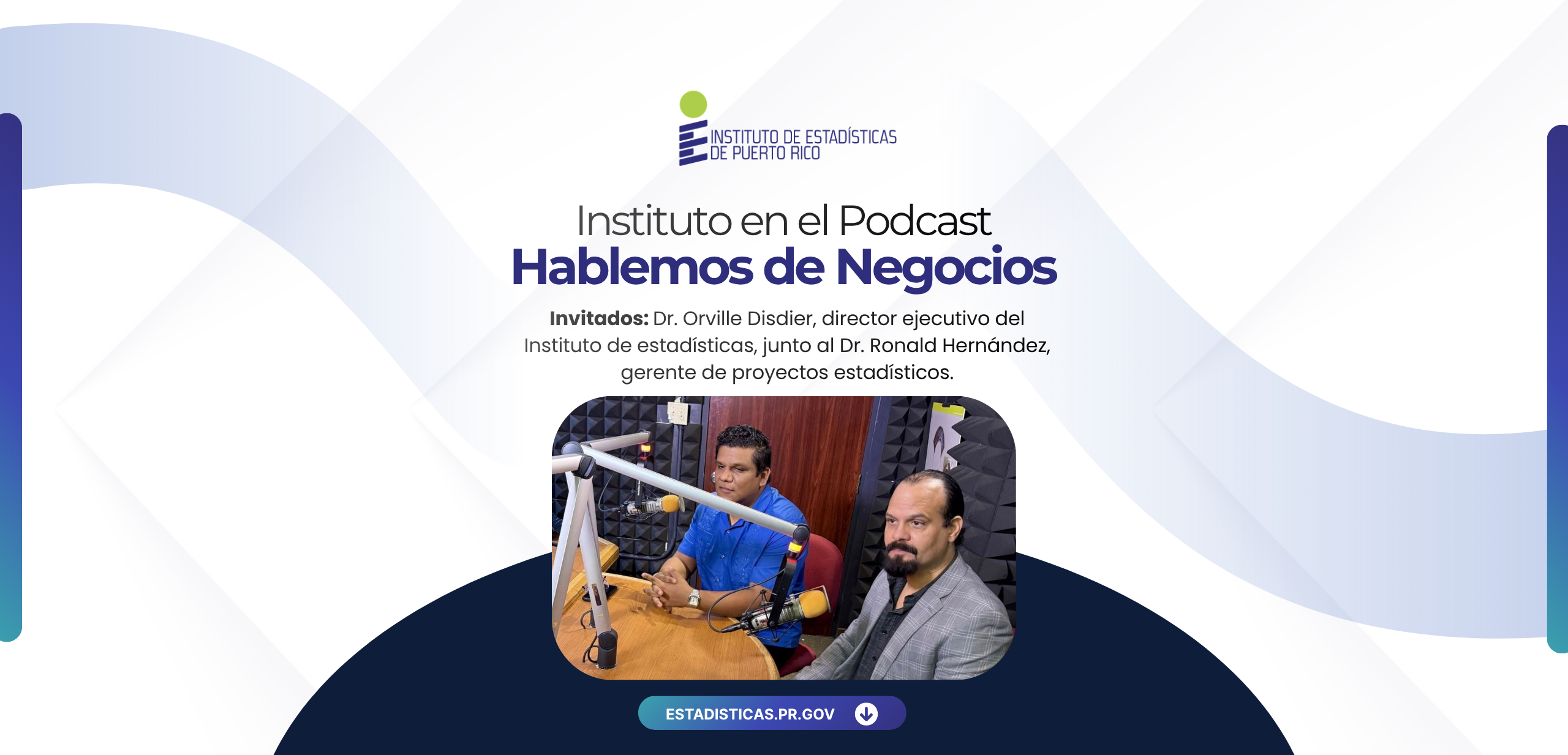

In the podcast Let's Talk About Business, Dr. Orville Disdier, executive director of the Puerto Rico Institute of Statistics, together with Dr. Ronald Hernández, manager of statistical projects, addressed various topics about the role of statistics in making informed decisions.
Among these issues, they highlighted one of the most debated — and often misinterpreted — concepts, inequality.
In a simple way, they describe it as the distance between those who have greater and lower purchasing power within a society. The larger that gap, the greater the inequality. In the case of Puerto Rico, they pointed out that, although not all people live in poverty, there is a significant difference between the extremes. Even if the group with the highest purchasing power is small, its impact on measurement is large due to this marked difference.
Why does it matter to understand this?
Because inequality is not just an economic fact. It is linked to social factors such as access to education, opportunities and even social tensions that can arise when the gaps are very wide.
In addition, the doctors emphasized that correctly interpreting these data makes it possible to better evaluate initiatives—such as economic aid or public policies—that seek to reduce this gap.
In short:
Understanding inequality is key to making informed decisions and building a more equitable society. We share the interview for the benefit of all and so that they can expand on these and other topics.
Access the interview: https://open.spotify.com/episode/5WDAUhFpJY9PKoQFoLmPV1?si=CtZVKuCKRMSg0h793ZbeGQ&pi=-e_fQ8PaS9WJi&t=17
-p-130x130q80.png)
.png)
.png)
.png)
.png)
.png)
.png)
.png)
.png)
.png)
.png)
.png)

.png)
.png)
.png)
.png)