
Statistics Institute requests information stipulated by law from government agencies

Announcements
IEPR
24 December 2025

‍PRESS RELEASE

Statistics Institute asks government agencies

information stipulated by law

Statistical information was requested from 38 government agencies

San Juan, PR, August 5, 2020 — The Puerto Rico Statistics Institute (Institute) reported that it recently requested in writing from 38 government agencies specific statistical information, as established in multiple laws in Puerto Rico. The initiative aims to ensure compliance with Article 13 of the Institute's Organic Law, Act No. 209 of August 28, 2003, as amended, which provides that all government agencies have the obligation to regularly and constantly send to the Institute any publication of statistical products they produce, in order to be incorporated into the Inventory of Statistics and to make them available to all citizens.

The Inventory of Statistics, specified by Article 5 (f) of the Institute's Organic Law, is where most of the statistical information collected by the Institute is kept and made available to the public, and is located online at: Inventory-of-statistics. It is the main source for those looking for official statistical information that describes, estimates or analyzes the characteristics of Puerto Rico and its society. The Inventory contains all important statistical activities carried out or planned to be carried out by government agencies, as well as information on how to obtain statistical reports for Puerto Rico that are prepared by government agencies and public corporations in Puerto Rico, municipalities and any other jurisdiction in the United States. Statistical reports from the private sector are also included in the Inventory.

The deadline given to agencies to respond is 20 calendar days, but agencies can request an extension, particularly if they receive multiple requests for statistical information. This is the case of agencies to which numerous laws that specify the generation of statistical information that is of great legislative interest apply, such as the Department of Education, the Department of Natural and Environmental Resources, the Department of Health and the Department of Public Safety. However, most of the government agencies contacted will receive few requests for statistical information and are not considered less important by the Institute. It should be noted that the Institute has tried to make the process for submitting the requested statistical products as efficient as possible, making it one that can be carried out completely online.

“We urge all government agencies contacted to provide the requested statistical information. The collaboration of government agencies will help the Puerto Rico Statistics Institute expand and keep its Statistics Inventory up to date. In addition, since these are statistical products specified by legal provisions, the information requested is particularly relevant to the decision-making processes of the Government of Puerto Rico,” said Jacobo M. Orenstein-Cardona, special assistant to the Institute's executive director and coordinator of this initiative.

About the Puerto Rico Institute of Statistics

The Puerto Rico Statistics Institute is an autonomous governmental entity tasked with coordinating the government's statistical production service to ensure that the data collection and statistics systems, on which public policies are based, are complete, reliable, and accessible quickly and universally.

For more information you can visit the website: https://estadisticas.pr.gov/. In addition, you can follow the Institute on social networks, through Facebook (@estadisticas .pr), Twitter (@EstadisticasPR) and LinkedIn (Institute of Statistics of Puerto Rico) accounts.

‍

Share this article:

Please let us know your satisfaction level with our services.

‍

Visit our Official Activities, and participate with us

Visit our Calls for applications and be part of the new opportunities we have for you.

If you have any questions or just want to contact us, visit the Contact Us section.

We are at your disposal. If you need custom statistics, do not hesitate to contact us.

Sign up for our online workshops. Connect with the experts and discover the power of data!

Visit our Blog and keep up to date with the latest news and topics of interest.

Visit our Press Releases and stay connected to the Institute.

Explore the Publication Calendar and keep up to date with Puerto Rico's statistics.

Complete the form for the selection of our Statistics Coordination Committee

Suscribe to receive news directly to your email.

Listen to the Official PRIS podcast and stay informed with the experts

No significant change in income in households and families in Puerto Rico

No significant change in income in households and families in Puerto Rico

PRESS RELEASE

PUERTO RICO STATE DATA CENTER NETWORK (SDC-PR)

No significant change in income in households and families in Puerto Rico

Based on the most recent data from the U.S. Census Bureau's Community Survey

San Juan, PR, September 14, 2022 — During the calendar year 2022, the median household income in Puerto Rico increased slightly, about $76, while the median family income fell by $363 compared to what was reported in 2021. This is revealed by the most recent Community Survey data released today by the U.S. Census Bureau, covering the 2022 calendar year. As a local liaison entity with the U.S. Census Bureau, the Puerto Rico Institute of Statistics shared several findings from the new 2022 survey data:

  1. The estimated median income for households and families showed no significant change, from $24,036 to $24,112 in households, and from $29,907 to $29,544 in families. This represented a change in household income of 0.3% and -1.3% in families.
  2. Regarding the migratory indicators for Puerto Rico, the estimates for 2022 showed the following changes compared to the most recent year of available information (2021):
    • Nearly 16,000 people immigrated to other jurisdictions in the United States in net terms, a decrease compared to the previous available year (2021) where the net balance was close to 27,000 people emigrating.
    • Some 26,989 people immigrated from the United States, reflecting a slight decrease in immigrants of -1.4% compared to 2021, where an estimated immigration of 27,380 people was estimated.
    • In the other direction, some 42,990 people migrated from Puerto Rico to other jurisdictions in the United States, showing a decrease of 21.4% compared to the figure for 2021, which was 54,669 people.
  3. Compared to the previous year 2021, during 2022, the following selected socioeconomic characteristics of Puerto Rico reflected statistically significant changes:
    • The unemployment rate fell from 13.1% to 9.9%, while the labor force increased by about 3.4%.
    • On the other hand, the percentages related to poverty increased in individuals (40.5% to 41.7%), in those under 18 years of age (54.9% to 57.6%) and in families (36.7% to 38.8%).
    • The percentage of grandparents who are responsible for their grandchild or granddaughter under 18 increased about seven points from 31.8% to 38.8%.
    • Among the total population aged 25 and over, the percentage of people with a higher education level or higher increased (79.6% to 81.7%), as well as those with a baccalaureate level or higher (28.5% to 29.8%).

“The survey information provides us with a recent overview of our society. Several of the indicators contrast with the reduction in the unemployment rate, while incomes (in households and families) remained unchanged. On the other hand, net emigration estimates were reduced for the third consecutive year since the post-hurricane emigration peak of 2018,” said Alberto L. Velázquez-Estrada, Manager of Statistical Projects at the Institute.

The main difference between household income and family income is that household income is considered to be the income of the head of household and any other individual in the household aged 15 years or older, even if not related to the head of the household. Family income, on the other hand, considers the income of all individuals in the household aged 15 years or older than if they are related to the head of the household.

Velázquez also indicated that as the leading entity of the Puerto Rico SDC, the Institute manages the SDC page, which contains the main statistical reports and publications of the U.S. Census Bureau on Puerto Rico, specifically those that are most in demand, such as annual population estimates; the Puerto Rico Community Survey (Puerto Rico Community Survey) and official statistics on Puerto Rico's decennial population and housing censuses, among others.

For more details, data and information about the 2022 Community Survey and previous years, interested parties can access: data.census.gov. The Puerto Rico State Data Center (SDC) page can be accessed at: https://censo.estadisticas.pr/.

The Puerto Rico Statistics Institute is an autonomous governmental entity responsible for coordinating the Government's statistical production service to ensure that the data collection and statistics systems, on which public policies are based, are complete, reliable, and have quick and universal access.

For more information you can visit the website: www.estadisticas.pr.gov on social networks through Facebook (@estadisticas .pr), Twitter (@EstadisticasPR) and LinkedIn (Institute of Statistics of Puerto Rico) accounts.

‍

Puerto Rico Statistics Institute Urges Secretary of Health to Provide Data on Covid-19 on the Island

PRESS RELEASE

Puerto Rico Statistics Institute Urges Secretary of Health to Provide Data on Covid-19 on the Island

April 8, 2020: In view of the non-compliance with the submission of data on COVID-19 in Puerto Rico and in accordance with Act No. 209-2003, as amended, known as the Statistics Institute Act, the executive director of that entity, Dr. Orville M. Disdier, made a formal request to the Secretary of the Department of Health (DS), Dr. Lorenzo González Feliciano, to provide the necessary data. “Although the Institute's Information Requirements Regulations state that, in response to an Official Information Request, the agency has up to 20 days to provide it, we ask the DS to do so immediately, as this is a matter of the highest priority, given the likelihood that infections and deaths will continue to increase in Puerto Rico,” said Disdier.

The Law that created the Puerto Rico Statistics Institute (Institute) states that its purpose is to promote changes in data collection and statistics systems so that they are complete, reliable and accessible quickly and universally. To this end, the Institute has the primary mission of coordinating the Statistics Production Service of the Government of Puerto Rico, of requesting information, both from the public and private sectors, and of developing the policy for the development of the public statistical function. According to Disdier, although most agencies comply with this, unfortunately there are others that do not do their duty.

“Since long before this COVID-19 emergency began, the Institute has been communicating, through official email and phone calls, with the Department of Health to offer collaboration and request that they provide us with detailed data on cases of COVID-19 in Puerto Rico. In addition, we have held communications and meetings with staff from Fortaleza and with some members of the Task Force that advises the governor on this pandemic. They repeatedly state that they will provide the data, but the reality is that they arrive late, incomplete, in inadequate formats or there are days when they simply don't arrive,” he said.

Specifically, the Institute has requested the following information and detailed data, for each individual being tested for COVID-19 in Puerto Rico: Case number (Unique ID), sex (M, F, or other), region of residence, municipality of residence, age (in years), test results for COVID-19 (positive, negative, pending, undetermined, or other), date of onset of symptoms (day and month), date of sample collection or date of submission of the sample (day and month), and if the person died.

Disdier highlighted that, in order to promote greater collaboration, the Institute served as a facilitator and for a few days now, the project to implement a rapid system for the daily collection of data on COVID-19 in hospitals has been successfully completed. As a result, every day the Department of Health receives data from hospitals, in a fast, simple and standardized way.

“It is now up to the Department of Health to share the revised and official data with the Institute. That is, right now we should be receiving these official data on a daily basis and that is not happening. These data are necessary so that the Institute can keep citizens informed and to develop action plans that make it feasible to control this pandemic,” concluded Disdier.

To learn more about the Institute of Statistics, you can access the website: www.estadisticas.pr.gov. On social media through Facebook (@estadisticas .pr), Twitter (@EstadisticasPR) and LinkedIn (Institute of Statistics of Puerto Rico) accounts.

###

Contacts:

Idia M. Martinez, R-28, 787-603-3200

Lourdes Burgos, R-27, 787-562-2932

‍

Fewer people left Puerto Rico

Fewer people left Puerto Rico

This is detailed in the most recent Migrant Profile 2021-2022

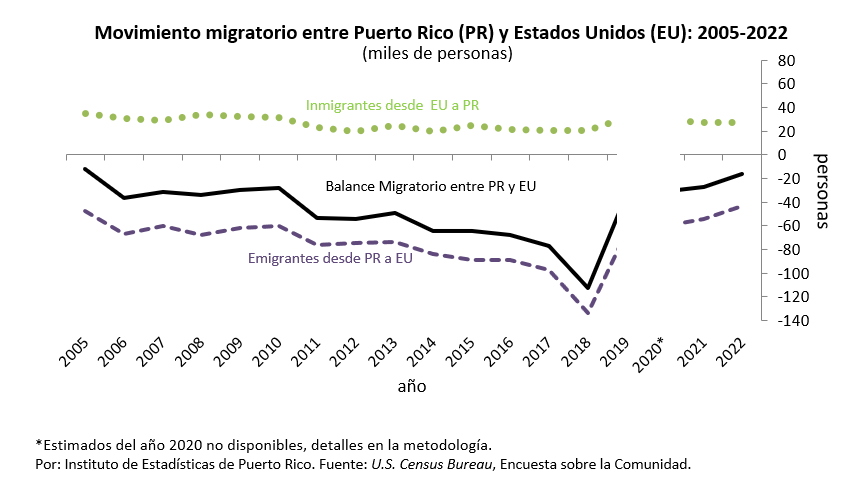
San Juan, PR, December 11, 2023 — During the calendar years 2021 and 2022, data from the Community Survey indicate that the net migration balance between Puerto Rico and the United States decreased from -27 to -16 thousand people emigrating or by -41%. This was revealed by the 2021-2022 Migrant Profile, which was published today by the Puerto Rico Institute of Statistics, and which presents an overview of the migratory movement in Puerto Rico in the calendar year 2021 and 2022. On the other hand, the values continue to reflect more people leaving than entering the jurisdiction in both years. Here are several key findings:

  1. Between 2021 and 2022, Puerto Rico's migration indicators according to the Community Survey showed that:
    • the number of emigrants to the United States was estimated at about 55 thousand and 43 thousand people respectively, resulting in a decrease of -21%. Since 2010, the figure had not been lower than 60,000 emigrants
    • about 27,000 people immigrated to Puerto Rico each year
    • in net terms, the migratory balance between Puerto Rico and the United States decreased from -27 to -16 thousand people emigrating or by -41%.
    • The median age of the emigrant population decreased from 31.9 to 30.3 years, and immigrants were younger than emigrants, showing a reduction in the median age from 39 to 33.8 years.
    • The net migratory balance of the population with some post-secondary education or more decreased from about ten thousand (2021) to four thousand (2022) people emigrating.
  2. DDuring the last twelve years of available information (2010-2019 and 2021-2022), it was estimated, according to the Community Survey, that some 649,000 more people have moved from residence to the United States from Puerto Rico than from the United States to Puerto Rico.
  3. In 2022, passenger flow indicated that:
    • The net movement by plane from Puerto Rico to all destinations (not just the United States) had between seven (-7) thousand and one thousand (-1) passengers according to the U.S. Bureau of Transportation Statistics (BTS) and the Port Authority (AP), respectively.
    • the net movement of passengers by sea (ferry) between Puerto Rico and the Dominican Republic was less than one thousand (724) passengers, according to Caribbean Ferries.
  4. The geographical distribution of emigrants to the United States was:
    • In 2022, as a destination for emigrants, 47% to the Southern region, 25% to the Northeast region and 16% to the Midwest region.
    • the Northeastern region reflected a gradual decrease in emigrants from 47% in 2005 to 25% in 2022.
    • The five states with the highest emigration from Puerto Rico were:
      • in 2021 Florida, Pennsylvania, Texas, Virginia and New Jersey.
      • in 2022 Florida, New York, Pennsylvania, Texas and New Jersey.

“The indicators indicate a reduction in net emigration in recent years. In other words, a decline has been identified in the notorious net migratory flows that prevailed from 2011 to 2019, where net emigration represented between 1.1% and 3.5% of the total annual population of Puerto Rico. Net emigration in 2021 and 2022 represented 0.8% and 0.5% of the total population, respectively. On the other hand, we cannot lose sight of the fact that more people continue to leave than those who enter, which continues to alter the demographic composition of our jurisdiction,” said Alberto L. Velázquez-Estrada, Senior Manager of Statistical Projects at the Institute.

(A graph is included with the series of migration estimates (2005-2022) according to the Community Survey and link to the visualization of the Puerto Rican population in the United States in recent decades as part of the Introduction to the Migrant Profile And to the Maps with the distribution of emigrants by Profile states.)

For more details and information on the full report of the 2021-2022 Migrant Profile, as well as previous publications, you can access the Publications section of the Puerto Rico Institute of Statistics at the link: https://estadisticas.pr/en/publicaciones.

‍

‍

As the lead entity of Puerto Rico's SDC program, the Institute manages the SDC page, which contains the main statistical reports and publications of the U.S. Census Bureau on Puerto Rico, specifically those that are most in demand, such as annual population estimates; the Puerto Rico Community Survey (Puerto Rico Community Survey) and official statistics on Puerto Rico's decennial population and housing censuses, among others.

The Puerto Rico Statistics Institute is an autonomous governmental entity responsible for coordinating the Government's statistical production service to ensure that the data collection and statistics systems, on which public policies are based, are complete, reliable, and have quick and universal access.

For more information you can visit the website: www.estadisticas.pror on social networks through Facebook (@estadisticas .pr), Twitter (@EstadisticasPR) and LinkedIn (Institute of Statistics of Puerto Rico) accounts.

###

Contacts:

Lourdes Burgos, R-27, 787-562-2932

Idia M. Martinez, R-28, 787-603-3200

‍