Institute of Statistics reveals www.transparenciafinanciera.pr where it is accountable to citizens for their income and expenses.


Download the Document
Statistics Institute reveals www.transparenciafinanciera.pr where it is accountable to citizens for their income and expenses.
Please let us know your satisfaction level with our services.
-p-130x130q80.png)
Visit our Official Activities, and participate with us
.png)
Visit our Calls for applications and be part of the new opportunities we have for you.
.png)
If you have any questions or just want to contact us, visit the Contact Us section.
.png)
We are at your disposal. If you need custom statistics, do not hesitate to contact us.
.png)
Sign up for our online workshops. Connect with the experts and discover the power of data!
.png)
Visit our Blog and keep up to date with the latest news and topics of interest.
.png)
Visit our Press Releases and stay connected to the Institute.
.png)
Explore the Publication Calendar and keep up to date with Puerto Rico's statistics.
.png)
Complete the form for the selection of our Statistics Coordination Committee
.png)
Suscribe to receive news directly to your email.
.png)
Listen to the Official PRIS podcast and stay informed with the experts
.png)
Statements by the Executive Director of the Institute, Dr. Mario Marazzi-Santiago, on the report of the Congressional Task Force
Statements by the Executive Director of the Institute, Dr. Mario Marazzi-Santiago, on the report of the Congressional Task Force
Statistics Institute presents a tool that allows a historical analysis of banking performance in Puerto Rico
San Juan, Puerto Rico. June 4, 2025. The Puerto Rico Statistics Institute (Institute) published a new interactive dashboard that presents key financial indicators for banking institutions operating in Puerto Rico and that are regulated by the Federal Deposit Insurance Corporation (FDIC). This tool consolidates historical data from 2001 to the present, incorporating the most recent data available, corresponding to the first quarter of 2025.
The dashboard integrates a set of eighteen (18) financial indicators presented in the form of ratios, grouped into two main categories: performance indicators (Performance Ratios) and financial condition indicators (Condition Ratios). A financial ratio is a measure that relates two numerical variables, providing a standardized indicator that facilitates comparative analysis over time and between different entities. Currently, the dashboard includes information from six (6) banking institutions operating in Puerto Rico under FDIC regulation.
Among the Performance Ratios What is included in the dashboard are: Yield on Earning Assets, Cost of Funding Earning Assets, Net Interest Margin, Noninterest Income to Average Assets, Noninterest Expense to Average Assets, Return on Assets (ROA), Return on Equity (ROE), Loan and Lease Loss Provision to Net Charge-Offs, and Earning Coverage of Net Loan Charge-Offs.
As for the Condition Ratios, the dashboard presents: Earning Assets to Total Assets, Loss Allowance to Noncurrent Loans and Leases, Noncurrent Loans to Loans, Net Loans and Leases to Deposits, Net Loans and Leases to Core Deposits, Leverage (Core Capital) Ratio, Common Equity Tier 1 Capital Ratio, Tier 1 Risk-Based Capital Ratio, and Total Risk-Based Capital Ratio.
As part of the analytical value provided by this tool, the Institute has developed the calculation of the industry average for each of the indicators included in the dashboard. This average provides an essential statistical reference framework for understanding the aggregate behavior of the sector and allows us to evaluate each institution in relation to the market in which it operates. This facilitates comparative analysis and monitoring of trends in the Puerto Rican banking industry.
“One of the fundamental contributions of this dashboard is to consolidate an extensive and continuous historical series, which allows us to identify structural trends and cycles in the banking industry. This long-term perspective is essential to understand the evolution of Puerto Rico's financial environment and to support more robust economic analyses,” said Dr. Ronald G. Hernández Maldonado, Manager of Statistical Projects at the Institute.
The dashboard is available in the Special Projects section of the Puerto Rico Institute of Statistics portal, under the name of “Financial Indicators-Banks” or through the following direct link: VVisualizing Financial Indicators - Banks.
The Puerto Rico Statistics Institute is an autonomous governmental entity responsible for coordinating the Government's statistical production service to ensure that the data collection and statistics systems, on which public policies are based, are complete, reliable, and have quick and universal access. For more information you can write to preguntas@estadisticas.pr. They can also follow social networks through Facebook (@estadisticas .pr), X (@EstadisticasPR), LinkedIn (Institute of Statistics of Puerto Rico) and Instagram (@institutodeestadisticas) accounts.
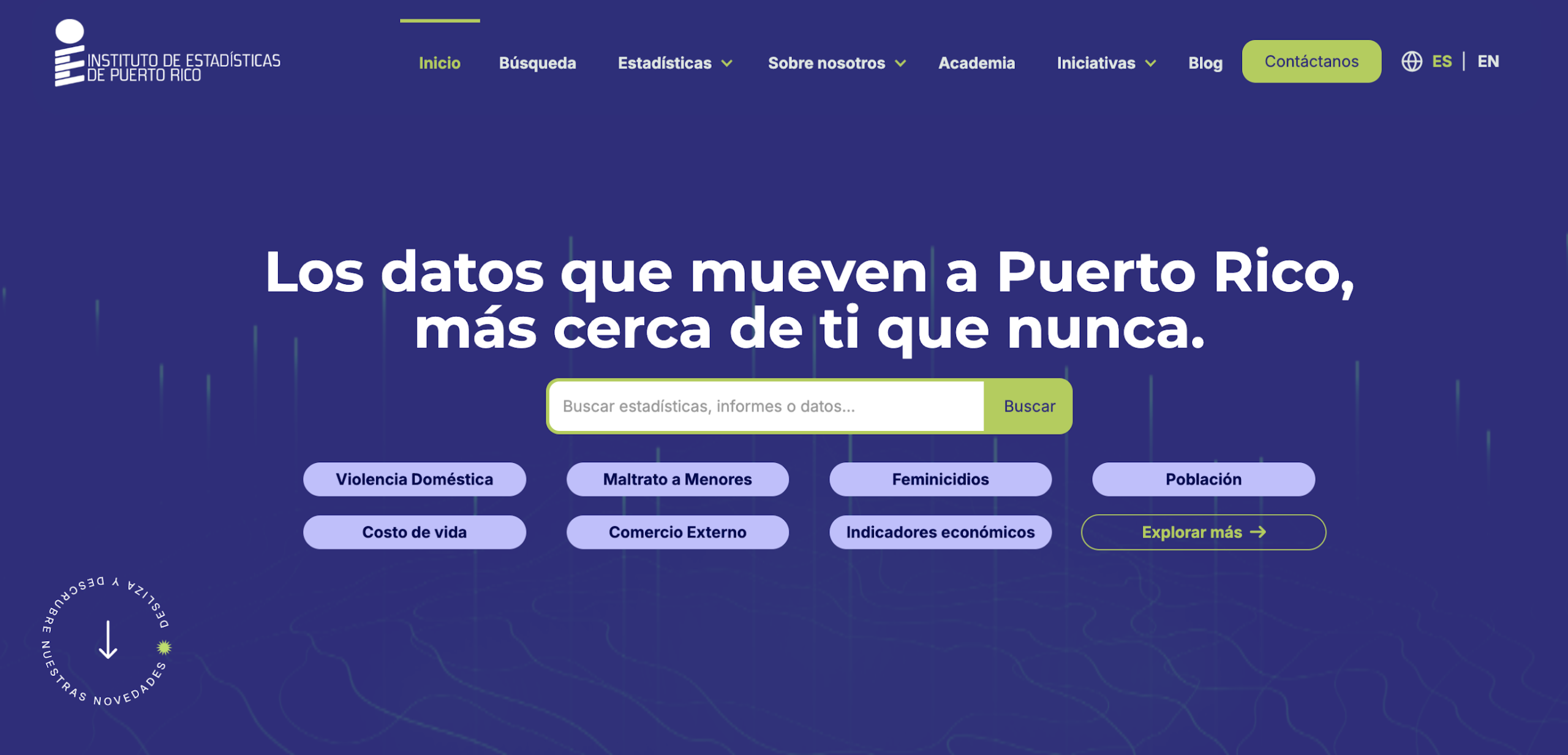
With a new website, the Institute of Statistics of Puerto Rico
San Juan, Puerto Rico. January 2, 2026. The Puerto Rico Statistics Institute announced the launch of its new website, a digital platform framed by the transparency and accessibility of critical statistics for Puerto Rico. The new website, available through: https://www.estadisticas.pr.gov, focuses on a better user experience with a better search engine, allowing for more intuitive navigation. The more than 300 statistical products contained in the new platform are rigorously organized by categories that make it easier to find information. This logical architecture makes it easier for students, researchers and citizens to locate specific indicators on economy, health, education or demography, among other topics, consolidating in a single access point the vast production of data and interactive dashboards that were previously more dispersed.
On the other hand, the new portal launches a dynamic blog section designed as an institutional chronicle center that includes, among others: press releases, recent activities, explanatory memorials, and notifications of importance to Puerto Rico. Another important aspect of the new website is that it has been designed to the highest standards to guarantee access for people with disabilities or with diverse access needs. In the same way, the cybersecurity of the portal was substantially improved. “With the creation of this new website, the Institute consolidates its leadership in providing Puerto Rico with quick and universal access to statistics, eliminating barriers and reaffirming that statistical knowledge is a right for the entire population,” said Dr. Orville M. Disdier, executive director of the Institute.
Anyone who has questions about the functionality of the new page or has difficulty finding any data or information on the page, can write to preguntas@estadisticas.pr. They can also follow social networks through Facebook (@estadisticas .pr), X (@EstadisticasPR), LinkedIn (Institute of Statistics of Puerto Rico) and Instagram (@institutodeestadisticas) accounts.
The Puerto Rico Statistics Institute is an autonomous governmental entity responsible for coordinating the Government's statistical production service to ensure that the data collection and statistics systems, on which public policies are based, are complete, reliable, and have quick and universal access.

.png)
.png)
.png)
.png)