
The Institute of Statistics publishes the Puerto Rico Lag Index

Announcements
IEPR
18 December 2025

San Juan, Puerto Rico — November 6, 2025 — The Institute of Statistics released the results of the Backwater Index for Puerto Rico, a study that offers a comprehensive look at the social and economic situation of Puerto Rico's municipalities. This index constitutes an analysis and planning tool that seeks to promote dialogue, reflection and informed action for the benefit of Puerto Rico's socioeconomic development.

El Lagging Index measures a multidimensional phenomenon using a summary data that allows us to compare the relative performance of municipalities in two dimensions: Economic Mobility and Demography. Five main variables were considered in its design: the percentage of people below the poverty level, the unemployment rate, the percentage of high school graduates (in a population aged 18 and over), the dependency rate by age and the median age.

The index was calculated for two comparative periods: 2014-2018 and 2019-2023, allowing us to observe changes in scores and relative positions of municipalities over time. Index values fluctuate between 0 and 1, with a higher score representing a higher relative level of lagging.

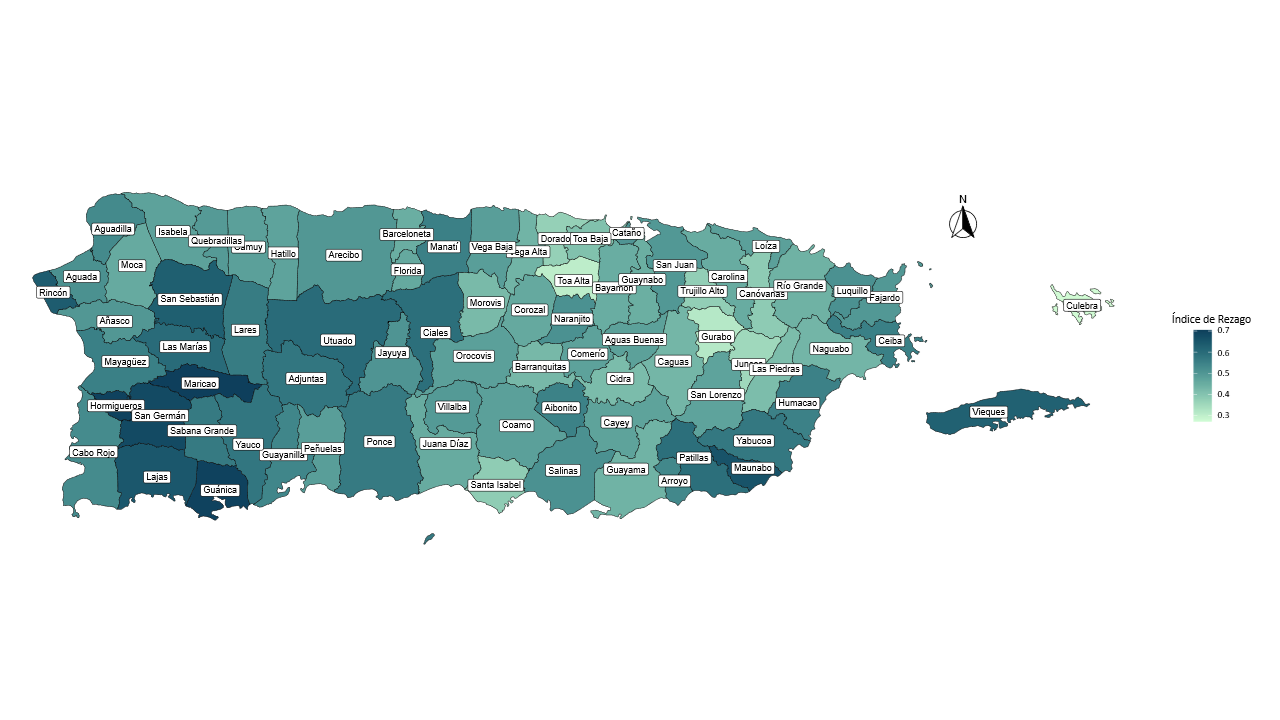
The analysis reveals that 42 municipalities showed a decrease in their score of the Lagging Index, which suggests a relative improvement in the conditions measured by the indicator. Of these, 22 municipalities registered a reduction of more than 5%. In the same way, there are concentrations of municipalities with higher scores —indicating greater relative lagging— in the center, south, southwest and southeast regions of Puerto Rico, while several municipalities in the metropolitan area and adjacent to it showed progress compared to the rest of the archipelago.

The municipalities of Culebra, Toa Alta, Gurabo, Juncos, Dorado, Trujillo Alto, Santa Isabel, Canóvanas, Toa Baja and Las Piedras performed better in their relative index in the last period analyzed (2019-2023). However, the Institute stresses that the index is a relative measure and not an absolute measure, so the results must be analyzed within the context and used as a basis for the development of more specific analyses.

“The value of the index is not in pointing out which municipality is better or worse, but in providing an objective basis for analysis, planning and decision-making. It is an opportunity for mayors and officials who participate in decision-making to know their social and economic reality and to develop strategies that respond to the specific needs of their municipalities,” said Dr. Ronald Hernández, Manager of Statistical Projects at the Institute of Statistics of Puerto Rico.

For the elaboration of the Lagging Index, the Institute applied rigorous statistical methods —including exploratory factor analysis, normalization and aggregation of variables—using data from the five-year estimates of the Community Survey of the U.S. Census Bureau And the Bureau of Labor Statistics.

Data

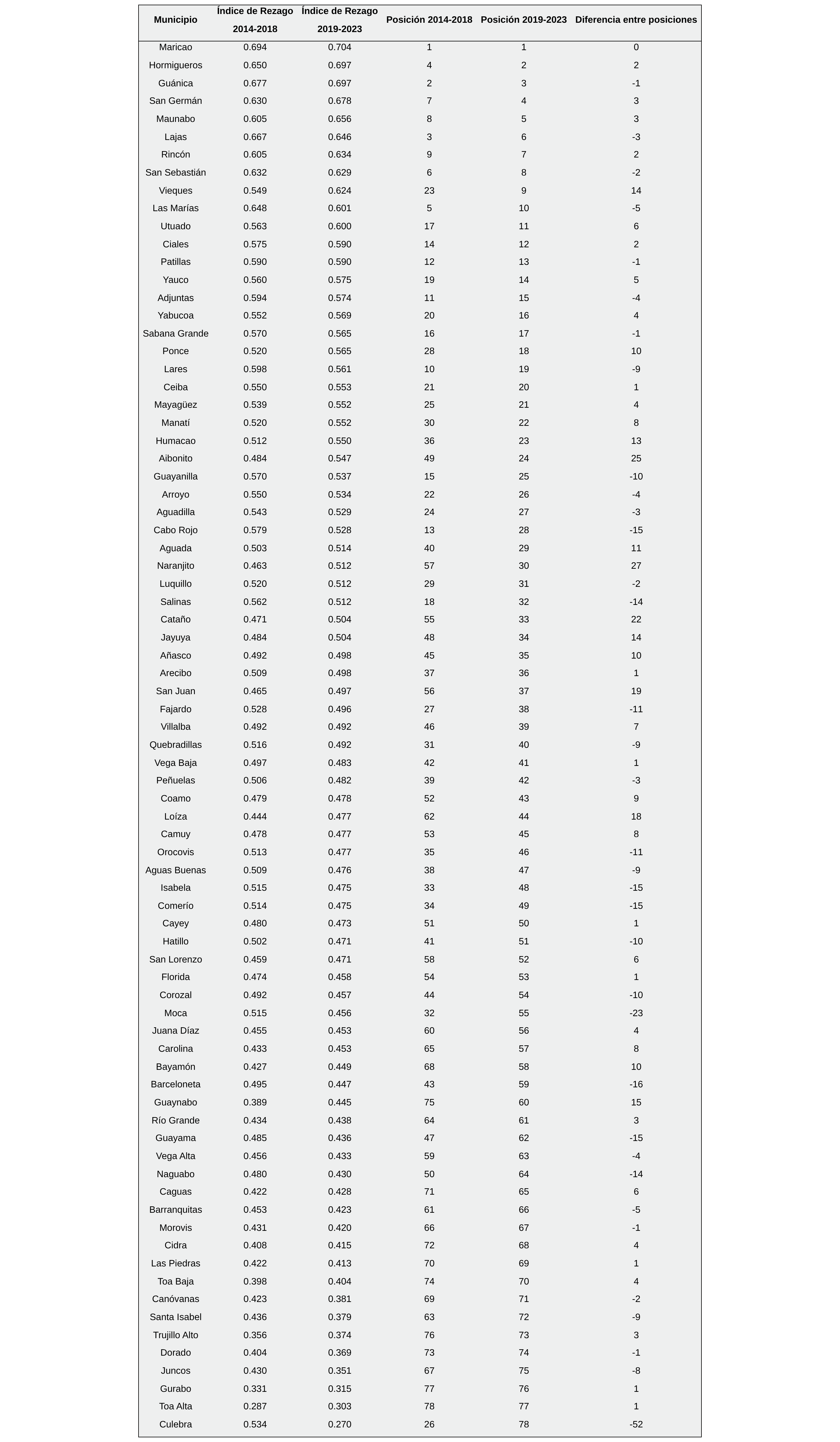
Table 1 shows the results of the Lagging Index at the municipal level for the periods 2014 - 2018 and 2019 - 2023. The table is ordered according to the position of the municipalities based on their index value for the period 2019 — 2023. The higher the index score, the worse or less favorable the outcome of the phenomenon.

Table 1: Lagging Index Results
According to Dr. Hernández, the results of the study highlight the need to design comprehensive public policies that address both the economic aspects and the demographic transformations of Puerto Rico. “The improvements seen in several municipalities are encouraging, but it is essential that socio-economic development efforts are integrated with strategies to respond to the ongoing demographic transition. This includes strengthening geriatric health services, care policies, retention of young people and urban planning adapted to long-lived communities,” said the Institute.”

Hernández indicated that, the Municipal Backwater Index seeks to promote an evidence-based dialogue between the different sectors of Puerto Rico. Its purpose is to serve as a planning and evaluation instrument, which facilitates the identification of areas of opportunity and guides investment decisions, municipal planning and public policy at the central and local levels.”

The full report of the Municipal Backwater Index is available in: Backwater Index for Puerto Rico

The Puerto Rico Statistics Institute is an autonomous governmental entity responsible for coordinating the Government's statistical production service to ensure that the data collection and statistics systems, on which public policies are based, are complete, reliable, and have quick and universal access.

For more information you can write to preguntas@estadisticas.pr. They can also follow social networks through Facebook (@estadisticas .pr), X (@EstadisticasPR), LinkedIn (Institute of Statistics of Puerto Rico) and Instagram (@institutodeestadisticas) accounts.

Share this article:

Visit our Official Activities, and participate with us

Visit our Calls and be part of the new opportunities we have for you.

If you have any questions or just want to contact us, visit the Contact Us section.

We are at your disposal. If you need custom statistics, do not hesitate to contact us.

Sign up for our online workshops. Connect with the experts and discover the power of data!

Visit our Blog and keep up to date with the latest news and topics of interest.

Visit our Press Releases and stay connected to the Institute.

Explore the Publication Calendar and keep up to date with Puerto Rico's statistics.

Complete the form for the selection of our Statistics Coordination Committee

Suscribe to receive news directly to your email.

Listen to the Official PRIS podcast and stay informed with the experts

The Institute of Statistics publishes the Puerto Rico Lag Index

San Juan, Puerto Rico — November 6, 2025 — The Institute of Statistics released the results of the Backwater Index for Puerto Rico, a study that offers a comprehensive look at the social and economic situation of Puerto Rico's municipalities. This index constitutes an analysis and planning tool that seeks to promote dialogue, reflection and informed action for the benefit of Puerto Rico's socioeconomic development.

El Lagging Index measures a multidimensional phenomenon using a summary data that allows us to compare the relative performance of municipalities in two dimensions: Economic Mobility and Demography. Five main variables were considered in its design: the percentage of people below the poverty level, the unemployment rate, the percentage of high school graduates (in a population aged 18 and over), the dependency rate by age and the median age.

The index was calculated for two comparative periods: 2014-2018 and 2019-2023, allowing us to observe changes in scores and relative positions of municipalities over time. Index values fluctuate between 0 and 1, with a higher score representing a higher relative level of lagging.

The analysis reveals that 42 municipalities showed a decrease in their score of the Lagging Index, which suggests a relative improvement in the conditions measured by the indicator. Of these, 22 municipalities registered a reduction of more than 5%. In the same way, there are concentrations of municipalities with higher scores —indicating greater relative lagging— in the center, south, southwest and southeast regions of Puerto Rico, while several municipalities in the metropolitan area and adjacent to it showed progress compared to the rest of the archipelago.

The municipalities of Culebra, Toa Alta, Gurabo, Juncos, Dorado, Trujillo Alto, Santa Isabel, Canóvanas, Toa Baja and Las Piedras performed better in their relative index in the last period analyzed (2019-2023). However, the Institute stresses that the index is a relative measure and not an absolute measure, so the results must be analyzed within the context and used as a basis for the development of more specific analyses.

“The value of the index is not in pointing out which municipality is better or worse, but in providing an objective basis for analysis, planning and decision-making. It is an opportunity for mayors and officials who participate in decision-making to know their social and economic reality and to develop strategies that respond to the specific needs of their municipalities,” said Dr. Ronald Hernández, Manager of Statistical Projects at the Institute of Statistics of Puerto Rico.

For the elaboration of the Lagging Index, the Institute applied rigorous statistical methods —including exploratory factor analysis, normalization and aggregation of variables—using data from the five-year estimates of the Community Survey of the U.S. Census Bureau And the Bureau of Labor Statistics.

Data

Table 1 shows the results of the Lagging Index at the municipal level for the periods 2014 - 2018 and 2019 - 2023. The table is ordered according to the position of the municipalities based on their index value for the period 2019 — 2023. The higher the index score, the worse or less favorable the outcome of the phenomenon.

Table 1: Lagging Index Results

According to Dr. Hernández, the results of the study highlight the need to design comprehensive public policies that address both the economic aspects and the demographic transformations of Puerto Rico. “The improvements seen in several municipalities are encouraging, but it is essential that socio-economic development efforts are integrated with strategies to respond to the ongoing demographic transition. This includes strengthening geriatric health services, care policies, retention of young people and urban planning adapted to long-lived communities,” said the Institute.”

Hernández indicated that, the Municipal Backwater Index seeks to promote an evidence-based dialogue between the different sectors of Puerto Rico. Its purpose is to serve as a planning and evaluation instrument, which facilitates the identification of areas of opportunity and guides investment decisions, municipal planning and public policy at the central and local levels.”

The full report of the Municipal Backwater Index is available in: Backwater Index for Puerto Rico

The Puerto Rico Statistics Institute is an autonomous governmental entity responsible for coordinating the Government's statistical production service to ensure that the data collection and statistics systems, on which public policies are based, are complete, reliable, and have quick and universal access.

For more information you can write to preguntas@estadisticas.pr. They can also follow social networks through Facebook (@estadisticas .pr), X (@EstadisticasPR), LinkedIn (Institute of Statistics of Puerto Rico) and Instagram (@institutodeestadisticas) accounts.

Puerto Rico Lag Index

Author: Alejandro López Flores and Ronald G. Hernández Maldonado

Date: November 6, 2025

Poverty must be contextualized with social variables to understand and address it effectively. The Backwardness Index for Puerto Rico is an indicator composed of five variables that comprise two dimensions: Economic Mobility and Demography. This index seeks to measure poverty beyond income thresholds, and to incorporate elements of social backwardness and relative deprivation. An exploratory factor analysis was carried out on a set of variables to validate the construction of the multidimensional deprivation model, and to retain the variables that best captured the phenomenon of deprivation. Then, the retained variables were normalized using thresholds. The thresholds were obtained with data from the Puerto Rico Community Survey (ECPR or PRCS in English) and the United States Bureau of Labor Statistics (BLS in English). The scores of the different variables were aggregated by dimension, using the arithmetic mean, and the scores resulting from the dimensions were aggregated using the geometric mean. The values of the index lie between 0 and 1 where, the higher the score, the worse the result of the phenomenon.42 municipalities showed a decrease in their index score between the periods compared. Of these 42 municipalities, 22 showed a decrease in their score greater than 5%. Likewise, there are concentrations of municipalities with high Lagging Index scores in the central-southwest and southeastern areas of Puerto Rico.

They request collaboration to complete a survey on parenting experiences

ESCAPE and the Puerto Rico Statistics Institute join efforts to develop the First Survey on the Parenting Experience in Puerto Rico

San Juan, Puerto Rico — February 27, 2025. ESCAPE, Center for Family Strengthening, in collaboration with the Puerto Rico Statistics Institute (Institute), are developing the Survey on the Parenting Experience in Puerto Rico. This initiative seeks to gather valuable information about the experiences of mothers, fathers and guardians (people who are responsible for the upbringing of children) with the objective of strengthening efforts for the prevention of child abuse and developing more effective programs to serve families according to their needs

The executive director of ESCAPE, Yadira Pizarro Quiles, requested citizen collaboration by completing and sharing a survey and highlighted the importance of this tool for designing more precise, relevant and relevant intervention strategies. “Every family in Puerto Rico faces unique challenges, and with this survey we will be able to better understand their realities. The data collected will allow us to evaluate existing programs and develop more effective initiatives to support parents and caregivers in parenting, thus strengthening efforts to prevent child abuse,” said Pizarro.

Participation in the Puerto Rico Parenting Experience Survey is completely voluntary and is intended for those who are responsible for raising one or more children under 18 years of age in Puerto Rico. The questionnaire, which lasts approximately 20 to 30 minutes, guarantees the confidentiality of the answers, which will be anonymous and securely stored by the Institute.

The questionnaire is structured in seven sections: Sociodemographic data of the child, Experiences and Expectations, Discipline and Communication, Technology and Quality Time, Support Needs and Future, Socio-Demographic Data on the Respondent and a Closure and Feedback.

The executive director of the Puerto Rico Institute of Statistics, Dr. Orville M. Disdier, highlighted the value of data and statistics in the formulation of prevention strategies. “Access to up-to-date and reliable information is key to making informed decisions. With this survey, we will be able to generate data that will not only help us better understand the dynamics of parenting in Puerto Rico, but also serve as a basis for the creation of public policies that reinforce the protection and well-being of children. That's why it's important to have the support of all sectors helping to share and complete this survey,” he said.

The survey can be accessed at the following link: https://www.surveymonkey.com/r/crianzamenores

To coordinate collaborative efforts, you can contact Mrs. Lourdes Burgos at 787-562-2932.

###

Contact: Lourdes Burgos, R-27 - Cell. 787-562-2932

About ESCAPE:

ESCAPE, Family Strengthening Center, was the first non-profit organization created on the Island (1983) with the mission of preventing child abuse. The organization is dedicated to supporting and educating families, parents and the community in general about healthy and positive ways to relate, communicate and above all to raise, care for and protect children and adolescents from violence and abuse.

About the Puerto Rico Institute of Statistics

The Puerto Rico Statistics Institute is an autonomous governmental entity responsible for coordinating the Government's statistical production service to ensure that the data collection and statistics systems, on which public policies are based, are complete, reliable, and have quick and universal access.