Statistics Institute calls for the opening of information on the economic incentives that the Government negotiates with private companies on Civic Hacker Day


Statistics Institute calls for the opening of information on the economic incentives that the Government negotiates with private companies on Civic Hacker Day
Please let us know your satisfaction level with our services.
Visit our Official Activities, and participate with us
Visit our Calls for applications and be part of the new opportunities we have for you.
If you have any questions or just want to contact us, visit the Contact Us section.
We are at your disposal. If you need custom statistics, do not hesitate to contact us.
Sign up for our online workshops. Connect with the experts and discover the power of data!
Visit our Blog and keep up to date with the latest news and topics of interest.
Visit our Press Releases and stay connected to the Institute.
Explore the Publication Calendar and keep up to date with Puerto Rico's statistics.
Complete the form for the selection of our Statistics Coordination Committee
Suscribe to receive news directly to your email.
Listen to the Official PRIS podcast and stay informed with the experts
San Juan, Puerto Rico. April 9, 2025 — Faced with growing public interest in issues related to international trade and tariffs, the Puerto Rico Statistics Institute reminded citizens that, on its official website, www.estadisticas.pr, the “External Trade Interface” tool is available, where they can access official data on imports and exports of goods in Puerto Rico.
The Foreign Trade section of the portal contains monthly statistics on the value and volume of goods entering and leaving the jurisdiction. This information allows us to know what products Puerto Rico exports, to which countries they are going and, in turn, which products are imported and from which countries they come. This data is useful for identifying business opportunities abroad, as well as within Puerto Rico. In addition, they are an important input for the preparation of Puerto Rico's Gross Domestic Product statistics.
“At a time when issues of international trade and tariffs are an active part of the public conversation, it is essential that citizens have access to official and reliable information that allows them to carry out adequate analyses and make informed decisions,” said Dr. Orville M. Disdier Flores, Executive Director of the Puerto Rico Institute of Statistics.
The statistics are collected and processed by the U.S. Customs and Border Protection And the U.S. Census Bureau, using customs and export declaration forms that are completed when importing or exporting goods. The Institute downloads, processes, transforms and organizes data so that information is available exclusively for Puerto Rico with its business partners.
As part of his commitment to statistical education, Dr. Ronald Hernández, Manager of Statistical Projects at the Institute, indicated that those interested in learning more about this tool can access a Webinar free of charge that explains in detail how to access, interpret and use foreign trade data. The video is available at the following link: https://youtu.be/2yuAh9X6qK4.
The Foreign Trade section allows you to filter the search and download of data since July 2002, according to different classifications used in economic analysis and international trade. These classifications include HTS systems and Schedule B, aimed at the classification of goods, including their tariff component; the SITC, used for the comparative analysis of trade by type of product; and the NAICS, which allows aggregation by sector or industry of origin or destination.
To access the External Trade Interface, you can visit www.estadisticas.pr and access the Foreign Trade section under the “Applications” tab. For the best experience, we recommend that you use the Firefox browser.
The Puerto Rico Statistics Institute is an autonomous governmental entity responsible for coordinating the Government's statistical production service to ensure that the data collection and statistics systems, on which public policies are based, are complete, reliable, and have quick and universal access.
For more information you can write to preguntas@estadisticas.pr. They can also follow social networks through Facebook (@estadisticas .pr), X (@EstadisticasPR), LinkedIn (Institute of Statistics of Puerto Rico) and Instagram (@institutodeestadisticas) accounts.
9 de diciembre de 2022: El Instituto de Estadísticas de Puerto Rico publicó el Compendio Estadístico de Escuelas Privadas PK-12 en Puerto Rico 2021-2022, y el Compendio Estadístico de Instituciones Postsecundarias Técnico-Vocacionales en Puerto Rico 2021-2022. Ambos compendios fueron producidos en colaboración con la Oficina de Registro y Licenciamiento de Instituciones de Educación, la cual forma parte del Departamento de Estado del Gobierno de Puerto Rico. Estos compendios proveen información estadística importante, como lo es la matrícula, cantidad de docentes, tasa de promoción, graduación o egresados, entre otros.
Se destacan como resultados relevantes del Compendio Estadístico 2021-2022 del sector de Educación Básica (PK-12) Privada:
Asimismo, se destacan como resultados relevantes del Compendio Estadístico 2021-2022 de sector de Instituciones Postsecundarias Técnico-Vocacionales:
“Durante la pasada década, el sistema educativo ha experimentado importantes cambios en todos los niveles. Estos cambios no solo se reflejan en el sector público, sino también en el sector privado de prekínder a duodécimo grado y en el sector postsecundario técnico-vocacional. Contar con información cuantitativa sobre estos cambios es primordial para, ante estos retos, tomar decisiones basadas en la evidencia, y planificar las acciones a futuro”, expresó el Dr. Orville M. Disdier.
Damaris Nolasco, directora de la Oficina de Registro y Licenciamiento de Instituciones de Educación del Departamento de Estado, expresó que, “Aunque la matrícula de estudiantes del sector privado PK-12 demostró un aumento en comparación con el año anterior 2020-2021, es importante esperar a los próximos compendios, pues, debido a la pandemia, el año 2020-2021 fue uno atípico y confirmar si esta tendencia de aumento se mantiene. Definitivamente, es importante recopilar, producir y publicar los compendios estadísticos en colaboración con el Instituto de Estadísticas de Puerto Rico”.
Tanto el Compendio Estadístico de Escuelas Privadas PK-12 en Puerto Rico, como el Compendio Estadístico de Instituciones Postsecundarias Técnico-Vocacionales en Puerto Rico 2021-2022, se puede acceder, en cualquier momento a través de la siguiente dirección electrónica:
Compendios estadísticos sobre la educación privada no universitaria
Para preguntas técnicas sobre este informe, pueden enviar un correo electrónico a: preguntas@estadisticas.pr.
Para conocer más sobre el Instituto de Estadísticas, pueden acceder la página web: www.estadisticas.pr.gov. En las redes sociales a través de las cuentas de Facebook (@estadisticas.pr), Twitter (@EstadisticasPR), Instagram (@institutodeestadisticas) y LinkedIn (Instituto de Estadísticas de Puerto Rico).
PRESS RELEASE
PUERTO RICO STATE DATA CENTER NETWORK (SDC-PR)
Six municipalities with at least 60% of their population living in poverty
They are located in the center and south-west according to the Map Series of the Puerto Rico Census Data Network
San Juan, PR, November 17, 2020 — The percentage of people living in poverty shows that six municipalities have between 60% and 64% of their population with this characteristic. The geographical distribution shows that they are located in the center and southwest of Puerto Rico, these being Maricao, Guánica, Adjuntas, Lajas, Jayuya and Comerío. La Selected Indicator Map Series includes the information collected during the period 2014-2018 through the Community Survey carried out by U.S. Census Bureau. This series includes ten indicators on demographic, social and economic topics at the level of municipalities and neighborhoods in Puerto Rico.
In addition, with information from the same period (2014-2018), the Socio-Demographic Profiles of Puerto Rico's Electoral Districts Which are divided volume I and II, with the 8 Senate Districts and with the 40 Representative Districts respectively. These provide a detailed photograph of each electoral district with essential information to know the particularities of the population that resides in each of them.
Both new products (Map and Profile Series) are part of the publications of the Puerto Rico Census Data Network (SDC-PR by its acronym in English). All of them can be accessed free of charge on the SDC-PR censo.estadisticas.pr. As a local liaison entity with the U.S. Census Bureau, the Institute of Statistics shares several findings from the Selected Indicator Map Series:
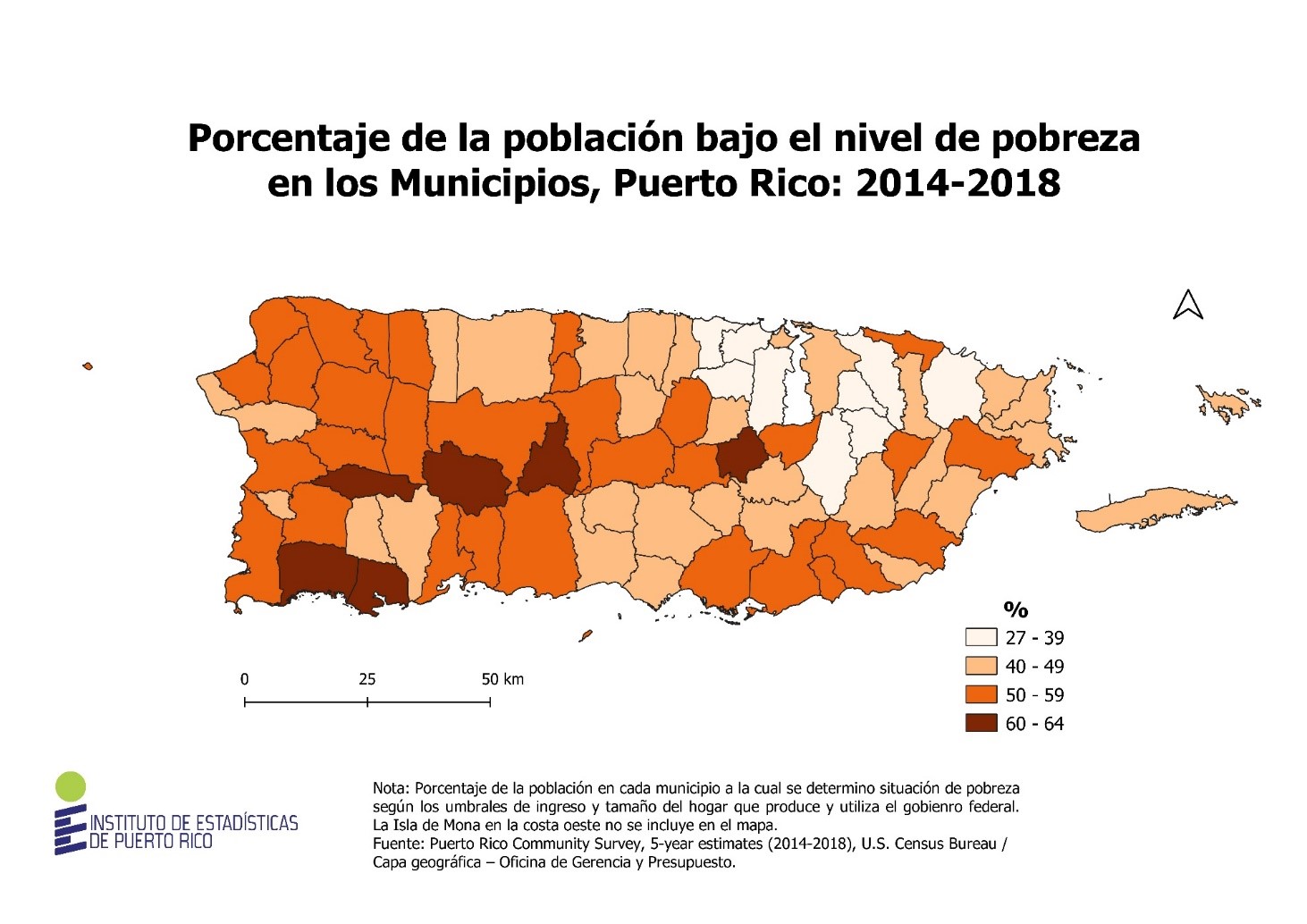
“The series of maps provides a geographical perspective on features of interest within Puerto Rico. The behavior of geographical patterns could support government and community management, analysis for decision-making, and stimulate research. In the same sense, the profiles of the electoral districts serve as basic metrics for current and future public policy that affects the residents of these regions.” said Alberto L. Velázquez-Estrada, Manager of Statistical Projects at the Institute.
The Puerto Rico Statistics Institute is an autonomous governmental entity responsible for coordinating the Government's statistical production service to ensure that the data collection and statistics systems, on which public policies are based, are complete, reliable, and have quick and universal access. In addition, as the leading entity of the SDC in Puerto Rico, the Institute manages the SDC portal, which contains the main statistical reports and publications of the U.S. Census Bureau on Puerto Rico, specifically those that are most in demand, such as annual population estimates; the Puerto Rico Community Survey (Puerto Rico Community Survey) and official statistics on Puerto Rico's 10-year population and housing censuses, among others. The Puerto Rico SDC portal can be accessed through: https://censo.estadisticas.pr/.
For more information you can visit our website: www.estadisticas.pr.gov. In addition, you can follow us on social networks through Facebook (@estadisticas .pr), Twitter (@EstadisticasPR) and LinkedIn (Institute of Statistics of Puerto Rico) accounts.
##
For questions:
https://preguntas.estadisticas.pr/

.png)
.png)
.png)
.png)

-p-130x130q80.png)
.png)
.png)
.png)
.png)
.png)
.png)
.png)
.png)
.png)
.png)
.png)