THE POPULATION OF PUERTO RICO IS ESTIMATED AT 3.2 MILLION IN 2018
With the post-hurricane effect, it points to a decrease of 14% since the 2010 Decennial Census
San Juan, PR — El U.S. Census Bureau released today the most recent annual population estimates for Puerto Rico. These statistics refer to July 1, 2017 and include the components of annual population change since July 1, 2010, which support the population estimate since the beginning of the decade. As the leading entity of the Network State Data Center (SDC) of the U.S. Census Bureau in Puerto Rico, the Puerto Rico Statistics Institute (Institute) presents this summary of the findings of the new annual population estimates for 2018:
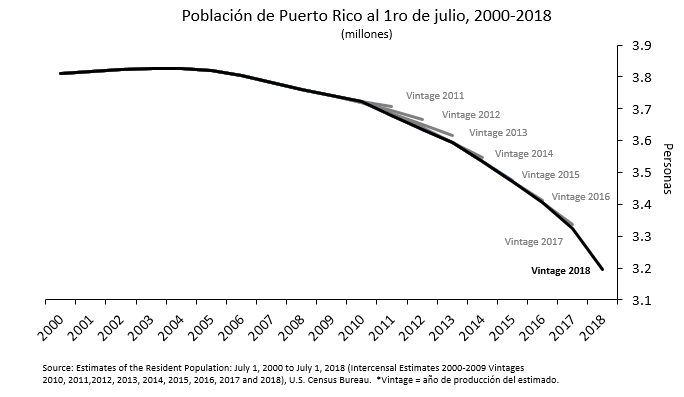
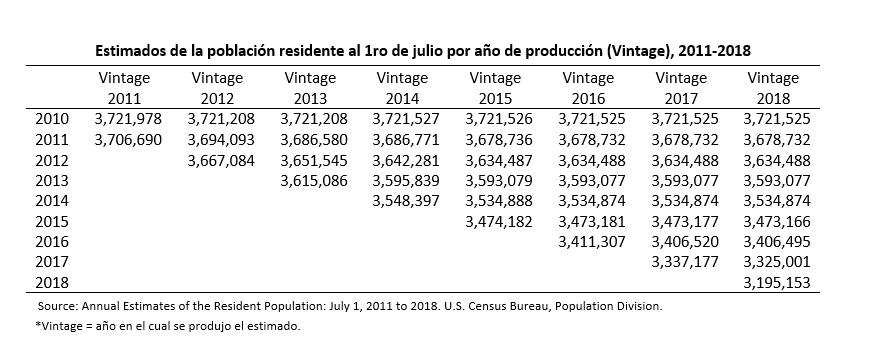
The population of Puerto Rico was estimated at 3,195,153 people as of July 1, 2018.
The impact of the hurricanes (Irma and María) in 2017 is included in the new estimates. These hurricanes further fueled the downward trend in population size in Puerto Rico. The absolute population change between July 2017 and 2018 was estimated to be close to 130,000 inhabitants, representing 3.9% of the total population.
Compared to the last 2010 Census, when the official list resulted in 3,725,789 people, the new estimate points to a cumulative decrease in the current decade of close to 14% until 2018.
In relation to the resident population 18 years of age or older (of voting age), this was estimated at 2,601.142 million, comprising 81 percent of the population in Puerto Rico.
The components of population change include that, between July 1, 2017 and July 1, 2018, about 24,000 births and 31,000 deaths occurred in Puerto Rico. As a result, annual population estimates reflect more deaths than births, resulting in a natural increase close to -6 thousand people. Regarding migration, the estimated net balance was approximately -123 thousand people during the same period.
“The 2018 population estimates give a little more detail to the repercussions of the hurricanes of the past year 2017 on the demographic components of Puerto Rico. The combination of a negative natural increase in the population (more deaths than births), combined with the drive of the already high net emigration, points to an impressive population loss of 3.9% in just one year. This presents us with a difficult scenario to assimilate in terms of the speed of the decrease, as well as the direct repercussions it entails on the local scene. On the other hand, the operations of the next Decennial Census 2020 are becoming more important, so that they result in the best possible official enumeration, then you can confirm the drastic demographic changes estimated during the current decade,” said Alberto L. Velazquez Estrada, Manager of Statistical Projects at the Institute.
After the completion of a Decennial Census (such as the 2010 Census) the U.S. Census Bureau prepare the annual population estimates, which allow us to approximate the population during the decade before the next Census. These estimates are prepared by analyzing data on births, deaths and migration. As a result, with each new publication of the estimates, adjustments are made to the previously estimated years. For example, with the publication of the 2018 estimates announced in this release, the estimates already published for 2011, 2012, 2013, 2014, 2015, 2016 and 2017 were revised. Each publication is distinguished according to the year in which they were produced and are named as Vintage.
More statistics on Puerto Rico's annual population estimates can be obtained at: https://censo.estadisticas.pr/EstimadosPoblacionales, in the population estimates section. Information on the methodology used to produce the estimates can be accessed hither.
The Puerto Rico Statistics Institute is an autonomous governmental entity responsible for coordinating the Government's statistical production service to ensure that the data collection and statistics systems, on which public policies are based, are complete, reliable, and have quick and universal access. The Institute has in its inventory, accessible through www.estadisticas.pr.gov, over 300 statistical products. In addition, it is a custodian and provides access to over 100 data sets or Data sets by means of www.data.pr.gov and to over 40 tables and more than 6 thousand indicators through: www.indicadores.pr
For more information you can visit our website: www.estadisticas.pr.gov. In addition, you can follow us on social networks through Facebook accounts (statistics.government.pr), Twitter (@EstadisticasPR) and LinkedIn (Institute of Statistics of Puerto Rico).
Puerto Rico Statistics Institute creates and publishes a new Educational Program in Podcast format
This program is the official Podcast of the Puerto Rico Institute of Statistics (Institute). This medium is a quick and convenient way to obtain information through a digital audio format. The audios can be listened to at any time, from anywhere, through various platforms on the Internet. Each episode of this podcast helps people have greater and better access to comprehensive, reliable statistics that are quickly and universally accessible.


-p-130x130q80.png)
.png)
.png)
.png)
.png)
.png)
.png)
.png)
.png)
.png)
.png)
.png)

.png)
.png)
.png)
.png)